
Table of Contents
Cerenovus Investment Report
Category: Enterprise AI, operational intelligence, knowledge management, process analytics
Company Stage: Pre-seed / accelerator-stage; Y Combinator Summer 2026
Founder or Founders: Jonathan Waldorf, Oliver Moreland, and Lucas Baur
Headquarters: San Francisco, California, United States
Funding: Backed by Y Combinator; amount and other financing not publicly disclosed
Business Model: Enterprise software with human-reviewed analysis; pricing not publicly disclosed
Product Hunt Launch Date: August 11, 2026
Report Date: August 14, 2026
| Investment Metric | Assessment |
|---|---|
| Venture Potential | 60/100 |
| Unicorn Path | Conditional |
| Valuation Attractiveness | Not Assessable |
| Evidence Confidence | 48/100 |
| Final Decision | Watch |
Executive Summary
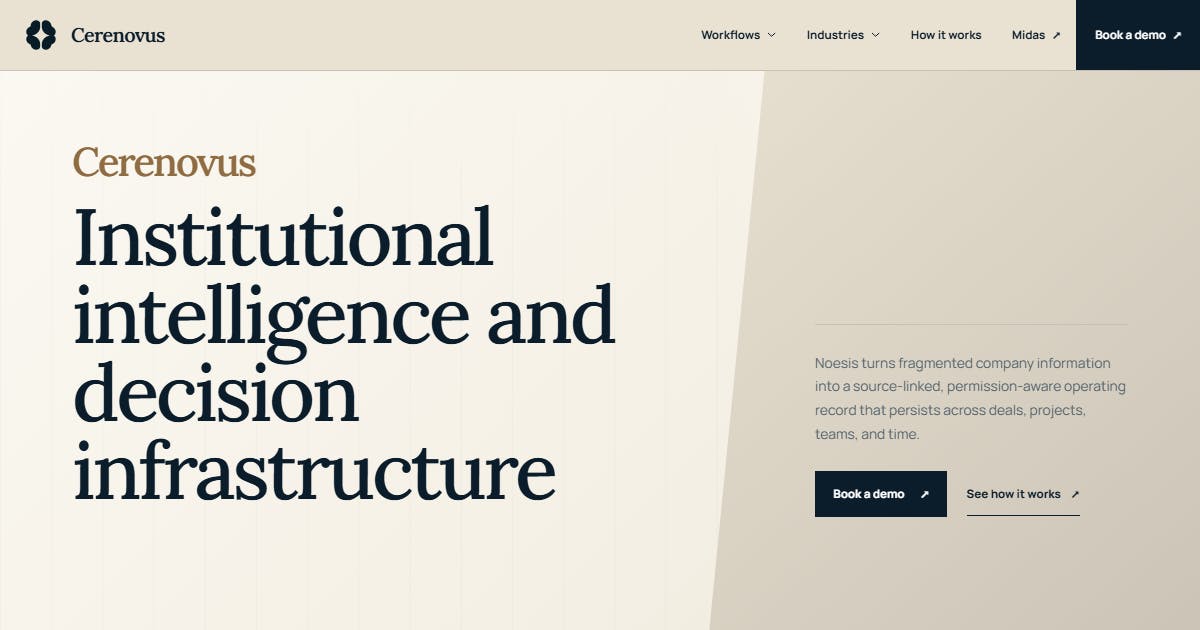
Cerenovus describes itself as an “AI operating partner” that connects read-only to enterprise systems, reconciles records across sources, identifies operational inefficiencies, and produces cited findings and recommendations. Its intended inputs include ERP and accounts-payable systems, CRM, email, calendars, contracts, tickets, and internal documents (Cerenovus: How It Works).
The initial proposition is attractive because it links AI analysis to measurable financial outcomes: duplicate payments, missed discounts, unused software licenses, stalled receivables, contract deviations, and operational bottlenecks. Its target buyers include executives at middle-market and large companies, private-equity operating teams, and consulting or advisory firms (Cerenovus: Who We Serve).
The strongest investment signal is the breadth and coherence of the product vision combined with Y Combinator acceptance. The founders also report that they left Harvard to work on the company and had live pilot customers before launch, although no customer identities, contract values, retention data, or independently verified outcomes have been published (YC company profile; Jonathan Waldorf’s LinkedIn).
The central concern is commercial validation. Revenue, paying-customer count, usage, retention, pricing, deployment time, gross margin, and quantified customer savings are all undisclosed. The product also asks enterprises to grant access to highly sensitive operational records, creating substantial security, compliance, accuracy, and sales-cycle hurdles.
Cerenovus could become venture-scale if it proves that deployments are repeatable, findings generate substantial recoverable value, and human review does not turn the business into a consulting operation. At present, the evidence supports Watch, not formal due diligence or investment.
Product Overview
Cerenovus addresses the fragmentation of operational information across accounting systems, contracts, email, chat, CRM, documents, and ticketing platforms. Executives often lack a reliable cross-functional view, while traditional analysis requires internal finance teams, consultants, data engineers, or point solutions.
The company says its system follows five stages: connect approved systems read-only; reconcile entities and records; sweep for inefficiencies; verify citations and escalate unresolved items to people; and deliver ranked briefs, live answers, and coverage reports (Cerenovus: How It Works). The system reportedly retains source history, uncertainty, access rules, reviewer decisions, and subsequent outcomes.
Initial use cases include spend and vendor intelligence, operational diagnostics, diligence, exit readiness, and monitoring of portfolio-company performance. For example, the spend product compares invoices with contracts, reconciles vendor aliases, identifies duplicate payments, and examines renewals against actual usage (Spend & Vendor Intelligence).
Target users are CEOs, CFOs, COOs, controllers, procurement leaders, private-equity operating partners, deal teams, and consultants. The company currently uses a demo-led sales motion; no public self-service application or standard pricing page was found. Pricing is therefore not publicly disclosed.
The primary alternative is a combination of ERP reporting, spreadsheets, business-intelligence tools, consultants, internal analysts, process-mining software, enterprise search, and manual document review. Product quality appears promising at the architecture and positioning level, but accuracy, integration reliability, deployment speed, and realized savings have not been independently verified.
Founder and Team Assessment
Cerenovus identifies three co-founders: Jonathan Waldorf, Oliver Moreland, and Lucas Baur. Its YC profile describes a five-person San Francisco company founded in 2026 (YC company profile). The company’s privacy policy identifies the legal operator as Cerenovus Inc., a Delaware corporation, and lists a San Francisco address (Privacy Policy).
Waldorf’s publicly visible background includes Harvard, quantum-computing projects, and an internship at QuEra. His public profile also states that pilot customers were live while Cerenovus was recruiting founding engineers (Jonathan Waldorf’s LinkedIn).
Moreland is listed as co-founder and CTO. His prior experience includes building AI reasoning and multi-agent prototypes for computational chemistry at Mirror Physics, while studying computer science at Harvard (Oliver Moreland’s LinkedIn).
Baur studied applied mathematics and economics at Harvard and had experience in private-equity analysis and consulting-related student organizations, giving him the closest publicly visible connection to the initial buyer segment (Lucas Baur’s LinkedIn). The founders state that they left school to build the company full-time (YC company profile).
The team appears technically capable and highly motivated, but it lacks publicly verified experience selling, deploying, or supporting mission-critical enterprise software at scale. No prior startup exit or substantial operating leadership experience was found.
Founder Assessment: Strong raw technical ability and relevant customer curiosity, but enterprise execution and commercial capability remain unproven.
Market Opportunity
The narrow initial market is operational intelligence for data-rich middle-market businesses and private-equity portfolio companies. The National Center for the Middle Market describes approximately 200,000 U.S. businesses with annual revenue between $10 million and $1 billion (Middle Market Indicator).
A bottom-up scenario illustrates the potential without asserting current pricing. If 20,000–50,000 organizations have sufficient data complexity and willingness to deploy this type of system, and annual contract value ultimately averages $50,000–$200,000, the addressable revenue pool would be approximately $1 billion–$10 billion. Both the customer count and contract values are analyst assumptions, not company-reported metrics.
Expansion opportunities include portfolio-wide PE deployments, consulting-firm licensing, operational due diligence, contract intelligence, procurement, compliance, corporate development, and continuous performance monitoring. International expansion is possible but would add data-residency, privacy, localization, and regulatory complexity.
The market is large enough for a venture outcome. However, willingness to pay depends on verified financial recovery, reliable access controls, low false-positive rates, and deployment costs substantially below the value identified.
Traction and Growth Signals
Cerenovus launched on Product Hunt on August 11, 2026, where the daily leaderboard showed it at approximately tenth place (Product Hunt). This represents launch attention, not evidence of product-market fit.
The company is part of YC’s Summer 2026 batch and has publicly recruited founding engineers (Work at a Startup). A founder stated that pilot customers were already live, but customer identities and results were not disclosed (Jonathan Waldorf’s LinkedIn).
No reliable public information was found for ARR, MRR, paying customers, contract values, active deployments, renewal rates, expansion revenue, implementation time, customer savings, or independent customer references. There are also no meaningful public review datasets or published case studies with named clients.
Traction Assessment: Credible launch and accelerator signals, but commercially unverified.
Competitive Position
Direct and adjacent competitors include Celonis and other process-mining platforms, Palantir Foundry/AIP, Glean, Microsoft Copilot, enterprise BI products, procurement-analysis software, contract-intelligence vendors, and AI-enabled consulting firms. ERP vendors, cloud providers, and major consultancies could also bundle similar analysis into existing relationships.
Cerenovus differentiates through cross-system synthesis, source-level citations, explicit treatment of conflicting evidence, human validation, and a focus on finding financially measurable operational problems rather than merely answering employee questions (Cerenovus: How It Works).
Potential switching costs could emerge from accumulated entity mappings, historical decisions, workflows, reviewer corrections, and integrations. Nevertheless, no proprietary dataset, patented technology, network effect, or uniquely advantaged distribution channel has been demonstrated.
If a large enterprise platform launched the same feature within six months, customers might retain Cerenovus because of superior cross-vendor neutrality and accumulated institutional context—but only if it has already proven greater accuracy and value realization. That evidence is currently absent.
Defensibility Assessment: Low to Medium
Business Model and Economics
The likely model is annual enterprise software contracts, potentially supplemented by implementation or analyst services. This is an inference from the demo-led product and human-review workflow; actual commercial terms are not publicly disclosed.
Gross-margin potential could be attractive if integrations and investigations become standardized. Costs will include model inference, document processing, data storage, connectors, security reviews, customer support, and human validation. Reading years of enterprise records may create material onboarding and compute expense.
The most important economic question is whether revenue expands faster than inference, integration, and analyst costs. A heavily customized deployment with continuous human review could produce consulting-like margins and limit scalability. Conversely, repeatable connectors, reusable “sweeps,” and high renewal rates could support enterprise-software economics.
No public evidence is available on gross margin, deployment labor, CAC, sales-cycle duration, payback, renewal, expansion, or customer concentration.
Unicorn Path
For a high-growth enterprise SaaS company with strong retention and software-like margins, an illustrative 8× revenue multiple is reasonable. This is an analytical assumption, not Cerenovus’s current multiple.
Required ARR would therefore be:
$1 billion ÷ 8 = approximately $125 million ARR.
At a hypothetical $100,000–$250,000 annual contract value, the company would need roughly 500–1,250 customers. Alternatively, portfolio-wide contracts with PE firms or consultancies could materially increase ACV and reduce the required account count. These are scenarios only because pricing is undisclosed.
If substantial human services depress gross margin and the applicable multiple falls to 4×–6× revenue, required annual revenue would rise to approximately $167 million–$250 million.
Reaching this scale requires standardized implementation, enterprise-grade security, quantified ROI, strong reference customers, high retention, portfolio or channel distribution, and proprietary operational learning that improves with each deployment. It must also show that customer data remains isolated and is not used in ways that create confidentiality or model-training concerns.
Unicorn Path: Conditional
Valuation Assessment
Cerenovus is publicly identified as YC-backed, but its investment amount, cap table, SAFE terms, current round, post-money valuation, and fundraising status are not disclosed (YC company profile).
Revenue and operating metrics are also unavailable, preventing a defensible comparison with enterprise-software financing multiples.
Valuation Attractiveness: Not Assessable
Assessment requires current ARR, growth, gross margin, retention, pipeline conversion, burn, runway, round size, SAFE cap or post-money valuation, investor ownership, and liquidation terms.
Key Risks
- No verified commercial traction: Pilots are founder-reported, with no named references or revenue evidence.
- Security and confidentiality: The product requires access to sensitive financial, contractual, communication, and employee records.
- Accuracy and liability: Incorrect findings could damage vendor relationships, diligence conclusions, or operating decisions.
- Services-heavy delivery: Human validation and custom integrations may prevent software-like margins.
- Long enterprise sales cycles: Procurement, security review, data access, and executive sponsorship could delay deployment.
- Competitive bundling: ERP, process-mining, enterprise-search, and cloud platforms can add overlapping functionality.
- Limited team experience: The founders have strong academic profiles but little verified enterprise operating history.
- Weak current defensibility: Proprietary data advantages and durable switching costs remain prospective.
- Brand and trademark risk: Johnson & Johnson already operates a neurovascular business under the registered CERENOVUS name, albeit in a different product category (J&J; trademark record).
Final Assessment
Venture Potential: 60/100
| Category | Score |
|---|---|
| Market Size and Expansion Potential | 17/20 |
| Traction and Growth Evidence | 7/20 |
| Founder and Team | 10/15 |
| Product Strength | 7/10 |
| Distribution Potential | 8/15 |
| Business Model and Economics | 6/10 |
| Defensibility | 5/10 |
| Total | 60/100 |
The strongest elements are a material enterprise problem, measurable potential ROI, and several adjacent expansion paths. The weakest are absent commercial metrics, deployment risk, limited enterprise experience, and unproven defensibility.
Evidence Confidence: 48/100
Founder identities, YC affiliation, legal entity, headquarters, target markets, and the intended workflow are reasonably well documented. Pilot status is founder-reported. Product efficacy, customer outcomes, pricing, revenue, retention, margins, security certifications, funding terms, and valuation remain unavailable.
Final Decision: Watch
Cerenovus is promising but insufficiently validated for formal diligence. Its venture path depends less on the conceptual product and more on proving repeatable deployment, trusted analysis, substantial customer savings, and software-level economics.
Upgrade Conditions
- At least three named enterprise or PE references with verified outcomes.
- Evidence of paid contracts and approximately $1 million ARR.
- Strong pilot-to-paid conversion and 12-month renewal evidence.
- Gross margin trending above 70% after implementation costs.
- Standard deployments completed in weeks rather than months.
- Independent security review and relevant compliance certifications.
- Repeatable acquisition beyond founder networks and Product Hunt.
- Evidence that proprietary mappings and outcome feedback improve accuracy.
Downgrade Conditions
- Pilots fail to convert or renew.
- Deployments require extensive bespoke consulting.
- False positives undermine customer trust.
- AI and human-review costs prevent software-like margins.
- Major enterprise platforms replicate the core workflow.
- A material data-security, privacy, or confidentiality incident occurs.
- Founders reduce full-time commitment.
- Trademark conflict requires a costly or disruptive rebrand.
Questions for Further Diligence
- What are current ARR, monthly revenue growth, paying-customer count, and average contract value?
- How many pilots have started, converted, expanded, or churned?
- What are 30-, 90-, 180-, and 365-day customer retention rates?
- What quantified savings have customers verified, and what share was actually recovered?
- How long does deployment take, and how many employee hours are required per customer?
- What are gross margins after inference, storage, integration, and human-review costs?
- Which acquisition channels generated the current pipeline, and what are CAC and sales-cycle length?
- How are source permissions preserved, and which security certifications are complete or planned?
- How does Cerenovus measure false-positive and false-negative rates?
- Which elements remain defensible if Microsoft, Palantir, Celonis, or an ERP vendor offers similar analysis?
- What are monthly burn, runway, cap-table structure, and founder vesting arrangements?
- What are the current round size, valuation or SAFE cap, ownership target, and investor rights?