
Table of Contents
Taku AI Investment Report
Category: AI app/agent marketplace and desktop workspace (“personal AI OS”)
Company Stage: Early / pre-seed or seed (financing not disclosed); product in Beta
Founder or Founders: Austin Zheng (Co-Founder & CEO)
Headquarters: United States (exact city not publicly disclosed)
Funding: Not publicly disclosed for Taku; founder previously raised a $22M seed at a $200M valuation for Sapient Intelligence (VentureBeat)
Business Model: Freemium subscription (credits-based) with a planned creator marketplace
Product Hunt Launch Date: August 18, 2026 (Taku 2.0; #2 Product of the Day)
Report Date: August 21, 2026
| Investment Metric | Assessment |
|---|---|
| Venture Potential | 56/100 |
| Unicorn Path | Conditional |
| Valuation Attractiveness | Not Assessable |
| Evidence Confidence | 42/100 |
| Final Decision | Watch |
Executive Summary
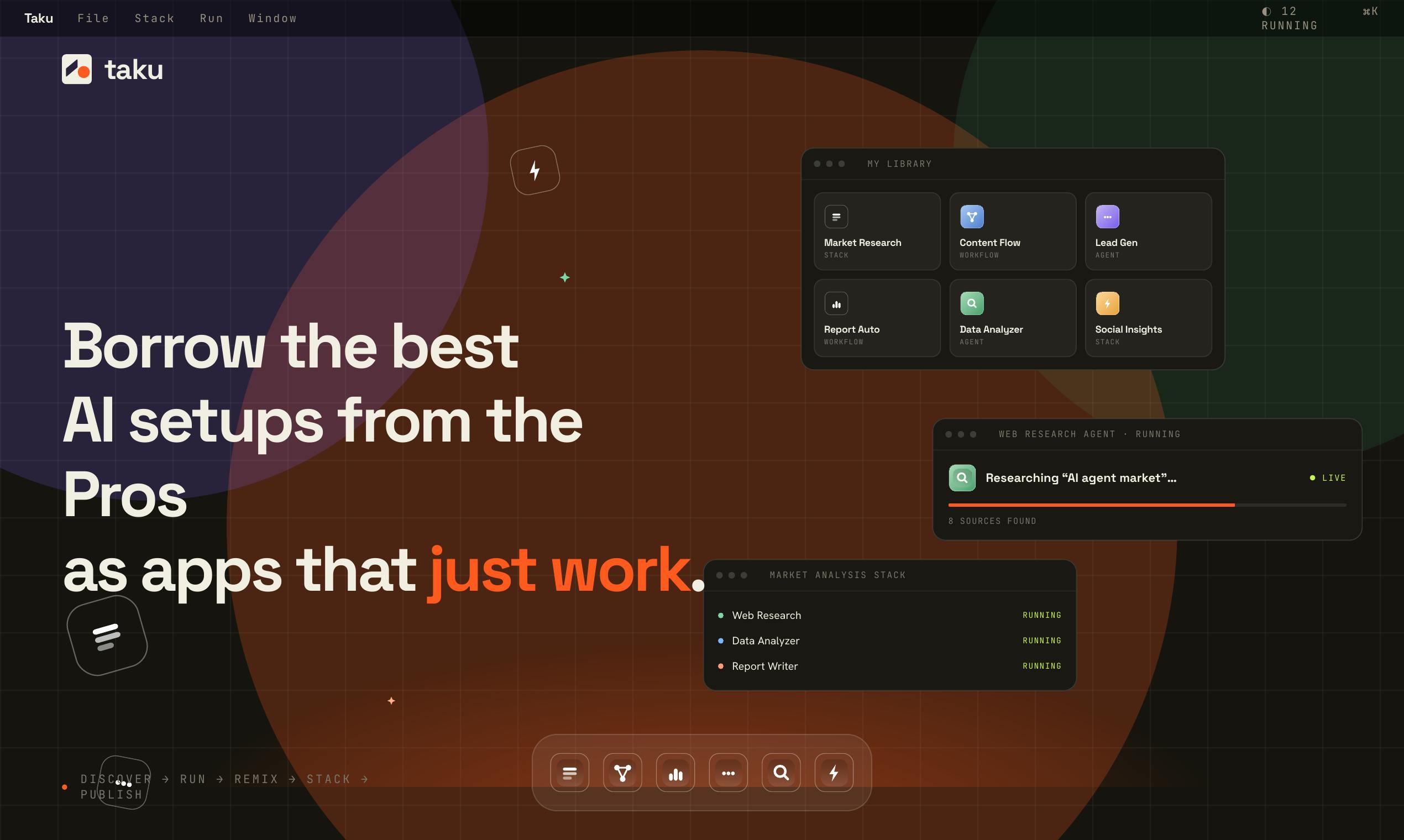
Taku AI is a desktop workspace (macOS and Windows) where non-technical users discover, run, remix, and publish AI apps, agents, and workflows — packaged as “Stax” — without touching GitHub, dependencies, or API keys. Users describe a goal in plain language; Taku assembles a workflow from marketplace components; creators can publish their own setups and, eventually, charge for them (taku.ai, Taku 2.0 announcement). The founder frames it as “TikTok for AI setups”: the best configurations find you.
The product targets the “last mile” problem of AI adoption: powerful open-source agents and skills exist, but setup friction excludes most users. That problem is real and growing. Taku’s answer — a runnable marketplace rather than a directory of links — is a genuinely differentiated framing versus prompt libraries and MCP registries.
The strongest positive signal is the founder. Austin Zheng verifiably co-founded Sapient Intelligence, raised $22M from Vertex Ventures, JAFCO and others at a $200M valuation, and recruited researchers from Anthropic, DeepMind, DeepSeek, and Qwen before leaving in April 2025 (LinkedIn, VentureBeat). That demonstrates fundraising capability and network access rare at this stage.
The most important concern is that the core bet — a two-sided marketplace for AI workflows with creator monetization — is unproven across the entire industry, including by OpenAI, whose GPT Store failed to produce a meaningful creator economy. Taku’s traction figures (12,000 apps, 3,400+ creators, 1.2M runs/month) are company-reported and unverified, and no revenue, funding, or retention data exists. The decision is Watch.
Product Overview
The customer problem: AI capability is abundant but operationalizing it requires cloning repos, managing environments, writing prompts, and babysitting configs. Taku 1.0 (built since roughly June 2025) was a describe-and-assemble workflow engine; Taku 2.0 (launched August 15–18, 2026, in Beta) wraps it in a marketplace: discover Stax that run in-place, remix them conversationally, and publish your own (Taku 2.0 blog, LaunchZone listing).
Core features: one-click running of community AI apps, natural-language workflow assembly, remixing, creator profiles and leaderboards, a community bounty board, and a model-proxy approach (“one subscription instead of 12,” per founder comments on Product Hunt). Pricing is freemium with credit-based paid tiers — reported by a secondary directory as Free, Starter $20/mo (6,000 credits), Standard $50/mo, Pro $200/mo, with 30% annual discount; the official pricing page confirms tiered monthly/annual billing but rendered no prices at report time, so treat tier details as unverified (Stork.ai, secondary, taku.ai/pricing). Creator monetization (subscriptions, one-time fees, marketplace sales) is explicitly “direction, not a promise” per the company’s own blog. It replaces the manual workflow of GitHub + .env files + multiple AI subscriptions.
Founder and Team Assessment
Austin Zheng is independently verifiable. His LinkedIn shows Co-Founder & CEO of Taku since June 2025 (“building next-gen personal OS”), preceded by Co-Founder of Sapient Intelligence (April 2024–April 2025), where he states he led fundraising and teambuilding for the $22M seed and “left the team in April 2025 when the team pivoted towards the Chinese market” (LinkedIn). The Sapient round and $200M valuation are corroborated by VentureBeat, which interviewed him as co-founder (VentureBeat). Note a minor conflict: other coverage names Guan Wang as Sapient’s founder/CEO (Actuia); the consistent reading is that Zheng was a co-founder focused on fundraising, not the technical CEO.
Caveats: his Sapient tenure was roughly one year; Taku’s co-founders, team size, and hiring are not publicly disclosed; and his current company has no disclosed funding. Key-person risk is high by default at this stage.
Founder Assessment: Verified fundraising pedigree and frontier-lab network, but short prior tenure and an unverified current team.
Market Opportunity
The initial customer is narrow: AI-curious prosumers, knowledge workers, and indie builders who want to run community AI workflows without engineering setup. Bottom-up: at a blended ~$25–$30/month (analyst assumption between the reported $20 and $50 tiers), 100,000 paying users would be ~$30–$36M ARR — a strong business, but the prosumer-AI willingness-to-pay segment is contested and churn-prone. The larger prize is the creator-marketplace layer: if Taku becomes a distribution and monetization rail for AI workflows, it takes a cut of GMV rather than relying on subscriptions.
Adjacent expansion includes teams/enterprise workflow sharing (where Gumloop just raised a $50M Series B led by Benchmark, and n8n raised $180M at a $2.5B valuation in October 2025 — evidence of real money in AI workflow tooling, albeit mostly B2B) (TechCrunch, TAMradar). Market timing is favorable — agentic AI adoption is surging — but the consumer/prosumer “AI app store” segment remains unproven at scale.
Traction and Growth Signals
Verified: Product Hunt launch on August 18, 2026 finished #2 Product of the Day, behind Clara AI SDR and ahead of Superflow AI (PH daily leaderboard); the product page shows 958 followers, a 4.0 rating from 1 review, and an active founder answering detailed technical questions in comments (Product Hunt). Company-reported and unverified: 12,000 apps & skills, 3,400+ creators, and 1.2M runs/month on the homepage — aggressive figures for a marketplace whose 2.0 version launched days ago, though Taku 1.0 existed for roughly a year prior. The company runs a bounty board with credit pledges, indicating early community seeding (taku.ai/events/bounty).
Missing and decisive: revenue, paying users, retention, run/repeat-usage rates, creator earnings, and any funding announcement. Product Hunt rank is launch attention, not product-market fit.
Traction Assessment: Strong launch-day attention and plausible prior-year usage, but commercially unverified.
Competitive Position
Direct competitors: agent/app marketplaces and builders — Agent.ai, Poe, Hugging Face Spaces, Coze, MindStudio, Wordware, Relevance AI; workflow tools — n8n, Zapier, Lindy, Gumloop, Flowise/Langflow; free alternatives — MCP registries (e.g., Smithery), Claude Skills, GitHub itself. Platform threats are severe: OpenAI already operates a GPT Store (whose creator monetization largely failed), and Anthropic, Perplexity, and browser agents (Comet, Dia) could bundle “run community workflows” natively.
Taku’s differentiation is real but narrow: runnable desktop execution (not links), conversational remixing, and a creator-economy narrative. If OpenAI or Anthropic shipped equivalent remixable skill marketplaces with revenue share within six months, Taku’s residual defense would be cross-model neutrality and its desktop workspace — a plausible but weak moat, since neutrality has not historically defended aggregators against platform owners. Switching costs are near zero today; the hoped-for moat is two-sided network effects, which require solving cold start against much larger distribution owners.
Defensibility Assessment: Low
Business Model and Economics
Freemium credits with paid tiers reportedly at $20/$50/$200 per month, plus a planned marketplace take on creator earnings. The model stacks two unproven layers: prosumer subscription willingness-to-pay and creator monetization that even OpenAI could not make work. On costs, the model-proxy approach means Taku likely resells inference, so gross margin depends on markup over LLM API costs minus free-tier burn; heavy agent runs are inference-intensive, and creator revenue share would add a third cost layer. Customer acquisition currently relies on Product Hunt and creator word-of-mouth — cheap but unrepeatable at scale. Everything material (conversion, churn, credit economics, take rate) is unverified and must be established in diligence.
Unicorn Path
Assume an 8–10x revenue multiple, appropriate for a subscription-plus-marketplace AI product with platform risk. Required revenue ≈ $100–125M. Under the subscription model at ~$300/year blended ARPU, that implies roughly 350,000–400,000 paying subscribers — a scale no prosumer AI tool outside the frontier labs has demonstrated. Under a marketplace model at a 20% take rate, it implies $500–625M in annual creator GMV — multiples of what the GPT Store ever generated. Reaching this requires: proving creator monetization (industry-first), expanding from prosumers to teams, international expansion, and likely raising significant capital to subsidize both sides. Possible, but only through execution that has eluded far larger players.
Unicorn Path: Conditional
Valuation Assessment
No funding round, valuation, SAFE cap, or investor list for Taku is publicly disclosed; no Crunchbase entry was found for this entity. The founder’s prior $22M raise suggests access to capital, but that is not evidence of Taku’s terms.
Valuation Attractiveness: Not Assessable. Required: current ARR/MRR, growth, retention, credit gross margin, burn and runway, round size, and post-money or SAFE cap. Comparable financings (Gumloop Series B, n8n Series C) frame the category but cannot price a pre-traction marketplace.
Key Risks
- Marketplace cold start against platform owners (OpenAI, Anthropic) with vastly larger distribution.
- GPT Store precedent: creator monetization for AI workflows has failed at scale before.
- No verified revenue, retention, or usage data; homepage traction figures are company-reported.
- Thin gross margins from resold inference plus future creator payouts.
- Security and trust exposure: users run third-party community “setups” on their desktops — a malware/abuse vector requiring real vetting infrastructure.
- Low switching costs and easy replication of the “remix” UX.
- Undisclosed team, funding, and runway; high key-person dependency on the founder.
- Founder’s prior startup tenure was ~12 months, ending in a strategic-pivot departure.
- Prosumer AI churn and willingness-to-pay risk at $20–$200/month.
Final Assessment
Venture Potential: 56/100
| Category | Score |
|---|---|
| Market Size and Expansion Potential | 14/20 |
| Traction and Growth Evidence | 8/20 |
| Founder and Team | 10/15 |
| Product Strength | 6/10 |
| Distribution Potential | 9/15 |
| Business Model and Economics | 5/10 |
| Defensibility | 4/10 |
| Total | 56/100 |
Strongest: market timing and founder fundraising pedigree. Weakest: defensibility and the absence of any verified commercial data.
Evidence Confidence: 42/100
Verified: founder identity and Sapient fundraising history, PH launch rank, product existence and positioning, category comparables. Company-reported: 12,000 apps, 3,400+ creators, 1.2M runs/month. Secondary-only: pricing tiers. Unavailable: Taku funding, team size, revenue, retention, creator earnings, and valuation.
Final Decision: Watch
Taku pairs a credible, well-networked founder with a genuinely large ambition, but it is three days post-launch of its defining version, in a category where the largest platform in the world already tried the marketplace model and stalled. Too early for DD; not a Pass, because the founder-market fit and timing justify monitoring.
Upgrade Conditions
- Verified $500K+ ARR or 5,000+ paying subscribers with disclosed growth
- 30%+ month-3 retention on runs (repeat usage, not installs)
- First verified creator payouts and a functioning take rate
- Disclosed seed round from credible investors with terms
- Evidence of vetting/security infrastructure for community Stax
Downgrade Conditions
- Run volume collapsing after launch-week spike
- Creator monetization slipping beyond ~2 quarters
- OpenAI/Anthropic shipping remixable skill marketplaces with rev share
- Any security incident from malicious community content
- Undisclosed runway distress or founder departure
Questions for Further Diligence
- What are current MRR, paying subscriber count, and monthly growth — split between Taku 1.0 legacy and 2.0?
- What are 30/90/180-day retention and repeat-run rates per active user?
- What is the gross margin per credit after inference costs, and how does it scale on the $20 tier?
- How many of the 3,400 creators have published a Stax that others actually ran, and what does the run distribution look like (top-1% concentration)?
- What is the planned marketplace take rate, and when does creator payout infrastructure ship?
- How do you vet community Stax for malware, prompt injection, and data exfiltration before users run them locally?
- What funding has Taku raised to date, on what terms, and what is current burn and runway?
- Who else is on the founding team, and what are their roles and vesting?
- What happened operationally at Sapient in the April 2025 pivot, and what did you take from it into Taku?
- Why will creators build here rather than on Claude Skills, MCP registries, or a future OpenAI rev-share program?
- What share of runs comes from the model proxy versus users’ own keys, and what happens to unit economics if model prices rise?
- What is the desktop-versus-web split, and what is the install-to-activation funnel?
Sources
- Product Hunt — Taku AI and PH daily leaderboard, Aug 18, 2026
- taku.ai — official site, pricing, Taku 2.0 announcement, bounty board
- Austin Zheng — LinkedIn
- VentureBeat — Sapient Intelligence $22M seed at $200M valuation
- TechCrunch — Gumloop $50M Series B and TAMradar — n8n $180M Series C context
- LaunchZone — Taku listing and Stork.ai — Taku AI review/pricing (secondary sources)