
Table of Contents
- Stitch AI by Dynamic Mockups Investment Report
Stitch AI by Dynamic Mockups Investment Report
Category: AI-assisted embroidery digitizing and e-commerce product-visualization software
Company Stage: Early-stage, commercial product; classified as “Scale-up” by Katapult
Founder or Founders: Luka Filipović; Miloš Medić is a significant shareholder and publicly identified as COO
Headquarters: Belgrade, Serbia; legal entity registered in London, United Kingdom
Funding: No verified equity round publicly disclosed; participant in the 2026 Katapult accelerator, which provides mentorship and financial support
Business Model: Freemium SaaS, usage-based credits, API access, and custom enterprise contracts; Stitch is currently free
Product Hunt Launch Date: September 2, 2026
Report Date: September 5, 2026
| Investment Metric | Assessment |
|---|---|
| Venture Potential | 67/100 |
| Unicorn Path | Conditional |
| Valuation Attractiveness | Not Assessable |
| Evidence Confidence | 56/100 |
| Final Decision | Watch |
Executive Summary
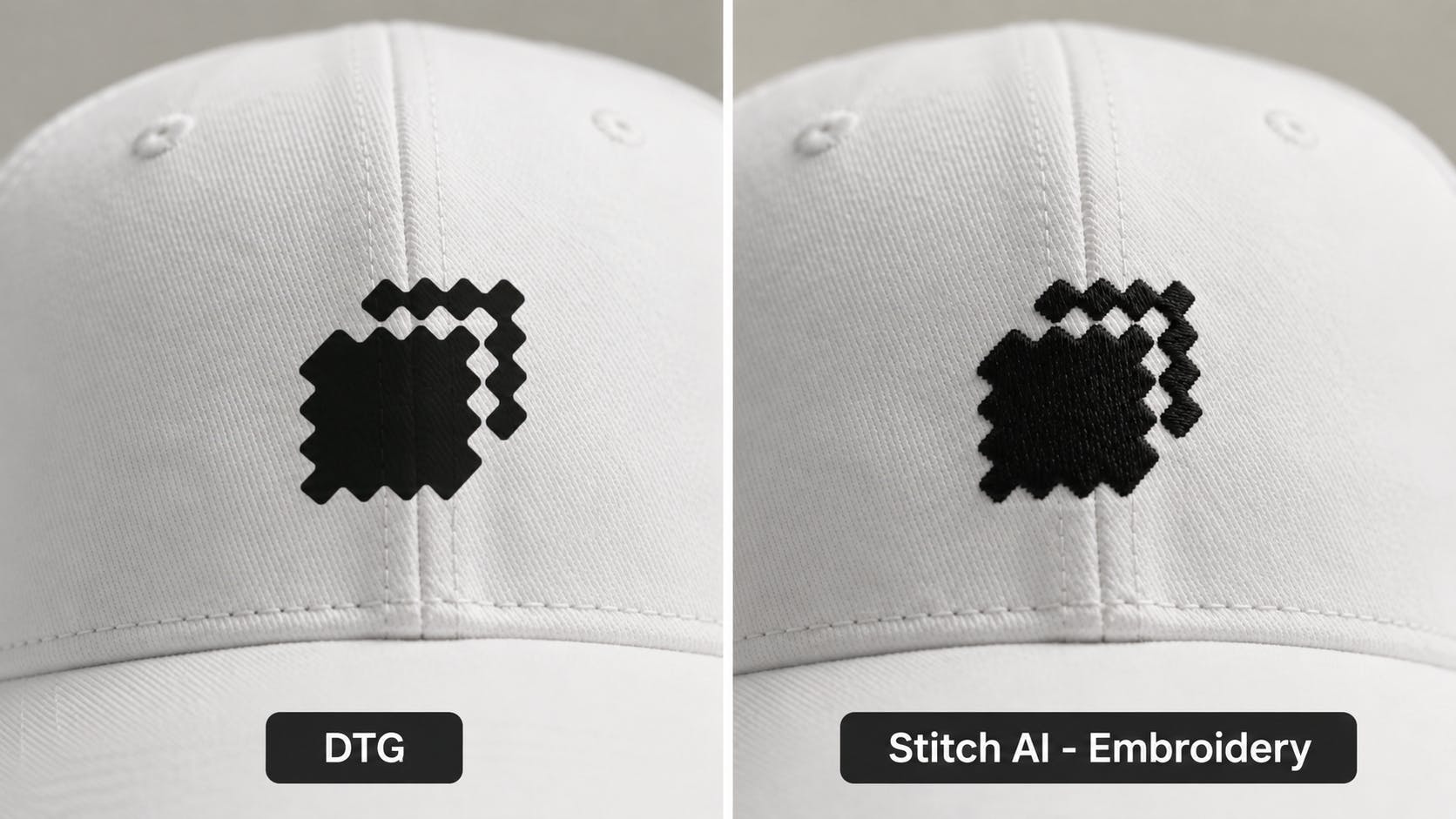
Stitch AI is a browser-based embroidery digitizing agent developed by Dynamic Mockups. It converts uploaded artwork into a stitch plan, photorealistic product preview, stitch count, production sheet, and embroidery-machine file. The company says this process takes approximately 15 seconds, compared with outsourcing digitization or learning specialist desktop software (Stitch).
The product addresses a real production bottleneck. Embroidery machines cannot directly use ordinary image files: artwork must be translated into stitch types, directions, densities, sequencing, and compensation settings. Stitch combines this production task with Dynamic Mockups’ existing product-visualization workflow, potentially reducing both quoting and merchandising time.
The strongest investment signal is the surrounding company rather than the new product alone. Dynamic Mockups reports more than 45,000 users, over 10,000 templates, API and commerce integrations, and an existing paid SaaS plan (website, pricing). Serbia’s Innovation Fund selected the company for the 2026 Katapult scale-up cohort and describes it as product-visualization API infrastructure based in Belgrade (Innovation Fund).
However, Stitch is currently free, has no disclosed usage, conversion, retention, or revenue, and has not been independently validated through production-scale sew-out testing. There is also a product-documentation inconsistency: the Product Hunt launch says DST, PES, and EXP files are available, while the official Stitch page says only DST is available today and PES/EXP are forthcoming (Product Hunt, Stitch FAQ).
The company may be venture-backable if Stitch becomes an entry point into a broader, high-value visual-commerce and production infrastructure platform. The evidence does not yet support formal diligence. The decision is Watch, pending paid adoption, retention, production accuracy, and enterprise economics.
Product Overview
Stitch serves embroidery shops, promotional-products distributors, merchandise brands, print-on-demand sellers, and patch or hat manufacturers. These customers currently use professional digitizers, desktop software such as Wilcom or Hatch, lower-cost auto-digitizing tools, or manual production workflows.
The product analyzes artwork region by region, recommends stitch treatments and thread colors, identifies limitations, and produces a 3D embroidered preview. Users can adjust color, stitch angle, density, finish, fill flow, borders, and three-dimensional puff settings. Quality-control tools include a density heatmap, stitch player, needle-path display, and problem inspector (Stitch product page).
Its principal product advantage is combining a sales artifact—the customer-facing mockup—with production outputs generated from the same stitch plan. This can shorten the transition from design inquiry to quote and machine preparation.
Stitch currently runs in Dynamic Mockups’ browser editor and is desktop-only. The official page states that a digitizing API is under development. The wider Dynamic Mockups platform already provides a REST API, SDKs, an embeddable editor, Shopify and WooCommerce integrations, and an open-source MCP server (API documentation, GitHub MCP server).
Stitch is free during its initial learning period, and no permanent pricing has been announced. Dynamic Mockups’ broader Pro plan is advertised at $15 per month when billed annually, with 3,600 annual credits; enterprise pricing is custom (pricing).
Product-quality assessment: Promising workflow design and unusually broad output, but production reliability remains company-asserted rather than independently established.
Founder and Team Assessment
Luka Filipović is publicly identified as founder and CEO. His company biography claims more than ten years in startups and product management, including AI integrations, but the detailed employment history was not independently verified (founder biography).
UK Companies House verifies that Filipović has been the sole active director of Design Copilot Ltd since June 2023 and controls more than 50% but less than 75% of its shares. Miloš Medić controls more than 25% but no more than 50% and is publicly identified as Dynamic Mockups’ COO (officers, ownership).
LinkedIn lists eight associated employees and an 11–50 employee size band, but this is self-maintained platform data rather than verified payroll information (LinkedIn). The Product Hunt launch was presented by team member Nemanja, indicating some product-marketing capacity beyond the founder.
The team has demonstrated sustained shipping across mockups, video, APIs, commerce integrations, and now embroidery. Nevertheless, specialist embroidery expertise, machine-testing personnel, enterprise sales capability, and full-time staffing are not publicly disclosed.
Founder Assessment: Credible product execution and founder-market engagement, but specialist production expertise and repeatable commercial scaling remain insufficiently verified.
Market Opportunity
The initial market should be defined as small and midsized embroidery decorators, promotional-products distributors, and e-commerce sellers that repeatedly convert customer artwork into embroidery files.
PPAI reports more than 45,500 promotional-products companies in the United States and $27.1 billion in distributor revenue, providing a meaningful—but not enormous—initial business population (PPAI). Etsy reported 5.6 million active sellers at year-end 2025, although only an unknown subset sells apparel or products suitable for embroidery (Etsy results).
A reasonable analyst scenario is 50,000–250,000 globally addressable professional and high-frequency merchant accounts. At an assumed $360–$1,200 annual spend, this represents approximately $18 million–$300 million in potential annual revenue. These are scenario assumptions, not measured market size.
The narrow digitizing market alone may not support a unicorn. Expansion into screen printing, direct-to-garment production, product configuration, quoting, manufacturer catalogs, embedded commerce, and API-based visual infrastructure would materially enlarge the opportunity.
Traction and Growth Signals
Dynamic Mockups reports 45,000-plus users on its website, up from a company announcement of 20,000 registered users in June 2025. The Product Hunt launch statement refers to more than 50,000 brands and sellers, creating a modest definitional discrepancy between “users,” “brands,” and “sellers” (website, Product Hunt).
The Katapult profile states that the platform has processed 100 million images, but this remains a company-supplied claim without an audited usage period or definition (Katapult profile).
Stitch ranked 12th on Product Hunt’s September 2 daily leaderboard and had approximately 116 points when researched. This indicates launch interest, not product-market fit (leaderboard).
Independent commercial evidence is limited. The Shopify listing had no reviews, while AppSumo displayed a small number of verified purchaser reviews that were generally positive but also identified credit constraints and occasional visibly AI-generated imagery (Shopify, AppSumo reviews). Trustpilot’s search listing showed six reviews and a weak score, conflicting with the company’s “4.9/5 from 45,000+ users” marketing claim; the source and sample behind the company rating are not disclosed.
Revenue, paid customers, Stitch runs, successful sew-outs, retention, conversion, and expansion revenue are not publicly disclosed. A third-party directory estimates $770,000 of 2025 revenue, but labels the figure estimated; it is therefore not treated as verified (GetLatka).
Traction Assessment: Meaningful top-of-funnel and product-usage signals at the parent-company level, but Stitch’s commercial traction is unverified.
Competitive Position
Direct alternatives include professional digitizing services, Hatch, Wilcom EmbroideryStudio, and the open-source Ink/Stitch platform. Hatch provides automatic and manual digitizing and prices its principal tiers from $199 to $1,199; its community exceeds 30,000 members (Hatch pricing). Ink/Stitch is free, open-source, cross-platform, and supports numerous stitch types and output formats (Ink/Stitch).
Stitch differentiates through browser delivery, rapid automated planning, integrated mockups, explainable compromises, and combined sales and production outputs. Dynamic Mockups also has an existing audience, API, template library, and commerce integrations that a standalone digitizer would need to build.
Switching costs are currently low. Customers can retain exported DST files and move to another digitizer. No proprietary training-data scale, production-success dataset, patents, or exclusive manufacturer relationships have been verified.
If Wilcom or another established embroidery platform launched a comparable agent within six months, customers would continue using Stitch only if it demonstrated materially better first-pass sew-out accuracy, easier commerce integration, or lower total workflow cost. That advantage has not yet been proven.
Defensibility Assessment: Low to Medium
Business Model and Economics
Dynamic Mockups monetizes through subscriptions, credit top-ups, clean API renders, and enterprise contracts. The $15-per-month annual Pro plan implies approximately $180 in annual recurring revenue before top-ups. Enterprise customers receive higher volume, custom integrations, white-label tools, onboarding, and service-level commitments.
Stitch’s future model is unknown. Plausible options include per-design credits, a professional subscription, API usage, or inclusion in enterprise contracts. A per-design model may align better with customer value than the low-priced general Pro plan.
Gross margin is not disclosed. Variable costs include AI inference, image and 3D rendering, storage, file processing, payment fees, and support. More importantly, failed production files could create garment waste, machine downtime, refunds, and high-touch support. Investors should verify whether additional usage produces contribution margin rather than escalating quality-assurance costs.
Unicorn Path
For an AI-enabled vertical SaaS and usage-based infrastructure business, an illustrative 10× ARR multiple is reasonable only if growth is strong, gross margins are software-like, and retention is durable.
Required ARR would therefore be:
$1 billion ÷ 10 = approximately $100 million ARR.
At the existing $180 annual Pro price, the company would need approximately 556,000 equivalent paid subscriptions. At an assumed $360 annual Stitch package, it would require approximately 278,000 paying customers. Both figures are demanding relative to the professional embroidery segment.
A more credible—but still difficult—scenario would combine 100,000 SMB accounts at $360 annually, producing $36 million, with 1,600 enterprise or platform accounts averaging $40,000 annually, producing $64 million. These are analyst assumptions, not forecasts.
Reaching this scale would require Stitch to expand from a free feature into paid production infrastructure, prove machine-level reliability, launch APIs, deepen e-commerce and manufacturer integrations, and extend beyond embroidery into multiple product-decoration workflows.
Unicorn Path: Conditional
Valuation Assessment
No verified equity financing, SAFE cap, post-money valuation, or current fundraising terms were found. Dynamic Mockups joined Katapult’s 2026 cohort, but the specific financial support allocated to the company is not disclosed. Company filings confirm the legal entity and ownership ranges but do not provide current venture valuation information.
Valuation Attractiveness: Not Assessable
Assessment requires current ARR, growth, gross margin, retention, cash balance, burn, runway, round size, valuation or SAFE cap, dilution, cap table, and liquidation preferences. The unverified $770,000 revenue estimate is insufficient for setting a responsible valuation range.
Key Risks
- Production reliability: No independent sew-out data establishes that generated files are consistently machine-ready.
- Commercial uncertainty: Stitch is free and has no disclosed conversion, revenue, or retention.
- Feature commoditization: Established vendors already offer auto-digitizing and can add agent-like interfaces.
- Documentation inconsistency: Supported file formats differ between Product Hunt and the official FAQ.
- Low switching costs: Exported files are portable, limiting lock-in.
- Narrow initial market: Embroidery digitizing alone may cap venture-scale revenue.
- Margin and liability exposure: Bad files can waste materials and require human intervention.
- Evidence-quality concerns: User and rating claims lack disclosed methodologies and conflict with small independent review samples.
- Platform dependency: Distribution relies partly on Shopify, Etsy, WooCommerce, AI providers, and cloud infrastructure.
- Key-person risk: Governance and senior operating responsibility appear concentrated among a small team.
Final Assessment
Venture Potential: 67/100
| Category | Score |
|---|---|
| Market Size and Expansion Potential | 15/20 |
| Traction and Growth Evidence | 12/20 |
| Founder and Team | 11/15 |
| Product Strength | 8/10 |
| Distribution Potential | 10/15 |
| Business Model and Economics | 6/10 |
| Defensibility | 5/10 |
| Total | 67/100 |
The strongest elements are the integrated production-and-visualization workflow, existing Dynamic Mockups distribution, and credible execution activity. The weakest are unverified Stitch accuracy, missing commercial metrics, uncertain monetization, and limited defensibility.
Evidence Confidence: 56/100
The legal entity, director, ownership ranges, pricing, product features, integrations, accelerator participation, and Product Hunt ranking are verifiable. User volume, image-processing volume, product speed, ratings, and production readiness are company-reported. Revenue is available only as an explicitly labeled third-party estimate.
Retention, paid customers, gross margin, acquisition costs, burn, runway, Stitch usage, enterprise concentration, funding terms, and valuation remain unavailable.
Final Decision: Watch
Stitch warrants observation because it addresses a costly workflow and leverages an existing product platform. It does not yet justify formal diligence because paid adoption, production reliability, retention, unit economics, and financing terms are unknown.
Upgrade Conditions
Upgrade to DD if the company demonstrates:
- At least $1 million of verified ARR across the platform, with Stitch contributing measurable new revenue.
- More than 70% six-month retention among professional embroidery users.
- Independent sew-out testing across major fabrics, machines, and design types.
- At least 20 referenceable embroidery shops or enterprise platforms.
- Gross margin above 65% after inference, rendering, support, and failed-output costs.
- Repeatable acquisition outside Product Hunt and promotional launches.
- Clear paid Stitch pricing and evidence of API or enterprise expansion.
Downgrade Conditions
Downgrade to Pass if paid conversion remains weak, production error rates require frequent human correction, incumbents replicate the workflow, usage fails to persist after the free period, gross margin is structurally low, or company claims prove materially misleading.
Questions for Further Diligence
- What are current MRR, ARR, monthly growth, and the portion attributable to API, Pro, and enterprise customers?
- How many of the reported 45,000–50,000 users are monthly active and paying?
- What are 30-, 90-, and 180-day retention and net revenue retention by customer segment?
- How many Stitch designs have been generated, downloaded, and successfully sewn?
- What percentage of Stitch outputs require manual correction or external re-digitization?
- What are planned Stitch prices and expected annual revenue per professional customer?
- What are gross margin and inference, rendering, storage, and support costs per Stitch design?
- Which acquisition channels produce paying customers, and what are CAC and payback period?
- What proprietary training data, production feedback, or manufacturer relationships support defensibility?
- Why do Product Hunt and the official FAQ disagree on PES and EXP availability?
- What funding or grants were received through Katapult, and what are current burn and runway?
- What are the current cap table, proposed round terms, valuation, and founder commitments?
Sources
- Product Hunt — Stitch AI
- Official Stitch product page
- Dynamic Mockups website
- Dynamic Mockups pricing
- Dynamic Mockups API documentation
- Official MCP server on GitHub
- UK Companies House — officers
- UK Companies House — ownership
- Serbia Innovation Fund — Katapult 2026 cohort
- Shopify App Store listing
- Hatch Embroidery pricing
- Ink/Stitch
- PPAI industry statistics
- Etsy 2025 results