
Table of Contents
- Octomind Cloud and Hub Investment Report
Octomind Cloud and Hub Investment Report
Category: AI agent infrastructure, cloud development environments, model gateway, developer tools
Company Stage: Bootstrapped, early commercial product
Founder or Founders: Don Karter and Vladimir Kosenko
Headquarters: Hong Kong is listed on LinkedIn; operations appear distributed, and the legal headquarters is not independently verified
Funding: Bootstrapped; Muvon states that it has no venture-capital funding
Business Model: Freemium subscriptions, cloud-compute usage, and prepaid premium-model credits
Product Hunt Launch Date: August 11, 2026
Report Date: August 14, 2026
| Investment Metric | Assessment |
|---|---|
| Venture Potential | 55/100 |
| Unicorn Path | Conditional |
| Valuation Attractiveness | Not Assessable |
| Evidence Confidence | 55/100 |
| Final Decision | Watch |
Executive Summary
Octomind Cloud and Hub is a hosted environment for running persistent AI agents. Users receive cloud Linux machines on which agents can browse, execute code, install software, retain files, and continue working after the user closes the browser. The accompanying Hub aggregates hosted language models behind one account and an OpenAI-compatible endpoint, reducing the need to manage provider-specific API keys (Octomind Cloud; Octomind Hub).
The product serves individual developers, technical power users, small teams, and companies experimenting with autonomous workflows. Its open-source runtime can run locally or in CI, daemon, WebSocket, and Agent Client Protocol modes, while the commercial service monetizes hosted models, persistent machines, storage, concurrency, and team access (GitHub repository).
The strongest positive signal is technical execution. The public repository shows an actively developed Rust codebase, an Apache-2.0 license, regular releases, and a functioning hosted product with transparent pricing. The founders also publish benchmark artifacts and detailed technical documentation. This provides more evidence of product substance than a typical Product Hunt launch.
The principal concern is commercial validation. Revenue, paid-account count, active machines, cohort retention, gross margin, and customer acquisition costs are not publicly disclosed. Public adoption remains small: the primary repository had 106 stars and nine forks, while crates.io reported 5,741 cumulative downloads and 516 recent downloads as of August 14, 2026 (GitHub API; crates.io). These figures demonstrate real usage but not product-market fit.
The market is large but exceptionally competitive, with GitHub, Anthropic, OpenAI, Cursor, cloud-development platforms, and numerous open-source agent runtimes pursuing overlapping workflows. The product is promising enough to monitor, but the available evidence does not justify formal due diligence. Final Decision: Watch.
Product Overview
Most local coding agents stop when a laptop sleeps, while cloud agents often use ephemeral environments that lose installed tools and state. Developers must also manage model-provider credentials, usage limits, and inconsistent APIs.
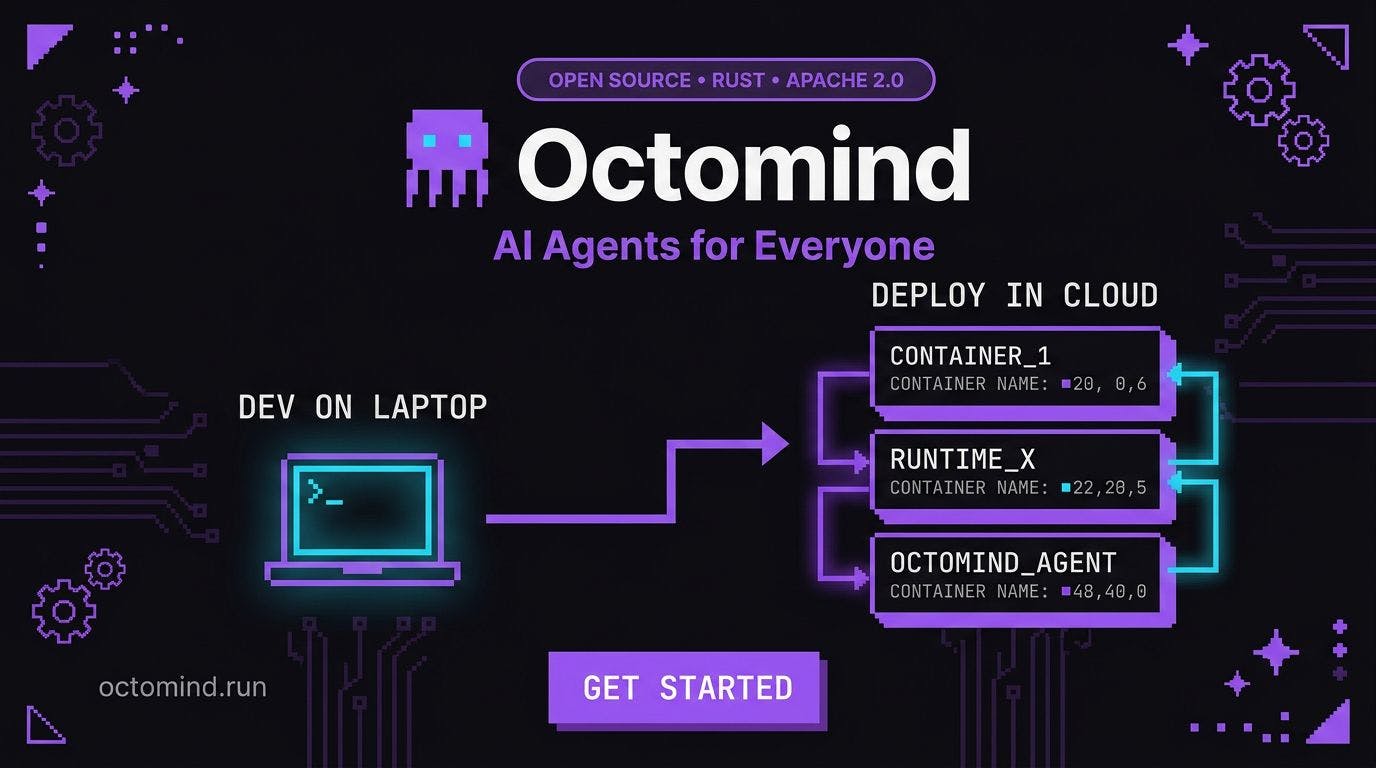
Octomind combines three layers. First, its open-source runtime manages agents, tools, workflows, permissions, context compression, spending caps, and persistent sessions. Second, Octomind Cloud supplies persistent containerized Linux machines with filesystems, browsers, shells, and an API. Third, the Hub offers hosted access to open and premium models through one gateway (official product page).
The runtime supports interactive terminal sessions, CI pipelines, background daemons, WebSocket clients, and use as a sub-agent through ACP. Agent configurations and deterministic guardrails are stored in TOML files, while external capabilities are added through MCP servers (documentation).
The commercial product has four plans:
- Free: $0, limited model allowance and one small machine.
- Pro: $10 for the first month, then $20 monthly.
- Max: $50 for the first month, then $100 monthly.
- Team: $500 monthly for unlimited members and pooled allowances.
Premium Claude and GPT usage is charged from prepaid credits, while cloud resources use metered billing. The company says it passes card fees through and applies no hidden markup to credits (pricing page).
The principal customer benefit is reducing operational friction: one account can provide models, durable execution, session continuity, cost controls, and remote access. Alternatives include running Claude Code, Codex, OpenCode, or similar tools locally; using GitHub’s cloud coding agent; renting a general-purpose VM; or assembling a model gateway and sandbox infrastructure internally.
Product quality appears above average for such an early project. However, reliability, multi-tenant isolation, support response, and uptime have not been independently verified.
Founder and Team Assessment
Muvon identifies Don Karter as CEO and co-founder and Vladimir Kosenko as software engineer and co-founder. The company describes itself as a two-founder, AI-augmented, bootstrapped studio (Muvon team; Muvon about page).
Karter reports more than 20 years of experience in backend systems, distributed architecture, AI integrations, Rust, Go, PHP, and open-source development. He is the primary visible contributor to Octomind and sets its technical direction (Don Karter profile). GitHub attributes the repository’s contributions almost entirely to two accounts associated with Karter, suggesting substantial execution ability but also significant key-person concentration (GitHub contributors API).
Kosenko reports prior engineering experience in payment systems, trading infrastructure, fintech, and blockchain. At Muvon, his stated responsibilities include product direction, positioning, developer community, and partnerships (Vladimir Kosenko profile).
These backgrounds are primarily company-reported and were not corroborated through detailed independent employment records. No prior institutional exit or scaled developer-tool company was verified. Muvon’s LinkedIn page lists Hong Kong as headquarters, a 2–10 employee range, and one visible employee; its website describes two human founders, making two the more reliable operating-team figure while exact staffing remains unverified (Muvon LinkedIn).
The founders appear committed, but Muvon also maintains several other products and offers selective consulting. This creates potential focus risk.
Founder Assessment: Strong technical execution and relevant infrastructure experience, but commercial scaling capability and exclusive focus remain unproven.
Market Opportunity
The initial segment is developers and small technical teams that regularly run long-duration AI agents and want durable cloud execution without assembling their own model gateway and infrastructure.
GitHub reported more than 180 million developers on its platform in 2025, but only a fraction are realistic buyers of dedicated cloud-agent infrastructure (GitHub Octoverse). A narrower analyst scenario of 10–30 million AI-intensive professional developers, with 2%–5% adopting a paid platform at $240 annually, produces a potential individual-subscription market of approximately $48 million–$360 million annually. These penetration assumptions are analytical, not company-reported.
The larger opportunity is teams and embedded infrastructure. At $6,000 annually for the Team plan, 10,000–30,000 subscribing organizations would represent $60 million–$180 million in annual subscription revenue. Additional compute and model usage could expand revenue per account, although the company’s margin on premium model credits appears limited.
Adjacent opportunities include APIs for software companies embedding agents, managed CI agents, enterprise governance, agent observability, private deployments, specialized workflow marketplaces, and higher-value security or compliance features. The realistic market is sufficient for a venture-scale company, but not necessarily for another undifferentiated coding-agent interface.
Traction and Growth Signals
The Product Hunt launch appeared at approximately number 11 on the August 11 daily leaderboard with around 108 votes. A third-party tracker captured 96 votes, likely at an earlier time; the Product Hunt figure is preferred because it is the primary source (Product Hunt page; Product Hunt leaderboard). This is launch attention, not commercial traction.
The GitHub repository was created in June 2025 and showed 106 stars, nine forks, two open issues, and active commits as of August 14, 2026 (GitHub API). Crates.io reported 52 published versions, 5,741 cumulative downloads, and 516 recent downloads; version 0.43.0 was released on August 11 (crates.io API). Rapid releases and extensive documentation indicate strong product activity.
Community validation is much weaker. A Show HN submission for Octomind Cloud received four points and one comment, while a Reddit technical discussion generated comments but was initiated by the founder (Hacker News; Reddit discussion).
The company reports that Octomind solved 24 of 25 real pull-request benchmark tasks using GLM-5.2, versus 23 for Claude Code and 21 for Codex. The benchmark repository and artifacts are public, but the study was designed and run by Muvon and has not been independently reproduced (benchmark report).
No reliable public information was found for registered users, active users, paid accounts, revenue, growth, retention, or customer references.
Traction Assessment: Active product development and modest open-source usage, but commercially unverified.
Competitive Position
Direct competitors include Claude Code, OpenAI Codex, GitHub Copilot’s cloud agent, OpenCode, Cline, OpenHands, and other agent runtimes. Cloud sandbox and development-environment providers can supply the execution layer, while OpenRouter and direct model APIs can replace the Hub.
Octomind’s differentiation is the combination of an open-source, provider-neutral runtime; persistent cloud machines; explicit spending caps; deterministic guardrails; long-session context management; and one hosted model gateway. The Apache-2.0 runtime lowers adoption friction and may help create developer trust (GitHub repository).
However, the open license also reduces software lock-in. Users can run the runtime with their own provider keys, while competitors can reproduce many features. Durable files and configured workflows create some switching costs, but no meaningful network effect or proprietary data advantage has been demonstrated.
If the largest platform launched the same feature within six months, why would customers continue using Octomind? The best answer is model neutrality, portability, open-source ownership, and superior policy controls. That may retain a specialist developer audience, but it is unlikely to be sufficient for mainstream teams unless Octomind proves better reliability, economics, and workflow performance.
Defensibility Assessment: Low to Medium
Business Model and Economics
Subscription revenue provides predictable pricing, while metered machines and premium credits introduce usage-based revenue. The $20 Pro tier is aggressive because it includes model allowances described as up to $120 monthly, although allowances are caps rather than guaranteed consumption (pricing page).
Variable costs include model inference, CPU and memory, storage, networking, browser workloads, container orchestration, payment fees, abuse prevention, and customer support. Persistent mutable environments also create operational and security burdens. The founder has acknowledged that environment drift and fully reproducible execution are not yet solved, describing the cloud product as MVP-stage during launch (Reddit discussion).
Gross margin depends on low average usage relative to plan caps, favorable model procurement, high machine-suspension rates, and automation of support. Rapid usage growth could increase infrastructure costs faster than subscription revenue. Revenue expansion could come from higher concurrency, teams, storage, private deployments, and developer API usage.
Gross margin, usage distribution, support cost, and model-provider terms are not publicly disclosed.
Unicorn Path
A high-growth infrastructure SaaS company with strong retention and approximately 70% or better gross margin could justify an illustrative 10× ARR multiple. Required ARR for a $1 billion valuation would therefore be:
$1 billion ÷ 10 = $100 million ARR.
At the standard $20 monthly Pro price, this requires approximately 417,000 Pro-equivalent subscribers. At $500 monthly, it requires roughly 16,700 Team-plan equivalents. A blended model could reach the same level with fewer customers if compute, enterprise governance, and API revenue materially increase average contract value.
This path requires a major increase from current public adoption, repeatable developer-led distribution, enterprise security controls, strong gross margins, and a reason for teams to standardize on Octomind rather than tools bundled by GitHub, Microsoft, Anthropic, or OpenAI. The company would also need to focus more narrowly on Octomind rather than operate primarily as a multi-product studio.
Unicorn Path: Conditional
Valuation Assessment
Muvon explicitly states that it is bootstrapped and has no venture investors (Muvon about page). No financing round, SAFE cap, secondary transaction, acquisition offer, or valuation was found. Revenue is also undisclosed.
The €4.5 million financing associated with another company called Octomind belongs to a separate German software-testing business and should not be attributed to Muvon or Octomind Cloud.
Valuation Attractiveness: Not Assessable
Assessment requires ARR, growth, gross margin, retention, burn, runway, ownership structure, proposed round size, pre- or post-money valuation, and financing terms.
Key Risks
- Unverified monetization and retention: No paid-customer or revenue evidence is public.
- Intense platform competition: Large vendors can bundle cloud agents with existing developer relationships.
- Potentially difficult unit economics: Model allowances and persistent machines may consume subscription margin.
- Small distribution footprint: Open-source and community adoption remain modest.
- Low switching costs: The runtime is open source and provider-neutral by design.
- Security exposure: Agents receive shells, browsers, files, credentials, and software-installation capability.
- Environment drift: Persistent mutable machines may become difficult to reproduce or debug.
- Key-person and focus risk: Development is heavily concentrated around Karter, while Muvon maintains multiple products and consulting activities.
- Brand confusion: A separate, venture-backed German software-testing company also uses the Octomind name.
Final Assessment
Venture Potential: 55/100
| Category | Score |
|---|---|
| Market Size and Expansion Potential | 18/20 |
| Traction and Growth Evidence | 6/20 |
| Founder and Team | 10/15 |
| Product Strength | 8/10 |
| Distribution Potential | 6/15 |
| Business Model and Economics | 4/10 |
| Defensibility | 3/10 |
| Total | 55/100 |
The product and market are the strongest elements. Commercial traction, distribution, margins, and defensibility are the weakest.
Evidence Confidence: 55/100
Pricing, source code, release activity, product capabilities, and founder identities are publicly observable. Founder experience and benchmarks are principally company-reported. Revenue, customers, retention, usage, margins, legal entity, capitalization, and financing terms remain unavailable.
Final Decision: Watch
Octomind is technically credible and addresses a rapidly expanding workflow, but it is too early and commercially unverified for formal diligence. Its current adoption is limited relative to the intensity of competition, and venture economics have not been demonstrated.
Upgrade Conditions
- Verified annualized recurring revenue of at least $1 million.
- More than 5,000 paying individual accounts or meaningful team adoption.
- Six-month paid retention above 70%.
- Gross margin above 65% after model and machine costs, with a path above 70%.
- Named customer references using agents in recurring production workflows.
- Repeatable organic acquisition beyond Product Hunt and founder-operated communities.
- Documented security controls, independent testing, and enterprise credential isolation.
- Evidence that workflows or policy infrastructure create durable switching costs.
Downgrade Conditions
- Weak conversion from free to paid plans.
- High churn after initial experimentation.
- Infrastructure or inference costs approaching subscription revenue.
- Security incidents involving customer code or credentials.
- Major platforms matching persistence, model neutrality, and guardrails.
- Falling repository activity or founder attention shifting to other products.
- Continued inability to reproduce or safely roll back cloud environments.
Questions for Further Diligence
- What are current MRR, paid-account count, and monthly revenue growth?
- How many free, Pro, Max, and Team accounts are active weekly?
- What are 30-, 90-, and 180-day retention by plan?
- What percentage of free users convert, and what triggers conversion?
- What are average model, compute, storage, and support costs per paid account?
- What is gross margin by plan after credits and cloud-machine usage?
- Which acquisition channels generate paying customers, and what is CAC by channel?
- How many customers use the API or agents in recurring production workflows?
- What isolation, penetration-testing, incident-response, and credential-management controls are in place?
- How are environment drift, snapshots, versioning, and rollback being addressed?
- How much founder time is allocated to Octomind versus consulting and other Muvon products?
- What are the legal entity, cap table, burn, runway, proposed round size, valuation, and investor terms?