
Table of Contents
Assembly Studio Investment Report
Category: Vertical AI app builder and client-operations SaaS
Company Stage: Post-Series A; Assembly Studio in early commercial launch
Founder or Founders: Marlon Misra and Neil Raina
Headquarters: New York City, United States
Funding: $13 million reported total; includes a $10 million Series A
Business Model: Tiered SaaS subscriptions, user/app/credit add-ons, enterprise contracts, and payment-processing fees
Product Hunt Launch Date: August 12, 2026
Report Date: August 15, 2026
| Investment Metric | Assessment |
|---|---|
| Venture Potential | 74/100 |
| Unicorn Path | Conditional |
| Valuation Attractiveness | Not Assessable |
| Evidence Confidence | 67/100 |
| Final Decision | DD |
Executive Summary
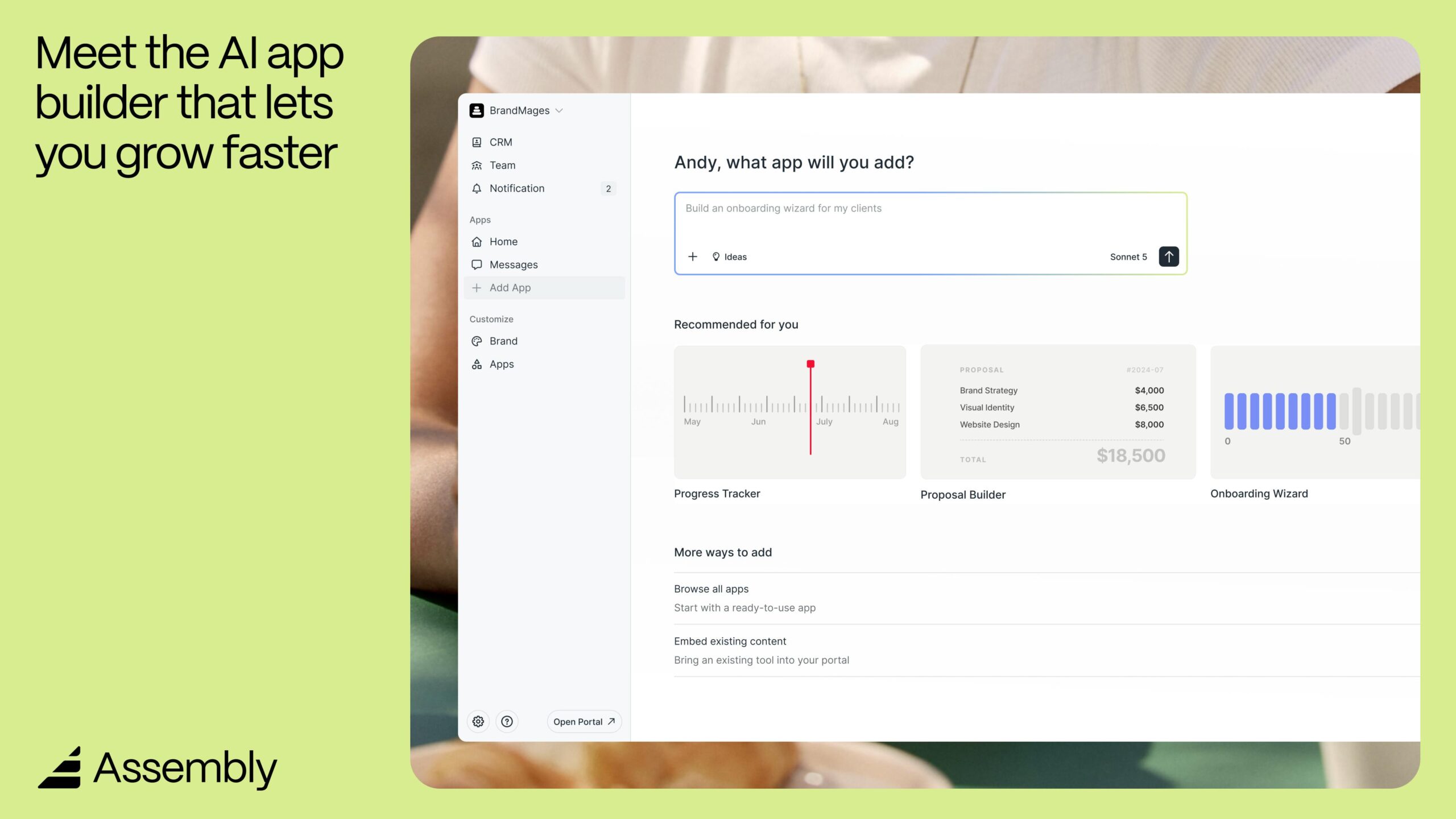
Assembly Studio is an AI app builder for professional-service firms. Users describe a client-facing or internal application in natural language; Assembly generates and deploys it within the firm’s existing branded client portal, CRM, identity system, permissions layer, and payment infrastructure. Typical applications include onboarding workflows, document collection, dashboards, approval systems, project hubs, and client-facing AI tools (official Studio documentation).
The product is more compelling than an undifferentiated “vibe coding” interface because Assembly already operates the underlying client-management platform. Generated applications inherit authentication, client records, permissions, hosting, and portal distribution. This reduces the deployment and security work that users of general-purpose builders such as Lovable, Base44, and Cursor must otherwise complete.
The strongest company-quality signal is Assembly’s pre-existing commercial base. The company reports more than 1,000 paying customers, while Y Combinator lists approximately 25 employees; Assembly also has a documented deployment with Capital One Luxury Travel covering more than 1,100 hotel partners (Assembly jobs page; YC profile; Capital One case study). These signals are materially stronger than Product Hunt attention, although product-level Studio revenue and retention are not disclosed.
The principal concern is whether Studio is a high-retention expansion engine or simply a feature that general-purpose app builders and established client-portal vendors can replicate. Assembly’s reported customer count, payment volume, and client reach are company-reported, and no current ARR, growth rate, net retention, gross margin, or Studio adoption data are public.
The company is sufficiently developed to justify formal diligence. Final Decision: DD, focused on whether Studio is expanding annual contract value and retention without creating excessive inference, hosting, support, and security costs.
Product Overview
Professional-service firms frequently combine email, spreadsheets, forms, e-signature, billing, project management, and file-sharing tools. This creates fragmented internal workflows and forces clients to use multiple interfaces. Custom software can solve the problem but is generally uneconomic for small agencies, consultancies, accounting firms, and similar businesses.
Assembly Studio generates applications from a written description, asks product-clarification questions, produces a build plan, and deploys the application into the customer’s Assembly workspace. Apps can use Assembly’s CRM records, notifications, permissions, client portal, and external API connections. Assembly states that each app receives a separate codebase, database, and sandboxed deployment (security page).
The free plan includes one internal user, five active client contacts, 50 monthly build credits, and three published apps. Paid plans include five apps, with additional apps at $5 monthly and excess build credits at $0.60 each. The underlying platform’s annual prices begin at $29 monthly for Starter, $99 for Professional, $499 for Advanced, and $2,000 for Enterprise; monthly Starter pricing is $49 (Studio pricing; platform pricing).
Assembly Studio is web-based. Its customer value is not merely faster software generation: it provides a preconfigured route from generated app to authenticated client distribution.
Founder and Team Assessment
Marlon Misra and Neil Raina founded the business in 2020, initially under the Portal and then Copilot names. The company rebranded as Assembly in September 2025 as “Copilot” became increasingly associated with Microsoft and other AI products (official rebrand announcement).
The founders previously participated in Y Combinator’s Winter 2018 batch and worked on Piccolo, a gesture-controlled smart-home vision product. Their experience as customers of agencies, accountants, lawyers, and recruiters led them to the fragmented-client-experience problem underlying Assembly (TechCrunch).
This history demonstrates product persistence and the technical ability to evolve from a client portal into a broader operating platform. The company’s longevity, commercial customers, and enterprise case study provide evidence of commercial competence. No previous founder exits were verified.
Y Combinator reports approximately 25 employees, and Assembly’s careers page states that the company is hiring from its New York office. Exact functional composition, current open-role count, founder ownership, and founder vesting are not publicly disclosed. Both founders continue to be identified in leadership roles, but full-time commitment should be confirmed directly.
Founder Assessment: Strong founder-market fit and sustained technical execution, with current ownership and scaling capability requiring diligence.
Market Opportunity
The initial customer is a technology-enabled professional-service firm with approximately 2–100 employees, recurring client relationships, and workflows too specialized for generic portal software but too small to justify an internal engineering team.
Assembly’s current annual base subscription ranges from $348 for Starter to at least $24,000 for Enterprise. A realistic target-market ACV is likely $1,200–$6,000 for small and midsized firms, excluding enterprise contracts and payment revenue.
For a bottom-up illustration, an analyst-defined serviceable segment of 100,000–500,000 digitally mature professional-service firms across the United States and other English-speaking markets, multiplied by $1,200–$6,000 in annual revenue, produces a potential revenue pool of approximately $120 million–$3 billion. This is an analytical scenario, not a verified market-size claim.
Adjacent opportunities include legal, healthcare administration, accounting, real estate, financial services, vertical application templates, an app marketplace, embedded payments, and enterprise partner portals. The U.S. alone has 36.2 million small businesses, but only a small percentage are credible near-term Assembly buyers; using the entire small-business population would materially overstate the opportunity (U.S. SBA).
The market is large enough for venture outcomes if Assembly becomes the application and data layer for service delivery rather than remaining a basic client portal.
Traction and Growth Signals
Assembly Studio ranked fourth on Product Hunt on August 12, with a third-party Product Hunt tracker recording approximately 137 upvotes (Product Hunt leaderboard; tracker). This represents launch attention, not recurring demand.
More meaningful evidence comes from the existing Assembly platform:
- Assembly reports more than 1,000 paying customers and says the business is growing quickly (careers page).
- The company website reports more than one million clients managed through the platform (official website).
- G2 reports 4.7/5 across 325 verified reviews, although these mainly assess the established client portal rather than the newly launched Studio product (G2 seller profile).
- Capital One Luxury Travel reports using Assembly since 2023 and reducing partner onboarding from approximately 60 to 30 days while expanding to more than 1,100 hotel partners (case study).
- Advertai Marketing reports creating more than five Studio apps and replacing at least five tools, but this remains a vendor-published customer case study (Advertai case study).
The company’s Metta Health case study contains an apparent numerical inconsistency: it describes a traditional cost of approximately $10 per form and an Assembly cost of “approximately $12 per form” while claiming 80% savings. This is likely a typographical error, but the published claim should not be relied upon without clarification (Metta case study).
Current ARR, revenue growth, Studio adoption, retention, expansion revenue, and paid conversion remain undisclosed.
Traction Assessment: Credible underlying platform traction, but Studio-specific commercial performance remains unverified.
Competitive Position
Direct client-portal competitors include SuiteDash, Moxo, Clinked, Hubflo, ManyRequests, and industry-specific practice-management software. Direct AI-builder competitors include Lovable, Base44, Softr, Glide, Bubble, Replit, and Cursor. Free or manual alternatives include Notion, Airtable, Google Workspace, spreadsheets, email, and custom development.
Assembly’s primary differentiation is the combination of application generation with client identity, permissions, CRM data, white-labeling, payments, and an existing distribution surface. General-purpose builders can generate standalone apps, but customers must still configure authentication, multitenancy, client records, and secure deployment.
Switching costs should increase as firms store contacts, payment histories, contracts, app data, and operational workflows in Assembly. However, there is no meaningful network effect yet, and proprietary data advantages remain unverified.
If Lovable, Microsoft, Salesforce, HubSpot, or a leading practice-management platform launched equivalent generation inside its customer-data layer, users would remain with Assembly primarily because of migrated client records, workflows, branded portals, and specialized service-firm templates. That is a credible but not impregnable answer.
Defensibility Assessment: Medium
Business Model and Economics
Assembly earns recurring subscription revenue, user and app add-ons, build-credit revenue, payment-processing fees, and enterprise contracts. A marketplace or partner channel could eventually add transaction or revenue-share income.
SaaS gross-margin potential is attractive, but Studio adds model inference, code generation, application hosting, database, storage, support, and security-review costs. Assembly says ordinary published-app usage does not consume credits and that hosting and AI usage are included. This improves customer predictability but exposes Assembly to margin compression from high-usage applications.
The critical economic question is whether Studio increases subscription conversion, plan upgrades, app add-ons, payment volume, and retention faster than infrastructure and support costs. No public evidence answers this.
Customer acquisition can benefit from free apps, templates, customer referrals, search content, and Assembly’s existing base. Enterprise deployments likely require higher-touch onboarding and technical support, reflected in plans beginning at $24,000 annually.
Unicorn Path
An 8–10× ARR multiple is appropriate for a growing vertical SaaS and AI platform with recurring revenue but unverified growth and AI-adjusted margins. A $1 billion valuation would require approximately $100–$125 million ARR.
At a hypothetical blended ACV of $2,400, Assembly would need approximately 42,000–52,000 paying firms. At $10,000 ACV, it would need 10,000–12,500 customers. Relative to the company-reported 1,000-plus paying customers, either path requires major customer growth, substantial ACV expansion, or both.
Reaching that scale likely requires Studio-driven upgrades, stronger enterprise sales, international expansion, vertical templates, payment revenue, a developer ecosystem, and evidence that generated apps materially reduce churn.
Unicorn Path: Conditional
Valuation Assessment
Assembly announced a $10 million Series A led by YC Continuity and Lachy Groom. TechCrunch reported $13 million in total capital and a $100 million post-money valuation in January 2023 (official announcement; TechCrunch).
No newer financing, current valuation, SAFE cap, secondary transaction, or fundraising terms were verified. The 2023 valuation is stale and predates both the Assembly rebrand and Studio.
Valuation Attractiveness: Not Assessable
Assessment requires current ARR, growth, gross margin, retention, burn, cash balance, round size, pre- and post-money valuation, liquidation preferences, and fully diluted ownership.
Key Risks
- Studio-specific revenue and retention are unverified.
- AI app generation may become a standard feature of larger platforms.
- Generated applications create security, permission, and reliability exposure.
- Included hosting and AI usage could pressure gross margins.
- The company must support highly heterogeneous customer-built applications.
- Low-priced SMB plans may produce high churn and support burden.
- Enterprise adoption may require longer sales cycles and compliance work.
- Reliance on third-party model and infrastructure providers may affect cost and quality.
- Published customer claims include at least one numerical inconsistency.
- Repeated rebranding may have weakened historical search visibility and brand continuity.
Final Assessment
Venture Potential: 74/100
| Category | Score |
|---|---|
| Market Size and Expansion Potential | 17/20 |
| Traction and Growth Evidence | 13/20 |
| Founder and Team | 12/15 |
| Product Strength | 8/10 |
| Distribution Potential | 10/15 |
| Business Model and Economics | 8/10 |
| Defensibility | 6/10 |
| Total | 74/100 |
The strongest elements are the existing customer base, vertical positioning, integrated platform, and experienced founders. The weakest are Studio-specific traction, uncertain AI economics, and replicability by larger platforms.
Evidence Confidence: 67/100
Founder identity, funding, historical valuation, pricing, headquarters, product functionality, team estimate, customer reviews, and selected deployments are publicly supported. Customer count, client reach, payment volume, and growth are largely company-reported. Revenue, retention, margins, burn, runway, current valuation, and Studio cohorts remain unavailable.
Final Decision: DD
Assembly has sufficient underlying traction and differentiation to justify a founder meeting and data-room review. It is not an “Invest” because current financing terms, revenue quality, retention, unit economics, and Studio adoption are unknown.
Upgrade Conditions
- Verify at least $5 million ARR with strong year-over-year growth.
- Demonstrate Studio adoption by more than 25% of paying customers.
- Show six-month logo retention above 85% for target professional-service firms.
- Maintain gross margin above 70% after Studio inference and hosting costs.
- Provide evidence that Studio increases net revenue retention and plan upgrades.
- Establish repeatable acquisition outside Product Hunt and founder-led channels.
Downgrade Conditions
- Studio usage falls materially after initial experimentation.
- AI infrastructure or support costs prevent attractive gross margins.
- Serious cross-client data exposure or generated-app security failures.
- General-purpose builders eliminate Assembly’s deployment advantage.
- SMB churn remains high despite Studio adoption.
- Current financing seeks a valuation unsupported by verified ARR and growth.
Questions for Further Diligence
- What are current ARR, monthly growth, and revenue by plan?
- How many of the reported 1,000-plus customers are active and paying today?
- What percentage have built, published, and repeatedly used a Studio app?
- What are 30-, 90-, and 180-day retention rates for Studio adopters versus non-adopters?
- What are gross and net revenue retention by customer cohort?
- What is average inference, hosting, and support cost per published app?
- What are blended gross margin and contribution margin by plan?
- Which acquisition channels produce the best payback and retention?
- How are generated applications tested for authorization and data-isolation failures?
- What are current burn, cash balance, runway, and hiring plans?
- What are the fully diluted cap table and founder ownership?
- What valuation, round size, and investor terms are currently proposed?