
Table of Contents
Tellie Prompter 1.5 Investment Report
Category: Voice-responsive teleprompter / creator productivity software
Company Stage: Bootstrapped, early commercial product
Founder or Founders: Steve Chazin
Headquarters: Fairfax, Virginia, United States
Funding: Not publicly disclosed
Business Model: Freemium desktop software with a $29 one-time Pro license
Product Hunt Launch Date: August 26, 2026
Report Date: August 29, 2026
| Investment Metric | Assessment |
|---|---|
| Venture Potential | 43/100 |
| Unicorn Path | Improbable |
| Valuation Attractiveness | Not Assessable |
| Evidence Confidence | 56/100 |
| Final Decision | Pass |
Executive Summary
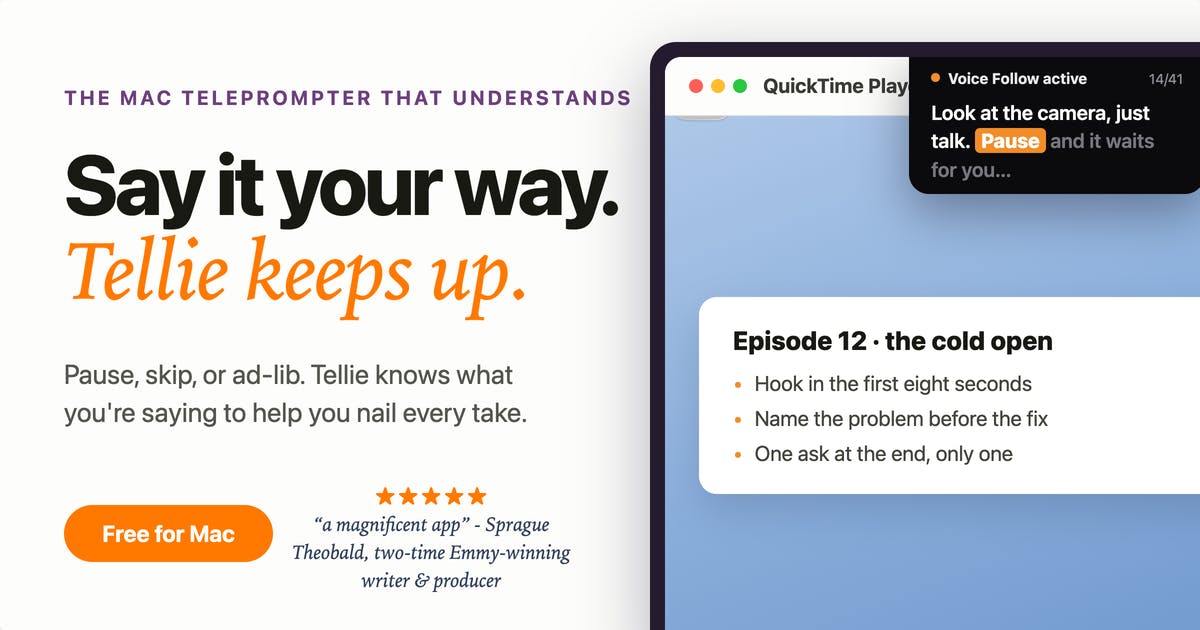
Tellie Prompter 1.5 is a native macOS teleprompter that follows the speaker’s words rather than scrolling at a fixed speed. Its Voice Follow feature uses Apple’s on-device speech-recognition framework, while Stagehand monitors whether the speaker has covered designated points. The product is designed for creators, presenters, salespeople, educators, actors, and other Mac users recording or delivering scripted material (official website).
The product appears thoughtfully designed. It works locally, requires no account, keeps scripts and speech on the device, and can exclude its window from screen recordings. At $29 for a perpetual Pro license covering up to three Macs, it is inexpensive relative to established subscription competitors (pricing and features; privacy policy).
The strongest investment signal is founder quality. Steve Chazin has extensive product, marketing, and operating experience at Apple, Avid, Salesforce, Symantec, Cisco, and Alarm.com. His background in video technology, collaboration products, product marketing, and SaaS distribution creates unusually strong founder-market fit for a small teleprompter product (founder profile; LinkedIn).
The central concern is not product quality but venture scale. Tellie is explicitly a one-person operation, is available only for Apple Silicon Macs, and monetizes through a low-priced, one-time purchase. Revenue, sales, active users, conversion, retention, and download totals are not publicly disclosed. The product’s Product Hunt launch generated early attention—142 points, 20 comments, and a #6 daily rank—but this does not establish product-market fit (Product Hunt launch).
Tellie could become a profitable independent software product. However, the current addressable segment, pricing model, platform limitation, low switching costs, and absence of recurring or enterprise revenue make a venture-scale outcome unlikely without substantial strategic expansion. The decision is Pass for a conventional venture fund, with reconsideration possible if Tellie evolves into a cross-platform workflow product for teams and professional content operations.
Product Overview
Traditional teleprompters require speakers to follow a predetermined scrolling speed. Tellie reverses that interaction: it matches spoken words to the script, pauses when the speaker pauses, and attempts to recover when the speaker skips or improvises. Stagehand lets users mark required talking points, checks them off even when paraphrased, warns about time, and produces a post-take debrief (official product page).
The product also offers per-take statistics, pace reporting, script playlists, global shortcuts, resizable positioning, and a window that macOS excludes from screen capture. It supports more than 40 languages through Apple’s speech framework. Supported inputs include text, Markdown, RTF, Word, PDF, and Pages documents (privacy documentation).
Tellie runs on Apple Silicon Macs with macOS 14 or later; Intel Macs, Windows, web, Android, and iOS are not currently supported (terms). A free version provides basic teleprompting, while a ten-day trial unlocks Pro. Pro costs $29 once, supports three Macs, includes Tellie 1.x updates, and has a 14-day refund policy (official pricing).
The primary benefit is more natural delivery without uploading confidential scripts or audio. It replaces fixed-speed teleprompters, printed notes, presenter view, and manually scrolling documents. Product quality appears strong, but independent validation remains limited to one Product Hunt review and company-selected testimonials.
Founder and Team Assessment
Steve Chazin is the verified founder and sole operator. Tellie’s privacy policy explicitly describes the business as a “one-person operation” under the Skytech.io umbrella (privacy policy). No employees, open positions, or external development team were identified.
Chazin’s public career history includes senior roles at Apple, Avid, Salesforce, Symantec, Cisco, and Alarm.com. Particularly relevant experience includes video-product marketing at Avid, collaboration products at Salesforce and Cisco, and general-management responsibilities for large SaaS operations. He holds an electrical-engineering master’s degree from Princeton and is named on multiple technology patents (founder biography; LinkedIn).
This provides strong product judgment and commercial experience. However, Tellie’s technical development is described by Skytech.io as one of several small applications Chazin built with AI assistance. The same site lists other projects and a newsletter, raising uncertainty about Tellie’s full-time priority and the founder’s intention to build a venture-backed organization rather than a portfolio of independent products (Skytech.io).
Key-person risk is therefore very high: product development, marketing, customer support, and strategy appear dependent on one individual.
Founder Assessment: Strong product and go-to-market experience, but team depth, full-time focus, and venture-building intent remain unverified.
Market Opportunity
The narrow initial market is Apple Silicon Mac users who regularly deliver scripted video, virtual presentations, sales demonstrations, lectures, auditions, sermons, or online courses. These users have a recognizable problem, but only a subset will pay for a specialized desktop teleprompter.
No reliable public count exists for Tellie’s realistically serviceable users. An illustrative—not verified—bottom-up scenario is:
- 250,000–1 million potential paying Mac users globally
- $29 gross revenue per one-time license
- Implied cumulative revenue opportunity of approximately $7.3–29 million before refunds, taxes, merchant fees, and repeat purchases
That range is an analyst scenario, not a measured market. Even at its high end, it does not support a large recurring software business because customers need purchase only once.
Adjacent expansion could include Windows, mobile and browser products; team script libraries; content approval; remote control; recording; editing; analytics; and enterprise presentation workflows. Competitors demonstrate demand beyond macOS: Teleprompter.com supports iOS, Android, macOS, and web, while its App Store listing claims more than five million downloads and shows 28,000 ratings (App Store). Another established app has 32,000 ratings and offers both subscription and perpetual upgrades (Teleprompter Pro).
Thus, a meaningful small-software market is evident, but Tellie’s present product and monetization capture only a narrow portion. Venture-scale revenue would require expansion from a Mac utility into a broader creator or enterprise communication platform.
Traction and Growth Signals
The August 26 launch received 142 Product Hunt points, 20 comments, a #6 daily rank, and a #31 weekly rank. The product had 189 Product Hunt followers and one review, producing a 4.0/5 rating when observed (launch page; reviews).
Tellie first launched on July 7, 2026, and version 1.5 followed approximately seven weeks later, indicating active early development. Nevertheless, Product Hunt activity is launch attention, not commercial traction.
No reliable public evidence was found for:
- Total or active downloads
- Paid licenses or revenue
- Free-to-paid conversion
- Repeat usage or cohort retention
- Refund rates
- Website traffic or organic search demand
- Business customers or customer concentration
- Revenue growth
Tellie is distributed directly rather than through the Mac App Store, so independent store rankings and verified purchase reviews are unavailable. Website testimonials are useful qualitative feedback but are selected by the company.
Traction Assessment: Positive early launch interest, but commercially unverified.
Competitive Position
Direct competitors include Teleprompter.com, Teleprompter Pro, PromptSmart, BIGVU, and numerous free mobile and browser teleprompters. Indirect alternatives include PowerPoint or Keynote presenter notes, Zoom notes, printed scripts, second monitors, and memorized talking points.
Tellie’s strongest differentiation is the combination of word-level voice following, must-cover tracking, screen-capture invisibility, local processing, no account, and a low perpetual price. Privacy is credible at the architectural level: the company states that scripts and speech remain local, while only update and license-verification requests contact its servers (privacy policy).
However, the underlying speech recognition relies on Apple’s framework rather than a proprietary model. Competitors already advertise voice-following, and larger products offer recording, editing, cloud synchronization, remote controls, mobile access, subtitles, and team workspaces (Teleprompter.com App Store listing; Teleprompter Pro listing).
If a large competitor launched equivalent word tracking and on-device privacy within six months, customers might retain Tellie for its simplicity, price, and Mac-native experience—but there are no meaningful switching costs, network effects, proprietary datasets, or locked-in workflows.
Defensibility Assessment: Low
Business Model and Economics
Tellie uses a freemium model with a $29 perpetual Pro license. Lemon Squeezy acts as merchant of record, handling payments and applicable taxes (terms). Local inference should produce favorable marginal software-delivery costs because Tellie does not pay recurring cloud-transcription expenses.
Gross-margin potential is therefore high, but verified gross margin is unavailable. Variable costs include payment processing, merchant-of-record fees, refunds, customer support, hosting, signing and update infrastructure. Founder time may be the largest practical cost.
The more serious issue is lifetime value. A one-time $29 license generates no automatic renewal, and free updates for the 1.x product create continuing support obligations. Expansion revenue would depend on major-version upgrades, paid add-ons, team licenses, or new products. Customer-acquisition costs are not disclosed and could quickly make the economics unattractive if paid marketing is required.
Unicorn Path
A 4× revenue multiple is appropriate for this calculation because Tellie currently has low-priced, non-recurring consumer-software revenue rather than contracted SaaS ARR. A $1 billion valuation would therefore require approximately:
$1 billion ÷ 4 = $250 million annual revenue
At $29 per license, that equals approximately 8.6 million new full-price purchases every year, before refunds, merchant fees, discounts, or taxes. At an assumed net receipt of $24–27 per sale, the requirement rises to approximately 9–10.4 million annual purchases. These are analytical assumptions, not company forecasts.
That scale is implausible for a Mac-only specialized utility. A credible path would require cross-platform distribution, recurring team plans, materially higher enterprise ACVs, collaboration and approval workflows, integration with video-production platforms, and a substantially larger organization. Even then, Tellie would be competing with established creator-video suites rather than only teleprompter applications.
Unicorn Path: Improbable
Valuation Assessment
No funding round, institutional investor, SAFE cap, valuation, acquisition offer, or active financing process was verified. Revenue and operating expenses are also undisclosed.
Valuation Attractiveness: Not Assessable
Assessment would require current revenue, license sales, conversion and refund rates, growth, gross margin, founder compensation, burn, financing terms, capitalization, and the proposed post-money valuation. Product quality or Product Hunt performance cannot justify a valuation range.
Key Risks
- Insufficient commercial evidence: No verified revenue, paid-user, conversion, or retention data.
- Structurally limited monetization: A $29 perpetual license caps customer lifetime value.
- Narrow platform support: Apple Silicon and macOS 14 requirements exclude Windows, mobile, Intel Mac, and browser users.
- Low defensibility: Core capabilities can be replicated using platform speech-recognition APIs.
- One-person dependency: Development, support, and distribution rely on Steve Chazin.
- Unclear founder commitment: Tellie is one of several Skytech.io products and content initiatives.
- Strong bundled competition: Larger teleprompter and video platforms offer broader recording and workflow features.
- Limited usage frequency: Some customers may use teleprompters only occasionally, weakening referrals and upgrade demand.
- Platform dependency: Product functionality depends on Apple APIs and screen-capture behavior.
- No enterprise motion: Team administration, centralized billing, compliance, and collaboration are not evident.
Final Assessment
Venture Potential: 43/100
| Category | Score |
|---|---|
| Market Size and Expansion Potential | 8/20 |
| Traction and Growth Evidence | 4/20 |
| Founder and Team | 12/15 |
| Product Strength | 8/10 |
| Distribution Potential | 5/15 |
| Business Model and Economics | 3/10 |
| Defensibility | 3/10 |
| Total | 43/100 |
The strongest elements are product usability, privacy architecture, and founder experience. The weakest are commercial validation, recurring monetization, platform breadth, and defensibility.
Evidence Confidence: 56/100
Product functionality, pricing, privacy design, founder identity, platform requirements, and the one-person operating structure are verified through official sources. Founder career information is supported by his public biography and LinkedIn profile, although some performance claims remain self-reported.
Product Hunt activity is verified but weak as commercial evidence. Revenue, users, conversions, retention, funding, valuation, burn, and customer acquisition are unavailable. Independent customer evidence consists of only one Product Hunt review.
Final Decision: Pass
Tellie appears to be a good product led by an experienced operator, but the current company resembles a potentially profitable independent-software business more than a venture-scale startup. The low one-time price, Mac-only distribution, absence of verified traction, and weak defensibility make the expected venture return unattractive. The decision reflects investment fit rather than a negative judgment on product quality.
Upgrade Conditions
- Verified annual recurring or repeatable revenue above $1 million.
- At least 10,000 paying customers with disclosed conversion and refund rates.
- Strong six- and twelve-month active-use retention.
- Launch on Windows, mobile, or web with measurable adoption.
- Introduction of recurring team or enterprise plans with meaningful ACV.
- At least ten verifiable business or professional-production references.
- A repeatable acquisition channel independent of Product Hunt and the founder’s audience.
- Hiring of a committed engineering and commercial team.
Downgrade Conditions
- Development activity slows materially after launch.
- Paid conversion remains low despite substantial free usage.
- Competitors duplicate Stagehand and local voice-following.
- Apple API changes impair speech recognition or screen-capture invisibility.
- Support requirements overwhelm the one-person operation.
- Privacy claims prove inaccurate or a material security issue emerges.
- Tellie becomes a secondary project without sustained founder commitment.
Questions for Further Diligence
- How many total downloads, monthly active users, and Pro purchasers does Tellie have?
- What are current monthly revenue, cumulative revenue, and month-over-month growth?
- What percentage of ten-day trials convert to Pro, and what is the refund rate?
- What are 30-, 90-, and 180-day active-use retention rates?
- How often does a typical active user use Tellie, and for which workflows?
- What acquisition channels produce paying customers, and what is CAC by channel?
- What net revenue remains from each $29 sale after taxes, Lemon Squeezy fees, discounts, and refunds?
- Is Steve Chazin working full-time on Tellie, and will additional employees be hired?
- What is the roadmap for Windows, mobile, browser, and team products?
- Which components beyond interface design and workflow logic are proprietary?
- What legal entity owns Tellie’s code and intellectual property?
- Is the company raising capital, and if so, what are the round size, valuation, cap-table, and investor terms?