
Table of Contents
OpenPilot — Investment Review
Product Hunt Launch Date: 2026/10/09
Product: OpenPilot
Product Hunt: https://www.producthunt.com/products/openpilot
Review date: 2026/10/12
Executive Summary
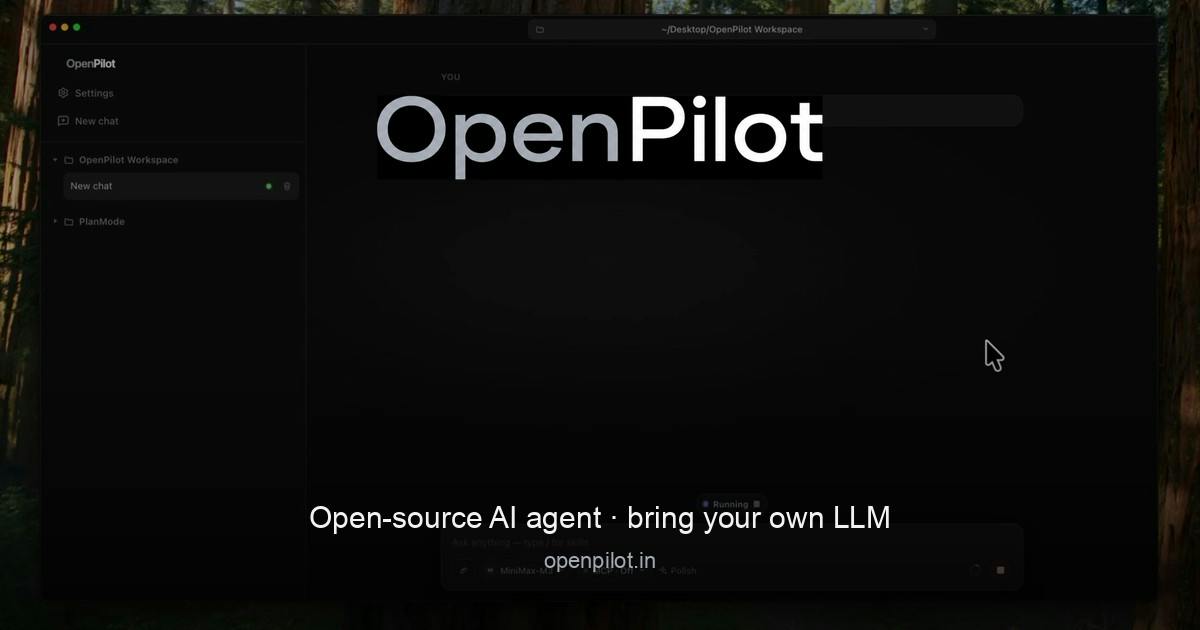
OpenPilot is an open-source desktop agent harness. Users connect an OpenAI-compatible cloud or local model, choose a project folder, and ask it to edit files, run commands, search the web, or use MCP tools. It is free, MIT-licensed, and requires no OpenPilot account. The maker positions it as an agent workspace, not an IDE, targeting developers who want action across a repository without model lock-in.
It combines local execution, model choice, a visible tool trail, and approval gates, but remains very early. The solo maker has not disclosed customers, revenue, retention, funding, or a commercial plan. GitHub shows seven stars and three forks. Windows is available; the official site says macOS is coming soon, while the maker calls it an early unsigned beta. There is no Linux build. Shell and MCP access create security and support obligations. Public evidence does not support underwriting a venture-scale business.
Recommendation: Pass at this stage. The product merits a lightweight follow-up if it demonstrates recurring developer use, a credible paid route, broader platform readiness, and an accountable security posture. This is a stage and evidence decision, not a claim that the product lacks user value.
Investment Metrics
| Metric | Assessment |
|---|---|
| Product Hunt launch date | 2026/10/09, as recorded in the source sheet |
| Category | Open-source desktop developer agent / AI coding agent |
| Stage | Newly launched, early product |
| Product pricing | Free on Product Hunt; no paid tier or pricing schedule disclosed |
| Business model | Not established publicly; user brings and pays for model/API usage |
| Team | Ibrahim, solo developer per maker statement |
| Public adoption signals | 73 Product Hunt followers; 101 points and #10 day rank in the current listing snapshot; GitHub 7 stars and 3 forks |
| Funding / revenue / customers | Not publicly disclosed in reviewed sources |
| Core investment question | Can a free, open-source local agent build durable developer adoption and monetize trust, collaboration, or enterprise operations? |
Product and Customer
The initial user is a developer who wants an agent to work in a local project without adopting a full AI IDE or a single model vendor. The advertised workflow combines filesystem actions, terminal, optional TinyFish search, reusable skills, AGENTS.md memory, MCP, and token tracking. Actions appear as cards; the maker says sensitive operations require approval. The official site supports custom OpenAI-compatible endpoints and local models.
The value proposition is portability and inspectability across models. A local harness may reduce workflow switching, while the visible trail and approval prompts are useful safeguards. They do not prove robust sandboxing, least privilege, safe command handling, or recovery from bad edits; these need verification. Quality also depends on the chosen model. The maker says small local models struggle on long tasks and there is no automatic loop warning, a usability risk for less experienced users.
Team
The Product Hunt maker identifies himself as Ibrahim, a solo developer, and explains that he built the product to get a model-independent, open-source agent workflow he could not find. This suggests founder-market fit, but does not establish capacity to support a security-sensitive cross-platform product or enterprise customers. No other team members, prior outcomes, or financing details appeared in reviewed materials. Key-person risk is high; diligence should cover shipping cadence, support, and security response.
Market and Competition
The category is broad, and local or model-agnostic workflows may appeal to open-source communities and teams with preferred endpoints. Competition is intense: editor-integrated Cursor and Cline, terminal agents Aider and OpenCode, and provider offerings such as Claude Code and Codex. These have larger communities or deeper integrations. OpenPilot’s wedge is a chat-first desktop shell combining user-selected models, local files, approvals, and MCP without its own account.
MIT licensing and BYO-model flexibility lower trial friction but make the code easy to fork. A moat would need to come from trusted security, model compatibility, workflow extensions, or team policy and collaboration. No independent market sizing or customer research was disclosed; category growth is not proof of capture potential.
Traction and Distribution
Product Hunt shows 73 followers, 101 points, and a #10 daily rank—launch signals, not retained usage or willingness to pay. GitHub shows seven stars, three forks, and 19 commits, but not active installations or contributors. No downloads, active users, retention, customer references, or revenue were found.
Likely channels are Product Hunt, GitHub, technical content, and word of mouth. Open source lowers trial friction, but competing agents vie for the same attention. Distribution depends on reliable installation, popular-model compatibility, and repeat-use value. Official materials describe Windows as live and macOS as coming soon; the maker calls macOS an early unsigned beta. This status mismatch needs clarification. Linux is not listed.
Business Model and Venture Potential
No monetization mechanism is disclosed. The free MIT product has no hosted model marketplace or account; users bring their own credentials, keeping inference costs off the maker but leaving ongoing development unfunded. Possible paths include paid team policy/admin, enterprise support, collaboration, managed routing, or extensions. These remain unvalidated hypotheses and must compete with free self-hosting and forks.
A venture-scale outcome would require evolution into a trusted team control plane with adoption, recurring revenue, and security assurances; none is evidenced today. A standalone valuation is unsupported because financials, financing terms, customer metrics, and company-specific comparables are unavailable. Product Hunt rank and GitHub activity are not valuation inputs.
Key Risks
- No demonstrated business: no public pricing, revenue, paid customers, or conversion evidence.
- Weak early traction: launch attention and repository activity are small and do not show retention.
- Security and data handling: shell execution, local file access, API credentials, telemetry defaults, and arbitrary MCP servers require clear threat modeling. The README says anonymous usage data is collected by default and excludes chats, files, paths, and API keys; privacy controls and the full data flow should be independently checked.
- Model reliability: weaker models can fail on long tasks; loop detection and reliable rollback are not established.
- Platform and maintenance risk: solo-founder capacity, unsigned builds, and unclear macOS availability may slow adoption and support.
- Competition and forkability: established tools can copy features, while MIT forks can fragment the community or capture improvements.
- External dependency risk: model APIs, local inference stacks, and optional web-search services can change or fail independently of OpenPilot.
Scorecard
| Dimension | Score | Rationale |
|---|---|---|
| Problem and market | 12/15 | Real, expanding workflow need; category is crowded |
| Product and differentiation | 12/15 | Clear local, model-agnostic workflow and visible tools; differentiation still shallow |
| Team | 7/15 | Founder understands the use case; solo capacity is a major constraint |
| Traction | 3/15 | Launch signals exist, but adoption evidence is very early |
| Business model | 2/15 | No disclosed route to recurring revenue |
| Distribution | 6/10 | Open-source and launch channels are plausible, not yet proven |
| Defensibility | 4/10 | Trust and workflow depth could compound; MIT core is readily forkable |
| Readiness and execution | 3/5 | Product is available on Windows; cross-platform status and safety maturity need work |
| Total | 49/100 | Insufficient evidence for investment today |
Evidence confidence: Low to moderate. Product and feature claims come mainly from the maker’s Product Hunt listing and official materials; there is little independent user or commercial evidence.
Final Decision: Pass
Do not pursue an investment based on the evidence available at launch. Revisit if the team publishes meaningful active-user and retention data, establishes a paid product with customer references, resolves the macOS/platform status, and demonstrates mature safeguards for shell, filesystem, credentials, telemetry, and MCP integrations. A useful next review threshold would be sustained month-over-month usage among developers plus evidence that teams will pay for security, administration, or support.
Due-Diligence Questions
- What are weekly and monthly active users, installation-to-activation conversion, and 30/90-day retention by platform?
- How many users have completed a second and tenth meaningful agent task, and what are the leading reasons for churn?
- Is there a committed pricing strategy? Which buyer, budget, and paid feature have been tested with actual purchases?
- What percentage of users supply cloud API keys versus local models, and what are typical model costs and task success rates?
- What exact data is sent by default telemetry, to which endpoints, for how long, and can organizations disable it centrally?
- How are shell commands, filesystem scope, MCP server permissions, secrets, and prompt injection threats isolated and audited?
- What safeguards cover loops, destructive commands, diffs, rollback, and failed runs?
- What is the release and signing plan for macOS and Linux, and what is the current status of the unsigned macOS build?
- What capacity and contributor or hiring plan supports maintenance, security, and support?
- Which workflows outperform alternatives, and what retention evidence supports that advantage?
- What are download, crash, and support rates across model providers and local inference?
- What would stop an incumbent or fork from copying the core experience?
Sources
- Product Hunt listing and maker disclosures — product description, solo-founder statement, platform caveats, model limitations, telemetry disclosure, launch snapshot.
- Official website — product scope, model-agnostic positioning, supported platform claims.
- Official FAQ — model compatibility, key-storage claims, competitor framing, licensing, platform availability.
- Official changelog and roadmap — current release features and planned platform/integration work.
- GitHub repository and README — code, MIT license, repository activity, local data paths, telemetry description, release artifacts.
Conclusion
OpenPilot addresses a real developer need with an attractive open-source, model-agnostic workflow. It is too early to establish repeat use, monetization, execution capacity, security maturity, or durable differentiation. The appropriate venture decision today is Pass, with a defined path to reconsider when measurable adoption and a credible paid offering exist.