
Table of Contents
screenpipe Investment Report
Category: AI agent memory — local-first continuous screen and audio capture for AI context (open-source developer tools)
Company Stage: Seed-stage, YC S26 batch, ~2 years old, early revenue
Founder or Founders: Louis Beaumont, founder and CEO
Headquarters: San Francisco, CA per company GitHub; one database lists Paris — conflicting records
Funding: ~$3.4M total per databases, latest round listed as Seed; Y Combinator is the only named investor; no primary funding announcement found
Business Model: Source-available desktop app with seat subscriptions ($25–$150 per seat/month) and enterprise licenses
Product Hunt Launch Date: Original Product Hunt presence dates to September 2024; relaunched around its July 23, 2026 Launch HN and August 21, 2026 YC launch
Report Date: August 31, 2026
| Investment Metric | Assessment |
|---|---|
| Venture Potential | 63/100 |
| Unicorn Path | Conditional |
| Valuation Attractiveness | Not Assessable |
| Evidence Confidence | 55/100 |
| Final Decision | DD |
Executive Summary
screenpipe is a local-first, source-available desktop app that continuously captures what a user sees, says, and hears on their computer — using event-driven accessibility-tree capture rather than brute-force video recording — indexes it in a local SQLite database, and exposes that history to any AI agent through a REST API, MCP server, and a plugin system of “Pipes” (scheduled AI agents defined as markdown files). github
The initial customers are developers and AI power users who want agents with persistent context; the expansion motion is a Teams/Enterprise product that maps repeated work across support, sales, finance, and operations teams and turns it into SOPs and automation candidates. github
The product is interesting because it occupies the memory layer for agents — a plausible piece of future AI infrastructure — with an architecture (100% local by default, deterministic per-pipe data permissions, SSO/MDM/SOC 2-ready enterprise controls) specifically designed to answer the category’s fatal objection: surveillance risk. github
The strongest positive signal is verifiable community and engineering traction: 21.3K GitHub stars, 2.2K forks, 165 contributors, 467 releases, and roughly 13,000 commits with activity through August 30, 2026. The founder has publicly claimed revenue growth from $15K to $50K MRR in four weeks in early 2026. github
The most important concern is that all commercial evidence is founder-reported, retention is unknown, and the category faces structural resistance: recording-consent laws, employee-relations friction, and OS vendors bundling the same capability — Microsoft Recall already ships inside Windows. github
Final decision: DD. Verified developer traction plus claimed early revenue justify formal diligence, but every commercial metric and the current financing terms require verification.
Product Overview
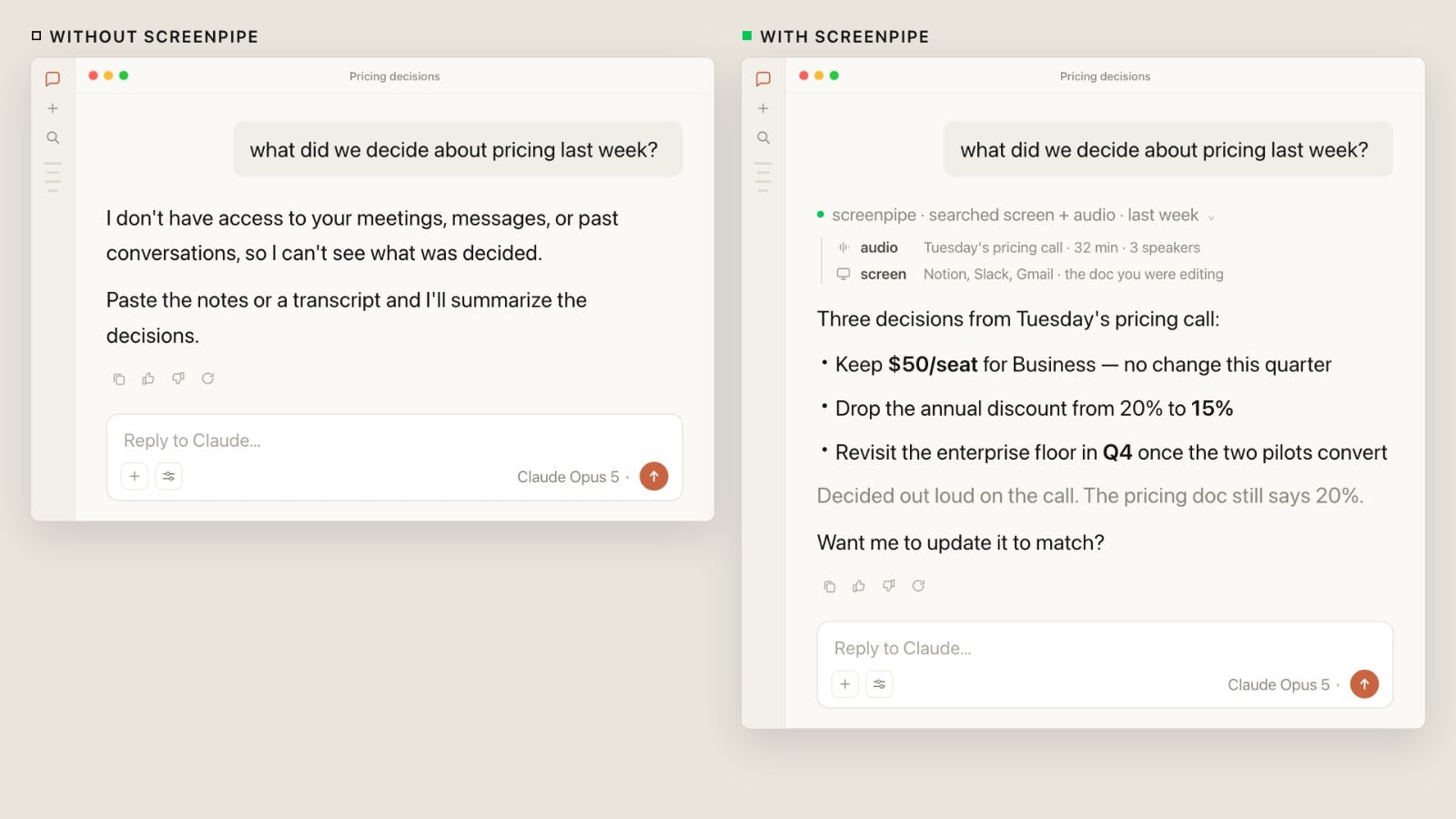
The customer problem: AI agents start every task from partial context. They see the prompt and connected apps, but not the meeting where a decision was made, the tab opened last Tuesday, or the workaround discovered mid-task. The manual alternative is pasting context into prompts or maintaining a second brain by hand. ycombinator
screenpipe listens for meaningful events (app switches, clicks, typing pauses), pairs a screenshot with the OS accessibility tree at that moment, and falls back to OCR only when needed — keeping CPU at 5–10% versus the space-heater profile of naive continuous recording. Audio is transcribed locally (Whisper or Parakeet) with speaker identification. Everything is searchable via natural language, exposed on localhost:3030, and consumable by Claude, Cursor, ChatGPT, or any MCP client. Built-in pipes handle meeting summaries, day recaps, standup updates, and time breakdowns; users can write new ones as markdown. Privacy controls include app/URL exclusions, incognito detection, a local PII-redaction model, and per-pipe YAML permissions enforced at three deterministic layers rather than by prompting. github
Target users: developers, researchers, people with ADHD, remote workers, and teams. Pricing is verified from the official repository: Standard $25/month, Pro $50/seat/month with cloud sync and teams (5+ seats self-serve), Enterprise $150/seat/month with SSO/SAML, MDM, audit logs, and sales-led deployment; lifetime licenses are no longer sold, and the source is available for personal, non-commercial use under a commercial license adopted June 10, 2026. Platforms: macOS, Windows, Linux. github
Founder and Team Assessment
Louis Beaumont is the verified founder and CEO (YC S26, San Francisco). His background is founder-reported but consistent across sources: a personal “second brain” practice since 2020, early RAG experimentation, authorship of Ava (an Obsidian AI plugin with a few thousand users), and a prior startup, Embedbase, a RAG API — screenpipe grew out of his own tooling in 2024, with an organic 2024 Hacker News post shaping the product. A personal leukemia diagnosis at age 13 appears in his published principles, indicating drive but nothing verifiable about commercial experience. news.ycombinator
Technical capability is strongly evidenced: the codebase is largely Rust and MLX, with 165 contributors and 467 releases, and the founder engages substantively on technical criticism. Team size is not disclosed; core-team composition beyond Beaumont is unclear, creating high key-person risk. No prior exits are known. github
Founder Assessment: Strong founder-market fit and exceptional technical execution, but the team around him is undisclosed and commercial capability is only beginning to be tested.
Market Opportunity
The initial segment is narrow: developers and AI power users willing to run always-on capture on their own machines — plausibly 1–5 million people globally today (analyst assumption), growing with agentic AI adoption. At $300/year (Standard), converting 3–5% would yield roughly $9–75M ARR — enough to prove the wedge, not to end the story.
The larger opportunity is the Teams product: workflow discovery and automation-candidate ranking across company machines, sold at $50–$150 per seat. This is adjacent to established enterprise spend on process and task mining, and screenpipe’s bottom-up, local-first approach undercuts heavyweight enterprise deployments. Bottom-up math for venture scale: 50,000 enterprise seats at $1,800/year — roughly one hundred 500-seat deployments — would produce $90M ARR. Geographic expansion is global by default (the app runs locally), though recording-consent law and works-council rules make Europe structurally harder than the US. screenpi
Timing is good: MCP adoption is exploding, and every agent platform needs a memory layer. The open question is whether that layer gets bought from a startup or bundled by OS and model vendors.
Traction and Growth Signals
Verified: 21.3K GitHub stars, 2.2K forks, 165 contributors, 467 releases, and near-daily commits through August 30, 2026 — exceptional open-source velocity. YC accepted the company into S26 and gave it a Launch HN on July 23, 2026, generating substantive community discussion. github
Company-reported but unverified: MRR grew from $15K to $50K in four weeks (early 2026), with a claimed $19K week and a public target of $100K MRR “next month”. No updated figure has been published since March 2026, and no paying-customer count, conversion rate, or retention data exists publicly. linkedin
Product Hunt presence is modest — a 5.0 rating from just one review and 122 followers — and is not a meaningful signal either way. The most important missing metrics are paying-customer count, cohort retention, free-to-paid conversion, and enterprise pipeline. producthunt
Traction Assessment: Outstanding verifiable developer traction with promising but unverified early revenue.
Competitive Position
Direct competitors: Rewind.ai (pivoted to Limitless, meetings-focused), Microsoft Recall (bundled with Windows), Granola and Otter.ai (meeting notes) — screenpipe itself names these as the alternatives it displaces. Adjacent: agent-memory platforms (Letta, Mem0, Zep) and first-party memory from OpenAI and Anthropic, which can already record manual workflows as skills. Free/open-source: a Linux-first clone (Daydream) emerged from screenpipe’s own Launch HN thread. github
Differentiation is real: event-driven accessibility capture (low CPU), cross-platform support, a full REST API and SDK, the Pipes plugin system, deterministic three-layer data permissions, and vendor-neutrality across every model and OS. The local-first architecture is both a privacy answer and a cost advantage. Switching costs are moderate (local data history accumulates, but export exists); network effects are weak today; the community itself is a distribution asset. github
The six-month question — “if Microsoft, OpenAI, or Anthropic shipped equivalent always-on agent memory, why would users stay?” — has a partial answer: auditable source, local control, and cross-platform vendor neutrality matter to privacy-sensitive users and enterprises, but consumer users may accept a bundled free version. That cap on defensibility is the category’s central strategic risk.
Defensibility Assessment: Low
Business Model and Economics
Revenue model: seat subscriptions across three verified tiers ($25/$50/$150 per seat/month) plus enterprise licensing; the source is free for personal, non-commercial use, and commercial use of the source requires a license. github
The local-first architecture is structurally favorable: capture, transcription, and search run on the user’s device, so revenue growth does not carry proportional inference or storage costs — the classic AI-infrastructure margin trap is largely avoided. Cloud transcription, sync, and AI are optional paid features. Payment processing is standard; there is no app-store dependency (direct distribution). Unverified items: gross margin, conversion, churn, support load, and the enterprise sales cycle. A consumer-app risk applies: if usage is episodic curiosity rather than daily habit, churn will be high — retention data would resolve this and does not exist publicly. The June 2026 license change from MIT to source-available protects commercial monetization but visibly alienated parts of the FOSS community, and commenters warned of an AI-laundered open clone emerging. github
Unicorn Path
Assume a 10x ARR multiple, appropriate for high-growth, high-gross-margin AI infrastructure SaaS with an open-source wedge. Required revenue is roughly $100M ARR. At verified pricing, that implies about 55,000 enterprise seats ($1,800/seat/year) — on the order of one hundred mid-size deployments — or roughly 167,000 Pro-tier seats, versus a claimed ~$50K MRR (~$600K ARR run rate) in early 2026, which is founder-reported. Gross margin should hold above 80% given the local-first architecture, so the binding constraint is seats, not economics. linkedin
Strategically, reaching that scale requires: converting open-source momentum into repeatable team/enterprise sales; surviving OS-vendor and model-vendor bundling; navigating recording-consent and employee-monitoring regulation; and likely raising substantial capital. None of that is demonstrated today, but none of it requires abandoning the current model — it is execution risk, not model risk.
Unicorn Path: Conditional
Valuation Assessment
Known funding: ~$3.4M total per a secondary database, with Y Combinator the only listed investor and the latest round listed as Seed. No round size, post-money valuation, SAFE cap, or current fundraising status has been disclosed in any primary source. There is no verified revenue with which to apply comparable multiples. billiondollarpitchdecks
Valuation Attractiveness: Not Assessable. A responsible assessment would require current ARR, growth since March 2026, retention, gross margin, burn, runway, round size, and post-money terms. Note that at the claimed ~$600K ARR run rate, even a $30–50M seed valuation would price in most of the remaining execution — terms matter enormously here.
Key Risks
- Privacy and regulatory exposure — recording-consent laws, employee-monitoring rules, and works-council objections; the Launch HN thread itself is full of trust objections, and Microsoft Recall’s backlash shows category-level resistance news.ycombinator
- Platform commoditization — Microsoft bundles Recall; OpenAI, Anthropic, and Google are building first-party memory
- Unverified traction — MRR claims are founder-reported with no retention or conversion data
- Enterprise adoption friction — the buyer (company) and the monitored party (employee) have opposed interests; the product tries to reconcile them, untested at scale
- Key-person dependency — one public founder, undisclosed team
- License-change fallout — MIT-to-source-available risks community forks and AI-laundered clones news.ycombinator
- Emerging free competitors — Daydream and other open-source clones news.ycombinator
- Thin capitalization — ~$3.4M raised against a category where platform giants could spend freely
Final Assessment
Venture Potential: 63/100
| Category | Score |
|---|---|
| Market Size and Expansion Potential | 14/20 |
| Traction and Growth Evidence | 11/20 |
| Founder and Team | 11/15 |
| Product Strength | 7/10 |
| Distribution Potential | 10/15 |
| Business Model and Economics | 6/10 |
| Defensibility | 4/10 |
| Total | 63/100 |
The strongest elements are open-source distribution, technical differentiation, and founder-market fit. The weakest are defensibility against platform bundling and the absence of verified commercial data.
Evidence Confidence: 55/100
Verified: product capabilities, pricing, license, GitHub statistics, founder identity, YC affiliation, and launch timeline. Founder-reported: MRR growth, the origin story, and enterprise interest. Third-party and conflicting: funding total (~$3.4M) and headquarters (San Francisco vs Paris). Unavailable: customer counts, retention, conversion, team size, burn, valuation, and current fundraising terms. github
Final Decision: DD
screenpipe meets the DD bar: a potentially large market (agent memory), meaningful differentiation, the strongest form of pre-commercial traction available (verifiable community adoption), a demonstrably capable founder, and a plausible venture path. It stops short of anything higher because every financial claim is founder-reported, retention is unknown, defensibility against OS and model vendors is unresolved, and no valuation or terms exist to evaluate. Diligence should prioritize financial verification, cohort retention, and the enterprise pipeline.
Upgrade Conditions
- Verified ARR above $2M with sustained month-over-month growth
- Demonstrated 6-month retention above 60% for paying users
- Three or more signed enterprise deployments at 100+ seats
- Independent security audit of the permission-enforcement layers
- A priced round with disclosed terms at a sensible multiple of verified ARR
Downgrade Conditions
- Revenue stalls below the claimed $100K MRR or churns down after novelty fades
- Microsoft Recall or first-party model memory reaches feature parity on Windows/macOS at scale
- A credible fully-open fork captures the community
- Any material privacy incident or regulatory action involving captured data
- Founder departs or the undisclosed team proves too thin for enterprise sales
Questions for Further Diligence
- What is current MRR/ARR, and did the publicly targeted $100K MRR materialize after March 2026?
- How many paying customers, and what is the mix across the $25, $50, and $150 tiers?
- What share of desktop-app users convert to paid, and from which acquisition channels?
- What are 30/90/180-day retention and churn by cohort?
- How many enterprise deployments are live, at what seat counts, and what is the sales-cycle length?
- What is gross margin, and what does cloud sync/cloud AI cost per Pro seat?
- What was the revenue impact of the June 2026 MIT-to-source-available license change?
- Who is on the team today, full-time versus contributor, and what is the hiring plan?
- What are the cap table, YC terms, and any community-round terms, and is a round currently open at what valuation?
- How have legal reviews gone in two-party-consent US states and EU works-council contexts?
- What is the strategic answer if OpenAI or Anthropic ships first-party always-on memory with OS-level integration?
- Has the three-layer permission enforcement been independently audited, and by whom?
Sources
- Product Hunt — screenpipe
- screenpipe official website and Teams/Enterprise page
- GitHub — mediar-ai/screenpipe repository
- Y Combinator — screenpipe launch page
- Hacker News — Launch HN: Screenpipe (YC S26)
- Louis Beaumont — founder LinkedIn profile and MRR growth post (founder-reported)
- screenpipe — founder principles page
- Billion Dollar Pitch Decks — screenpipe funding profile (secondary, unverified)