
Table of Contents
Video Agent by Fotor Investment Report
Category: AI video creation and motion-graphics software
Company Stage: Established private company; post-Series B
Founder or Founders: Tony Duan; public founder information is limited
Headquarters: Chengdu, Sichuan, China
Funding: At least $10.6 million reported: $3 million Series A and $7.6 million Series B
Business Model: Freemium subscriptions plus usage-based AI credits
Product Hunt Launch Date: August 31, 2026
Report Date: September 3, 2026
| Investment Metric | Assessment |
|---|---|
| Venture Potential | 70/100 |
| Unicorn Path | Conditional |
| Valuation Attractiveness | Not Assessable |
| Evidence Confidence | 58/100 |
| Final Decision | DD |
Executive Summary
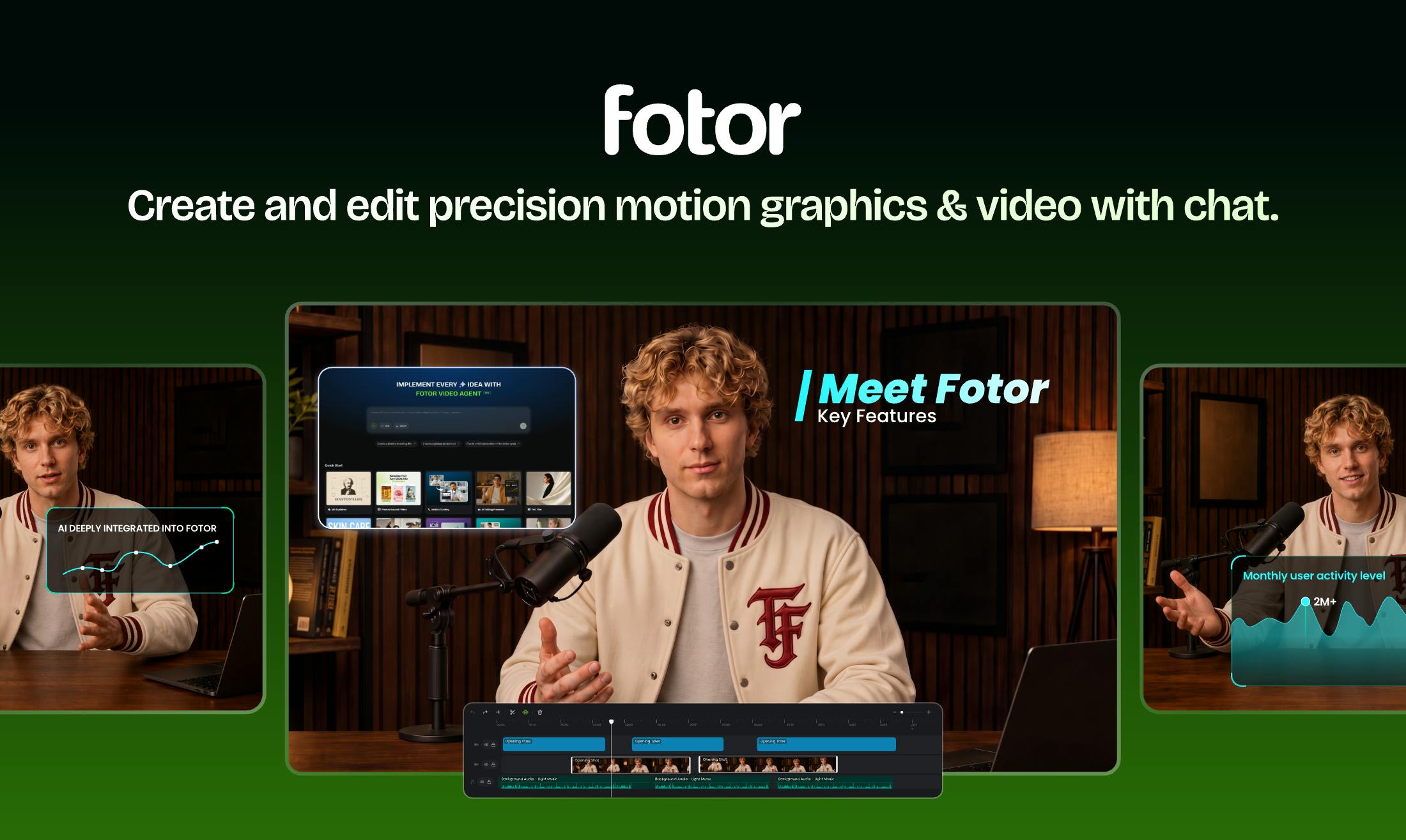
Video Agent is Fotor’s conversational video-production product. It converts briefs, scripts, PDFs, and media assets into assembled videos with scenes, effects, kinetic typography, and animated charts. Its principal differentiation is an editable multi-track timeline: users can change text, statistics, logos, timing, and other elements without regenerating the entire video (Product Hunt; official product page).
The target customers are founders, marketers, creators, e-commerce sellers, and small businesses that need promotional videos or explainers but lack professional editing resources. Fotor claims internally that a workflow previously taking three to five days can be completed in about 40 minutes; this is a company-reported test, not independently validated customer evidence (Product Hunt).
The strongest investment signal is not the Product Hunt launch but Fotor’s pre-existing distribution. The company reports 800 million users across more than 200 countries, while its US iOS application has 42,000 ratings and a 4.7/5 score (Fotor About; Apple App Store). An AWS case study reported 600 million users as of July 2024, support for 300 requests per second, and a tenfold increase in daily users after generative-AI adoption, although no baseline or revenue figures were disclosed (AWS case study).
The primary concern is that Video Agent enters a highly commoditized market. Major creative platforms already offer text-to-video, avatars, scripts, templates, and editing. Fotor also depends partly on third-party models including Veo, Kling, Seedance, Hailuo, FLUX, and PixVerse, weakening model-level defensibility and exposing margins to external inference costs (Fotor Privacy Policy).
The decision is DD, based on credible company-level scale and a potentially differentiated editing workflow. It is not an Invest decision because Video Agent-specific revenue, retention, margins, conversion, financing terms, and valuation are unavailable.
Product Overview
Video Agent addresses the fragmented workflow of scripting, generating footage, creating motion graphics, and editing scenes in separate applications. Its agent plans the video and assembles scenes while preserving editable layers rather than delivering only a locked rendered file.
Core workflows include product-launch videos, explainers, talking presenters, product advertisements, UGC-style ads, long-video-to-short conversion, and motion graphics (official product page). The strongest customer benefit is rapid iteration: a marketer can correct a number or replace a brand asset without regenerating every scene.
Fotor operates across web, iOS, Android, desktop, and cloud storage. The iOS application lists annual Pro subscriptions at $47.99, monthly subscriptions at $8.99, and weekly subscriptions at $6.99, although pricing may differ by platform and geography (Apple App Store). Fotor’s web pricing page offers Basic, Pro, and Pro+ plans, with AI use governed by credits and task limits (pricing page). Pro and Pro+ include 100 and 300 monthly credits respectively, according to Fotor’s support documentation (Fotor Help Center).
Product-quality assessment: Strong workflow concept and broad functionality, but independent evidence regarding generation reliability, export quality, and professional repeat usage remains limited.
Founder and Team Assessment
Tony Duan is identified by third-party company databases as Fotor’s founder and CEO (Crunchbase). Everimaging was founded in 2009, and Fotor launched as its consumer brand in 2012 (LinkedIn company profile). The company’s longevity, multi-platform deployment, and high-concurrency infrastructure indicate substantial technical execution capability.
Public evidence concerning Duan’s detailed operating history, ownership, current role, and full-time commitment is thin. No reliable public evidence of a previous exit was found. LinkedIn classifies Everimaging as a 51–200-person company but shows only 20 associated profiles, making current headcount uncertain (LinkedIn).
Founder Assessment: Demonstrated long-term product and infrastructure execution, but current leadership structure, commercial capability, ownership, and key-person risk require verification.
Market Opportunity
The initial segment is small businesses and independent marketers producing recurring social, product, and explainer videos. The US alone has approximately 36.2 million small businesses (US Small Business Administration).
As an analyst scenario—not a verified market figure—if 5%–10% of those businesses adopted AI creative software at $100–$300 annually, the US opportunity would be approximately $181 million to $1.09 billion in annual subscription spending. This excludes global businesses, agencies, and individual creators but overstates Fotor’s obtainable market because many businesses will use bundled or free alternatives.
Expansion opportunities include team workspaces, brand governance, campaign variation, e-commerce integrations, APIs, localization, and enterprise video automation. The realistic category can support venture-scale revenue, but Fotor must capture workflow ownership rather than remain one generator among many.
Traction and Growth Signals
Video Agent reportedly ranked #1 on Product Hunt on August 31, 2026, with 197 upvotes (secondary launch tracker). This demonstrates launch interest, not product-market fit.
More meaningful company-level signals include:
- Company-reported 800 million users and more than three billion photos edited (Fotor About).
- 42,000 US iOS ratings and a 4.7/5 score (Apple App Store).
- A maintained iOS product, with version 11.2.11 listed in August 2026 (Apple App Store).
- AWS-reported support for 300 requests per second and more than 50% faster inference after infrastructure changes (AWS).
- Company-reported tenfold daily-user growth and “substantial” revenue growth following generative-AI integration, without disclosed periods, baselines, or amounts (AWS).
These indicators largely relate to Fotor’s broader photo-editing platform, not Video Agent. Video Agent-specific active users, paid conversion, revenue, retention, and repeat creation rates are not publicly disclosed.
Traction Assessment: Strong inherited distribution and credible platform activity, but Video Agent’s commercial traction is unverified.
Competitive Position
Direct and adjacent competitors include:
- Runway, offering AI video plans from $12 per month annually, with explicit generation-credit economics and enterprise plans (Runway pricing).
- Canva, offering prompt-to-video, synchronized audio, talking avatars, templates, and integrated editing (Canva AI Video).
- Adobe Firefly, offering generative image, audio, and video plans within a broader creative suite (Adobe Firefly plans).
- CapCut, offering free AI ad generation with scripts, avatars, templates, transitions, and exports (CapCut AI Ads).
Fotor’s best differentiation is editable, parametric motion graphics inside an agent-generated project. Its installed user base and cross-platform suite provide lower-cost distribution than a new standalone startup.
However, switching costs appear low, and Fotor’s privacy policy confirms substantial reliance on external model providers. Proprietary editing workflows, customer-history personalization, templates, and custom models may provide some differentiation, but no strong network effect is evident.
If a major creative platform launched the same editable-agent workflow within six months, customers would stay primarily because of existing Fotor projects, familiarity, pricing, or superior execution—not because of a demonstrated structural moat.
Defensibility Assessment: Low to Medium
Business Model and Economics
Revenue appears to come from Pro and Pro+ subscriptions, AI credits, and in-app purchases. Enterprise revenue is possible but not publicly demonstrated. The approximate consumer ACV is $48–$108 based on annual and monthly iOS pricing; web and enterprise ACVs are not verified.
Gross-margin potential is lower than traditional editing SaaS because video generation consumes meaningful GPU and third-party-model capacity. Fotor’s use of asynchronous inference and custom models may reduce costs, but cost per completed video, regeneration rate, and gross margin are unknown (AWS).
Mobile revenue may also incur app-store commissions. The central diligence question is whether credit revenue rises faster than video inference, storage, moderation, support, and payment costs. There is insufficient public evidence to answer it.
Unicorn Path
A 6× revenue multiple is assumed. This is above the March 2026 public-SaaS median of 3.4× but allows a premium for strong growth and AI-enabled consumer scale; simple horizontal tools without proprietary advantages may deserve less (Aventis SaaS multiples).
Required annual revenue = $1 billion ÷ 6 = approximately $167 million.
At approximately $48 annual subscription revenue, reaching $167 million would require roughly 3.5 million full-price annual subscribers before app-store fees, taxes, refunds, discounts, and AI costs. At an illustrative $40 of net annual revenue per subscriber after channel deductions, the requirement rises to approximately 4.2 million subscribers.
That is mathematically possible against Fotor’s claimed user base but commercially unverified. It would require strong paid conversion, durable renewal, disciplined inference economics, and expansion into higher-ACV team or enterprise products.
Unicorn Path: Conditional
Valuation Assessment
Fotor reportedly raised $3 million from Lenovo in 2012 and $7.6 million from GF Securities in 2017 (Global Corporate Venturing). No reliable current valuation, secondary transaction, fundraising process, or recent round terms were found.
Valuation Attractiveness: Not Assessable
Assessment requires current ARR, growth, gross margin, retention, burn, cash balance, cap table, liquidation preferences, round size, and proposed pre- and post-money valuation. Product quality and Product Hunt ranking do not support a responsible valuation range.
Key Risks
- Video Agent-specific revenue and retention are undisclosed.
- Rapid replication by larger creative suites.
- Low switching costs and limited network effects.
- Dependence on third-party video models and changing inference prices.
- Consumer subscription churn and uncertain video-creation frequency.
- Licensing, likeness, copyright, and commercial-output risk.
- User content is transmitted to selected third-party model providers (privacy policy).
- Unverified team size, ownership, burn, and founder commitment.
- Potential customer-service or billing friction; public reviews should be examined during diligence.
- Product Hunt attention may not convert into sustained usage.
Final Assessment
Venture Potential: 70/100
| Category | Score |
|---|---|
| Market Size and Expansion Potential | 17/20 |
| Traction and Growth Evidence | 14/20 |
| Founder and Team | 10/15 |
| Product Strength | 8/10 |
| Distribution Potential | 13/15 |
| Business Model and Economics | 5/10 |
| Defensibility | 3/10 |
| Total | 70/100 |
The strongest elements are installed distribution, product breadth, and technical operating history. The weakest are defensibility, Video Agent-specific commercial validation, and unknown unit economics.
Evidence Confidence: 58/100
Product functionality, pricing structure, legal entity, infrastructure, app ratings, and historical financing are reasonably documented. User totals, satisfaction improvement, and growth figures are company-reported. Revenue, retention, conversion, gross margin, burn, current team size, cap table, and valuation remain unavailable.
Final Decision: DD
Fotor merits formal diligence because it combines an established global product with a potentially valuable editable-agent workflow. The recommendation remains below Invest because commercial metrics and financing terms are missing, and the market is vulnerable to bundling and feature commoditization.
Upgrade Conditions
- Verify at least $1 million in Video Agent ARR or material incremental platform revenue.
- Demonstrate strong 90- and 180-day paid retention.
- Establish repeatable acquisition beyond the existing Fotor user base.
- Maintain gross margin above 65% after video inference costs.
- Secure recurring team or enterprise contracts.
- Demonstrate a proprietary workflow, model, or data advantage.
Downgrade Conditions
- Weak repeat creation or paid conversion.
- Video-generation costs rising faster than revenue.
- Rapid feature parity from bundled competitors.
- Material billing, privacy, copyright, or security issues.
- Declining product release activity or founder disengagement.
- Financing terms implying an unsupported valuation.
Questions for Further Diligence
- What are current Video Agent MRR, paying users, and monthly growth?
- How much revenue is incremental rather than migrated from existing Fotor subscriptions?
- What are 30-, 90-, and 180-day creator and subscriber retention?
- How many videos does a retained user generate and export monthly?
- What are free-to-paid conversion and annual renewal rates?
- What is gross margin after model, GPU, storage, moderation, and app-store costs?
- What is the inference cost per completed exported video?
- Which acquisition channels generate customers outside Fotor’s existing base, and at what CAC?
- What proprietary models, workflow data, or editing technology cannot be readily replicated?
- What are current burn, cash balance, runway, headcount, and founder commitment?
- What is the fully diluted cap table and the status of earlier investor preferences?
- What valuation, round size, security, and liquidation terms are currently proposed?