Table of Contents
Doop Investment Report
Category: Design tools / AI agents — open-source multiplayer design canvas for humans and AI agents (MCP-native)
Company Stage: Pre-revenue, free open beta (public since August 22, 2026)
Founder or Founders: Kevin Goedecke (solo founder; also founder/CEO of SlideSpeak, previously Magicul)
Headquarters: Not publicly disclosed; founder based in the US (San Francisco Bay Area per LinkedIn, Austin per company blog — conflicting)
Funding: Not publicly disclosed; founder states all his businesses are self-funded
Business Model: None active — free while in beta; paid plans not yet announced
Product Hunt Launch Date: September 2, 2026
Report Date: September 5, 2026
| Investment Metric | Assessment |
|---|---|
| Venture Potential | 49/100 |
| Unicorn Path | Improbable |
| Valuation Attractiveness | Not Assessable |
| Evidence Confidence | 48/100 |
| Final Decision | Watch |
Executive Summary
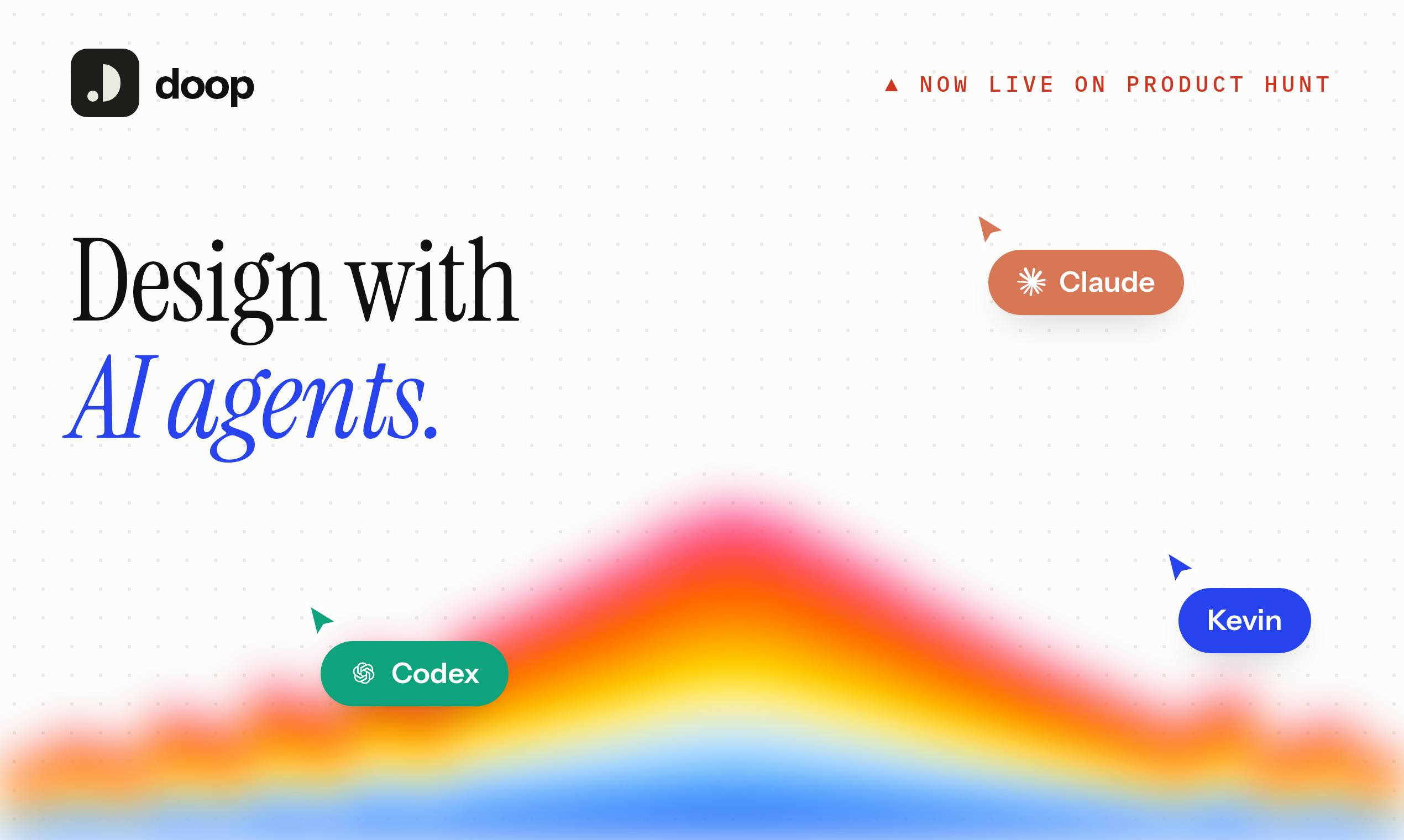
Doop is an open-source, multiplayer design canvas where AI agents — Claude Code, Codex, or any MCP-compatible client — design alongside humans in real time. Agents stream HTML frames onto the canvas live, show cursors and presence, self-review their work via headless screenshots, pick up human comments as tasks, and share a persistent “design memory” (an editable rules file plus a knowledge graph) of decisions and taste across every agent that joins. producthunt
It serves developers and technical designers who already work with coding agents and want design collaboration to happen in the same medium as code. The positioning is explicit: an open-source alternative to Google’s Paper.design and Anthropic’s Claude design artifacts. github
The strongest positive signal is authentic early adoption: the repository reached roughly 587 stars and 74 forks within two weeks of its open-source release, with 8 contributors and daily commits, alongside a #14 Product Hunt daily ranking and substantive community discussion. The founder is a credible serial bootstrapper: Kevin Goedecke built Magicul (design file conversion) and SlideSpeak (AI presentations), both self-funded. github
The most important concern is that there is no business: Doop is free, open-source under AGPL-3.0, self-hostable in one Docker command, and deliberately takes no margin on AI usage — “no platform tokens, no markup”. It also competes head-on with Google, Figma, and Anthropic, all of whom are shipping agentic design features natively. producthunt
The product is genuinely novel and well-executed, but nothing about the current model suggests venture economics. Decision: Watch — the open-source traction and category timing justify observation, not capital.
Product Overview
The problem: coding agents can produce designs, but design work happens in files and chat windows with no shared context — agents forget decisions, can’t see each other’s work, and humans can’t watch or steer the work as it happens.
Doop’s answer is a canvas where agents are first-class collaborators. Humans edit frames in the browser; agents edit through a built-in MCP server, streaming HTML into sandboxed frames at a readable pace. Key mechanics: live cursors and task narration per agent; comments that become claimable work items; self-review through headless browser screenshots; URL-importable web pages that become editable snapshots; a reference-image system that distills a style brief from pages you like; and a six-role “crew” (generalist, UX, copy, brand, accessibility, polish) that routes a card through sequential passes. github
Target users are developers and design-technical teams already paying for Claude, Codex, or similar agent subscriptions. Pricing: free during beta, with terms of service (updated August 19, 2026) promising reasonable notice before paid plans arrive or the free tier is reduced; a third-party review reports no announced pricing at all, and the site hints at a future low-price framing (“$0 / $6”) in a product demo, which is not a published plan. Self-hosting is free under AGPL-3.0. doop
It replaces the workflow of prompting an agent in a terminal, exporting HTML, and reviewing it manually — and, ambitiously, the workflow of design tools like Paper.design and Figma Make. doop
Founder and Team Assessment
Founder identity is verified: Kevin Goedecke, a Stuttgart-educated engineer with 10+ years of SaaS experience, founder/CEO of SlideSpeak (September 2023–present), previously founder of Magicul, a design-file conversion engine. His own site states that all his businesses are self-funded and that he angel-invests on the side; Crunchbase shows no meaningful external funding for SlideSpeak. kevingoedecke
Assessment points:
- Strong technical execution: Doop’s two-week-old repository shows 92 commits, 7 releases, OIDC/SSO support, a desktop app, CI discipline, and a security policy — unusually mature engineering for a two-week-old public project. github
- Genuine founder-market fit: his prior company literally converted design files between tools; he has lived in the design-tool interoperability niche for years. kevingoedecke
- Commitment is a question mark: he runs SlideSpeak concurrently, and Doop appears to be a solo project with community contributors (8 contributors, several likely automated). github
- No prior exits, no venture-backed operating experience, and no commercial track record at venture scale — a bootstrapper profile, which is not a negative per se but shapes the venture case.
Founder Assessment: Proven fast-shipping technical founder with deep design-tool domain expertise, but solo, part-time-split, and with commercial capability at venture scale unproven.
Market Opportunity
The initial customer is narrow: individual developers and small technical teams who use Claude Code or Codex daily and need quick UI/design artifact generation with persistent context. This overlaps the emerging “agentic design” category currently contested by Google’s Paper.design, Anthropic’s Claude artifacts, Figma Make, Vercel’s v0, and Lovable, plus open-source canvases like tldraw and local-first competitors like BeatDesign. doop
Willingness to pay is unproven and structurally suppressed: the leading substitutes are free or bundled (Claude subscriptions include artifacts; Google ships Paper free; Figma bundles Make into seats). Doop’s explicit promise of “no markup” on AI usage further limits pricing headroom on the core workflow. producthunt
Bottom-up view (analyst assumption): if 1–2 million developers worldwide become regular agent users and 1–2% adopt a third-party design canvas at $10–20/month, the accessible revenue pool is roughly $15–50 million ARR across all vendors — meaningful, but split across well-funded incumbents. Expansion paths (team/enterprise collaboration features, hosted memory, brand-compliance agents) could raise ACV, but each moves Doop closer to Figma’s turf, where switching costs are dominated by incumbents.
The category is well-timed but likely winner-take-platform; whether an independent layer can hold value between the model vendors and the design incumbents is the core market question.
Traction and Growth Signals
Verified:
- GitHub: ~587 stars, 74 forks, 8 contributors, 92 commits, 7 releases in roughly two weeks since the August 22, 2026 open-sourcing — respectable organic OSS traction. github
- Product Hunt: #14 on the September 2, 2026 daily leaderboard, 107 followers; comments include a self-identified paying user of adjacent tools describing real usage for ad creative design. producthunt
- Community: a well-received r/LLMDevs launch thread and founder activity on X. reddit
- Development velocity: feature tour August 15, open-source release August 22, OIDC/SSO and desktop releases through September 3 — extremely active. github
Not available: any revenue, user, or retention figure; no app-store presence; no customer count; no traffic data. All traction is two weeks old — too early to distinguish launch spike from durable adoption.
Traction Assessment: Strong-for-its-age open-source momentum, but commercially unmeasured and two weeks deep.
Competitive Position
Direct competitors: Google’s Paper.design (which Doop explicitly clones in architecture), Anthropic Claude artifacts, Figma Make and Figma’s Dev Mode MCP server, Vercel v0, Lovable, and open-source rivals BeatDesign and OpenDesign. github
Free alternatives: raw Claude Code generating HTML files, tldraw, and self-hosting Doop itself (AGPL). Manual alternative: prompting agents directly, which is free and improving monthly.
Differentiation today: open-source and self-hostable (enterprise data-control angle); true multiplayer multi-agent presence; shared cross-agent design memory; BYO-model with no markup; polished agent UX (streaming, task narration, feedback claiming). That is a real product-lead over the incumbents’ first-generation artifact viewers. github
The problem: “If Google, Figma, or Anthropic shipped this within six months, why would customers stay?” The honest answer is self-hosting, data control, and openness — values that matter to a minority of users, not the mainstream. Google’s Paper already uses the same steering architecture Doop describes. There is no proprietary data, no network effect yet, and low switching costs (frames are exportable HTML). The AGPL license and trademark reservation provide modest protection against cloud-provider appropriation, nothing more. github
Defensibility Assessment: Low.
Business Model and Economics
There is no active revenue model. The hosted beta is free; the repository is AGPL-3.0 with the name and logo trademarked; self-hosting is free. Terms of service promise notice before paid plans appear, and a third-party review confirms nothing has been announced. github
The plausible future model is hosted-SaaS seats or usage tiers for the built-in “Doop Agent” crew — but the architecture pushes costs toward users (BYO subscriptions/keys) and caps Doop’s monetizable surface. The built-in agent’s free tier runs on the server’s Anthropic key, with users connecting their own ChatGPT subscription or OpenAI key afterward. github
Two economics flags:
- The README itself warns that driving ChatGPT subscriptions from a third-party server “is not something OpenAI’s terms sanction,” with suspension risk — a genuine ToS exposure on the flagship onboarding path. github
- AGPL self-hosting lets the most sophisticated (and highest-value) users avoid paying entirely, concentrating monetization on less-commelling segments.
Gross margin is unknowable until pricing exists. The key diligence question is whether any paid surface (collaboration, memory, brand agents, enterprise SSO) survives contact with free incumbents.
Unicorn Path
Assume a future SaaS/usage hybrid commands an 8x revenue multiple at scale (optimistic for a design-adjacent tool competing with free incumbents). Required revenue for a $1 billion valuation: roughly $125 million ARR.
At a plausible $15/month pro tier, that implies roughly 700,000 paying subscribers — an implausible share of the addressable developer population for a tool whose two nearest substitutes (Google Paper, Claude artifacts) are free and bundled. Reaching that scale would require: paid tiers with enterprise ACVs ($10K+), team and brand-compliance workflows that displace Figma budget, surviving direct replication by Google, Anthropic, and Figma, and building a real team — none of which exists today, on top of a founder who has never raised venture capital and is running another company.
The current model (free, open-source, no markup) has no route to venture-scale revenue; the plausible routes require both a new business model and beating incumbent platforms at their own game.
Unicorn Path: Improbable.
Valuation Assessment
No funding, investors, rounds, or valuations are publicly disclosed; the founder reports self-funding all his companies. Revenue is zero. No comparable financings exist for a two-week-old free open-source canvas. kevingoedecke
“Valuation Attractiveness: Not Assessable.” Required information: any announced pricing, user or revenue metrics, and — if the founder ever raises — round size, instrument, post-money valuation, and cap table.
Key Risks
- Platform replication: Google Paper, Figma Make, and Claude artifacts can absorb the core experience as a free feature. doop
- No monetization path: free beta, AGPL self-hosting, and a “no markup” promise structurally cap revenue. producthunt
- OpenAI ToS exposure on the ChatGPT-connect path, acknowledged in the project’s own documentation — risk of the flagship onboarding flow being cut off. github
- Solo, part-time founder running SlideSpeak concurrently; key-person risk is total. kevingoedecke
- Two-week-old traction: stars and Product Hunt rank prove interest, not retention or usage depth.
- Fast-moving category: agent capabilities improving monthly could make a dedicated canvas unnecessary.
- Self-host leakage: AGPL lets sophisticated teams bypass the hosted product entirely.
- The product openly admits its architecture mirrors Paper.design’s — differentiation is execution speed and openness, not invention. github
Final Assessment
Venture Potential: 49/100
| Category | Score |
|---|---|
| Market Size and Expansion Potential | 12/20 |
| Traction and Growth Evidence | 8/20 |
| Founder and Team | 8/15 |
| Product Strength | 7/10 |
| Distribution Potential | 8/15 |
| Business Model and Economics | 3/10 |
| Defensibility | 3/10 |
| Total | 49/100 |
Strongest: founder-market fit, exceptional engineering velocity, and timely OSS traction. Weakest: absent business model, near-zero monetization surface, and low defensibility against free incumbent platforms.
Evidence Confidence: 48/100
Verified: founder identity and history, product existence and quality, license, pricing status (free), GitHub statistics, launch timeline. Company-reported: roadmap hints and the “$0/$6” demo framing. Unknown: team size beyond the founder, users, revenue, retention, funding, valuation, and the founder’s time allocation between Doop and SlideSpeak.
Final Decision: Watch
Doop scores at the boundary between “niche/bootstrapped business” and “promising but insufficiently validated.” The product is among the best-executed entries in the emerging agent-native design category, and the founder has a credible track record of shipping self-funded SaaS. But there is no revenue model, no commercial evidence beyond two weeks of stars, unresolved ToS exposure on a core flow, and three of the world’s best-distributed software companies positioned to commoditize the category. Nothing here yet justifies formal diligence capital allocation, and nothing disqualifies the company either.
Upgrade Conditions
- Announcement and adoption of a paid tier with meaningful free-to-paid conversion.
- Sustained GitHub and usage growth three to six months post-launch (not just the launch spike), e.g., stars compounding past a few thousand with external contributors.
- Evidence of enterprise/self-hosted deployments converting to commercial contracts.
- The founder committing full-time, hiring, or raising a priced round with a coherent go-to-market thesis.
- A durable wedge emerging — e.g., design memory or brand-compliance agents — that free incumbents demonstrably don’t replicate.
Downgrade Conditions
- Paid plans launch and conversion is negligible.
- Google, Figma, or Anthropic shipping equivalent multiplayer agent canvases at no cost.
- OpenAI blocking the ChatGPT-connect flow, breaking the built-in agent onboarding.
- Repository activity collapsing or the founder deprioritizing Doop for SlideSpeak.
- Evidence that star/PH traction is not translating into recurring usage.
Questions for Further Diligence
- What is the intended pricing model, and what surface do you expect to charge for given AGPL self-hosting?
- How many hosted accounts, canvases, and weekly active canvases exist today?
- What share of signups connect an MCP agent, and how many return weekly?
- What are the infrastructure costs (Chromium rendering, screenshot generation) per active user at current scale?
- What is your time split between Doop and SlideSpeak, and what would make Doop your full-time focus?
- Have you raised or do you plan to raise capital for Doop, and on what terms?
- What is your plan if OpenAI enforces its terms against the ChatGPT-connect flow?
- How many of the 587 stars have converted to contributors, self-hosters, or enterprise inquiries?
- What enterprise demand — if any — have you seen for self-hosted deployments with SSO?
- How do you win a user whose Claude subscription already includes design artifacts for free?
- Is there a team behind the 8 contributors, or is this effectively solo with automation?
- What did you learn from Magicul and SlideSpeak that changes how you would scale Doop commercially?
Sources
- Product Hunt — Doop producthunt
- Doop official website doop
- Doop GitHub repository (kgoedecke/doop) github
- Kevin Goedecke personal site kevingoedecke
- Kevin Goedecke LinkedIn linkedin
- SlideSpeak founder bio slidespeak
- Open-source announcement (X) x
- Reddit r/LLMDevs launch thread reddit
- Product Hunt daily leaderboard, Sept 2, 2026 producthunt
- Doop blog — Claude Design alternatives landscape doop
- Makerstack Doop review (secondary source for ToS details) makerstack
- FutureStack Doop review (secondary source for pricing status) usefuturestack