
Table of Contents
dif.sh Investment Report
Category: Developer tools; feature flags; product experimentation
Company Stage: Launch-stage product; financing stage not publicly disclosed
Founder or Founders: Chris Fowles and David Herzog
Headquarters: Not publicly disclosed for dif.sh
Funding: Not publicly disclosed
Business Model: Open-source CLI/SDK with hosted SaaS analytics
Product Hunt Launch Date: September 5, 2026
Report Date: September 8, 2026
| Investment Metric | Assessment |
|---|---|
| Venture Potential | 53/100 |
| Unicorn Path | Conditional |
| Valuation Attractiveness | Not Assessable |
| Evidence Confidence | 43/100 |
| Final Decision | Watch |
Executive Summary
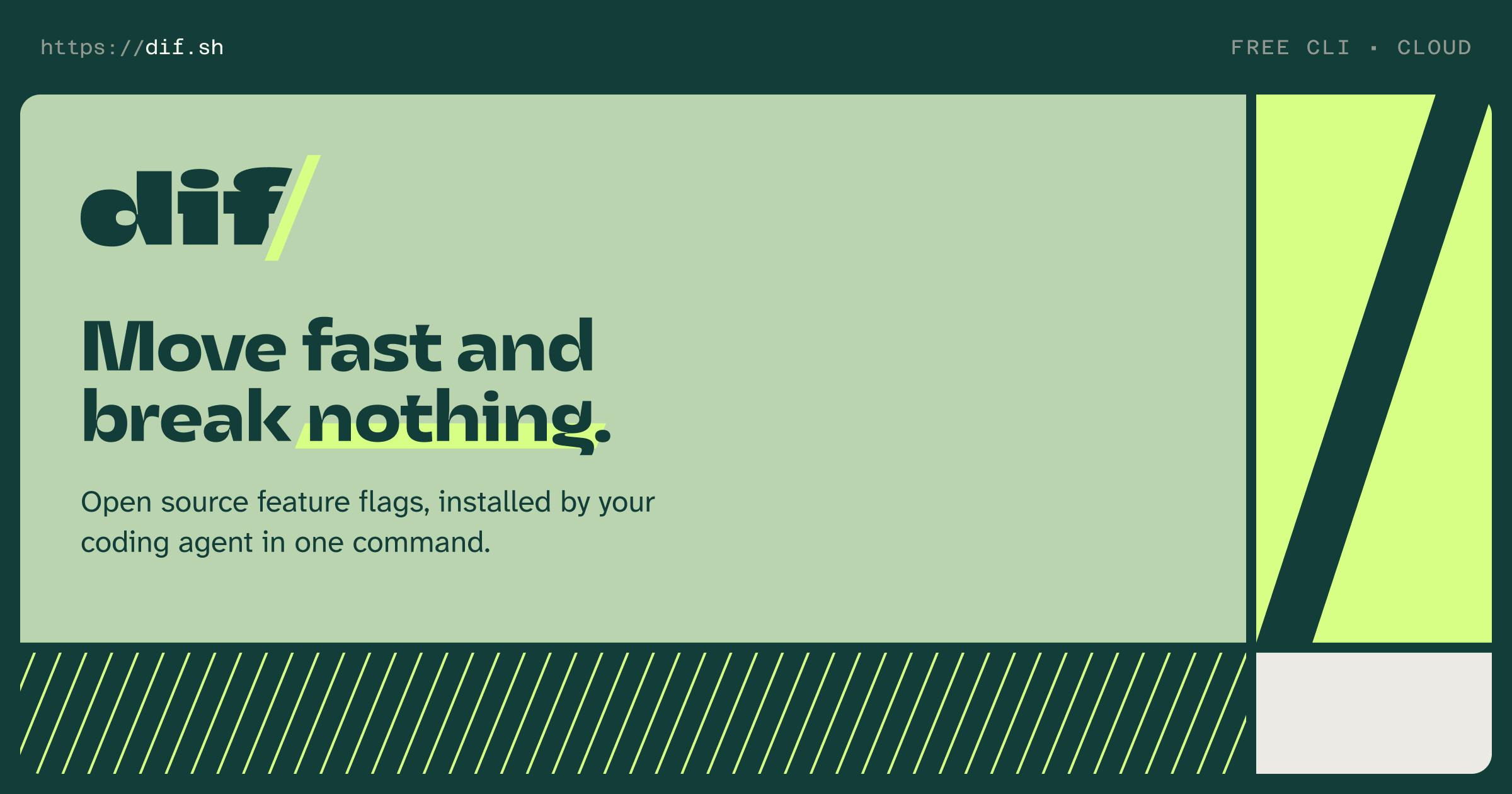
dif.sh is a developer-focused feature-flag and experimentation system in which each flag or A/B test is stored as a Markdown file inside the customer’s code repository. Its CLI validates experiments, generates a local runtime client, detects conflicting tests, and writes experiment context that coding agents can read. An optional hosted product, Dif Cloud, receives events and presents lift, confidence intervals, experiment history, and proposed conclusions (official site, documentation).
The product addresses a legitimate workflow problem: feature flags and experiment decisions often become detached from source code and accumulate as poorly documented operational debt. Keeping definitions, hypotheses, decisions, and historical learning in Git is coherent and particularly well aligned with agent-assisted software development.
Product quality appears promising. The public repository is MIT-licensed, includes a Rust CLI and TypeScript runtime packages, and has produced multiple releases. However, commercial validation is effectively absent. Public signals include 18 GitHub stars, zero forks, 89 CLI downloads and 75 SDK downloads during the latest reported month, and one Product Hunt review (GitHub, npm CLI downloads, npm SDK downloads). Downloads are not unique users and may include maintainers or automated systems.
The strongest company signal is founder-market fit: Chris Fowles has engineering and experimentation experience, while David Herzog has product, design, and growth experience. Both previously built Oboe, another experimentation platform. The main concern is that dif.sh currently looks like a well-executed product thesis rather than a demonstrated company: revenue, customers, retention, conversion, founder commitment, funding, legal structure, and Cloud adoption are all unverified.
Decision: Watch. The product merits monitoring, but the available evidence does not yet justify formal investment diligence. Product Hunt attention should not be confused with product-market fit.
Product Overview
The initial customer is a small software team using Git and coding agents that wants simple feature flags or A/B tests without operating a separate administrative dashboard.
Each experiment is represented by Markdown frontmatter and prose describing its owner, hypothesis, audience, variants, metrics, guardrails, and decision. dif build generates a typed runtime client and context.json; dif validate checks schema and experiment conflicts; and dif conclude archives an experiment and records its learning (repository README).
The open-source CLI and SDK are free. Dif Cloud costs $50 per month, including one million events and unlimited seats. Cloud adds experiment monitoring, confidence intervals, metrics, history, and proposed decisions delivered through pull requests (Dif Cloud).
Installation supports standalone binaries for macOS and Linux, Homebrew, and an npm wrapper that also supports Windows. The documented runtime is centered on JavaScript/TypeScript, with React and Svelte packages (documentation).
The primary benefit is reducing context fragmentation between code, feature-flag configuration, and experimental learning. It replaces dashboard-based flag systems, home-grown configuration files, spreadsheets, and experiment notes scattered across analytics and collaboration tools. Product availability is verifiable, although production reliability and customer usage are not.
Founder and Team Assessment
Product Hunt identifies Chris Fowles and David Herzog as co-founders (Chris’s profile, David’s profile).
Fowles is publicly listed as a partner and engineering director at Niftic and founder/CTO of Oboe. His profile describes full-stack, DevOps, product-development, and experimentation experience (LinkedIn). GitHub shows him as the dominant human contributor to dif.sh’s public repository, with 32 attributed contributions versus one from another named contributor (contributors).
Herzog is listed as Niftic’s founder and creative director and Oboe’s founder/head of product. His experience is concentrated in design, product strategy, growth, and experimentation (LinkedIn).
This is a complementary technical/product pairing with relevant domain experience. Nevertheless, both profiles retain concurrent roles, and full-time commitment to dif.sh is not verified. No previous exit was found. The public repository’s contribution concentration creates key-person risk.
There is also corporate ambiguity: Oboe’s terms identify it as a DBA of Niftic Company, while no equivalent legal disclosure was located for dif.sh (Oboe terms). Whether dif.sh is a new brand, product line, successor to Oboe, or separate entity requires clarification.
Founder Assessment: Relevant and complementary experience, but commitment, legal structure, and broader team capacity remain unverified.
Market Opportunity
The narrow initial segment is Git-centric software teams that run enough releases and experiments to require structured flag management but find established platforms too complex or expensive.
A bottom-up scenario—not a verified market estimate—is:
- 100,000 potentially suitable teams globally
- Current annual Cloud revenue per team: $600
- Illustrative revenue pool: $60 million annually
That would not itself support a strong unicorn case, and 100% penetration is unrealistic. The opportunity becomes venture-scale only if dif.sh expands toward larger teams, multi-repository governance, security controls, enterprise support, additional runtimes, and substantially higher annual contract values.
The existence of large competitors confirms meaningful spending in the category. GrowthBook offers free and $40-per-seat plans plus enterprise pricing, while LaunchDarkly offers usage-based and enterprise tiers with governance and many SDKs (GrowthBook pricing, LaunchDarkly pricing). Statsig’s announced $1.1 billion acquisition by OpenAI also demonstrates strategic value in experimentation infrastructure, although it does not establish demand for dif.sh specifically (TechCrunch).
Market timing is favorable because coding agents benefit from repository-native context. The unresolved question is whether that interface is a standalone category or merely a feature incumbents can add.
Traction and Growth Signals
dif.sh ranked #1 on Product Hunt on September 5, 2026 and presently shows 796 followers, one review, and a 4.0 rating (daily leaderboard, reviews). This establishes launch interest, not commercial traction.
The GitHub repository was created May 22, 2026 and reports 18 stars, zero forks, zero open issues, and a last push on August 6, 2026 (GitHub API). Releases progressed to v0.6.1, demonstrating shipping activity, although visible repository activity paused roughly one month before the Product Hunt launch (releases).
npm reported 89 CLI downloads and 75 SDK downloads from August 8 through September 6. Daily CLI data contains release-day spikes and little sustained volume, making actual active installations impossible to infer (download history).
Revenue, Cloud accounts, paying customers, production experiments, retention, event volume, growth, case studies, and customer references are not publicly disclosed.
Traction Assessment: Launch attention is positive, but sustained adoption and commercial traction are unverified.
Competitive Position
Direct competitors include LaunchDarkly, GrowthBook, PostHog, Statsig, Unleash, and developer-built flag infrastructure. Indirect alternatives include environment variables, configuration files, analytics tools, Git history, and manually documented experiments.
dif.sh differentiates through Markdown-as-source-of-truth, local deterministic assignment, no-account installation, agent-readable experiment context, and low fixed Cloud pricing. The approach offers strong developer ergonomics and avoids runtime dependency on a remote flag service.
However, local compilation also weakens a major traditional feature-flag benefit: changing or disabling behavior instantly without redeploying. Enterprise buyers may additionally require broader SDK coverage, remote configuration, SSO, audit controls, service-level commitments, and compliance. GrowthBook already offers unlimited flags and experiments on its free tier, while LaunchDarkly provides extensive SDK, governance, and observability capabilities.
If the largest platform launched the same feature within six months, why would customers continue using dif.sh? Today, the best answer is simplicity, open-source portability, and deep Git-native workflow—not proprietary data, network effects, or high switching costs. Those advantages may attract developers but are readily replicable.
Defensibility Assessment: Low
Business Model and Economics
The current model is open-source adoption feeding a $50-per-month hosted analytics subscription. At list price, annual contract value is approximately $600.
Gross-margin potential should be SaaS-like, but one million included events creates variable ingestion, storage, statistical-processing, and support costs. Any AI-generated experiment suggestions add inference expense. No evidence is available on actual cloud cost per million events, gross margin, paid conversion, churn, customer acquisition cost, or support burden.
Unlimited seats simplify adoption but prevent seat-based expansion. Sustainable expansion would likely require event overages, multi-repository plans, enterprise security, governance, support, or higher-value analytics. The open-source product may distribute efficiently through GitHub, npm, coding-agent communities, and developer referrals, but current adoption signals are too small to demonstrate this loop.
Unicorn Path
Assuming an optimistic 10× ARR multiple for a high-growth, high-margin developer SaaS business:
Required ARR = $1 billion ÷ 10 = approximately $100 million.
At the current $600 annual price, dif.sh would require approximately:
$100 million ÷ $600 = 166,667 paying organizations.
That is implausible for a specialized experimentation product without massive self-service distribution. A more credible—but still difficult—route would be 10,000 organizations at $10,000 average ARR, or 2,000 enterprise customers at $50,000 ARR.
Reaching that scale would require enterprise packaging, proven reliability, more SDKs, governance and compliance, multi-repository deployment, repeatable product-led acquisition, and differentiated experiment intelligence or proprietary cross-workflow data. It may also require consolidation with or expansion beyond the founders’ existing Oboe product.
Unicorn Path: Conditional
Valuation Assessment
No reliable public information was found concerning dif.sh funding, investors, round size, SAFE cap, valuation, acquisition offers, or current fundraising status. Revenue and growth are also unknown.
The Statsig transaction demonstrates that experimentation platforms can achieve unicorn outcomes, but without comparable revenue, customer scale, growth, or product breadth, it cannot responsibly anchor dif.sh’s valuation.
Valuation Attractiveness: Not Assessable
Required information includes ARR, growth, gross margin, retention, burn, runway, cap table, legal ownership, round size, SAFE cap or post-money valuation, investor rights, and the relationship between dif.sh, Oboe, and Niftic.
Key Risks
- No verified paying customers, revenue, retention, or production usage.
- Current $600 ACV requires unrealistic customer volume for venture-scale revenue.
- Strong incumbents offer free tiers, mature analytics, governance, and broader SDK coverage.
- Git-native Markdown workflows are easy for incumbents or open-source projects to replicate.
- Low switching costs and limited proprietary data or network effects.
- Local compilation may not satisfy teams needing instant remote flag changes and kill switches.
- Founder attention may be divided among dif.sh, Oboe, and Niftic.
- Corporate ownership, IP assignment, and product relationship with Oboe are unclear.
- Event-ingestion economics and AI inference costs are undisclosed.
- Minimal independent customer-review evidence.
Final Assessment
Venture Potential: 53/100
| Category | Score |
|---|---|
| Market Size and Expansion Potential | 14/20 |
| Traction and Growth Evidence | 3/20 |
| Founder and Team | 10/15 |
| Product Strength | 8/10 |
| Distribution Potential | 7/15 |
| Business Model and Economics | 6/10 |
| Defensibility | 5/10 |
| Total | 53/100 |
The strongest elements are a coherent developer workflow, relevant founders, and a category with demonstrated strategic value. The weakest are commercial evidence, current contract value, and defensibility.
Evidence Confidence: 43/100
Verified information includes product functionality, documentation, pricing, repository activity, npm downloads, Product Hunt ranking, and public founder profiles. Feature and positioning claims are principally company-reported. The market scenarios and unicorn calculations are analyst assumptions.
Revenue, customers, retention, conversion, margins, funding, valuation, burn, runway, cap table, legal entity, founder commitment, and current fundraising status remain unavailable.
Final Decision: Watch
dif.sh is an interesting product but not yet an investable company based on public evidence. Venture potential depends on converting open-source adoption into materially higher-value Cloud and enterprise contracts. Low observed distribution and the lack of customer or revenue evidence make Watch more appropriate than DD.
Upgrade Conditions
- At least $1 million ARR with verifiable growth.
- Ten or more referenceable production customers.
- Six-month paid retention above 70% and credible cohort data.
- Gross margin above 70% after event-processing and AI costs.
- Repeatable acquisition beyond Product Hunt.
- Enterprise contracts demonstrating materially higher ACV.
- Clear legal ownership, founder commitment, and cap table.
- Evidence that repository-native context creates durable retention or proprietary data.
Downgrade Conditions
- Repository and release activity remains dormant.
- Product Hunt attention fails to convert into installations or Cloud accounts.
- High Cloud churn or weak free-to-paid conversion.
- An incumbent releases an equivalent Git-native agent workflow.
- Infrastructure costs make the $50 plan uneconomic.
- Loss of founder focus or unresolved IP ownership.
- Material security, statistical-validity, or privacy failures.
Questions for Further Diligence
- What are current MRR, paying organizations, and monthly revenue growth?
- How many repositories and experiments are active weekly?
- What are 30-, 90-, and 180-day retention by installation cohort?
- What percentage of CLI users connect Dif Cloud and become paying customers?
- What are Cloud gross margin and cost per million events?
- Which acquisition channels generated retained users rather than launch traffic?
- What production customers can provide references?
- How will pricing expand beyond $600 annual ACV?
- What functionality or data remains defensible if LaunchDarkly or GrowthBook copies the Git-native workflow?
- Is dif.sh owned by Niftic, Oboe, a separate entity, or the founders personally?
- Are both founders working full-time, and who comprises the current team?
- What are the cap table, burn, runway, current valuation, and proposed financing terms?
Sources
- Product Hunt product page
- Product Hunt September 5 leaderboard
- Official dif.sh website
- Dif Cloud and pricing
- Official documentation
- GitHub repository
- GitHub repository metadata
- npm CLI download data
- Chris Fowles profile
- David Herzog profile
- GrowthBook pricing
- LaunchDarkly pricing
- Statsig acquisition coverage