
Table of Contents
Kit by Speakeasy Investment Report
Category: Open-source AI coding-agent runtime / enterprise AI infrastructure
Company Stage: Series A; Kit itself is an early open-source product
Founders: Sagar Batchu, CEO; Simon Yu, COO
Headquarters: San Francisco, California, United States
Funding: At least $26 million publicly announced: $11 million across pre-seed and seed rounds, followed by a $15 million Series A
Business Model: Kit is free under the MIT License; Speakeasy monetizes enterprise AI-control-plane software through custom contracts
Product Hunt Launch Date: September 6, 2026
Report Date: September 9, 2026
| Investment Metric | Assessment |
|---|---|
| Venture Potential | 72/100 |
| Unicorn Path | Conditional |
| Valuation Attractiveness | Not Assessable |
| Evidence Confidence | 68/100 |
| Final Decision | DD |
Executive Summary
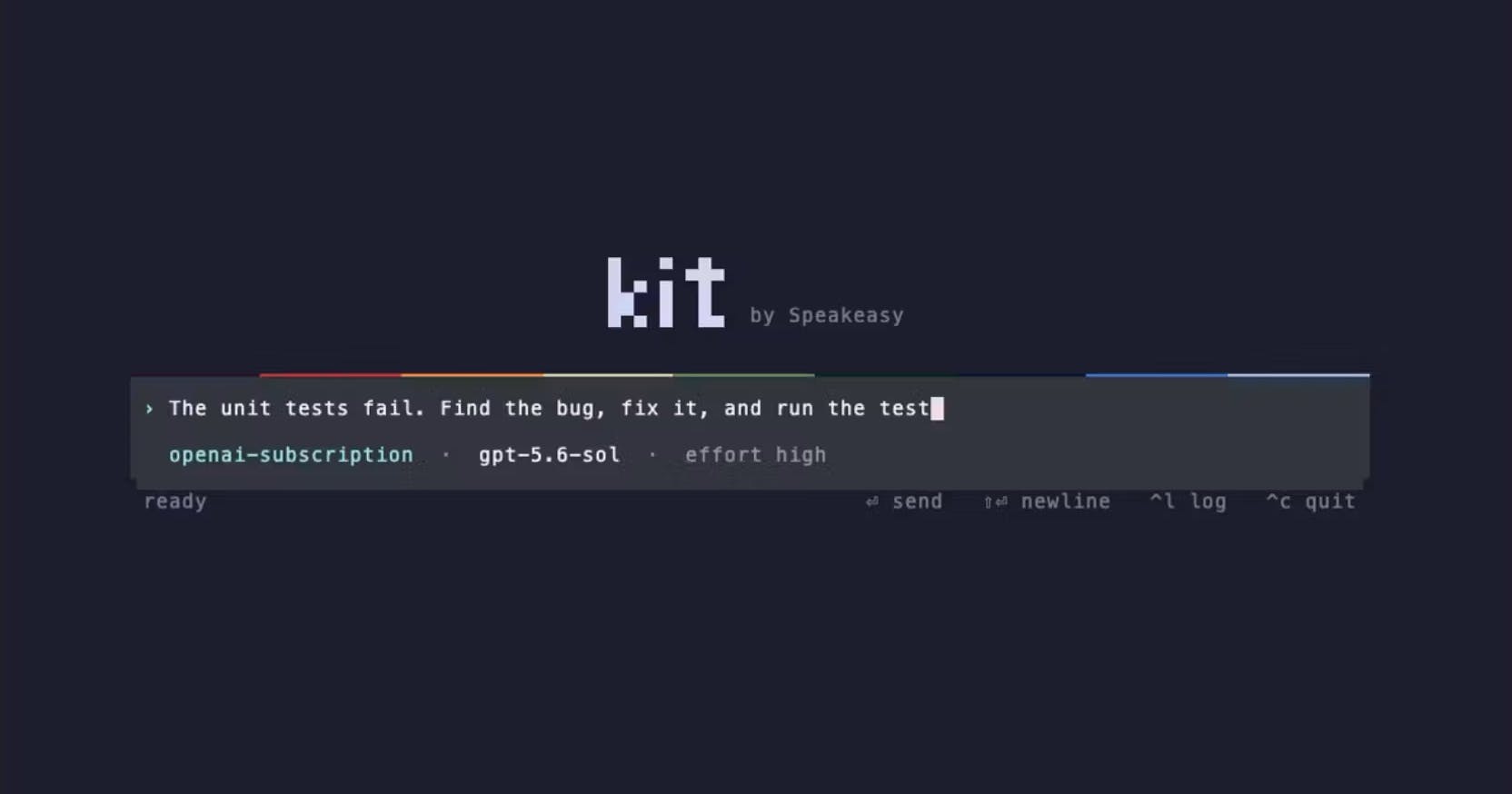
Kit is an open-source coding-agent runtime designed to reduce the number of model interactions required for software-engineering tasks. Instead of exposing many separate tools, it gives the model a single compose tool through which it can run commands, inspect or edit files, retry work, invoke tools, and delegate to subagents. It supports terminal use, the Agent Client Protocol, agent-to-agent communication, and several model providers in one static binary (GitHub).
The initial audience is technically sophisticated developers who want a model-independent alternative to vertically integrated coding agents. The broader strategic opportunity is more important: Kit could become an open-source distribution layer for Speakeasy’s paid enterprise AI control plane, which provides identity, access controls, policy enforcement, observability, and cost management across agents (Speakeasy).
The strongest investment signal is not Kit’s Product Hunt launch. It is the parent company’s pre-existing enterprise position. Speakeasy publicly identifies customers including MoonPay, PlanetScale, Vercel, Mistral, Verizon, DocuSign, Cisco, Glean and LaunchDarkly, although the commercial terms and current status of each relationship are not disclosed (customer directory). The company has also raised institutional capital from FPV Ventures, GV and Quiet Capital and reports a LinkedIn team size of 45 (Series A announcement; LinkedIn).
The principal concern is that Kit has almost no publicly verifiable product-market-fit evidence. As of September 9, 2026, its repository had only 37 stars and three forks, while the latest binary showed minimal recorded downloads. The product is free, has no disclosed Kit-specific customers or revenue, and is largely dependent on one principal GitHub contributor (GitHub API; contributors).
The decision is DD, but on Speakeasy rather than on Kit as a standalone business. Kit is best understood as a potentially useful open-source wedge into Speakeasy’s enterprise governance platform. Formal diligence is warranted because of the founders, existing enterprise distribution and strategic market positioning, but investment cannot be recommended without current ARR, retention, gross-margin and valuation data.
Product Overview
Coding agents typically expose file operations, shell commands and other capabilities as separate model tools. Kit instead exposes a single compose interface backed by Runlet, a compact language that allows one model response to execute multiple dependent or parallel actions. The intended benefit is fewer model round trips and less repeated context (GitHub README).
Kit includes:
- A terminal client and native macOS application.
- ACP v1/v2 interfaces over standard input, HTTP/SSE and WebSocket.
- An A2A endpoint and subagent orchestrator.
- Support for MCP servers, agent skills and plugin packages.
- Persistent sessions, context compaction and OpenTelemetry export.
- Authentication for ChatGPT subscriptions, OpenRouter and Speakeasy’s control plane.
The product is available as an MIT-licensed Rust project and prebuilt macOS and Linux binaries. It does not provide a sandbox or permissions framework and explicitly states that it is “not a security boundary”; users are expected to place it inside a trusted boundary (security disclosure and README).
Speakeasy reports that, across 16 production pull requests, Kit used roughly half the input tokens and active time per hand-written line compared with Codex CLI or Claude Code. This is a company-run benchmark, not independent validation. Its small sample, task selection and per-line normalization prevent treating it as conclusive evidence of superior performance (benchmark methodology).
Pricing: Kit is free under the MIT License. Users pay their chosen model or subscription provider. Speakeasy’s associated enterprise platform uses tailored pricing rather than public list prices (Kit license; Speakeasy pricing).
Founder and Team Assessment
Sagar Batchu has served as Speakeasy’s co-founder and CEO since 2022. His prior roles include Director of Engineering at LiveRamp and engineering work at Enlighted; he studied computational physics at Harvey Mudd College (LinkedIn).
Simon Yu is currently listed as co-founder and COO. His background includes product roles at Flexport, SafeGraph and VMware, two previous startup efforts, technology investing at Francisco Partners and consulting at BCG. He holds an MBA from Harvard Business School (LinkedIn).
The pairing is credible: Batchu supplies infrastructure engineering and organizational leadership, while Yu brings product, finance and go-to-market exposure. Both remain publicly identified as full-time Speakeasy executives. No verified prior founder exit was found.
LinkedIn lists 45 people associated with Speakeasy, within its 11–50 employee category, and the company advertised engineering, sales and forward-deployed roles during 2026 (LinkedIn company page; careers).
Kit itself has notable concentration risk. GitHub attributes 284 contributions to danielkov, versus 11 or fewer for every other human contributor. That indicates rapid execution but substantial dependence on one principal maintainer (GitHub contributors).
Founder Assessment: Strong technical and commercial founding team, offset by high maintainer concentration within Kit.
Market Opportunity
The narrow initial segment is developers and engineering teams using multiple AI coding models or clients who want orchestration, protocol interoperability and lower token consumption. Individual willingness to pay is uncertain because Kit is free and alternatives are bundled into existing AI subscriptions.
The more credible commercial segment is enterprises deploying AI agents across many employees and internal systems. Kit could make Speakeasy’s runtime and control plane easier to deploy, while the paid platform handles identity, policy enforcement, agent governance, observability and audit requirements (Speakeasy platform).
A bottom-up scenario illustrates the opportunity but is not a company forecast:
- Potential enterprise customers: 15,000–40,000 global organizations with sufficiently large software or AI operations.
- Potential annual contract value: $25,000–$100,000 for governance, security and support.
- Illustrative addressable revenue: approximately $375 million–$4 billion annually.
Both customer count and ACV are analyst assumptions requiring verification. The upper end requires Speakeasy to sell beyond developers into security, IT, compliance and procurement budgets.
Market timing is favorable because coding agents are increasingly available across terminal, editor, desktop and cloud environments. However, the same trend attracts well-capitalized model providers and open-source projects, making the market large but intensely competitive.
Traction and Growth Signals
Kit launched on Product Hunt on September 6, 2026. The page contains supportive comments and three product reviews, but this represents launch attention rather than commercial validation (Product Hunt).
The public repository was created on August 24, 2026. By September 9 it had 37 stars, three forks and 22 open issues. Its latest release was version 0.1.130, published September 8, indicating exceptionally rapid development, although the version count should not be interpreted as equivalent to 130 mature releases (repository metadata; latest release).
A Hacker News launch post confirms that Kit began as its principal developer’s experiment and became that developer’s preferred daily coding environment. This is useful qualitative founder-product evidence, not independent customer validation (Hacker News).
Speakeasy has stronger company-level evidence. Its 2024 Series A announcement reported nearly 3,000 users generating 7,250 SDKs during that year and a 575% increase in companies investing in its API tooling. Those figures are company-reported, predate Kit, and do not establish current revenue or retention (Series A announcement).
Current ARR, Kit active users, paying customers, usage frequency, retention, conversion and revenue growth are not publicly disclosed.
Traction Assessment: Credible parent-company enterprise activity, but Kit-specific adoption and monetization remain commercially unverified.
Competitive Position
Direct competitors include Anthropic’s Claude Code, OpenAI Codex, OpenCode and Block’s Goose. Claude Code works across terminal, IDE, desktop and web surfaces, while Codex offers terminal, editor and ChatGPT interfaces with parallel cloud agents (Anthropic; OpenAI). OpenCode is model-independent and open source, reporting 195,000 GitHub stars and 16 million monthly developers—company-reported figures that demonstrate substantially greater distribution than Kit (OpenCode).
Kit’s differentiation is architectural: one composable tool, a compact orchestration language, open model choice, ACP/A2A interoperability and deployment as a static binary. ACP itself seeks to decouple agents from editors, potentially making Kit portable across compatible interfaces (ACP specification).
Switching costs are currently low. Kit configuration, transcripts and orchestration patterns may create workflow familiarity, but its MIT license permits competitors to copy or fork substantial functionality. It has no disclosed proprietary dataset or network effect.
If the largest platform launched the same feature within six months, why would customers continue using Kit? The strongest answer is neutrality across models and integration with Speakeasy’s governance platform. That is credible for enterprises avoiding provider lock-in, but weak for individual developers who prioritize model quality and convenience.
Defensibility Assessment: Medium-Low.
Business Model and Economics
Kit has no direct disclosed revenue model. The plausible strategy is open-source-led distribution: attract developers with a free runtime, then sell governance, identity, observability, deployment and support to enterprises.
Speakeasy offers custom enterprise pricing and features including scoped RBAC, audit trails, SSO, dedicated support and service-level agreements (pricing page). Expansion revenue could arise from additional employees, agents, requests, governed applications or security modules, but pricing units and contract values are not public.
Kit can shift most model-inference expense to users because they authenticate with their own subscriptions or API providers. Speakeasy would still incur cloud, telemetry, security, support and enterprise deployment costs. Gross margin, inference pass-through, customer-acquisition cost and payback are not publicly disclosed.
Unicorn Path
A 10× ARR multiple is used as a planning assumption for a rapidly growing, high-gross-margin enterprise software company. It is not a statement of Speakeasy’s current valuation.
\[
\$1\text{ billion} \div 10 = \$100\text{ million ARR}
\]
Illustrative routes include:
- 2,000 enterprise customers at $50,000 ARR;
- 1,000 customers at $100,000 ARR; or
- approximately 278,000 paid developer seats at $30 per month.
The seat scenario is inconsistent with Kit’s current free model. The enterprise route is more credible but requires repeatable security-led distribution, strong retention, expansion within large accounts, and evidence that Kit materially increases adoption of the paid control plane.
Unicorn Path: Conditional.
Valuation Assessment
Speakeasy announced $11 million in combined pre-seed and seed financing and subsequently raised a $15 million Series A led by FPV Ventures, with GV and Quiet Capital participating (seed announcement; Series A). This implies at least $26 million of publicly announced funding.
The Series A post-money valuation, current valuation, ARR, growth rate and current financing terms are not publicly disclosed. Unverified directory claims of a $1 billion valuation are inconsistent with the absence of a primary announcement and should not be relied upon.
Valuation Attractiveness: Not Assessable.
Assessment requires current ARR, growth, gross margin, retention, burn, runway, round size, post-money valuation, ownership targets and liquidation preferences.
Key Risks
- No Kit-specific commercial validation: Revenue, active usage and retention are unknown.
- Strategic ambiguity: Kit may be an effective open-source project without generating meaningful control-plane revenue.
- Platform competition: Anthropic, OpenAI and editor vendors can bundle similar orchestration.
- Weak open-source distribution: Thirty-seven stars is modest relative to established alternatives.
- Security limitations: Kit expressly provides no sandbox or permissions framework.
- Maintainer concentration: Development is dominated by one contributor.
- Low switching costs: MIT licensing and open protocols facilitate replication.
- Company repositioning risk: Speakeasy has expanded from API tooling into enterprise AI governance, creating execution and messaging risk.
- Unknown economics: ARR, gross margin, CAC, burn and runway are unavailable.
Final Assessment
Venture Potential: 72/100
| Category | Score |
|---|---|
| Market Size and Expansion Potential | 17/20 |
| Traction and Growth Evidence | 11/20 |
| Founder and Team | 14/15 |
| Product Strength | 8/10 |
| Distribution Potential | 11/15 |
| Business Model and Economics | 6/10 |
| Defensibility | 5/10 |
| Total | 72/100 |
The strongest factors are the experienced founding team, existing enterprise relationships and opportunity to connect an open runtime to a paid governance layer. The weakest are Kit-specific traction, unclear monetization and limited defensibility against model and editor incumbents.
Evidence Confidence: 68/100
Funding, founders, repository activity, licensing, product architecture and named customer references are verifiable. Benchmark results and customer outcomes are primarily company-reported. Revenue, retention, gross margin, customer concentration, burn, runway and valuation remain unavailable.
Final Decision: DD
Speakeasy warrants formal diligence because it has institutional backing, enterprise distribution and a potentially valuable position between coding agents and corporate security infrastructure. Kit alone would merit Watch, but as a distribution and runtime component within Speakeasy, it strengthens the rationale for investigating the company.
Upgrade Conditions
- Verified ARR above $5 million with sustained growth.
- Gross margin above 70% after inference and observability costs.
- Net revenue retention above 110%.
- Evidence that Kit generates qualified enterprise pipeline.
- At least several thousand active Kit developers with strong 90-day retention.
- Reduced maintainer concentration and independent ecosystem contributions.
- Referenceable enterprise deployments using both Kit and the control plane.
- Financing terms consistent with verified commercial performance.
Downgrade Conditions
- Kit adoption stalls after launch.
- Open-source users do not convert into enterprise opportunities.
- Claude Code, Codex or OpenCode replicate Kit’s efficiency advantage.
- Security incidents arise from unsafe local execution.
- Existing customers fail to adopt Speakeasy’s newer AI-governance offering.
- Gross margins deteriorate because of model, telemetry or support costs.
- Materially inflated commercial claims or unfavorable financing terms emerge.
Questions for Further Diligence
- What are current ARR, year-over-year growth and contracted annual recurring revenue?
- How much revenue comes from SDK tooling versus the AI control plane?
- How many active Kit users return after 30 and 90 days?
- What percentage of Kit users create a Speakeasy account or enterprise lead?
- What are gross margin and infrastructure cost per governed agent session?
- What are customer and gross-dollar retention by product cohort?
- What are median enterprise ACV, sales-cycle length, CAC and CAC payback?
- How many named customer logos represent active paying contracts?
- What is the roadmap for sandboxing, permissions and enterprise policy enforcement in Kit?
- How will Speakeasy reduce dependence on Kit’s principal maintainer?
- What proprietary advantage remains if a major model provider adopts
compose-style orchestration? - What are the current round valuation, security type, dilution, liquidation preferences, burn and runway?
Sources
- Kit by Speakeasy — Product Hunt
- Kit repository and documentation — GitHub
- Kit repository metadata — GitHub API
- Speakeasy enterprise platform
- Speakeasy pricing
- Speakeasy customer directory
- Speakeasy Series A announcement
- Sagar Batchu — LinkedIn
- Simon Yu — LinkedIn
- Agent Client Protocol
- Claude Code documentation
- OpenAI Codex
- OpenCode