
Table of Contents
Diiverge Investment Report
Category: AI-native gaming / interactive storytelling / creator tools
Company Stage: Pre-seed or bootstrapped product experiment; formal company stage not publicly disclosed
Founder or Founders: Charlie Clark
Headquarters: Not publicly disclosed; founder is based in Brooklyn, New York
Funding: Not publicly disclosed; no reliable financing announcement found
Business Model: Paid scene packs and sponsorship-funded public scenes
Product Hunt Launch Date: September 12, 2026
Report Date: September 12, 2026
| Investment Metric | Assessment |
|---|---|
| Venture Potential | 49/100 |
| Unicorn Path | Improbable |
| Valuation Attractiveness | Not Assessable |
| Evidence Confidence | 43/100 |
| Final Decision | Watch |
Executive Summary
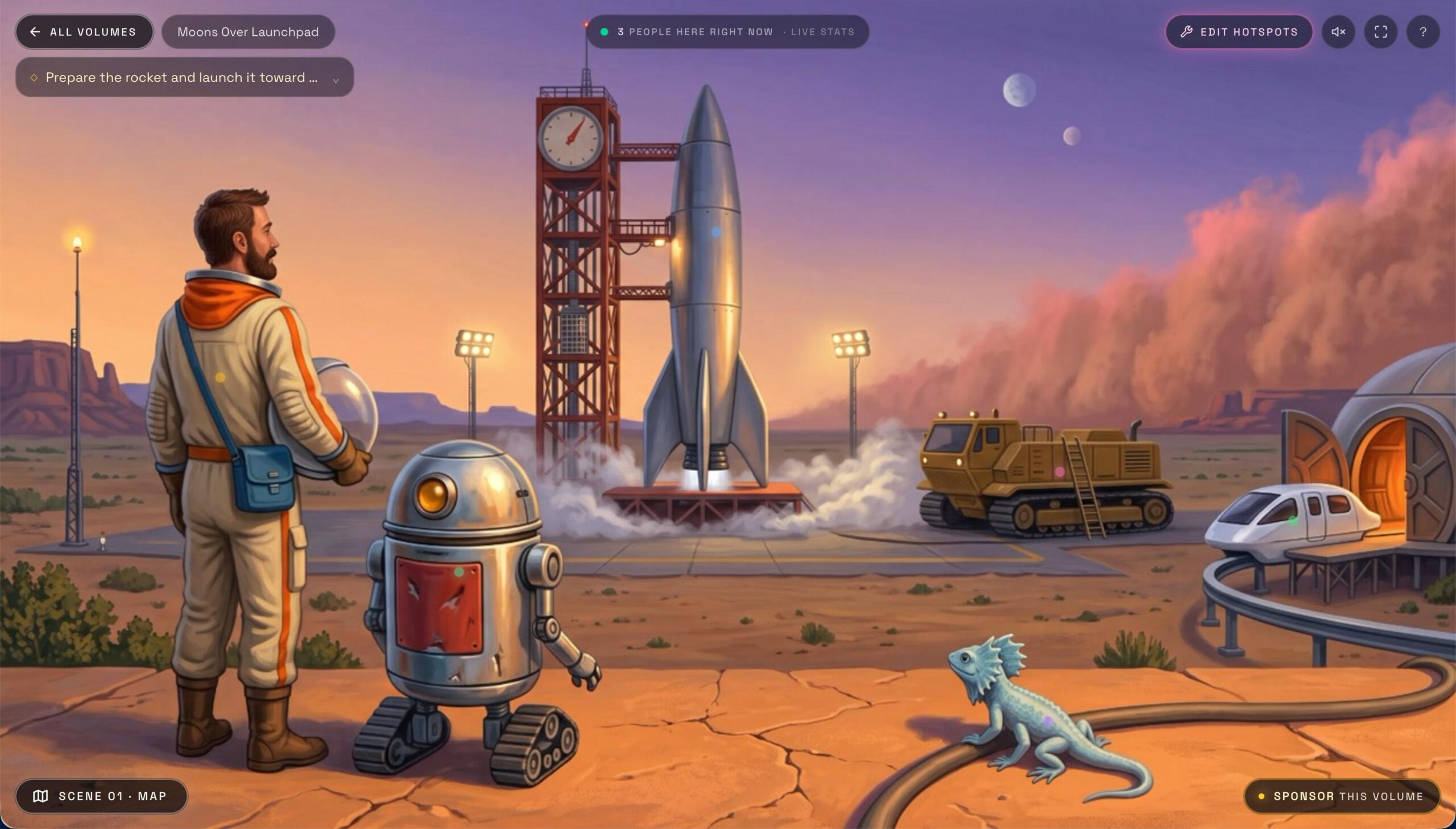
Diiverge is a browser-based generative adventure product that turns a photograph, painting, or screenshot into an explorable point-and-click world. Users click an object, select what happens next, and receive a newly generated image plus a short video transition. Every generated scene becomes a persistent branch that later visitors can replay or extend (official website).
The product combines generative images, video, vision analysis, image segmentation, narrative continuity, and persistent branching into an unusually coherent consumer experience. Unlike a general-purpose image generator, Diiverge gives each generation a reason to exist within an expanding world. Its strongest product characteristic is the combination of immediate play, creator ownership, and shareable branching paths.
The strongest positive investment signal is founder-product fit. Charlie Clark has more than a decade of design and software-development experience, including work at Squarespace and interactive-development studios. He also founded Liinks, which his personal site says was bootstrapped to more than $30,000 in monthly recurring revenue. That revenue claim is founder-reported rather than independently audited, but it provides some evidence of product, design, and monetization capability (founder site; LinkedIn).
Early usage is visible: the official homepage reported approximately 3,033 scenes in its first public volume and 2,835 in its second—about 5,868 scenes combined within roughly nine days. However, scene count is not equivalent to users, retention, or revenue. Product Hunt showed approximately 100 points and a No. 12 daily rank around launch, which indicates launch interest but not product-market fit (official website; Product Hunt).
The main investment concern is economics. Diiverge says generating one new scene—including an image, a ten-second video, and interaction mapping—costs approximately $0.50. Public sponsorship adds two scenes per dollar, implying that sponsorship revenue may largely cover generation cost rather than produce meaningful gross profit. Pricing for private scene packs is not publicly visible without signing in, and there is no disclosed revenue, customer count, retention, or gross margin (sponsorship page).
The product is worth monitoring, but current evidence supports an impressive creative experiment more than a venture-scale company. The decision is Watch, pending proof of repeat usage, attractive unit economics, meaningful creator monetization, and a scalable distribution loop.
Product Overview
Diiverge addresses the gap between passive AI-generated media and playable experiences. Image and video generators produce isolated outputs; conventional game-development tools require design, scripting, assets, and technical expertise. Diiverge attempts to make interactive world creation as simple as uploading one image and choosing narrative actions.
The system works as follows:
- A creator uploads an image.
- A segmentation model identifies clickable objects.
- A vision model interprets the objects and possible actions.
- The user selects what happens.
- An image model produces the resulting scene.
- A video model generates a short transition between scenes.
- A judge model checks choices against narrative continuity.
- The new scene is stored as a permanent branch.
Public worlds are free to explore, including replaying paths generated by previous visitors. Creating a new public scene uses the volume’s remaining funded allowance. Sponsors can add scenes, while creators can purchase private scene packs through the studio and share completed adventures by URL (official website; sponsorship page).
The current product is web-based. No verified native App Store or Google Play application was found. Authentication uses email without a password; the studio states that only the user’s email is stored during registration (studio).
The core benefit is a very low-friction path from an image to an interactive story. It replaces combinations of image-generation tools, video-generation tools, branching-story software, and manual game implementation. The experience is visually differentiated, although generation latency, consistency, moderation quality, and long-session engagement have not been independently benchmarked.
Product Quality Assessment: Creative and technically coherent, with a strong initial interaction model; replay depth and sustained entertainment value remain unproven.
Founder and Team Assessment
The site metadata identifies @charliie as the creator, while Product Hunt identifies the maker as Charlie. Public profiles connect that account to Charlie Clark (site metadata; Product Hunt; X profile).
Clark’s LinkedIn profile lists software-engineering roles at Squarespace from 2015 to 2024, preceded by interactive-development positions at B-Reel, Domani Studios, and Stinkdigital. He studied communication design at Parsons and lists multiple awards for interactive web projects (LinkedIn).
His personal site lists Diiverge among several active projects and identifies him as the founder of Liinks. It reports that Liinks was bootstrapped solo to more than $30,000 MRR, while the Liinks website claims use by more than 10,000 creators. Both figures are company- or founder-reported and not independently verified (founder site; Liinks).
This history demonstrates unusually strong design-engineering capability and some evidence of consumer SaaS monetization. Commercial focus is less certain. Clark continues to identify as Liinks’ founder and maintains numerous other products, making full-time commitment to Diiverge unclear.
No co-founders, Diiverge employees, hiring activity, legal entity, or advisory team were found. The product appears to be founder-led and potentially solo-built, creating substantial key-person risk.
Founder Assessment: Strong creative and technical founder-product fit with prior bootstrapping experience, but focus, team depth, and venture commitment are unverified.
Market Opportunity
The narrow initial market consists of AI-curious consumers, point-and-click adventure fans, visual storytellers, and creators who want to turn personal images or artwork into interactive experiences.
Potential willingness to pay may come from:
- Consumers purchasing additional scenes;
- Creators building shareable stories;
- Fans funding public worlds;
- Brands sponsoring interactive campaigns;
- Educators creating visual narratives;
- Entertainment companies licensing characters or intellectual property;
- Developers embedding the generation engine.
Because public pricing for private scene packs is unavailable, a bottom-up market model requires analyst assumptions. If an active paying creator spends $50–$100 annually:
| Paying Creators | Illustrative Annual Revenue |
|---|---|
| 10,000 | $0.5M–$1M |
| 100,000 | $5M–$10M |
| 1 million | $50M–$100M |
This excludes sponsorships and assumes revenue rather than gross profit. At the disclosed cost of approximately $0.50 per newly generated scene, gross margin will depend heavily on the markup in private packs, model-cost reductions, caching, and the ratio of replayed to newly generated content.
The broad gaming and creator markets are large, but Diiverge’s current niche is much smaller. A venture-scale opportunity would require expanding from a novelty experience into a durable user-generated-content platform with high replay frequency, creator discovery, social identity, collaborative worlds, payments, and potentially licensed content.
Traction and Growth Signals
The official site reported two public volumes:
- The Lantern Cove: approximately 3,033 scenes;
- The Crystal Pass: approximately 2,835 scenes.
Together, they represent roughly 5,868 generated scenes during the product’s first nine days. These are first-party counts and do not reveal how many scenes were generated by the founder, sponsors, or unique users (official website).
The site’s large XML sitemap includes individual scene URLs, providing technical evidence that branches are being stored and indexed rather than presented only as a static demo (sitemap).
Product Hunt displayed approximately 100 points and a No. 12 daily rank at the time of review. No reliable review count or sustained post-launch performance was available (Product Hunt).
The founder also launched a creator studio within days of the initial public worlds, indicating rapid product iteration. Still, no verified information was found for registered users, daily active users, paying customers, scene-pack sales, sponsorship revenue, repeat sessions, retention, or conversion.
Traction Assessment: Visible early creation activity, but commercially and behaviorally unverified.
Competitive Position
Direct and adjacent competitors include:
- AI Dungeon, which offers persistent generative text adventures through free and paid memberships ranging up to $49.99 per month (AI Dungeon pricing).
- Rosebud AI, which lets users create playable browser games through prompts and templates (Rosebud).
- Hidden Door, an AI-powered social roleplaying and fan-fiction platform pursuing licensed story worlds (Hidden Door).
- Google’s Project Genie, an experimental product for creating, exploring, and remixing interactive generated worlds (Google).
- Conventional tools such as Twine, visual-novel engines, game engines, image generators, and manually linked media.
Diiverge’s differentiation is its image-first entry point, persistent public branching, cinematic transitions, and extremely simple interaction model. The growing world provides a limited network effect: one user’s generated branch becomes free content for later visitors.
Defensibility is weak at present. The models appear to come from third-party providers, and the core pipeline—segmentation, object selection, image generation, video interpolation, and narrative judging—can be replicated. There is no disclosed proprietary model, exclusive intellectual property, creator marketplace, or substantial content catalog.
If Google, Roblox, or a major AI-game platform launched the same feature within six months, Diiverge would need superior community, creator identity, distinctive worlds, better narrative continuity, and a large persistent content graph to retain users. Those advantages do not yet exist at meaningful scale.
Defensibility Assessment: Low
Business Model and Economics
Diiverge currently has two monetization mechanisms:
- Private scene packs: Creators buy scenes for their own adventures. Pack sizes and prices are not publicly visible before authentication.
- Public sponsorships: Sponsorship begins at $25 and adds approximately two scenes per dollar. Sponsor names appear on frames, weighted by the amount contributed (sponsors).
The company states that each new scene costs about $0.50 to generate. Because $1 of sponsorship adds two scenes, the disclosed sponsorship model appears approximately cost-recovery-oriented before payment-processing, storage, bandwidth, moderation, and support expenses. It may fund public engagement but is unlikely to provide attractive gross margins in its present form.
Private packs may include a markup, but this is not disclosed. Gross margin could improve as image and video generation prices fall, if users replay existing scenes frequently, or if sponsored worlds create high-value brand inventory. Conversely, long video outputs, failed generations, refunds, and content moderation could increase costs.
There are no App Store fees because the current product is browser-based. Payment-processing fees likely apply, but the payment provider and terms are not publicly disclosed.
Unicorn Path
A consumer gaming and creator platform with meaningful variable generation costs might support a 5× annual-revenue multiple at scale, assuming strong growth, healthy gross margin, and durable engagement.
\[
\$1\text{ billion} \div 5 = \$200\text{ million annual revenue}
\]
At an average annual payer spend of:
- $50: four million paying users would be required;
- $100: two million paying users would be required;
- $200: one million paying users would be required.
Alternatively, at $0.50 of revenue per scene, Diiverge would need 400 million paid scenes annually. That would be economically unattractive if each scene still cost approximately $0.50 to generate.
A credible path therefore requires material change:
- Lower generation costs;
- Substantial markup or subscription revenue;
- High ratios of free replay to paid generation;
- Creator discovery and social distribution;
- A marketplace or revenue share;
- Mobile distribution;
- Brand and entertainment partnerships;
- Licensed story worlds;
- Strong moderation and intellectual-property controls.
These developments are possible but not demonstrated. The current product would need to evolve from a creative experiment into a large UGC entertainment platform.
Unicorn Path: Improbable
Valuation Assessment
No reliable public information was found regarding Diiverge funding, investors, valuation, SAFE cap, acquisition offers, or current fundraising.
The founder’s other product, Liinks, reportedly generates recurring revenue, but there is no evidence that Liinks and Diiverge share a legal entity, financing structure, or economics. Liinks revenue should therefore not be attributed to Diiverge.
Valuation Attractiveness: Not Assessable
Required information includes Diiverge revenue, gross profit, growth, retention, legal ownership, founder time allocation, infrastructure costs, burn, runway, proposed round size, valuation cap, post-money ownership, and liquidation preferences.
Key Risks
- Unproven retention: Initial curiosity may not translate into repeated play.
- Weak unit economics: The stated $0.50 generation cost appears to absorb all public sponsorship revenue.
- No verified commercial traction: Paying users, revenue, conversion, and sponsorship totals are undisclosed.
- Feature replication: Major model providers and gaming platforms can reproduce the interaction.
- Founder attention: Diiverge is one of many projects listed by a solo founder.
- Content moderation: Uploaded images and user-directed transformations can create sexual, violent, hateful, or otherwise unsafe material.
- Intellectual-property exposure: Users may upload copyrighted artwork, characters, brands, or photographs without permission.
- Third-party model dependency: Pricing, availability, output quality, and moderation rules depend on external providers.
- Narrative quality: Branching worlds may become inconsistent or repetitive over longer sessions.
- Consumer distribution: A browser novelty can attract attention without developing low-cost, repeatable acquisition.
Final Assessment
Venture Potential: 49/100
| Category | Score |
|---|---|
| Market Size and Expansion Potential | 12/20 |
| Traction and Growth Evidence | 6/20 |
| Founder and Team | 10/15 |
| Product Strength | 8/10 |
| Distribution Potential | 7/15 |
| Business Model and Economics | 3/10 |
| Defensibility | 3/10 |
| Total | 49/100 |
Product execution and founder capability are the strongest elements. The weakest are current economics, defensibility, lack of recurring commercial evidence, and uncertainty over whether Diiverge is a committed company or one of several founder projects.
Evidence Confidence: 43/100
The working product, scene counts, basic monetization, generation cost, founder identity, and professional history are publicly visible. Founder focus, legal entity, team size, funding, revenue, users, retention, conversion, gross margin, infrastructure costs, and valuation remain unknown. The approximately $30,000 MRR attributed to Liinks is founder-reported and is not Diiverge revenue.
Final Decision: Watch
Diiverge is too early for formal due diligence but too distinctive to dismiss. It demonstrates strong product craftsmanship and visible early engagement, while the founder has relevant technical and bootstrapping experience. The current business, however, appears closer to a high-quality experimental consumer product than a validated venture-scale platform.
Upgrade Conditions
- At least 10,000 monthly active users with sustained three-month growth.
- Verified 30- and 90-day retention demonstrating repeat play.
- At least 1,000 paying creators or meaningful recurring sponsorship revenue.
- Gross margin above 60% after image, video, storage, and payment costs.
- Evidence that public branches generate organic sharing and returning traffic.
- A clear subscription, marketplace, or high-margin creator model.
- Founder commitment to Diiverge as a primary company.
- Moderation and intellectual-property policies suitable for user-generated content.
- A meaningful proprietary content graph or creator network.
Downgrade Conditions
- Scene creation falls materially after launch attention subsides.
- Users replay worlds but do not pay to create branches.
- Generation cost remains equal to or greater than monetization.
- Major platforms launch equivalent image-to-world functionality.
- Copyright complaints or moderation failures become material.
- The founder treats the product as a short-lived experiment.
- Generation quality or narrative continuity degrades across longer worlds.
Questions for Further Diligence
- How many unique registered, monthly active, and daily active users does Diiverge have?
- What percentage of visitors generate at least one scene?
- What are day-1, day-7, day-30, and day-90 user-retention rates?
- How many users have purchased scene packs, and what is average spend?
- What revenue has come from scene packs versus sponsorships?
- What is the exact gross cost per successful scene, including failed generations?
- What are gross margin and contribution margin by scene-pack size?
- Which image, video, segmentation, and vision providers are used, and how concentrated is vendor exposure?
- What percentage of scene views come from replaying existing content versus generating new content?
- Is Charlie Clark working on Diiverge full-time, and does the product share resources or ownership with Liinks?
- What legal entity owns the code, domain, user data, and generated content?
- What are the current financing terms, cap table, burn, runway, and planned hiring?