
Table of Contents
Tucky Investment Report
Category: Productivity software / AI-assisted note-taking
Company Stage: Early commercial launch
Founder or Founders: Mehdi Harzallah is publicly identified as a coconutStudio co-founder; additional founders not conclusively verified
Headquarters: Algeria
Funding: Not publicly disclosed
Business Model: Freemium desktop software, $4 monthly subscription, AI usage top-ups planned, and separately licensed commercial use
Product Hunt Launch Date: September 7, 2026
Report Date: September 10, 2026
| Investment Metric | Assessment |
|---|---|
| Venture Potential | 45/100 |
| Unicorn Path | Conditional |
| Valuation Attractiveness | Not Assessable |
| Evidence Confidence | 48/100 |
| Final Decision | Watch |
Executive Summary
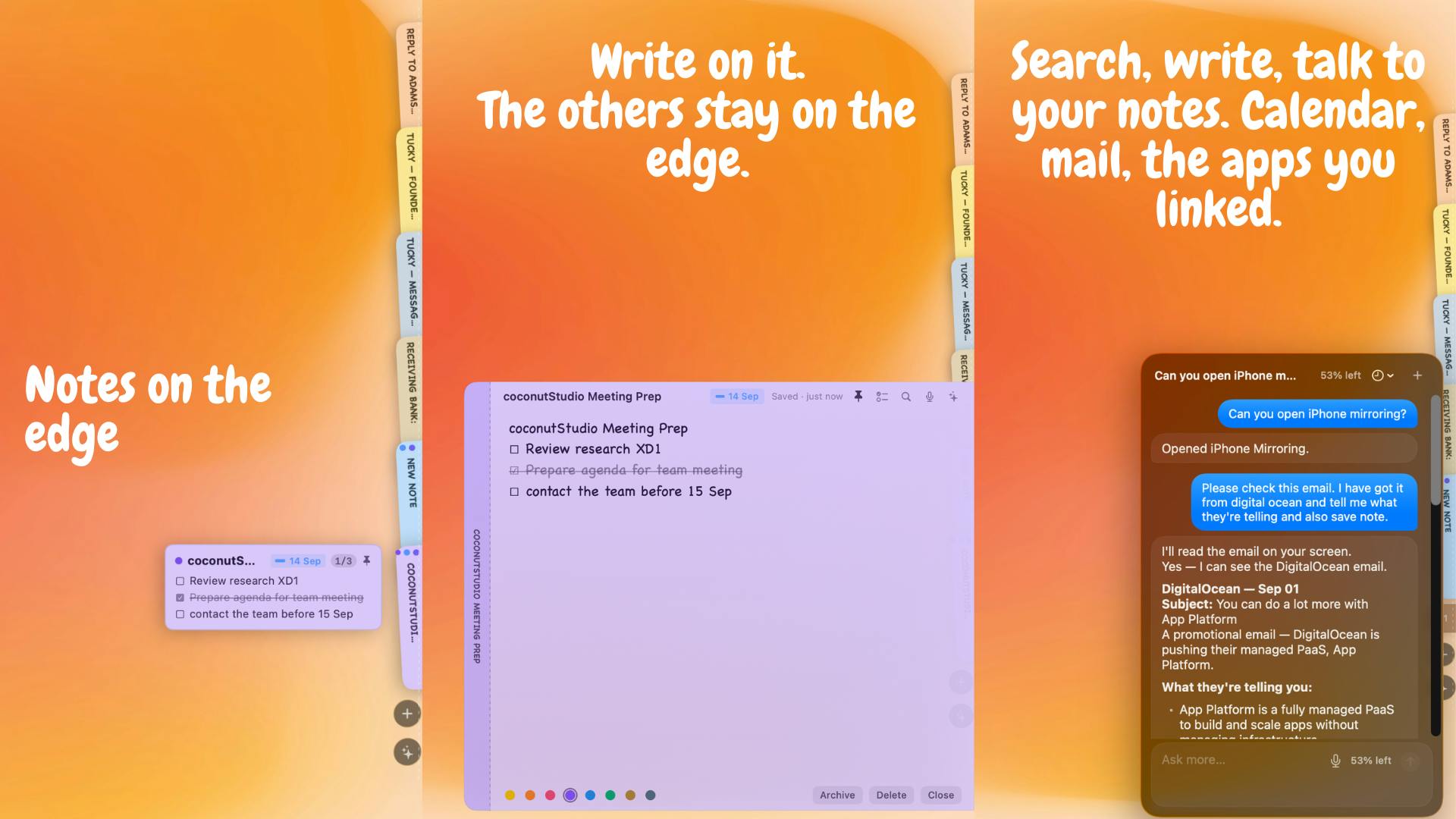
Tucky is a native macOS note-taking application that remains collapsed at the edge of the screen until the user activates it. It combines local encrypted notes with an AI agent, voice dictation, and connectors to Gmail, Google Calendar, Google Docs, Google Sheets, GitHub, and Notion. Its current free plan permits five local notes; Plus costs $4 per month and adds unlimited notes, hosted AI, voice, and connectors (official website).
The product addresses a real but narrow workflow problem: capturing and acting on short notes without changing windows or interrupting the current task. Its strongest product characteristic is the combination of an unobtrusive edge interface and an agent that can turn notes into actions across connected applications. The local-first architecture also differentiates it from cloud-first AI workspaces, although note content leaves the device when users authorize the agent to process or send it (privacy policy).
The strongest company-level signal is coconutStudio’s broader distribution base. The company reported 14,000 users in June 2026, while a later founder-associated announcement claimed 17,000 users in three months. These figures relate to coconutStudio’s broader AI platform—not specifically to Tucky—and remain company-reported rather than independently audited (CoconutStudio LinkedIn, launch statement). If engaged, that audience could provide Tucky with a low-cost initial distribution channel.
The most important investment concerns are weak product defensibility, an unusually low subscription price relative to hosted AI costs, and absent Tucky-specific commercial metrics. Tucky is explicitly based on Noty, an MIT-licensed open-source application that already provides the edge-docked interface, encryption, tasks, and quick capture (Tucky license, Noty GitHub). Tucky’s proprietary value therefore rests primarily on AI, voice, connectors, branding, and distribution rather than the core note interface.
Decision: Watch. Product quality is promising, but neither Tucky-specific traction nor sustainable unit economics are demonstrated. The company should be reconsidered for formal diligence after verifying paid retention, AI gross margins, commercial licensing terms, and the conversion of coconutStudio’s reported user base into retained Tucky subscribers.
Product Overview
Tucky targets Mac-based founders, developers, and knowledge workers who frequently capture short tasks or thoughts while working in other applications. Traditional alternatives require opening a notes window, switching context, or navigating a larger workspace.
The application rests as a thin strip at the edge of the display. Notes fan out when activated, and users can open, edit, search, or ask an AI agent about them. Global shortcuts allow users to invoke the agent from another application. The website lists Markdown formatting, checklist tasks, encrypted local storage, voice dictation in more than 60 languages, and integrations with productivity applications (Tucky).
Current requirements are macOS 15 or later, with support for both Apple silicon and Intel Macs. The application is distributed directly as a notarized DMG and includes an automatic updater; it is not dependent on the Mac App Store (official website).
Pricing is:
- Free: Five encrypted local notes; no AI, voice, or connectors.
- Plus: $4 per month; unlimited notes, hosted models, voice, and connectors.
- AI top-ups: Announced as coming soon.
- Commercial use: Requires a separate coconutStudio license with no public price list.
The commercial-use restriction is important. The standard license permits personal, study, research, and noncommercial activity, while using Tucky for company work requires separate permission (license). This conflicts operationally with Product Hunt positioning around founder workflows unless commercial licensing is made clear during onboarding.
A Product Hunt review lists Plus at $12 per month, whereas the current official website, privacy policy, and terms consistently state $4. The primary-source price of $4 is therefore used; the conflicting review reduces confidence in historical pricing evidence (Product Hunt review, terms).
Product Quality Assessment: Well-designed and workflow-conscious, with useful AI expansion, but much of the core interface is derived from an available open-source product.
Founder and Team Assessment
Tucky is presented as a product of coconutStudio. Mehdi Harzallah publicly identifies as a coconutStudio co-founder and AI/DevOps engineer (LinkedIn profile). Abdelbasset Henna is publicly associated with coconutStudio as a full-stack software engineer, although his exact ownership or founder status was not verified (LinkedIn search result).
LinkedIn categorizes CoconutStudio as a self-owned information-services company with 2–10 employees, but only two employees were visible on its public company profile. This is a platform estimate rather than verified payroll data (company profile). Previous exits, institutional fundraising, and complete employment histories were not found.
The team demonstrates credible technical breadth across macOS development, hosted AI, DevOps, OAuth connectors, data infrastructure, and local encryption. Commercial execution has some positive signal from coconutStudio’s company-reported user acquisition, but Tucky has not demonstrated paid conversion or category-specific distribution.
The relationship with Noty requires clarification. Tucky’s license credits Aymen Hamza’s MIT-licensed Noty code, while Tucky adds coconutStudio features and applies a PolyForm Noncommercial license to its own distribution (license). The use appears license-compatible based on the published notice, but investors should verify code provenance and ownership of all modifications.
Founder Assessment: Technically credible small team with potential distribution leverage, but ownership, commercial experience, and Tucky-specific commitment require verification.
Market Opportunity
The narrow initial market is Mac-based knowledge workers who value instant-access notes and are willing to pay for AI actions across email, calendar, documents, and development tools.
Direct willingness to pay is visible in adjacent products. SideNotes sells an edge-access note application through a one-time purchase model and includes iCloud synchronization, backups, tasks, automation, and mobile support (SideNotes). Bear charges $2.99 monthly or $29.99 annually for its broader note product, while Raycast Pro starts at $8 monthly and includes AI, notes, and cross-device synchronization (Bear pricing, Raycast pricing).
No reliable count of potential Tucky customers is publicly available. An illustrative analyst scenario assumes 1–3 million globally reachable Mac users with frequent short-note and AI-assistant workflows. At $48 in annual subscription revenue, that represents a $48 million–$144 million initial serviceable revenue pool. This is an assumption, not a verified market estimate, and capturing a significant percentage would be difficult.
Adjacent expansion could include Windows, iOS, shared team notes, enterprise knowledge search, automated workflows, and a cross-platform AI assistant. Those adjacencies could support venture-scale revenue, but they would move Tucky beyond its current Mac utility positioning.
Traction and Growth Signals
Available evidence includes:
- Product Hunt’s final daily #3 award on September 7, 2026 and 505 followers shortly after launch (awards).
- One Product Hunt review with a 4/5 rating; this is too small a sample to establish satisfaction (reviews).
- Version 1.1.2 was publicly available as of the report date (Tucky).
- The underlying Noty repository had 413 stars, 60 forks, and recent code activity, indicating developer interest in the edge-docked interface but not Tucky adoption (GitHub API).
- Noty’s version 1.6.1 release recorded more than 1,100 downloads across Apple silicon and Intel assets. These are Noty downloads and must not be attributed to Tucky (Noty releases).
- CoconutStudio reported 14,000 broader platform users in June, subsequently claiming 17,000. Neither figure identifies active, retained, or paying users, and neither verifies Tucky adoption (CoconutStudio LinkedIn).
No Tucky-specific downloads, active users, subscribers, revenue, conversion, retention, cohort data, website traffic, or customer acquisition costs were publicly disclosed.
Traction Assessment: Visible launch interest and potential parent-platform distribution, but Tucky’s commercial traction is unverified.
Competitive Position
Direct competitors include SideNotes and the free open-source Noty. Indirect competitors include Apple Notes, Bear, Raycast Notes, Unclutter, Notion, and desktop sticky-note applications.
Tucky’s differentiation is the combination of edge access, local encrypted notes, hosted AI, voice, and application connectors at $4 monthly. However:
- Noty provides substantially the same edge-docked note interface under an MIT license.
- SideNotes provides mature edge notes, integrations, iCloud synchronization, mobile access, and backups.
- Raycast can combine global invocation, notes, AI, extensions, and cross-device sync.
- Large productivity platforms can bundle AI connectors and quick capture.
Switching costs are low because Tucky supports Markdown and text export. There is no verified proprietary dataset, network effect, or exclusive integration. Its most credible advantages are price, local-first design, user experience, and access to coconutStudio’s existing audience.
If the largest platform launched the same feature within six months, customers would probably remain only if Tucky were materially faster, more private, less expensive, or substantially better at executing cross-application actions. Those advantages have not yet been demonstrated through retention or comparative performance.
Defensibility Assessment: Low
Business Model and Economics
Tucky’s main recurring revenue is $48 per subscriber annually before discounts, taxes, refunds, and processing costs. Commercial licenses and future AI top-ups could add higher-margin or usage-based revenue.
The website describes Plus as “$4 of AI” with voice and connectors included. If the entire monthly subscription is effectively an AI allowance, gross margin may depend heavily on unused credits, model routing, negotiated inference prices, and top-up behavior. CoconutStudio uses external model providers through OpenRouter, Fireworks.ai, and other vendors, while Composio supplies part of the integration layer (coconutStudio privacy policy).
Local note storage should be inexpensive. Variable costs arise when users invoke hosted models, speech services, connector infrastructure, European hosting, and customer support. Heavy users could be unprofitable at $4 unless usage is tightly capped or routed to inexpensive models.
Enterprise potential is currently constrained by unpublished commercial-license pricing, limited administration features, and the lack of public evidence for shared workspaces, security certifications, or service-level commitments.
Unicorn Path
Assume an 8× ARR multiple for a high-growth subscription software company with defensible retention and healthy gross margins. Tucky does not currently merit that multiple; it represents the performance needed for a future unicorn outcome.
Required ARR = $1 billion ÷ 8 = approximately $125 million.
At the current $48 annual subscription price:
Required paying subscribers = $125 million ÷ $48 ≈ 2.6 million.
That calculation excludes discounts and assumes revenue rather than gross profit. If AI costs materially reduce gross margin, Tucky would require more subscribers or a higher valuation multiple than fundamentals justify.
A credible route would require:
- Windows and mobile expansion.
- Higher-priced team and enterprise plans.
- Shared knowledge, administration, and security controls.
- Usage-based AI revenue and disciplined model routing.
- Strong conversion from coconutStudio’s broader user base.
- Proprietary workflow data or automation advantages.
- Repeatable international distribution.
Under the current Mac-only notes model, the required subscriber count is implausibly large. The route becomes conceivable only if Tucky evolves into a broader cross-platform AI productivity workspace.
Unicorn Path: Conditional
Valuation Assessment
No reliable information was found regarding funding rounds, investors, SAFE caps, post-money valuation, acquisition offers, or current fundraising. References to support from Crearena do not establish an equity investment or financing amount.
Valuation Attractiveness: Not Assessable
Assessment requires Tucky and coconutStudio revenue, paid growth, gross margin by usage cohort, retention, burn, runway, cap table, round size, valuation cap, investor ownership, and liquidation preferences.
Key Risks
- No Tucky-specific commercial validation.
- Potentially weak AI gross margins at $4 per month.
- Core interface available through free MIT-licensed Noty.
- Low switching costs and intense productivity competition.
- Commercial-use licensing creates friction for the stated professional audience.
- Mac-only platform limits reach and creates ecosystem dependency.
- Sensitive connector and screen-content processing increases privacy and security exposure.
- Pricing inconsistency in public reviews may confuse prospective customers.
- Small-team execution and key-person concentration.
- Parent-platform user claims are unverified and may not translate into Tucky retention.
Final Assessment
Venture Potential: 45/100
| Category | Score |
|---|---|
| Market Size and Expansion Potential | 10/20 |
| Traction and Growth Evidence | 5/20 |
| Founder and Team | 8/15 |
| Product Strength | 8/10 |
| Distribution Potential | 6/15 |
| Business Model and Economics | 5/10 |
| Defensibility | 3/10 |
| Total | 45/100 |
Product design, technical execution, and potential coconutStudio distribution are the strongest elements. Defensibility, Tucky-specific traction, and AI unit economics are the weakest.
Evidence Confidence: 48/100
Product functionality, pricing, privacy architecture, licensing, platform availability, and source-code provenance are publicly documented. Team size and coconutStudio users are platform- or company-reported. Tucky revenue, downloads, subscribers, retention, gross margin, funding, ownership, burn, and valuation remain unavailable.
Final Decision: Watch
Tucky may become a sustainable independent productivity business, but the present evidence does not establish a venture-scale company. The combination of open-source substitutability, low pricing, uncertain AI costs, and absent retention data prevents a DD recommendation.
Upgrade Conditions
- At least $500,000–$1 million ARR with verified monthly growth.
- More than 10,000 paying Tucky subscribers.
- Six-month paid retention above 70%.
- Gross margin above 70% after model and connector costs.
- Documented conversion from coconutStudio users into Tucky subscribers.
- Public team and business licensing with materially higher annual contract value.
- Repeatable acquisition beyond Product Hunt and lifetime-deal channels.
Downgrade Conditions
- AI usage causes persistently weak or negative contribution margin.
- Paid conversion remains low after the launch period.
- Commercial-license restrictions suppress professional adoption.
- Noty or SideNotes reproduces Tucky’s agent functionality.
- Security incidents involving notes, OAuth tokens, email, or screen captures.
- Development slows or the product is absorbed without a distinct commercial strategy.
Questions for Further Diligence
- How many Tucky downloads, MAUs, and paying subscribers exist today?
- What are 30-, 90-, and 180-day retention by free and paid cohort?
- What percentage of coconutStudio’s reported users have installed Tucky?
- What are current Tucky MRR, monthly growth, and free-to-paid conversion?
- How much AI and connector cost does an average and heavy subscriber generate?
- What usage limits apply before top-ups are required?
- Who owns coconutStudio, Tucky’s modifications, brand, and customer contracts?
- What are the team structure, founder commitments, burn, and runway?
- What commercial license is required for founders using Tucky at work, and what does it cost?
- How are OAuth tokens, screen captures, and note content secured and deleted?
- What current round, valuation, cap table, and financing terms are being offered?
- What proprietary advantage will remain if Noty or Raycast adds equivalent connectors?
Sources
- Tucky official website and pricing
- Tucky on Product Hunt
- Product Hunt awards
- Tucky privacy policy
- Tucky terms
- Tucky software license and Noty attribution
- coconutStudio privacy and infrastructure disclosures
- CoconutStudio LinkedIn company profile
- Noty open-source repository
- SideNotes official website
- Raycast pricing
- Bear pricing