
Table of Contents
Appwrite 2.0 Investment Report
Category: Open-source backend-as-a-service and application cloud
Company Stage: Series A / commercial-growth stage
Founder or Founders: Eldad Fux
Headquarters: San Francisco, California; remote-first global team
Funding: $37 million publicly announced
Business Model: Open-core cloud infrastructure, usage-based hosting, project subscriptions and enterprise contracts
Product Hunt Launch Date: September 16, 2026
Report Date: September 19, 2026
| Investment Metric | Assessment |
|---|---|
| Venture Potential | 79/100 |
| Unicorn Path | Plausible |
| Valuation Attractiveness | Not Assessable |
| Evidence Confidence | 72/100 |
| Final Decision | DD |
Executive Summary
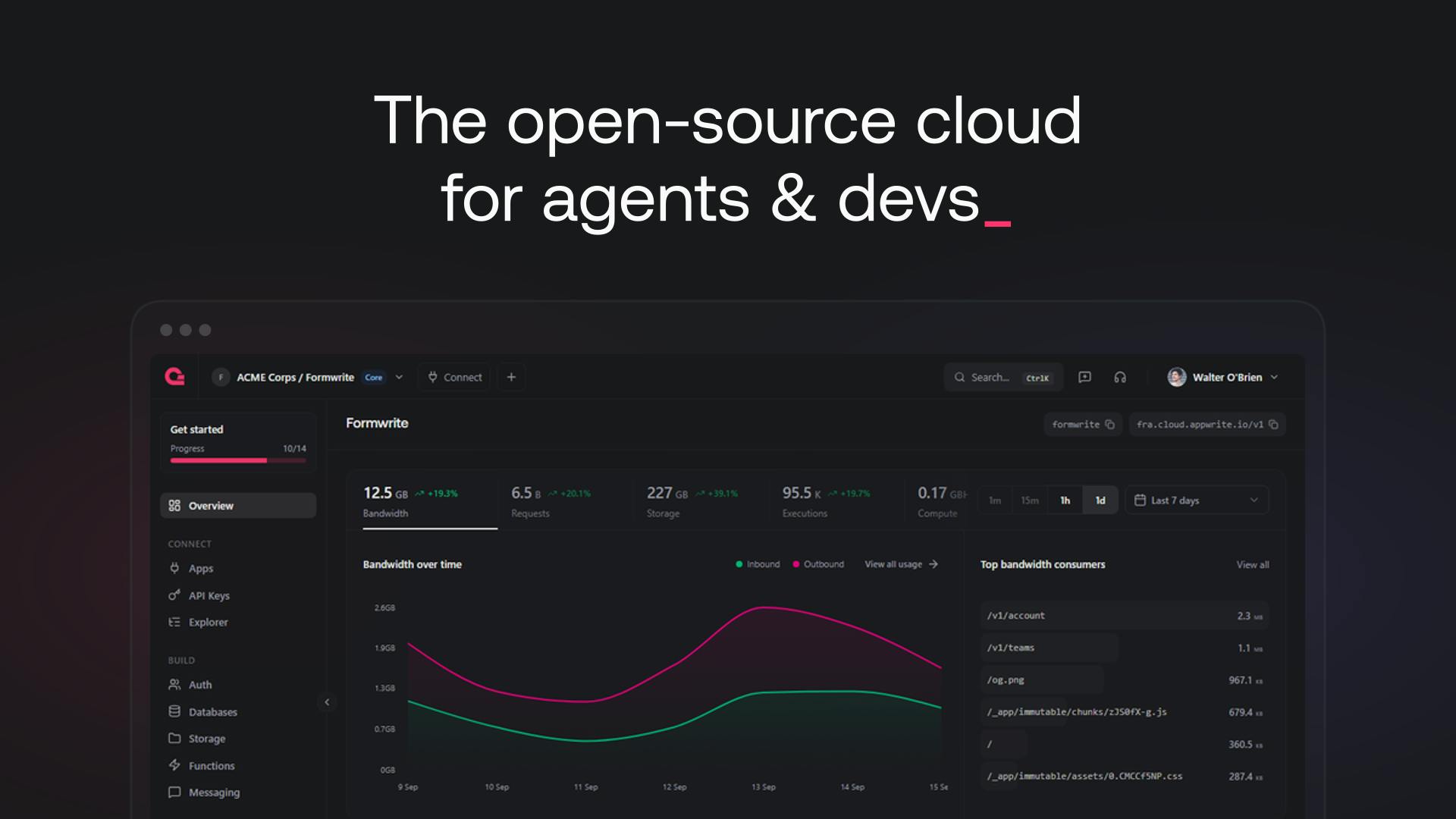
Appwrite 2.0 is the second major generation of Appwrite’s open-source application-development platform. It combines authentication, databases, object storage, serverless functions, messaging, hosting, realtime services and networking. Version 2.0 adds native PostgreSQL and MySQL, schemaless and vector databases, S3-compatible storage, OAuth 2.1/OpenID Connect, firewall controls, domain management and a rebuilt management console (2.0 announcement).
The product serves developers and small-to-medium software teams that want a consolidated backend without assembling separate database, authentication, storage and deployment vendors. Customers can use Appwrite Cloud or self-host the BSD-licensed project, reducing lock-in relative to proprietary backend platforms. The central product thesis—one portable platform for applications built by developers and coding agents—is credible.
The strongest investment signal is sustained developer adoption rather than the recent Product Hunt launch. Appwrite began as an open-source project in 2019, reports hundreds of thousands of developers, and had approximately 57,400 GitHub stars and 5,730 forks at the report date. The repository remains active, with Appwrite 2.2 released shortly after 2.0 (company history; GitHub metadata; releases).
The principal concern is monetization visibility. Appwrite has raised $37 million, but revenue, growth, paying-customer count, cloud conversion, retention, gross margin and cash runway are not publicly disclosed. Cloud only reached general availability in September 2025, several years after the open-source project launched, so the conversion of community adoption into durable cloud revenue remains unverified.
Decision: DD. Appwrite has a large addressable market, an established developer brand, significant open-source distribution and a credible route to $100 million-plus revenue. Formal diligence is justified, but investment attractiveness cannot be determined without financial performance and current financing terms.
Product Overview
Appwrite addresses the operational burden of combining and maintaining authentication, databases, storage, functions, messaging, hosting and networking. The conventional alternatives are assembling multiple specialized services, adopting a proprietary backend platform or operating open-source components manually.
Appwrite 2.0 offers:
- TablesDB, DocumentsDB, VectorsDB and native PostgreSQL and MySQL.
- Authentication plus an OAuth 2.1/OpenID Connect server.
- S3-compatible storage.
- Functions, application hosting, realtime APIs and messaging.
- Firewall, domains, DNS and automatic TLS.
- A rebuilt console, browser terminal and API explorer.
- Cloud-hosted and self-hosted deployment options.
Appwrite says existing projects can continue without migration. Native SQL databases can be accessed through standard clients and ORMs, while S3 compatibility lets developers use existing AWS-compatible tools. This protocol-first strategy materially improves portability (official launch details).
Appwrite Cloud has a free plan, Pro pricing starting at $25 per project per month, usage overages and custom enterprise pricing. Dedicated database compute starts at $10 monthly and reaches $960 monthly before replicas, recovery and overages. Pro includes a project-level resource allocation rather than per-seat pricing (pricing page; pricing update).
The product is active and shipping rapidly: version 2.2 was published on September 15, 2026, with fixes and infrastructure changes across databases, authentication, functions and hosting (GitHub release).
Founder and Team Assessment
Eldad Fux founded Appwrite after more than a decade at Walla!, where the company reports that he progressed from developer to CTO. He previously co-founded Careerpage and served as its CTO. Appwrite began as his open-source side project in 2019 (company page).
This background supports strong founder-market fit: Fux has infrastructure, open-source and technical-leadership experience directly relevant to the product. He has also demonstrated persistence through seven years of product development and the transition from open-source project to managed cloud.
Appwrite describes itself as a remote-first team spanning more than 15 countries and five continents. LinkedIn shows 35 associated profiles and a company-size band of 11–50, but exact employee count is not publicly disclosed. The official company page says 68% of the team is in engineering and currently lists no open roles (company page; LinkedIn).
No previous founder exit was verified. Commercial leadership depth, founder ownership and succession coverage are unknown.
Founder Assessment: Strong technical and open-source execution; commercial scaling capability requires verification.
Market Opportunity
The initial segment is developers and software teams launching production web, mobile or AI applications that need several backend services but lack dedicated infrastructure teams.
Willingness to pay is supported structurally by the cost and complexity of operating databases, authentication, storage and deployment infrastructure. However, Appwrite’s own paid conversion and customer spending are not public.
A bottom-up scenario illustrates the opportunity:
- 100,000 production projects;
- $1,200 average annual revenue per project, including base subscriptions and usage;
- Resulting annual revenue: $120 million.
At the minimum Pro price of $300 annually, Appwrite would require approximately 333,000 paid projects to reach $100 million ARR. A more enterprise-oriented mix—10,000 customers at $10,000 annual contract value—would also produce $100 million ARR.
These are analyst scenarios, not forecasts. Current paying-project count and average revenue per customer are unknown.
Adjacent opportunities include dedicated databases, enterprise security, managed self-hosting, support, higher-availability infrastructure, domains, messaging, AI/vector workloads and marketplace integrations. Because Appwrite is globally distributed and delivered through cloud or self-hosting, geographic expansion is not a major structural constraint.
Traction and Growth Signals
Appwrite reports that the platform is used by hundreds of thousands of developers worldwide. An April 2022 funding report cited more than 150,000 developers and 550 maintainers at that time, but neither source identifies current active or paying users (company page; CTech).
GitHub provides the strongest independently observable traction: approximately 57,400 stars, 5,730 forks, 385 listed contributors and continuing releases. Stars are not revenue, but this scale and multi-year activity demonstrate durable developer awareness rather than a one-day launch effect (GitHub).
Appwrite publishes customer stories spanning products such as Lorari, Radar and Majik Kids. These offer evidence of real production usage, although contract values and independent customer verification are limited. Lorari is company-reported as serving more than 130 fitness studios and 13,000 students on Appwrite Cloud (customer stories; LinkedIn).
Appwrite 2.0 ranked #2 Product of the Day on September 16, 2026. Reliable vote and comment totals were not available. This ranking indicates launch interest but adds little to the commercial assessment (Product Hunt; daily leaderboard).
Critical missing metrics are ARR, growth, paid projects, cloud usage, free-to-paid conversion, churn, net revenue retention and enterprise contract count.
Traction Assessment: Strong open-source and product-usage signals, but monetization remains commercially unverified.
Competitive Position
Direct competitors include Supabase, Firebase and other backend-as-a-service platforms. Free and manual alternatives include PocketBase, self-hosted Appwrite and individually assembled databases, authentication tools, storage systems and serverless platforms.
Supabase offers managed PostgreSQL, authentication, storage, realtime functions and enterprise plans, while Firebase combines proprietary backend products with the broader Google Cloud ecosystem (Supabase pricing; Firebase pricing). PocketBase provides a lighter open-source backend built around SQLite, user management, files and realtime subscriptions, but warns that full backward compatibility is not guaranteed before version 1.0 (PocketBase).
Appwrite’s advantages are breadth, self-hosting, permissive licensing, existing community distribution and increasing support for standard protocols. Its integrated stack can increase switching costs once an application depends on multiple Appwrite services. However, database portability does not eliminate lock-in in authentication rules, functions, messaging and platform-specific APIs.
There are no strong network effects. Defensibility derives primarily from the codebase, community, developer brand, integrations and accumulated operational experience.
If the largest platform in this market launched the same feature within six months, why would customers continue using Appwrite? Customers valuing source access, self-hosting, vendor neutrality and a unified cross-cloud experience would have reasons to remain. Customers prioritizing hyperscaler scale, procurement relationships or native cloud integration could switch.
Defensibility Assessment: Medium-High
Business Model and Economics
Revenue comes from per-project subscriptions, database compute, storage, bandwidth, functions, messaging, enterprise plans and related infrastructure usage. The free and self-hosted editions are acquisition channels for the managed cloud.
Base Pro pricing is low, so venture-scale economics depend on projects growing into meaningful infrastructure spend or converting into enterprise contracts. Dedicated databases, high availability, backups and usage overages provide expansion revenue.
Gross-margin potential is lower and more variable than pure application SaaS because Appwrite bears compute, storage, bandwidth and support costs. Vector embedding features may add inference costs. Revenue should rise with usage, but gross margin depends on infrastructure procurement, utilization, regional scale and pricing discipline. No public gross-margin data is available.
Customer acquisition likely combines open-source discovery, documentation, community activity, referrals and product-led conversion. Enterprise security and support may require a direct sales motion. CAC and payback are unknown.
Unicorn Path
An assumed 10× ARR multiple is reasonable for a fast-growing cloud infrastructure company with strong retention and healthy gross margins. At that multiple:
Required ARR = $1 billion ÷ 10 = $100 million
Potential routes include:
- 333,000 Pro projects at the $300 annual base price;
- 100,000 production projects averaging $1,000 ARR;
- 10,000 larger customers averaging $10,000 ARR;
- A blended model combining project fees, usage and enterprise contracts.
The path is credible because backend infrastructure supports substantial usage expansion, and Appwrite already has broad developer distribution. It nevertheless requires major conversion of free and self-hosted adoption into paid cloud usage, enterprise-grade reliability, materially higher average contract values and disciplined infrastructure margins.
Unicorn Path: Plausible
Valuation Assessment
Appwrite raised a $10 million seed round led by Bessemer Venture Partners and Flybridge, followed by a $27 million Series A led by Tiger Global with participation from existing investors. The official history dates completion of the Series A to December 2021, while press coverage announced it in April 2022; this appears to be a completion-versus-announcement distinction, but the precise closing date should be verified (company page; CTech).
The latest valuation, current fundraising status and financing terms are not publicly disclosed. No reliable comparable financing or acquisition data provides a responsible valuation range without Appwrite’s revenue and growth.
Valuation Attractiveness: Not Assessable
Required information includes ARR, growth, gross margin, retention, burn, runway, cloud revenue mix, current round size, post-money valuation, investor ownership, option pool and liquidation preferences.
Key Risks
- No verified revenue, growth or paid-customer data despite seven years of product history.
- Strong competition from well-funded developer platforms and hyperscalers.
- Potentially expensive cloud infrastructure and support requirements.
- Unproven conversion from open-source users to paid cloud customers.
- Low initial pricing may require very high project volume.
- Self-hosting can reduce monetization and enable customers to avoid cloud fees.
- Broad product scope creates execution and reliability complexity.
- Developers may prefer best-of-breed components over one integrated platform.
- Security failures would be especially damaging because Appwrite handles authentication and application data.
- Unknown runway and valuation after the last disclosed funding round.
Final Assessment
Venture Potential: 79/100
| Category | Score |
|---|---|
| Market Size and Expansion Potential | 19/20 |
| Traction and Growth Evidence | 14/20 |
| Founder and Team | 13/15 |
| Product Strength | 9/10 |
| Distribution Potential | 14/15 |
| Business Model and Economics | 7/10 |
| Defensibility | 3/10 |
| Total | 79/100 |
The strongest elements are market size, open-source distribution and product breadth. The weakest are limited commercial disclosure, uncertain infrastructure economics and competition from platforms with greater capital and distribution.
Evidence Confidence: 72/100
Product features, pricing, funding, founder identity and GitHub activity are well supported. Developer counts and customer outcomes are company-reported. Revenue, retention, gross margin, burn, runway, active cloud usage and valuation remain unavailable.
Final Decision: DD
Appwrite merits formal diligence because it has a mature product, sustained organic distribution and a plausible route to infrastructure-scale revenue. It does not merit an “Invest” decision from public evidence because valuation, financial performance, retention and unit economics are unknown.
Upgrade Conditions
- Verified ARR above $10 million with strong sustained growth.
- Net revenue retention above 115%.
- Cloud gross margin approaching or exceeding 65–70%.
- Demonstrated conversion of self-hosted users into paid cloud accounts.
- Material enterprise contracts and credible customer references.
- Repeatable acquisition with acceptable CAC payback.
Downgrade Conditions
- Flat or declining cloud revenue despite community growth.
- Weak free-to-paid conversion or high project churn.
- Infrastructure costs producing structurally low gross margins.
- Serious security or availability incidents.
- Material loss of community contributors or release velocity.
- Financing terms implying an unsupported valuation.
Questions for Further Diligence
- What are current ARR, cloud revenue and monthly growth?
- How many active, paying projects and paying organizations use Appwrite?
- What are free-to-paid conversion and 30-, 90- and 180-day retention?
- What are gross retention and net revenue retention by customer segment?
- What are average revenue and gross margin per production project?
- How much revenue comes from subscriptions versus compute and bandwidth?
- What percentage of active workloads are Cloud versus self-hosted?
- What are CAC, payback and the largest acquisition channels?
- How concentrated is revenue among the largest customers?
- What are current burn, runway and team structure?
- What service-level, security and data-sovereignty obligations apply to enterprise customers?
- What are the cap table, current valuation and proposed financing terms?