
Table of Contents
Superset Mobile Investment Report
Category: Developer tools / AI-agent orchestration
Company Stage: Seed
Founder or Founders: Kiet Ho, Satya Patel, Avi Peltz
Headquarters: San Francisco, California
Funding: Approximately $11.5 million in equity financing
Business Model: Freemium, per-seat SaaS, and custom enterprise contracts
Product Hunt Launch Date: September 21, 2026
Report Date: September 25, 2026
| Investment Metric | Assessment |
|---|---|
| Venture Potential | 74/100 |
| Unicorn Path | Conditional |
| Valuation Attractiveness | Not Assessable |
| Evidence Confidence | 65/100 |
| Final Decision | DD |
Executive Summary
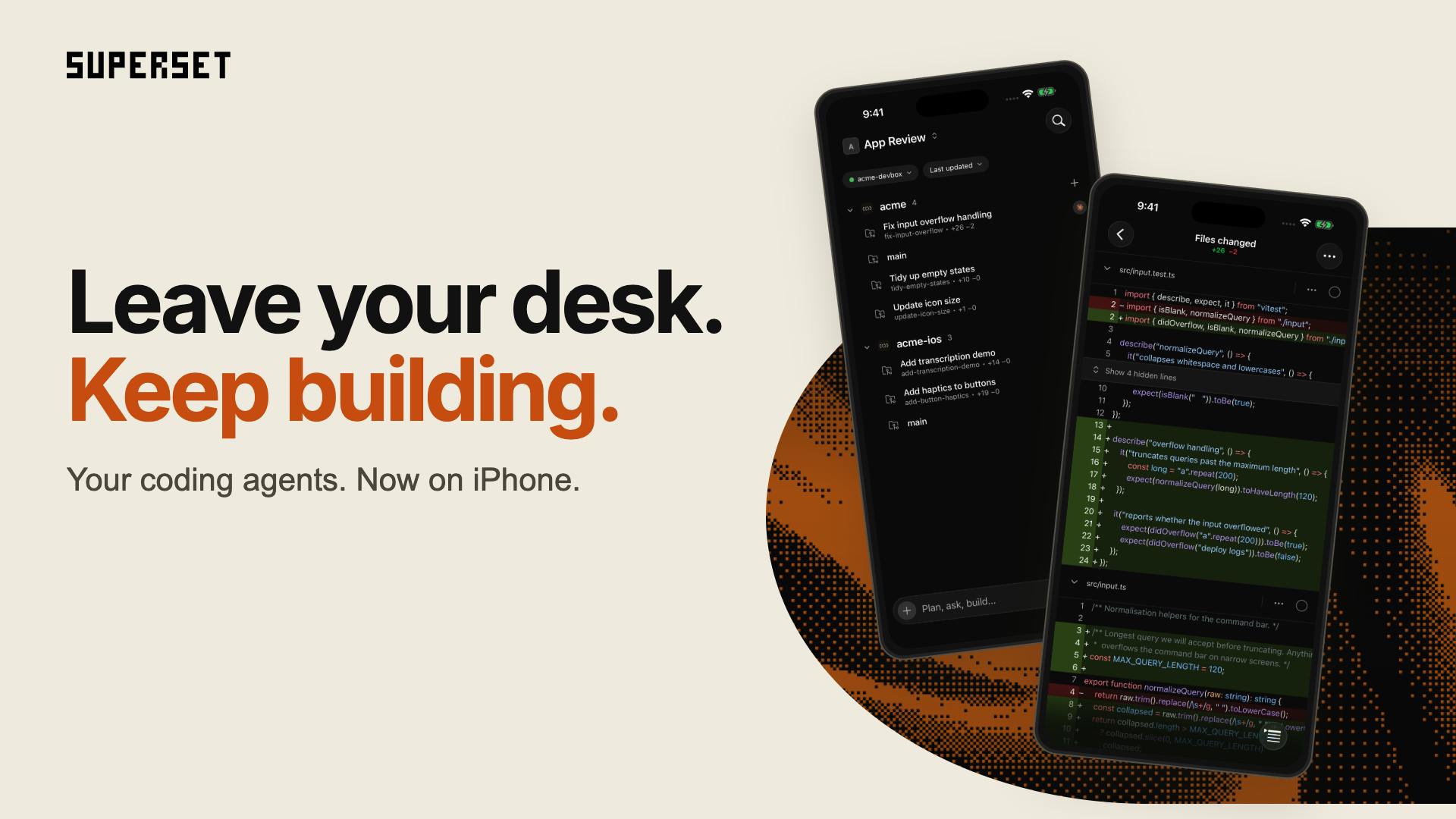
Superset Mobile is the iPhone companion to Superset, a terminal-first workspace for operating multiple AI coding agents. Developers can initiate tasks, monitor terminal sessions, respond to agents, review code changes, and merge pull requests while away from their computers. The mobile product is included with Superset Pro and requires a connected host running the desktop software (Product Hunt; Superset Mobile).
The broader product is more important to the investment case than the mobile application alone. Superset organizes coding-agent sessions in separate Git worktrees, supports multiple third-party command-line agents, and provides diff review, remote access, scheduled automations, CLI and SDK access, and team integrations. The company does not supply the underlying models; customers bring their existing agent subscriptions or API keys (official website; GitHub repository).
The strongest evidence is product velocity and developer adoption. Superset’s public repository has approximately 14,600 stars and 1,300 forks, while its launch materials reported more than 75 contributors and tens of thousands of engineers using the desktop product. Its changelog shows substantial weekly releases, and an SEC Form D records approximately $11.5 million of equity sold to 35 investors in 2026 (GitHub; YC launch; SEC filing).
The principal concern is defensibility. Agent orchestration, worktree management, remote sessions, and mobile control are becoming standard capabilities across coding platforms. Superset faces both specialized competitors and model or IDE vendors that control underlying distribution. Its source-available architecture and agent neutrality encourage adoption but do not yet create high switching costs.
The final decision is DD. Product quality, team experience, community traction, and market timing justify formal diligence. However, revenue, paid seats, retention, gross margin, enterprise pipeline, and financing valuation remain undisclosed.
Product Overview
Superset addresses the coordination problem created when developers run several coding agents concurrently. A conventional terminal or editor can become difficult to manage when multiple agents operate across repositories, branches, and tasks. Superset gives each task a separate Git worktree and persistent terminal session, then centralizes status monitoring, review, and merging.
Superset Mobile extends that control layer to the iPhone. Users can:
- Start agent tasks on a connected computer;
- Monitor output and permission requests;
- Send follow-up instructions or dictated prompts;
- Attach screenshots and photos;
- Review file-by-file diffs;
- Comment on specific lines;
- Open and merge pull requests.
The application works with terminal agents including Claude Code, Codex, Gemini CLI, Cursor Agent, GitHub Copilot, OpenCode, and others. Code and agent processes remain on the connected computer; the phone functions primarily as a remote interface (App Store; GitHub documentation).
Pricing is transparent. The individual desktop product is free. Pro costs $20 per active seat monthly or $15 per seat monthly when billed annually and includes mobile access, remote access, automations, team collaboration, and Slack and Linear integrations. Enterprise pricing is custom and includes SSO, SCIM, audit logs, support, and service-level commitments (pricing page).
Desktop support is strongest on macOS. Linux is experimental, Windows is not currently available, and the mobile product requires iOS 26 or later. Android is listed as coming soon. These limitations narrow the current addressable user base.
Founder and Team Assessment
Superset was founded by Kiet Ho, Satya Patel, and Avi Peltz. The SEC filing identifies all three as executive officers and directors, and Kiet Ho as CEO (SEC Form D).
The company describes Ho as the former CTO of Onlook, a YC W25 company, with previous engineering roles at Amazon and ServiceNow. Patel is described as the former CTO of Untether Labs, with previous experience at Scribe, Google, Amazon, and Facebook. Peltz is described as the former CTO of Adam and a founder of BioGlyph (Superset team).
Y Combinator reports that Superset was founded in 2026, has three employees, and is based in San Francisco. Superset’s own site similarly describes the founders as three former CTOs of YC-backed companies (Y Combinator; Superset team). This supports strong technical and founder-market fit, although the team remains small relative to its product surface and enterprise ambitions.
Commercial capabilities are less established publicly. No previous founder exit was verified, and no dedicated sales or customer-success organization was identified. The founders’ direct engagement with users on Hacker News is positive but also highlights key-person and support-capacity risk.
Founder Assessment: Strong technical founder-market fit and shipping velocity, but enterprise go-to-market execution remains unverified.
Market Opportunity
The initial customer segment is software engineers who use CLI-based coding agents frequently enough to operate multiple concurrent sessions. The immediate buyer is either an individual developer paying $180–$240 annually or an engineering organization purchasing Pro or Enterprise seats.
A bottom-up scenario illustrates the potential:
- 500,000 paid Pro seats × $180 annual revenue = $90 million ARR
- 50,000 enterprise seats × an assumed $500–$1,000 annual contract value per seat = $25–$50 million ARR
These are analyst scenarios, not forecasts or company-reported figures. The enterprise assumption includes potential security, support, and administrative premiums not reflected in published Pro pricing.
Adjacent opportunities include hosted development environments, agent evaluation, automated code review, workflow analytics, organizational governance, agent marketplaces, and consumption-based cloud execution. International expansion is feasible because the product already supports 17 interface languages, although localization does not prove demand (changelog).
The market can support venture-scale revenue if multi-agent coding becomes a standard engineering workflow. The narrower risk is that developers may prefer agent functionality bundled into their primary IDE, source-control platform, or model subscription.
Traction and Growth Signals
Superset Mobile was Product Hunt’s Launch of the Day on September 21, 2026. The overall Product Hunt product page reports approximately 2,200 followers, eight reviews, and a 5.0 rating. These figures indicate launch visibility, not product-market fit (Product Hunt launches; Product Hunt awards).
More substantive signals include:
- Approximately 14,600 GitHub stars and 1,300 forks for the main repository;
- A company-reported 11,000 stars and 75 contributors within five months of launch;
- Company-reported use by tens of thousands of engineers;
- Frequent weekly releases documented through September 2026;
- A completed SOC 2 Type II audit;
- Approximately $11.5 million sold in an equity offering to 35 investors;
- A reported tripling of users during an earlier Hacker News launch (GitHub; Superset changelog; Vercel customer story).
The iPhone application is too new to establish sustained mobile traction. Its App Store listing shows a 5.0 rating from only nine ratings. No download count, active-user figure, conversion rate, or subscription retention is disclosed (App Store).
Community feedback is mixed but useful. Hacker News users describe successful multi-session workflows, while others report resource usage, terminal-rendering problems, setup friction, and uncertainty over whether managing many agents is actually productive. These comments are anecdotal rather than representative customer research (Hacker News).
Traction Assessment: Strong open-source and product-activity signals, but paid traction and retention remain commercially unverified.
Competitive Position
Direct competitors include Conductor, Vibe Kanban, Emdash, cmux, and other multi-agent worktree managers. Indirect competitors include terminal multiplexers, custom scripts, native Git worktrees, and coding platforms that integrate parallel or background agents.
Large-platform threats are more important. Cursor offers agent functionality inside its editor, GitHub sells Copilot plans with coding-agent capabilities, and Claude Code provides remote control from mobile devices (Cursor pricing; GitHub Copilot pricing; Claude Code Remote Control).
Superset differentiates through agent neutrality, terminal-first workflows, persistent sessions, local execution, source availability, mobile review, and a single interface spanning desktop, CLI, SDK, and MCP. Customers can change model providers without replacing the orchestration layer.
Nevertheless, switching costs are currently moderate at best. Worktrees and branches remain standard Git objects, and technically capable users can reproduce basic orchestration with terminal tools and scripts. The Elastic License prevents competitors from directly reselling Superset as a service, but it does not prevent independent implementations.
If the largest coding platform launched an equivalent feature, customers would stay only if Superset remained materially better at cross-agent orchestration, workflow automation, remote operation, or enterprise governance. That advantage has not yet been proven durable.
Defensibility Assessment: Medium-Low
Business Model and Economics
Superset’s seat-based model avoids direct model-inference costs because users bring their own subscriptions or API credentials. This should produce better gross-margin potential than an all-inclusive AI subscription, subject to cloud sync, remote-access infrastructure, storage, support, and payment-processing costs.
At annual Pro pricing, individual ACV is $180. A ten-seat team represents $1,800 in annual recurring revenue before discounts. Meaningful enterprise growth will therefore require thousands of teams or higher-value security and workflow products.
The free desktop tier supports distribution but may limit conversion because core local orchestration remains free forever. Paid conversion depends on mobile access, remote access, automations, collaboration, integrations, and enterprise administration being sufficiently valuable.
App Store commissions appear limited because the iOS paywall directs users to web billing rather than offering native in-app subscription purchases, according to the product changelog. Exact payment fees and gross margin are not disclosed.
Unicorn Path
An illustrative 10× ARR multiple is appropriate for a fast-growing developer-infrastructure SaaS company with strong retention and high gross margins.
Required ARR = $1 billion ÷ 10 = $100 million.
At $180 per annual Pro seat, Superset would require approximately 556,000 paid seats. Alternatively:
- 200,000 Pro seats = $36 million ARR;
- 20,000 enterprise customers at $3,200 average annual contract value = $64 million ARR;
- Combined ARR = approximately $100 million.
That customer mix is possible but not demonstrated. It requires international expansion, Windows support, enterprise-grade administration, durable team adoption, and likely higher enterprise ACVs. Cloud workspaces or consumption-based automation could materially expand revenue but would also introduce infrastructure and AI-cost exposure.
Unicorn Path: Conditional
Valuation Assessment
Superset’s website states that it raised $11 million. The more precise SEC Form D records $11,500,089 of equity sold to 35 accredited investors, with the first sale on July 31, 2026. The filing does not identify the valuation or individual investors.
No reliable public information was found regarding the post-money valuation, SAFE caps, liquidation preferences, founder ownership, or current fundraising status. Revenue and growth are also undisclosed.
Valuation Attractiveness: Not Assessable
Responsible assessment requires current ARR, paid-seat growth, gross margin, net and gross retention, burn, runway, post-money valuation, investor ownership, and preference terms.
Key Risks
- Paid conversion and subscription retention are undisclosed.
- Core orchestration may be bundled by model providers or established IDEs.
- The free desktop tier may capture usage without sufficient monetization.
- Developer workflows may not require dozens of parallel agents.
- Windows is unavailable and Linux support remains experimental.
- Product quality complaints include resource usage and terminal stability.
- Low switching costs weaken pricing power.
- Enterprise security and support could strain a three-person team.
- Dependence on third-party agents and their authentication interfaces creates integration risk.
- Remote access to development machines creates meaningful security obligations.
Final Assessment
Venture Potential: 74/100
| Category | Score |
|---|---|
| Market Size and Expansion Potential | 18/20 |
| Traction and Growth Evidence | 14/20 |
| Founder and Team | 14/15 |
| Product Strength | 9/10 |
| Distribution Potential | 11/15 |
| Business Model and Economics | 5/10 |
| Defensibility | 3/10 |
| Total | 74/100 |
The strongest elements are founder-market fit, rapid shipping, open-source distribution, and positioning across multiple agent providers. The weakest are monetization evidence and resistance to platform replication.
Evidence Confidence: 65/100
Verified information includes the legal entity, founders, headquarters, financing amount, pricing, product availability, GitHub activity, App Store listing, and release history. User-count and customer claims are company-reported. Revenue, retention, margins, burn, valuation, and paid-seat metrics remain unknown.
Final Decision: DD
Superset is sufficiently differentiated and well-executed to justify founder meetings and data-room diligence. It has a credible venture path, but a unicorn outcome depends on converting community adoption into durable team and enterprise revenue. Unknown valuation and commercial metrics preclude an Invest decision.
Upgrade Conditions
- Verified ARR above $2–$3 million with strong monthly growth;
- More than 70% six-month paid-seat retention;
- Repeatable team expansion and net revenue retention above 110%;
- Gross margin above 80%;
- Material enterprise contracts;
- Successful Windows and Android launches;
- Evidence that mobile and automations materially improve paid conversion.
Downgrade Conditions
- Weak free-to-paid conversion or high Pro churn;
- Major agent providers bundling equivalent orchestration;
- Declining repository or release activity;
- Persistent performance and terminal-stability problems;
- Security incidents involving remote machine access;
- Enterprise adoption failing to develop despite SOC 2 completion.
Questions for Further Diligence
- What are current MRR, ARR, and month-over-month revenue growth?
- How many organizations and paid seats use Pro or Enterprise?
- What are 30-, 90-, and 180-day retention by free and paid cohort?
- What percentage of active desktop users adopt Mobile or Remote Access?
- What are free-to-paid conversion and annual-plan renewal rates?
- What are gross margin and infrastructure cost per paid seat?
- Which acquisition channels generate paying customers rather than GitHub stars?
- What are average enterprise contract value, sales cycle, and pipeline?
- How does usage differ between individual developers and engineering teams?
- What technical advantage would remain if a major IDE copied mobile orchestration?
- What are current burn, runway, team plan, cap table, and financing terms?
- How are remote credentials, terminal data, and organization metadata secured?