
Table of Contents
Maximem Synap Investment Report
Category: AI-agent memory and context-management infrastructure
Company Stage: Early-stage, founded 2025; Synap recently launched
Founder or Founders: Gaurav Dadhich, Founder and CEO; Product Hunt also identifies Anish Yadav and Shreyansh Singh Gautam as founding engineers
Headquarters: San Francisco, with engineering in Bangalore (company-reported)
Funding: Not publicly disclosed; Maximem says it was incubated at Scaler Innovation Lab
Business Model: Usage-based API subscriptions with credit allowances, overages, and custom Enterprise plans
Product Hunt Launch Date: September 24, 2026
Report Date: October 8, 2026
| Investment Metric | Assessment |
|---|---|
| Venture Potential | 58/100 |
| Unicorn Path | Conditional |
| Valuation Attractiveness | Not Assessable |
| Evidence Confidence | 41/100 |
| Final Decision | Watch |
Executive Summary
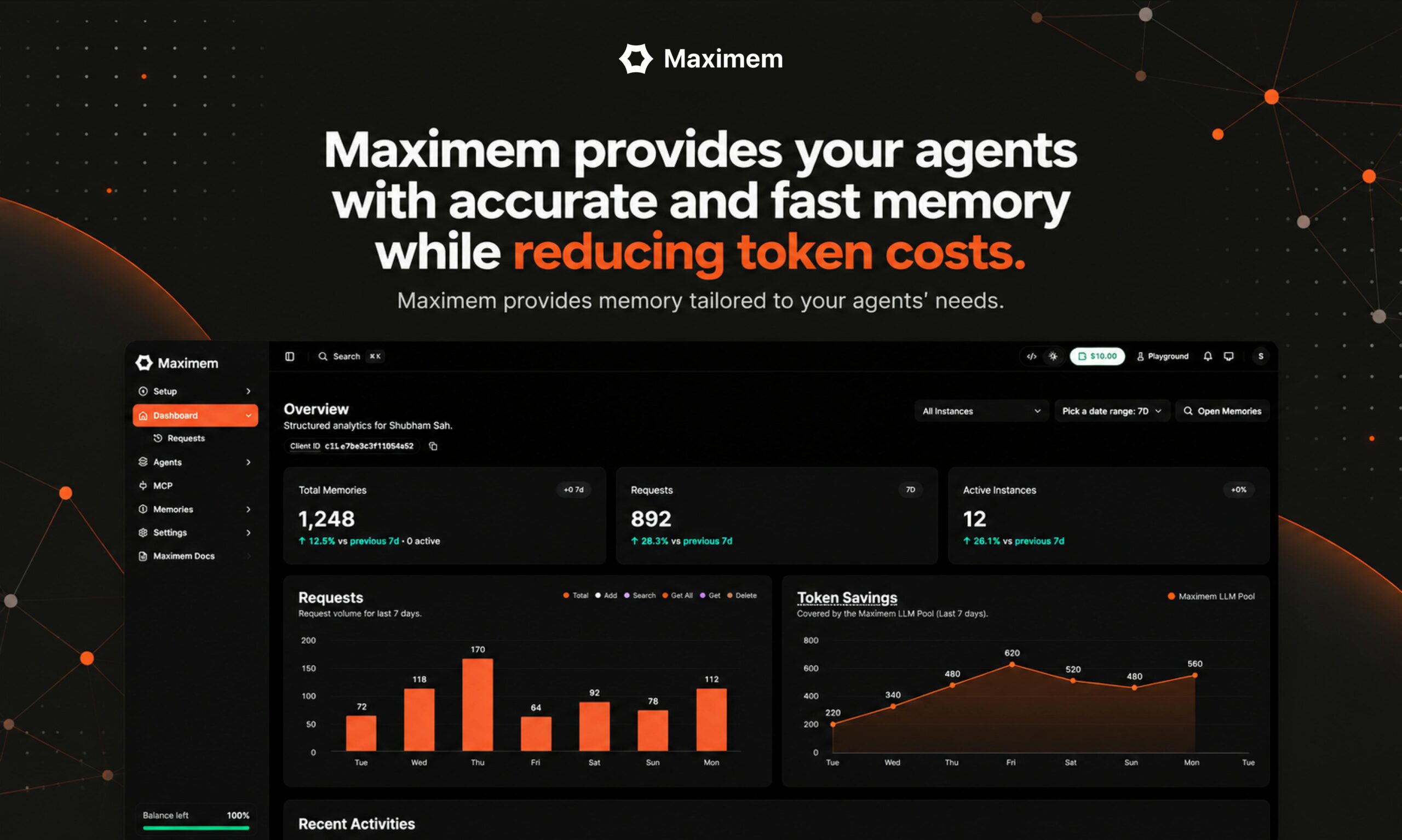
Synap is a managed memory/context layer for developers building agents. Apps send conversations through its SDK/API; Synap organizes scoped memories and returns context for later turns. It targets support, sales, voice, and multi-user agents. (Synap; GitHub SDK)
It advertises entity/temporal handling, anticipatory retrieval, compaction, and broad framework adapters. SDKs are open-source, but the managed engine is proprietary; on-prem/air-gapped deployment is a company-advertised Enterprise option. (GitHub; security)
A positive signal is technical transparency: Maximem publishes an evaluation harness, security details, and pricing. It reports 92.0% LongMemEval and 93.2% LoCoMo using GPT-5-mini as answer and judge. These are company results on synthetic benchmarks, not independent validation. (Methodology)
Commercial validation is missing: no public revenue, paid users, retention, funding, or margin. Product Hunt showed 152 points/#9 daily rank and no reviews; the SDK had 77 stars/15 forks. These are interest signals, not PMF. Build-vs-buy is real: 32% in McKinsey’s 2026 survey said coding agents let them build instead of buying software. (Product Hunt; GitHub; McKinsey)
Decision: Watch. Reconsider after paid production usage, retention, reproducible results, security validation, and financing terms are disclosed.
Product Overview
Synap serves agents needing cross-session facts, entity resolution, temporal updates, and user/tenant isolation. Python/JS SDKs and framework integrations ease adoption, but the proprietary engine creates vendor dependence. (Product; SDK)
Pricing is free, $19 promotional Starter ($49 list), $249 Pro, $999 Scale, and custom Enterprise, metered by credits for retrieval/ingestion/compaction. Pro+ supports BYOK. Maximem claims token savings of about 20% of a typical LLM bill; verify on customer workloads. (Pricing)
Founder and Team Assessment
Maximem says it was founded in 2025, is headquartered in San Francisco with engineering in Bangalore, and was incubated at Scaler. Its pages name Gaurav Dadhich as CEO; Product Hunt lists founding engineers Anish Yadav and Shreyansh Singh Gautam. Team size, exits, and full-time commitment are unknown. (About; Scaler; Product Hunt)
Founder Assessment: Team is identifiable, but scale and execution track record need verification.
Market Opportunity
The target is a production-agent team needing persistent, multi-user context, especially in support, sales, voice, and workflow use cases. It replaces in-house pipelines or open-source memory/database components. WTP depends on recall, latency, privacy, and total cost.
Surveys indicate agent deployment is rising but do not count buyers of memory infrastructure: LangChain found 57% of respondents had production agents; McKinsey found agent scaling at 40% of large firms versus 22% of smaller ones. No reliable buyer count was found; a precise TAM would be false precision. (LangChain; McKinsey)
Annual list equivalents range from $588 Starter to $11,988 Scale. Venture scale requires many production accounts or higher enterprise ACVs; agent growth alone is insufficient if memory is bundled or built internally.
Traction and Growth Signals
Product Hunt showed 152 points/#9 rank/259 followers with no reviews; the SDK had 77 stars and 15 forks. This is early interest, not production traction. (Product Hunt; GitHub)
Revenue, customers, usage, retention, growth, and funding are undisclosed.
Traction Assessment: Technically visible launch; commercial traction is unverified.
Competitive Position
Alternatives include Mem0, Zep, Supermemory, Letta, Cognee, framework-native memory, and in-house systems; some are open-source/self-hostable, others managed and usage-priced. (Mem0; Zep; Supermemory)
Differentiation is a managed memory lifecycle rather than vector search alone. Maximem’s open harness is useful, but its vendor-controlled comparisons use different configurations and are not directly comparable. Customer tests must prove quality and cost. Open SDKs aid distribution but do not create a data network effect.
Defensibility Assessment: Medium-Low
Business Model and Economics
Credit-based pricing can expand with usage; unit economics depend on model processing, storage, support, and CAC. BYOK may shift inference costs on upper tiers, but plan-level cost mix is undisclosed. (Pricing)
The company says managed data is US-hosted and encrypted, raw payloads are kept 15 days, memories until deletion, and tenant isolation/DPA/self-hosted options are available. These are unaudited company claims; no public SOC 2 was found. Data security is central to enterprise sales. (Security)
Unicorn Path
Use an illustrative 8x ARR multiple for a scaled, high-growth infrastructure SaaS business; it is a scenario, not a company valuation or a verified comparable. A $1 billion valuation would imply about $125 million ARR. At Starter’s $49 list price ($588 annualized), that requires roughly 213,000 equivalent accounts; at Pro’s $249/month ($2,988 annualized), about 41,800; at Scale’s $999/month ($11,988 annualized), about 10,400. These simplified calculations assume list price and exclude churn, discounts, overages, costs, and plan mix.
A path requires memory to become a separate standard layer and Synap to win high-ACV enterprise workloads. Bundling and DIY are credible threats; current scale is unproven.
Unicorn Path: Conditional
Valuation Assessment
No funding round, investors, valuation, or fundraise was disclosed. Scaler incubation does not establish financing. Revenue/growth are unknown, so valuation cannot be assessed.
Valuation Attractiveness: Not Assessable. Require ARR, cohorts, gross margin, costs, CAC/payback, runway, cap table, and financing terms.
Key Risks
- Build-versus-buy: Coding agents and open-source components may make internal memory systems cheaper to build.
- Bundling/platform risk: Agent frameworks, model providers, and cloud platforms may add persistent memory as a native feature.
- Benchmark external validity: Scores on synthetic datasets may not predict task success on messy, contradictory production conversations.
- Data/security exposure: Memory stores sensitive user context; a breach, tenant-isolation failure, or deletion gap could be severe.
- Weak public traction: No revenue, retention, or paid production customer metrics are disclosed.
- Low switching costs: SDK integrations can be replaced unless migration, historical memory, or workflow dependencies become meaningful.
- Economics uncertainty: Model processing, credits, storage, and enterprise support may pressure margins or create unpredictable usage costs.
- Young company/team: Funding, runway, headcount, and prior operating outcomes are unknown.
Final Assessment
Venture Potential: 58/100
| Category | Score |
|---|---|
| Market Size and Expansion Potential | 16/20 |
| Traction and Growth Evidence | 4/20 |
| Founder and Team | 9/15 |
| Product Strength | 8/10 |
| Distribution Potential | 9/15 |
| Business Model and Economics | 7/10 |
| Defensibility | 5/10 |
| Total | 58/100 |
Synap has a real emerging problem and a thoughtful product. The missing proof is paid adoption, renewals, and advantage over open-source or internal tools.
Evidence Confidence: 41/100
Publicly verifiable items include the product, published prices, GitHub SDK/license, founder attribution, and company-authored benchmark/security material. Benchmark, savings, and security claims remain company-reported. Revenue, customers, retention, margins, funding, runway, and valuation are unknown; benchmark results are not independent production evidence.
Final Decision: Watch
Monitor and request a founder conversation after production usage appears. Launch activity and benchmarks alone do not establish PMF.
Upgrade Conditions
- Provide paying customer counts, usage cohorts, renewals, expansion, and customer references from production deployments.
- Reproduce benchmark and latency results independently on customer workloads; disclose run variance and total serving cost.
- Show attractive gross margin and predictable unit economics by plan, including model processing and support.
- Complete enterprise security reviews and substantiate tenant isolation, deletion, residency, and on-premise claims.
- Demonstrate durable framework integrations and a repeatable acquisition channel beyond Product Hunt/open-source discovery.
Downgrade Conditions
- Customers can reproduce similar results with framework-native or open-source tools at materially lower cost.
- Independent evaluations show weak recall, temporal handling, latency, or task completion on real workloads.
- Security, residency, or deletion requirements block enterprise procurement.
- Usage is mostly free/testing, with poor conversion, retention, or gross margin.
Questions for Further Diligence
- What are current MRR/ARR, paid organizations, active agents, and monthly credit consumption by plan?
- What are conversion, 30/90/180-day retention, expansion, and churn by customer cohort?
- Which use cases have production customers, and can we speak with references under NDA?
- What is observed ARPA, CAC, sales cycle, payback, and pipeline mix across self-serve and enterprise?
- What are gross margins after model calls, storage, data processing, customer support, and credits overages?
- How are the 92% LongMemEval and 93.2% LoCoMo results reproduced, and what is run-to-run variance?
- What are accuracy, latency, and cost on real customer data against their existing memory stack?
- What exactly is included in self-hosted/air-gapped deployment, and what are its price and support requirements?
- Which subprocessors receive memory content, and how are deletion, retention, and residency contractually enforced?
- What are Gaurav Dadhich’s and the founding engineers’ relevant prior outcomes and full-time commitments?
- Has Maximem raised capital; what are the cap table, burn, runway, and current financing terms?
- How will Synap defend itself if a major framework or model provider includes memory features natively?
Sources
- Product Hunt: Maximem Synap
- Official Synap product page and pricing
- Benchmark methodology and Apache-2.0 SDK repository
- Security and privacy and About Maximem
- LongMemEval paper and LoCoMo paper
- McKinsey State of AI 2026 and LangChain State of Agent Engineering
- Mem0 pricing, Zep pricing, and Supermemory pricing