
Table of Contents
Bitrise Build Hub Investment Report
Category: Mobile DevOps infrastructure; managed CI runners for GitHub Actions
Company Stage: Series C-backed operating scale-up; Build Hub is an early self-serve product
Founder or Founders: Barnabás Birmacher, Viktor Benei, and Daniel Balla
Headquarters: Not publicly disclosed. Bitrise Ltd lists a London registered seat and a Hungary branch.
Funding: Bitrise reports $95M+ total funding; its last disclosed round was a $60M Series C in 2021. Its About timeline lists $67.5M for that round, a company-source discrepancy.
Business Model: Subscription and usage-based managed compute, with Basic/Pro tiers and custom Enterprise plans
Product Hunt Launch Date: September 24, 2026
Report Date: October 8, 2026
| Investment Metric | Assessment |
|---|---|
| Venture Potential | 74/100 |
| Unicorn Path | Conditional |
| Valuation Attractiveness | Not Assessable |
| Evidence Confidence | 58/100 |
| Final Decision | DD |
Executive Summary
Build Hub is managed macOS/Linux infrastructure for mobile teams retaining GitHub Actions. A runner-label change routes jobs to Bitrise’s iOS/Android-ready machines, promising faster builds, current Apple Silicon, pre-warmed VMs, and less CI maintenance. (Build Hub; Product Hunt launch)
This extends Bitrise’s existing mobile DevOps platform. Founded in 2014 by developers with a mobile agency, Bitrise brings relevant founders, existing customers, and infrastructure—advantages over a standalone runner startup. (About Bitrise; Series C) (About Bitrise; 2021 Series C announcement)
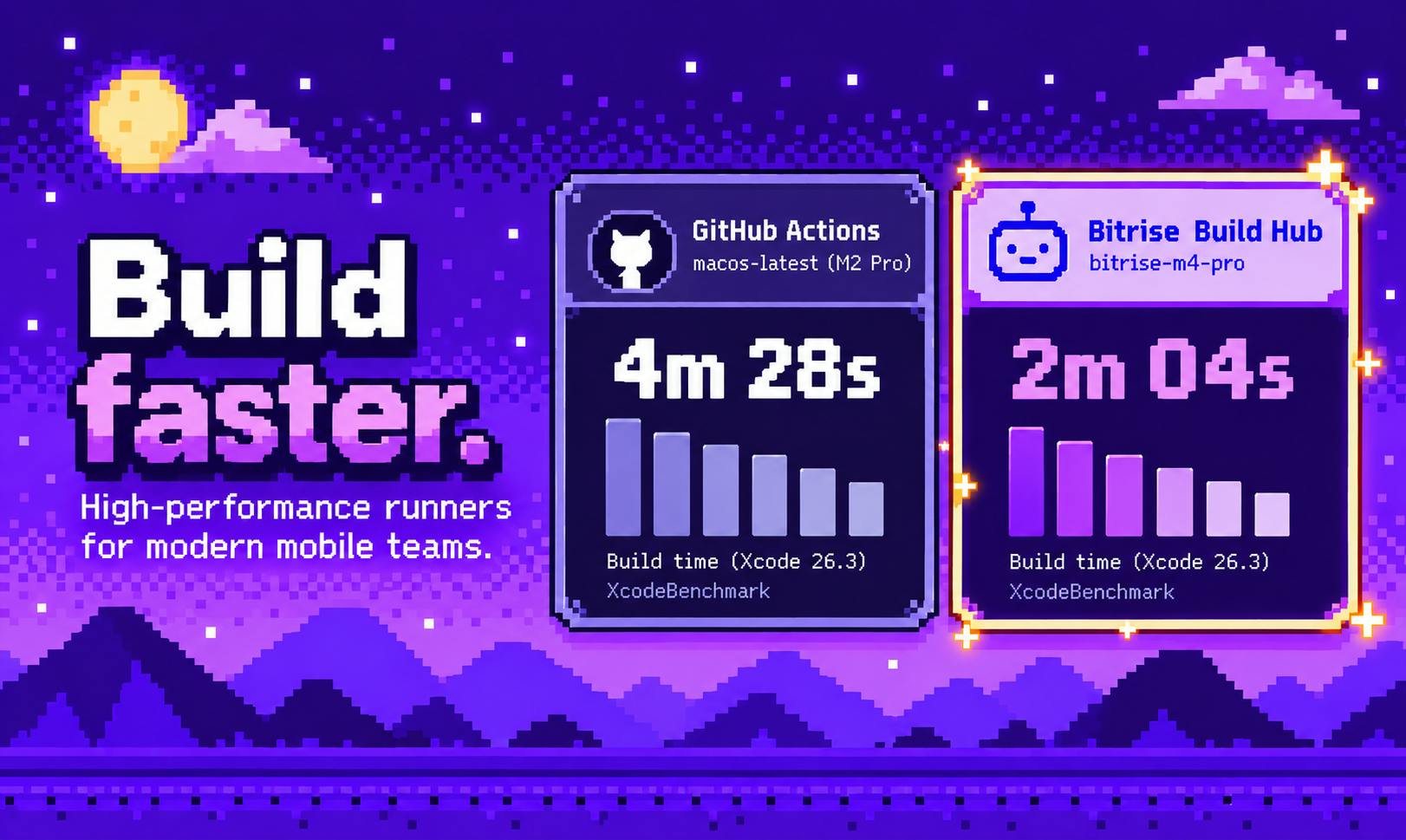
Mobile builds need macOS, Xcode, and specialized tooling. Bitrise claims 54% faster iOS and 31% faster Android builds versus selected GitHub-hosted baselines; buyers should validate these company benchmarks on their own workloads. (Benchmarks; trial) (Benchmark page; trial launch)
Product-company fit and GitHub workflow compatibility are positives. The main concern is economics: premium Mac capacity, virtualization, networking, and support create utilization and capital costs that low entry prices may not cover. Direct runner and mobile-CI competitors are active.
Recommendation: DD, not Invest. The company and product merit diligence, but Build Hub adoption, unit economics, current valuation, and conflicting company metrics require verification.
Product Overview
Build Hub routes GitHub Actions jobs to Bitrise-managed, mobile-ready Mac/Linux runners with preinstalled toolchains and optional colocated Build Cache. Teams keep GitHub Actions; adding other CI providers remains a company roadmap claim. (Build Hub)
Self-serve Basic starts at $13.50/month annualized ($15 monthly); Pro starts at $189 annualized ($210 monthly), with higher and custom Enterprise tiers. Monthly compute budgets make realized revenue usage-dependent. The product was announced in February; September 24 is its Product Hunt date. (Pricing; self-serve; announcement)
Buyers are mobile engineering/DevOps teams with slow iOS builds, high concurrency, or recurring Xcode maintenance. Value is less waiting and toil; ROI must be measured against alternatives.
Founder and Team Assessment
Bitrise identifies Barnabás Birmacher (CEO), Viktor Benei (CTO), and Daniel Balla (CPO) as co-founders. The company grew from their mobile agency, joined YC in 2017, and acquired Outlyer in 2019. The 160-person count is from 2021; current team size is unknown. (About; press kit)
The company reports operating its own Mac virtualization, stacks, cache, and data centers; current capacity and utilization need diligence. Founder Assessment: Relevant domain experience; current execution capacity remains to be verified.
Market Opportunity
The target is a mobile software team with GitHub Actions and enough build volume to justify dedicated infrastructure. The market is mobile CI/build systems, not all developers; adjacent opportunities include other orchestrators, caching, and release tools.
Bitrise reports 6K+ customers/100K+ developers on About, versus 8.5K+ brands/400K+ developers in its press kit; definitions are unreconciled. As a scenario, if 10–25% of 6K–8.5K organizations use GitHub Actions for mobile builds, the cross-sell pool is 600–2,125 accounts. At $15/month, full adoption yields $108K–$383K annualized—an assumption, not TAM or forecast. The wider GitHub-mobile market needs validation. (About; press kit; pricing)
Traction and Growth Signals
Bitrise reports 2M+ monthly builds; its customer/developer counts differ across About and press pages. The Build Hub site includes a positive ForeFlight quote, but testimonials do not disclose contract value or retention. (About; press kit; Build Hub)
Self-serve went live in late August. Bitrise cites a 28% average reduction across its build analysis and 54%/31% Build Hub benchmarks; these are not independently replicated. Product-specific revenue, customers, usage, retention, and conversion are undisclosed. (announcement; self-serve update)
Traction Assessment: The parent business has substantial reported usage and named references; Build Hub’s own commercial traction remains unverified.
Competitive Position
Alternatives include GitHub runners, self-hosted Mac fleets, Depot, and mobile-focused Codemagic. Published macOS rates range from GitHub $0.062–$0.102/min, Depot $0.08, and Codemagic $0.095–$0.114, but machine specs and included minutes differ. (GitHub; Depot; Codemagic)
Differentiation is mobile stacks, current Apple Silicon, pre-warmed runners, cache, and low-migration GitHub compatibility. Fleet know-how takes time to reproduce, but alternatives are strong and switching costs may remain low. Durable advantage requires reliable end-to-end savings, not benchmark claims alone.
Defensibility Assessment: Medium
Business Model and Economics
Plans bundle monthly compute allowances; Enterprise is custom. Build Cache, CI, and release-management cross-sell could raise account value. Pro starts at $210/month billed monthly, with higher tiers up to $810 before Enterprise. (Pricing)
Margins depend on hardware, facilities, virtualization, capacity utilization, refresh, and support. Pre-warmed capacity may hurt margins if underused; high utilization may create queues. Margins, utilization, CAC, and payback are undisclosed. Bitrise announced a 2026 SOC 2 Type II assessment, a positive company-reported readiness signal. (SOC 2 update)
Unicorn Path
Use an illustrative 8x ARR multiple for a scaled, high-growth infrastructure software business; this is an analytical scenario, not a valuation or a Bitrise comparable. A $1 billion valuation would imply about $125 million ARR. At the $15/month entry price ($180 annualized), that requires about 694,000 equivalent accounts; at $210/month ($2,520 annualized), about 49,600; at $810/month ($9,720 annualized), about 12,900. These simplified equivalents assume list price and ignore usage, churn, discounts, costs, and enterprise plan mix. They are not forecasts.
Build Hub could contribute to a unicorn-scale Bitrise platform if the parent business converts its existing customer base, adds GitHub-native teams, increases account value through cache and release products, and expands to other CI systems. Whether the parent company already has sufficient revenue scale is unknown because current ARR is not disclosed. Build Hub alone has no publicly demonstrated path to the revenue threshold.
Unicorn Path: Conditional
Valuation Assessment
About reports $95M+ total funding; Bitrise announced a $60M 2021 Series C, while its timeline lists $67.5M. No later round, valuation, or fundraising status was found; revenue and margin are undisclosed. (About; Series C)
Valuation Attractiveness: Not Assessable. A decision requires current ARR, growth, gross margin, cash/burn/runway, parent and Build Hub contribution, cap table, current round size, valuation, and liquidation/SAFE terms. Historic capital raised is not a substitute for current value.
Key Risks
- Infrastructure utilization and capital intensity: Mac hardware, facilities, maintenance, and idle capacity could constrain gross margin.
- Competitive response: GitHub, Depot, Codemagic, cloud vendors, or self-hosted fleets can compete on speed, pricing, and hardware.
- Benchmark generalizability: Published speed gains use selected comparisons; customer workloads may yield smaller savings or different cost trade-offs.
- Platform dependence: Build Hub currently depends on GitHub Actions; policy, interface, pricing, or runner changes could affect its value proposition.
- Operational reliability: A queue, outage, or runner inconsistency directly blocks engineering and release work; uptime claims need operating-history evidence.
- Parent-company metric inconsistency: Public customer/developer counts and Series C amounts differ across Bitrise pages.
- Product adoption risk: Self-serve availability and low entry pricing do not prove conversion, retention, or expansion.
- Security and code confidentiality: Build systems handle source code, credentials, artifacts, and signing materials; controls and incident history require technical diligence.
Final Assessment
Venture Potential: 74/100
| Category | Score |
|---|---|
| Market Size and Expansion Potential | 15/20 |
| Traction and Growth Evidence | 14/20 |
| Founder and Team | 13/15 |
| Product Strength | 8/10 |
| Distribution Potential | 12/15 |
| Business Model and Economics | 6/10 |
| Defensibility | 6/10 |
| Total | 74/100 |
Bitrise combines a credible platform and team with a real mobile-engineering bottleneck. The case is tempered by unknown Build Hub adoption, infrastructure economics, competition, and current financials.
Evidence Confidence: 58/100
Founders, history, product, prices, and 2021 funding are public. Usage, speed, and total-funding claims are company-reported and inconsistent. Current ARR, Build Hub economics, and valuation are unknown; market sizing is an analyst scenario.
Final Decision: DD
Proceed to a founder meeting and data-room review, not an investment commitment. Current valuation and product economics remain prerequisites.
Upgrade Conditions
- Verify Build Hub paid accounts, monthly usage, cohort retention, expansion, and channel-level acquisition.
- Validate build speed and total cost savings across representative customer workloads.
- Demonstrate attractive gross margins at observed fleet utilization, with hardware replacement and support included.
- Reconcile customer, developer, build, and funding metrics; review current ARR, burn/runway, cap table, and financing terms.
- Confirm roadmap delivery for additional CI systems and durable customer demand beyond existing Bitrise accounts.
Downgrade Conditions
- Build Hub cannot sustain positive contribution margins at competitive market pricing.
- Measured customer workloads show no material time/cost advantage or adoption remains low after trials.
- GitHub or a competitor removes the differentiation through comparable mobile-ready capacity.
- Reliability, security, or platform-policy issues materially impair customer trust.
Questions for Further Diligence
- What are Bitrise’s current ARR, growth, gross margin, burn, and runway, and what share is attributable to Build Hub?
- How many Build Hub trial, paid, and Enterprise accounts exist, and what are monthly active builds and paid conversion?
- What are 30-, 90-, and 180-day retention, net revenue retention, and expansion by Build Hub cohort?
- What is runner utilization by machine type and region, and how does it affect contribution margin?
- What are hardware, data-center, bandwidth, virtualization, support, and refresh costs per billable minute?
- Can Bitrise provide reproducible benchmark results across a representative customer workload set, including total cost?
- What are CAC, sales cycle, payback, and channel mix for existing-customer cross-sell versus new GitHub accounts?
- How many current customers use GitHub Actions for mobile builds, and what share of that base has adopted or evaluated Build Hub?
- What is the status, schedule, and customer demand for integrations beyond GitHub Actions?
- What security controls protect source code, signing keys, build logs, and artifacts, and what incidents or audits are disclosed?
- Why do the About, press-kit, and funding pages report different customer/developer counts and Series C totals?
- What are current financing terms, cap table, valuation, investor preferences, and any expected liquidity or follow-on requirements?