
Table of Contents
- MCP Connectors by Databox Investment Report
MCP Connectors by Databox Investment Report
Category: Business intelligence, agentic analytics, and MCP connectors
Company Stage: Established private SaaS company; MCP Connectors is a new feature within Databox, not a separately disclosed startup
Founders / Leadership: Databox was founded by Davorin Gabrovec and Vlada Petrovic; current CEO is Peter Caputa IV, with Gabrovec as President & CPO
Headquarters: Boston, Massachusetts, with a Slovenia office
Funding: Publicly reported $3.3M seed round in 2015 led by Founder Collective with Accomplice participation; current valuation, financing, and terms are not disclosed
Business Model: Tiered analytics subscriptions; MCP Connectors are included with Databox plans and have no separately listed fee
Product Hunt Launch Date: 2026/09/28
Report Date: 2026/10/08
| Investment Metric | Assessment |
|---|---|
| Venture Potential | 70/100 |
| Unicorn Path | Conditional (parent company only) |
| Valuation Attractiveness | Not Assessable |
| Evidence Confidence | 73/100 |
| Final Decision | Watch |
Executive Summary
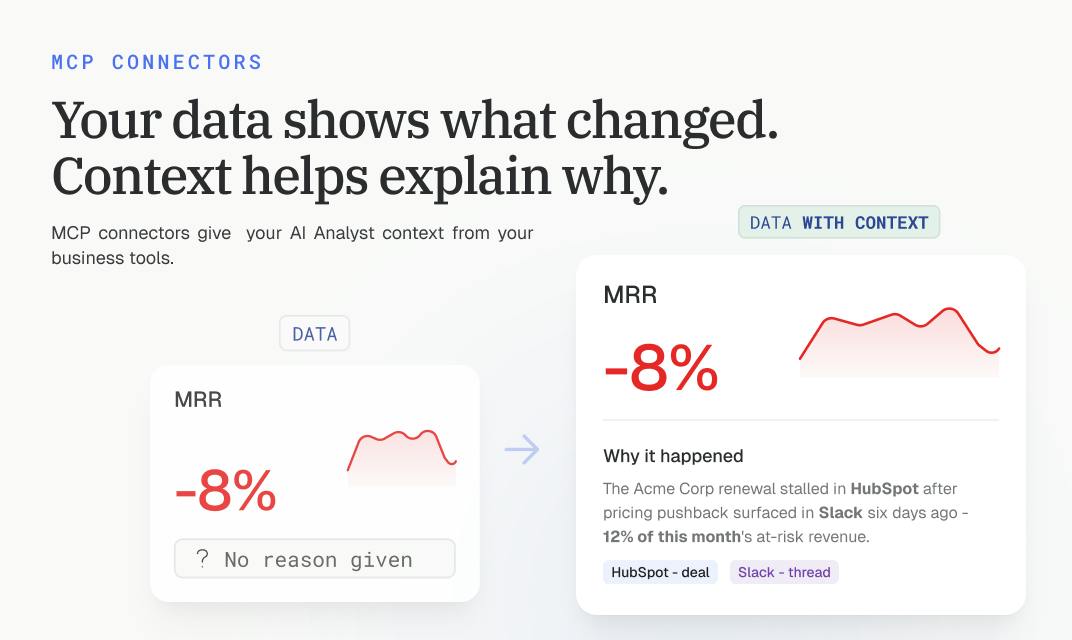
MCP Connectors extends Databox’s existing analytics and AI Analyst (Genie) by giving it MCP access to business records in CRM, support, collaboration, and project tools. The goal is to explain why a KPI moved, not only report the change, and optionally act with permission. MCP Connectors
The feature addresses a real gap between dashboards and operational context. Databox reports 20K+ businesses, 130+ native integrations, and 70M+ metrics tracked. The launch reached #1 Product of the Day on Product Hunt, but that is attention, not adoption or PMF.
This is an internal feature of a private analytics company founded in 2012, not a separate venture; MCP is bundled rather than standalone-priced. It may improve conversion, retention, or expansion, but no feature-level usage or revenue is public. Recommendation: Watch the feature and reassess Databox only with current financials and investable terms.
Product Overview
MCP Connectors lets Genie reach outward through prebuilt or custom MCP servers; Databox’s separate MCP server exposes Databox data to external AI tools. Its connector directory lists 34 connectors and custom-server support, complementing 130+ native analytics integrations, the semantic layer, skills, and routines. Connectors · MCP docs
Users connect metrics and source tools, ask why a KPI changed, and retrieve related deals, conversations, tickets, or tasks. Each tool is configurable as Always, Ask, or Block, and the product says new tools default to approval. Databox reviews official connectors but not custom servers. Its separate MCP server is documented as beta with OAuth-scoped access; verify which controls apply to each product.
Target users are SMBs, agencies, and teams already on Databox. Connecting a related Slack thread to a metric does not prove causality: trust requires sources, freshness, permissions, and clear labels separating evidence from inference.
Founder and Team Assessment
Davorin Gabrovec founded Databox and is President/CPO; Vlada Petrovic is in technical leadership and Peter Caputa IV is CEO. Caputa previously led sales and marketing at HubSpot. Their history in analytics, integrations, and SMB/agency products is relevant. Team · Founder profile · Leadership background
Databox reports 20K+ businesses, 70M+ metrics, 130+ integrations, and 394K+ shared dashboards/reports. These are parent-wide company-reported indicators, not MCP adoption or paying accounts. The team spans product, engineering, data, and customer success, but feature-specific ownership and resourcing are not public.
Founder Assessment: Relevant operating history and existing distribution; MCP accountability and dedicated investment are undisclosed.
Market Opportunity
The opportunity sits across BI, analytics, and business-context retrieval for SMBs, agencies, and growth teams. Databox’s potential edge is to combine governed metrics with the CRM, support, and collaboration records that explain business changes.
Illustrative attach scenario, not a forecast: 5–10% of the reported 20K-business base upgrading to team plans at roughly $2.4K–$3.8K annual list price implies $2.4M–$7.6M in plan-level contract value. It is not incremental MCP ARR: the base may include free or inactive users, the feature is bundled, and the plans include other features. Standalone MCP market size cannot be isolated from the parent platform.
Traction and Growth Signals
Product Hunt lists the September 28 launch at #1 for the day, #4 for the week, and 461 points. The maker says users connected their first tool. This is launch interest, not sustained use or willingness to pay. Launch · Maker follow-up
Parent-level company claims include 20K+ businesses, 70M+ metrics, and 130+ integrations. Genie, Databox MCP, Routines, and Skills indicate a broader agentic-analytics roadmap. No public data show MCP connections, activation, query volume, ARR, retention, or conversion. Product Hunt’s 4.8/5 score is for Databox overall and only eight reviews, not this feature. Company · Pricing/features
Traction Assessment: Established platform and strong launch; incremental product adoption and economics remain unknown.
Competitive Position
Alternatives include Power BI, Tableau, Looker, CRM/marketing analytics, and AI clients that connect to MCP servers directly. Databox’s own MCP documentation describes use by outside AI clients, making bypass a real substitute. MCP docs
The potential moat is the combination of KPI integrations, governed definitions, lineage, business-specific skills, and scheduled analysis—not MCP itself. Its installed base creates cross-sell potential, but the open protocol lowers entry barriers and first-party analytics/AI vendors can add similar context retrieval.
To win, Databox must demonstrate better metric grounding, source-backed explanations, lower setup effort, and habitual use. Defensibility Assessment: Medium-low for connectors alone; stronger only within a sticky platform.
Business Model and Economics
Databox sells subscriptions and custom services. Public annual-billing list prices include Free ($0), Analyst ($71/month), and Team from $199/month, with a higher Team tier at $319/month. MCP is bundled with plans, not separately priced. AI credits and data-source limits constrain usage. Pricing
Value capture is indirect—better paid conversion, upgrades, retention, or AI usage. No feature-level revenue, ARPA, gross margin, churn, CAC, or inference-cost data are public. Credits may cap costs but also limit the value customers receive.
Custom MCP servers can access AI Analyst content and are not reviewed by Databox; users set per-tool permissions, starting in approval mode. Validate admin control, logs, least privilege, prompt-injection protections, data retention, and the security certificate’s scope. Databox’s pricing page lists SOC 2 certification. Connector controls
Unicorn Path
MCP Connectors has no separate revenue, so a standalone unicorn path is not meaningful. For the parent, $1B at an illustrative 10× ARR requires $100M ARR. At $2.4K–$3.8K annual plan prices, that is about 42K–26K paid plan-equivalents before churn, discounts, and costs. Databox’s 20K+ businesses may include free/inactive users; this is a hurdle, not a forecast.
Unicorn Path: Conditional for Databox, not independently assessable for the feature.
Valuation Assessment
A $3.3M seed round was reported in 2015. Current valuation, financials, cap table, and financing terms are undisclosed; old financing does not indicate today’s price. MCP is not a separate security. Valuation Attractiveness: Not Assessable.
Key Risks
- Feature, not company: no separate MCP revenue or financing.
- Commoditization: open MCP access can bypass Databox.
- False causality: retrieved context may not explain a metric change.
- Data exposure: custom servers are unreviewed and can access AI content.
- Permission failures: write actions require strong audit and least privilege.
- AI economics: credit limits may constrain value; inference may erode margin.
- Attribution: other AI features may drive any observed retention changes.
- Financial opacity: current revenue, growth, valuation, and terms are unknown.
Final Assessment
Venture Potential: 70/100
| Category | Score |
|---|---|
| Market Size and Expansion Potential | 16/20 |
| Traction and Growth Evidence | 12/20 |
| Founder and Team | 12/15 |
| Product Strength | 9/10 |
| Distribution Potential | 12/15 |
| Business Model and Economics | 5/10 |
| Defensibility | 4/10 |
| Total | 70/100 |
The feature is well aligned with Databox’s analytics product and addresses a real gap between KPI movement and operational context. The parent’s existing reach and prior product execution are advantages. Score deductions reflect feature-level monetization opacity, open-standard competition, and absent customer adoption data.
Evidence Confidence: 73/100
Product scope, connector permissions, public plans, company-reported platform scale, and the Product Hunt ranking are documented. Funding history is old, and Databox does not disclose current financials. The overall Product Hunt review count is small and not feature-specific. MCP beta status and feature-specific action availability should be confirmed in a live product demo.
Final Decision: Watch
Track MCP Connectors as a potentially valuable distribution and retention feature, but do not treat the launch or its points as investable traction. The company is the potential investment, not this feature; no current financing or valuation is public. Revisit after management reports MCP activation, repeat use, paid conversion/expansion, and measurable retention or revenue impact, and if a financeable opportunity with clear terms emerges.
Upgrade Conditions
Move to DD if MCP usage grows across cohorts, paid-plan conversion or retention improves versus controls, users repeatedly rely on source-grounded explanations, permissions pass enterprise security review, and Databox opens a current financing process with transparent financials and reasonable terms.
Downgrade Conditions
Remain Pass if MCP usage is primarily launch-driven, customers can obtain equivalent results directly from MCP clients, unsupported actions or weak citations undermine trust, connector maintenance grows faster than value, or AI costs are not covered by subscription economics.
Questions for Further Diligence
- How many weekly/monthly active Databox customers have connected MCP tools, and how many use them repeatedly?
- What share of connected workspaces use official versus custom servers, and which connectors drive adoption?
- Does MCP improve paid conversion, upgrades, net revenue retention, or churn compared with matched customers?
- Which plans and AI-credit limits currently support MCP Connectors, and how are complex queries/actions billed?
- What are incremental inference, connector-maintenance, and support costs per active workspace?
- Which actions can Genie execute today, and how do defaults, approvals, logs, and admin policies operate?
- How does the product label source evidence and distinguish correlation from a causal explanation?
- What is Databox’s current ARR, growth, profitability, paid-customer count, and customer concentration?
- What SOC 2 scope, penetration tests, incident history, subprocessors, and custom-server safeguards can be reviewed?
- Is the company currently raising capital, and what are the valuation, cap table, ownership, and expected investor liquidity?