
Table of Contents
Harmony Investment Report
Category: AI-native IT service management (ITSM) and enterprise service management (ESM)
Company Stage: Seed-stage enterprise SaaS
Founders: Nitzan Shapira (co-founder and CEO) and Ran Ribenzaft (co-founder and CTO)
Headquarters: New York, with a Tel Aviv location listed by the company
Funding: $34 million seed round announced July 28, 2026, led by Lightspeed Venture Partners, with Hitachi Ventures, Fin Capital, Mercer Ventures, Operator Partners, and angels. Current valuation and terms are undisclosed
Business Model: Enterprise subscriptions with custom deployment quotes; company positions pricing around organization/departments, request volume, and complexity, and elsewhere describes action-based pricing
Product Hunt Launch Date: 2026/09/27
Report Date: 2026/10/08
| Investment Metric | Assessment |
|---|---|
| Venture Potential | 77/100 |
| Unicorn Path | Plausible, execution-dependent |
| Valuation Attractiveness | Not Assessable |
| Evidence Confidence | 72/100 |
| Final Decision | DD |
Executive Summary
Harmony is building an AI-native service desk that resolves employee IT requests rather than routing them into queues. Employees use Slack, Teams, email, or a portal; agents use identity, device, HR, SaaS, and policy context to execute approved workflows or escalate exceptions. The company aims to extend this model from IT to HR, finance, procurement, and other services. Platform
The premise is attractive: automate repetitive access, onboarding, password, device, and policy work, and consolidate ticketing, agents, knowledge, assets, and governance. The founders previously built Epsagon, acquired by Cisco, and Harmony announced a $34M seed round. Customer case studies describe meaningful automation and response-time gains.
Yet the public evidence is company-selected and does not disclose ARR, retention, margin, implementation cost, or valuation. Incumbents are adding agents to existing systems of record. Recommendation: DD, focused on whether outcomes repeat safely and profitably and whether current round terms are attractive.
Product Overview
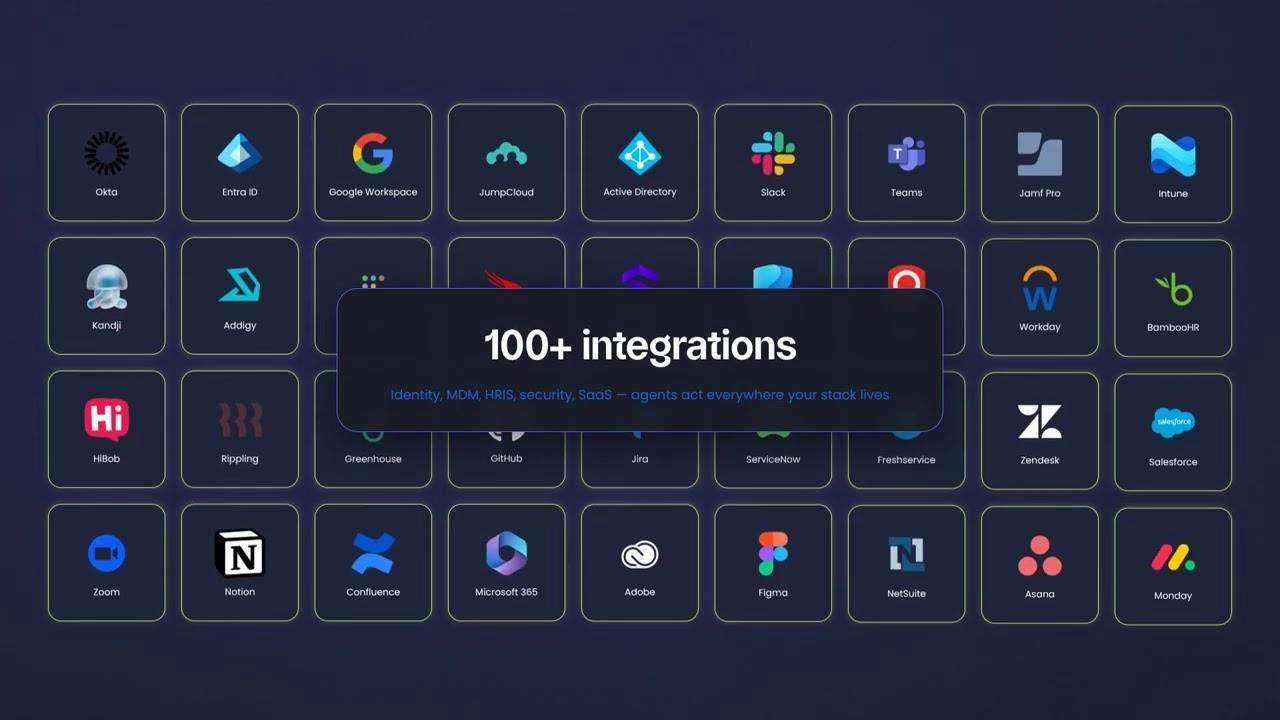
Harmony combines an AI service desk, 100+ prebuilt agents, a workflow builder, knowledge generation, ticketing, asset/SaaS management, and policy governance. Employees start in Slack, Teams, email, or a portal; integrations connect identity, endpoints, HR systems, collaboration tools, and incumbent ITSM platforms. The thesis is to resolve routine tasks first and create tickets for exceptions. Platform · Agents · Integrations
Target customers are growing companies with lean IT teams, substantial employee-request volume, and connected identity/device/HR systems. IT-to-ESM expansion could increase account value but raises the bar for permissions, data separation, and workflow reliability.
Product Hunt lists a one-month free option. There is no public rate card: quotes depend on company size, departments, request volume, and complexity; a comparison page describes action-based billing. Definitions, minimums, overages, and actual prices are undisclosed and require diligence. Pricing · Pricing comparison
Founder and Team Assessment
CEO Nitzan Shapira and CTO Ran Ribenzaft previously co-founded Epsagon, an observability company acquired by Cisco in 2021; Harmony reports a $500M acquisition price. Their infrastructure and enterprise experience, plus prior collaboration, are relevant. Treat the transaction price as company-reported, not independently verified here. Founder profile · Funding announcement
The $34M seed, led by Lightspeed with other investors, can fund product, security, and sales, but creates growth and capital-efficiency expectations. LinkedIn lists 51–200 employees and New York HQ, with Tel Aviv also listed; these are profile-reported figures. Leadership depth, runway, and customer-success capacity are not public.
Founder Assessment: Strong founder-market fit and prior exit; validate operating depth and focus as scope expands beyond IT.
Market Opportunity
Harmony targets ITSM/help desk, employee service management, workflow automation, and adjacent asset/software management. It competes for budgets already spent on ServiceNow, Jira Service Management, Freshservice, and integration tooling. The larger prize is automating actions across identity, devices, SaaS, and employee lifecycles—not only answering questions.
A bottom-up scenario, not a market forecast: 1,000–5,000 suitable organizations at $50K–$150K annual contracts would imply $50M–$750M potential annual contract value before penetration, churn, discounting, or services. Both organization count and ACV are assumptions; Harmony has not disclosed actual ACV. IT-to-HR expansion may lift account value, while mid-market buyers may deploy faster but be more price-sensitive.
Traction and Growth Signals
Harmony announced a $34M seed in July 2026, led by Lightspeed, and names Cyera, n8n, Mammoth Brands, Fireblocks, Exodigo, and others as customers. Funding · Customers
Vendor-published case studies report Cyera auto-resolving roughly 85–89% of requests and 90–95% of access requests, with 25–30 minutes saved per employee daily; it says Cyera replaced Jira in two days. Mammoth Brands reports a three-person IT team serving about 600 employees, a two-week rollout, first response falling from four hours to seven seconds, and 4.7 CSAT. These examples suggest value and time-to-deploy, but are selected references without disclosed contract values, audited baselines, or broad cohorts. Cyera · Mammoth Brands
Product Hunt currently shows #6 and 146 points—awareness, not PMF. Gartner Peer Insights lists 19 ratings averaging 4.8, but the small sample and inconsistent product metadata warrant caution; verify references directly. Product Hunt · Gartner
Traction Assessment: Promising customer outcomes and financing; ARR, renewals, sales efficiency, and repeatability are not public.
Competitive Position
Competitors include ServiceNow, Jira Service Management, Freshservice, and AI-first service vendors. ServiceNow has workflow, CMDB, and enterprise incumbency and is expanding agentic ITSM; Atlassian and Freshworks offer virtual agents and AI-enabled service workflows. They can bundle AI into systems that already hold ticket history and permissions. ServiceNow · Atlassian · Freshworks
Harmony’s wedge is chat-first UX, an AI-first resolution flow, and ability to work across existing tools or replace them. Named cases support the pitch, but do not yet prove superior accuracy, cost, or breadth. Integrations and policy context could create workflow switching costs, not a network effect. Against incumbent parity, Harmony must demonstrate faster deployment, safer resolution, lower administration, or lower total cost across mixed stacks.
Defensibility Assessment: Medium, contingent on repeatable outcomes and deep workflows.
Business Model and Economics
Harmony sells custom enterprise deployments. Quotes reflect company size, service desks, request volume, and integration complexity; the company also describes action-based billing. This can align price with value but raises predictability questions: what counts as resolved, how are failed or reopened actions billed, and what are minimums? ACV, revenue mix, margins, renewal, CAC, and payback are undisclosed.
Reusable agents could support software margins, but inference, connectors, indexing, implementation, support, and human escalations add cost. Customer-specific policies and integrations may make onboarding services-heavy. If customers generate costly model activity that is not billable, margins could disappoint.
Security is core because agents can change identity, device, and app state. Harmony lists SOC 2, ISO 27001, and other controls on its security page and says its workflows constrain actions. Obtain certificates/reports, scopes, penetration tests, data-processing terms, subprocessors, and evidence for least privilege and audit logs; marketing claims are not a technical review. Security
Unicorn Path
At an illustrative 10× ARR, a $1B valuation requires $100M ARR. With assumed $50K–$150K ACV, that is roughly 2,000–667 customers, before churn, discounts, services, and margins. This is arithmetic, not a forecast; actual ACV is unknown. Venture scale requires repeatable deployment, retention, expansion across service desks, and sales beyond founder relationships.
Unicorn Path: Plausible, execution-dependent.
Valuation Assessment
The $34M seed is public; valuation, dilution, security type, cap table, and terms are not. Without ARR, growth, margin, retention, and implementation costs, valuation attractiveness and return potential cannot be assessed. No valuation is inferred. Valuation Attractiveness: Not Assessable.
Key Risks
- Action safety: incorrect access/device changes could create incidents; validate resolution definitions.
- Security/compliance: verify controls, data boundaries, and certifications.
- Incumbents: ServiceNow, Atlassian, and Freshworks can bundle agents.
- Integration burden: each IdP, MDM, HRIS, and SaaS stack adds maintenance.
- Services intensity: custom workflows may constrain margins and rollout speed.
- Pricing ambiguity: action-based quotes may impair budget predictability.
- Scope creep: ESM breadth could distract from a repeatable IT wedge.
- Evidence quality: selected cases and small reviews do not prove retention.
- Financing: valuation, runway, and dilution are undisclosed.
Final Assessment
Venture Potential: 77/100
| Category | Score |
|---|---|
| Market Size and Expansion Potential | 17/20 |
| Traction and Growth Evidence | 15/20 |
| Founder and Team | 15/15 |
| Product Strength | 9/10 |
| Distribution Potential | 10/15 |
| Business Model and Economics | 6/10 |
| Defensibility | 5/10 |
| Total | 77/100 |
The founders’ relevant experience, funded product breadth, customer references, and specific operational outcomes make Harmony more compelling than a launch-stage concept. Deductions reflect unverified economics, limited distribution relative to incumbents, and dependence on safe, repeatable integrations.
Evidence Confidence: 72/100
Founder identities, announced financing, product scope, pricing approach, integrations, and security claims are documented. Named-customer results are detailed but vendor-published; revenue, retention, unit economics, and valuation are not public. Third-party rating evidence is limited and contains metadata inconsistencies.
Final Decision: DD
Advance to diligence, not an unconditional investment recommendation. Validate customer-level resolution outcomes, references, renewal and expansion, deal economics, and security architecture. If metrics corroborate the case studies and deployments scale with healthy margins, the company could support a venture-scale opportunity. Public facts do not yet establish an attractive entry valuation.
Upgrade Conditions
Consider Invest if independent customer references confirm sustained resolution and satisfaction, cohort retention and expansion are strong, deployment time and services burden fall with scale, gross margins remain attractive after inference and integrations, security diligence clears, and round terms support target returns.
Downgrade Conditions
Move to Pass if resolution metrics exclude escalations or re-opened tickets, customer outcomes fail to repeat, implementations require extensive custom engineering, per-action pricing creates disputes, security controls are inadequate, or incumbents eliminate the product’s time-to-value advantage.
Questions for Further Diligence
- What are ARR, growth, paying customer count, ACV distribution, pipeline, and bookings by quarter?
- What are gross margin and contribution margin after model, cloud, connector, support, and implementation costs?
- Define “auto-resolved”: are reopened tickets, escalations, approvals, and customer-confirmed outcomes counted?
- Provide 90-/180-day retention, gross/net revenue retention, expansion, and churn cohorts.
- Can we speak with a representative sample of customers, including churned or non-expanding accounts?
- What is implementation effort per customer, time to production, and percentage of deployments requiring custom code?
- How are integrations authenticated and permissioned, and what prevents prompt injection or unauthorized execution?
- Provide current SOC 2/ISO certificates and scope, penetration-test findings, incident history, and subprocessor/model terms.
- What exactly is billable under action-based pricing, how are failures handled, and what are typical contract minimums?
- What are current valuation, round terms, cap table, dilution, runway, and planned use of the $34M seed?