
Table of Contents
GenCode Investment Report
Category: Developer tools; AI coding agents
Company Stage: New product (September 2026) within Genspark, a growth-stage Series B company
Founder or Founders: GenCode product lead not publicly disclosed. Genspark co-founders: Eric Jing (CEO), Kay Zhu (CTO), Wen Sang (COO)
Headquarters: Palo Alto, California, United States
Funding: GenCode is not separately financed. Parent Genspark announced a $100M Series B extension at a $2.6B post-money valuation in June 2026
Business Model: GenCode consumes Genspark credits; monetization is bundled into Genspark individual/team subscriptions and enterprise plans
Product Hunt Launch Date: September 28, 2026 (spreadsheet B-column date; Product Hunt confirms)
Report Date: October 8, 2026
| Investment Metric | Assessment |
|---|---|
| Venture Potential | 71/100 |
| Unicorn Path | Clear (parent company; not a standalone GenCode outcome) |
| Valuation Attractiveness | Not Assessable |
| Evidence Confidence | 63/100 |
| Final Decision | DD |
Executive Summary
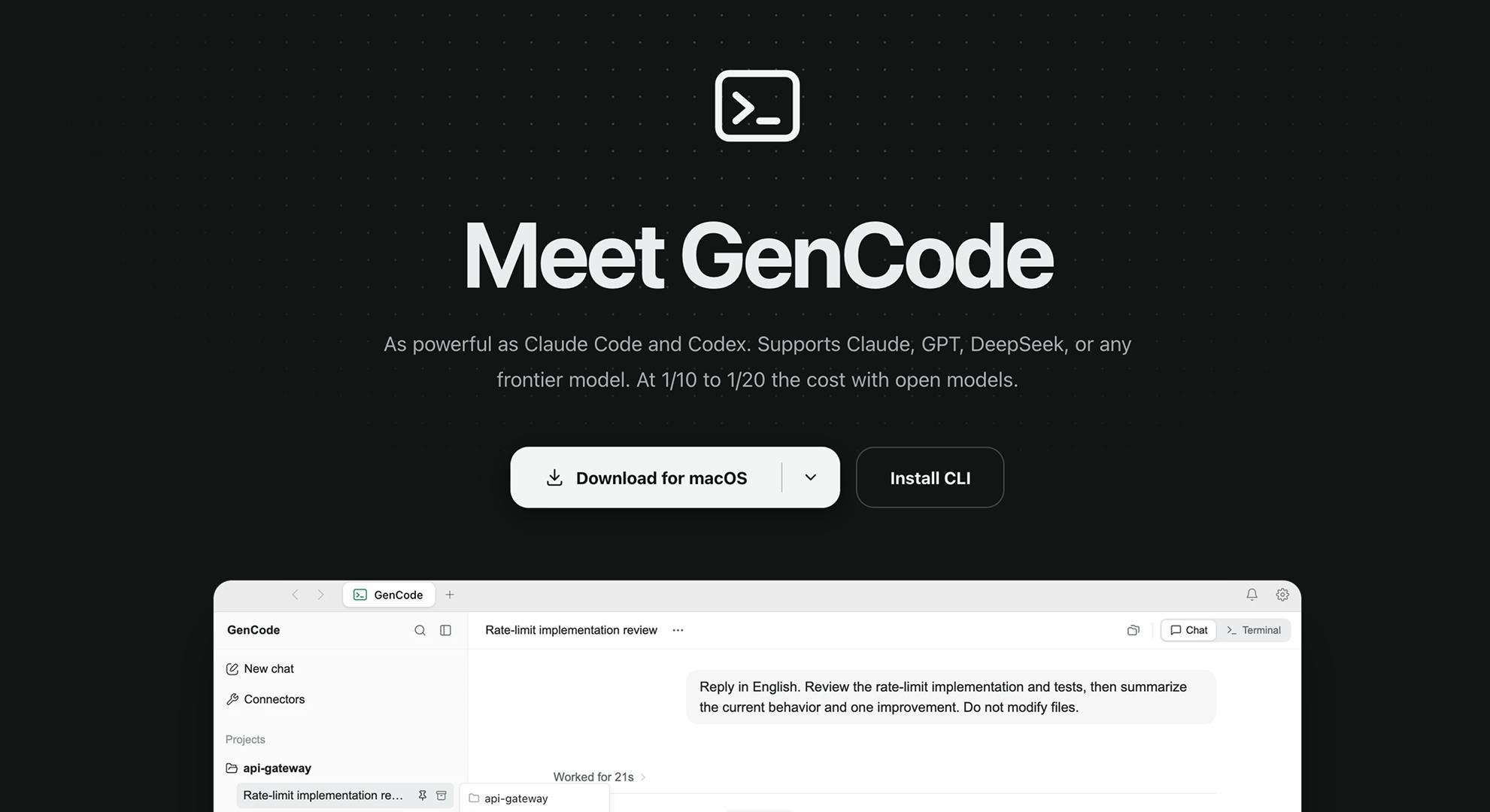
GenCode is Genspark’s coding agent, offered as a CLI and Super App workspace. It works on a selected directory, supports sub-agents and JSON scripting, and uses a nine-family hosted model catalog. It is built on Genspark’s OpenCode fork and bills through existing account credits (official GenCode guide, Product Hunt launch).
The exact identity matters: GenCode is not Genspark Code, the separate browser-based app builder, and is not an independent company. It is a new product in Genspark’s portfolio. Product Hunt recorded 133 points and a #7 day rank for the September 28 launch. The npm package shows about 4,428 weekly downloads and 94 versions, useful early distribution and shipping signals but not unique users, active developers, or paid adoption (npm package).
Parent-company evidence cannot be attributed to GenCode. In June 2026 Genspark announced a $100M Series B extension at a $2.6B post-money valuation and $645M total funding. It reported $100M ARR since April 2025 plus $150M added in Q1 2026. These unaudited company figures describe Genspark overall, not GenCode (financing announcement).
This is a product-line expansion, not a standalone startup. Bundled distribution is the advantage; competition, unproven retention/economics, and code privacy are key risks. Recommendation: DD at parent level, with a separate GenCode cohort review.
Product Overview
GenCode is a CLI and desktop coding agent for local repositories. It reads, edits, and runs code in a chosen directory; its CLI supports JSON/CI scripting and bounded sub-agents. It uses Genspark-hosted models and account credits or an API-key account (guide, npm).
Its nine-family model catalog and shared credits are differentiators. GenCode is distinct from “Genspark Code,” the browser app builder. It has no separate subscription: users consume credits through Genspark’s Free, Plus, Pro, $30/seat Team, or custom enterprise plans. These workspace prices are not GenCode revenue (pricing, billing).
Founder and Team Assessment
Genspark lists Eric Jing, Kay Zhu, and Wen Sang as CEO, CTO, and COO/co-founders (leadership). Jing reports nearly 20 years in search/AI, including Bing and AI hardware (profile); the company cites experience from Microsoft, Google, Meta, YouTube, and Pinterest and names major investors in its financing release.
The parent can fund distribution, but GenCode’s lead, headcount, and roadmap owner are undisclosed. Product Hunt’s hunter is not its founder. Parent key-person risk is lower than product-level accountability risk.
Founder Assessment: Experienced, heavily financed parent team with relevant AI/search backgrounds; GenCode’s own product leadership and resourcing need verification.
Market Opportunity
Buyers are developers needing a repository agent/model choice, Genspark subscribers, and teams standardizing agents. Market count and product ACV are unknown. Illustratively, $100M/year requires ~417,000 accounts at $240 ACV or ~41,700 at $2,400; these parent plan equivalents are not GenCode pricing. Winning developer habit and enterprise trust is key.
Traction and Growth Signals
Product Hunt’s GenCode launch page lists September 28, 2026, 133 points, and a #7 day rank. The parent Genspark page shows 12 reviews and a 4.4 rating for the overall platform; these are not GenCode-specific reviews. The npm package reports roughly 4,428 weekly downloads, 94 versions, and frequent publication. Downloads include repeat installs, automation, and CI and do not measure retained developers or revenue.
Parent traction is substantial but separate. No GenCode active users, paid seats, credit consumption, retention, revenue, or customer references are public.
Traction Assessment: Early distribution and shipping activity are visible; product-level commercial validation is not.
Competitive Position
Alternatives include OpenCode, Claude Code, Codex, Cursor, Windsurf, and GitHub Copilot. They already provide repository-aware agents, tool execution, and broad IDE/platform workflows (Cursor agent docs, OpenAI Codex CLI, GitHub Copilot, OpenCode agents).
GenCode’s advantages are nine model families, bundled credits, CLI/desktop, and existing workspace distribution. OpenCode lineage is a substitute, not a moat; routing and local agents are replicable. Durable value would require workflow integration, quality, cost efficiency, and cross-product retention, none proven yet.
If a large coding agent copied this in six months, GenCode must win on cost, model routing, or Genspark integration. A model catalog alone is insufficient.
Defensibility Assessment: Low to Medium
Business Model and Economics
GenCode is a credit-consuming feature inside a freemium, subscription workspace; there is no separate GenCode price. This makes product adoption potentially valuable through plan upgrades, higher credit consumption, retention, or team seats, but none is disclosed. The plan system has a paid Plus tier, expensive Pro tier, $30/month Team seats, and custom enterprise offerings.
Costs vary by model, context, tools, and task length; high-use coding may burn credits. No GenCode margin, cost per successful task, credit breakage, or expansion revenue is public. Parent ARR is not unit economics. Enterprise seats and cross-sell are hypotheses.
Genspark says certain open-weight models use US providers with zero-retention/no-training terms; enterprise materials cite SOC 2 Type II and ISO 27001. Verify these controls apply to each model and GenCode workflow, including code retention (model data handling, enterprise plans).
Unicorn Path
Genspark has already crossed a $1B valuation; GenCode has no separate entity, revenue line, or valuation. A hypothetical $100M ARR line implies ~417,000 accounts at $240/year or ~41,700 at $2,400, using parent plan equivalents. GenCode must prove retained paid use and incremental upgrades, not merely shift existing credits.
Unicorn Path: Clear for parent Genspark; standalone GenCode is not separately assessable.
Valuation Assessment
The parent’s June 2026 round was $100M at $2.6B post-money; total Series B was $485M and total funding $645M. It reported $100M ARR since April 2025 plus $150M added in Q1 2026—an implied ~10.4× run-rate multiple, using unaudited parent-wide figures. Valuation Attractiveness: Not Assessable for GenCode, which has no separate security or disclosed revenue. Parent analysis needs current ARR, retention, margins, round terms, and cap table.
Key Risks
- Product-market proof: Downloads and launch points do not establish retained coding use or willingness to pay.
- Bundled economics: Credits may not translate into incremental revenue; high-token tasks can erode margins.
- Intense competition: Cursor, Codex, Claude Code, Copilot, and open source can replicate multi-model CLI workflows.
- Quality and reliability: Poor edits, failed tests, or model-specific inconsistency can quickly lose developer trust.
- Sensitive code: Source and prompts may traverse hosted models; exact retention, routing, and tier protections need validation.
- Platform dependence: GenCode depends on Genspark accounts, model availability, credit rules, and parent roadmap.
- Open-source/IP exposure: The product is based on a fork of OpenCode; license and differentiation protections require diligence.
- Attribution and capital allocation: Parent metrics and valuation say little about GenCode’s contribution or its priority versus other Genspark products.
Final Assessment
Venture Potential: 71/100
| Category | Score |
|---|---|
| Market Size and Expansion Potential | 17/20 |
| Traction and Growth Evidence | 9/20 |
| Founder and Team | 14/15 |
| Product Strength | 8/10 |
| Distribution Potential | 13/15 |
| Business Model and Economics | 7/10 |
| Defensibility | 3/10 |
| Total | 71/100 |
Parent strength and bundled distribution are positives; GenCode is new, with unknown traction/economics and modest feature defensibility.
Evidence Confidence: 63/100
Product features, pricing, launch, npm package, and parent round are public. ARR and security claims are company-reported; GenCode paid users, retention, unit economics, and contribution remain unknown.
Final Decision: DD
DD applies to Genspark, not a standalone GenCode security. Parent financing and reported growth merit review; GenCode adoption and economics are unproven. Any investment decision needs parent terms and evidence that GenCode increases retention or revenue.
Upgrade Conditions
- Provide weekly and monthly active GenCode developers, paid conversion, cohort retention, and usage by CLI versus Super App.
- Show incremental paid upgrades, credits, or enterprise seats attributable to coding users.
- Demonstrate low cost per successful task and healthy contribution margin by model and workload.
- Establish enterprise-grade code privacy, model routing controls, and customer references.
- Show repeat use and objective completion quality versus leading coding agents.
Downgrade Conditions
- Downloads fail to convert to retained, paid users.
- Credit burn makes coding tasks feel unpredictable or uneconomic.
- A competitor bundles equivalent multi-model terminal access with stronger IDE/repository distribution.
- Code privacy or model routing fails enterprise expectations.
- Parent product priorities shift and GenCode’s shipping pace or support declines.
Questions for Further Diligence
- How many GenCode weekly/monthly active developers, paying users, and retained cohorts exist since the September launch?
- What share of the reported 4,428 weekly npm downloads are unique installs versus CI/repeated installs?
- How many Genspark users use GenCode, and what is activation and 30-/90-day retention by channel?
- Does GenCode drive upgrades, additional credit purchases, or seat expansion, and how is that attribution measured?
- What are cost per task and gross margin for common coding workloads across the nine model families?
- How do task completion, acceptance, test pass rates, and developer time savings compare with Codex, Cursor, Claude Code, and OpenCode?
- What code, prompts, logs, and telemetry leave the local machine; what is retained, and which ZDR/no-training terms apply to each model?
- What product team and roadmap are dedicated to GenCode, and who owns its success metrics?
- What share of Genspark’s $2.6B valuation or reported ARR is attributable to coding products, if any?
- What were the latest parent ARR, NRR, gross margin, burn, runway, and enterprise mix after Q1 2026?
- Is Genspark raising now or planning another round, and what are expected valuation, dilution, and terms?
- What are the licensing obligations and proprietary additions in Genspark’s OpenCode fork?
Sources
- Product Hunt GenCode launch within Genspark
- Official GenCode documentation
- GenCode npm package and download metrics
- Genspark individual and business pricing
- Genspark June 2026 financing announcement
- Genspark co-founder and CEO profile
- Genspark leadership event
- Genspark model data-handling guidance
- Genspark team and enterprise plans
- Cursor coding-agent documentation
- OpenAI Codex CLI overview
- GitHub Copilot
- OpenCode agent documentation