
Table of Contents
Okara Investment Report
Category: AI marketing automation, social media, SEO/GEO
Company Stage: Early growth; global launch reported in March 2026
Founder or Founders: Fatima Rizwan (Founder & CEO); other ownership roles not publicly disclosed
Headquarters: Singapore
Funding: Not publicly disclosed; no verified funding round or valuation found
Business Model: Freemium subscription SaaS; $129/$249 monthly tiers, annual plans, and agency pricing
Product Hunt Launch Date: September 28, 2026 (spreadsheet B-column date)
Report Date: October 8, 2026
| Investment Metric | Assessment |
|---|---|
| Venture Potential | 67/100 |
| Unicorn Path | Conditional |
| Valuation Attractiveness | Not Assessable |
| Evidence Confidence | 57/100 |
| Final Decision | DD |
Executive Summary
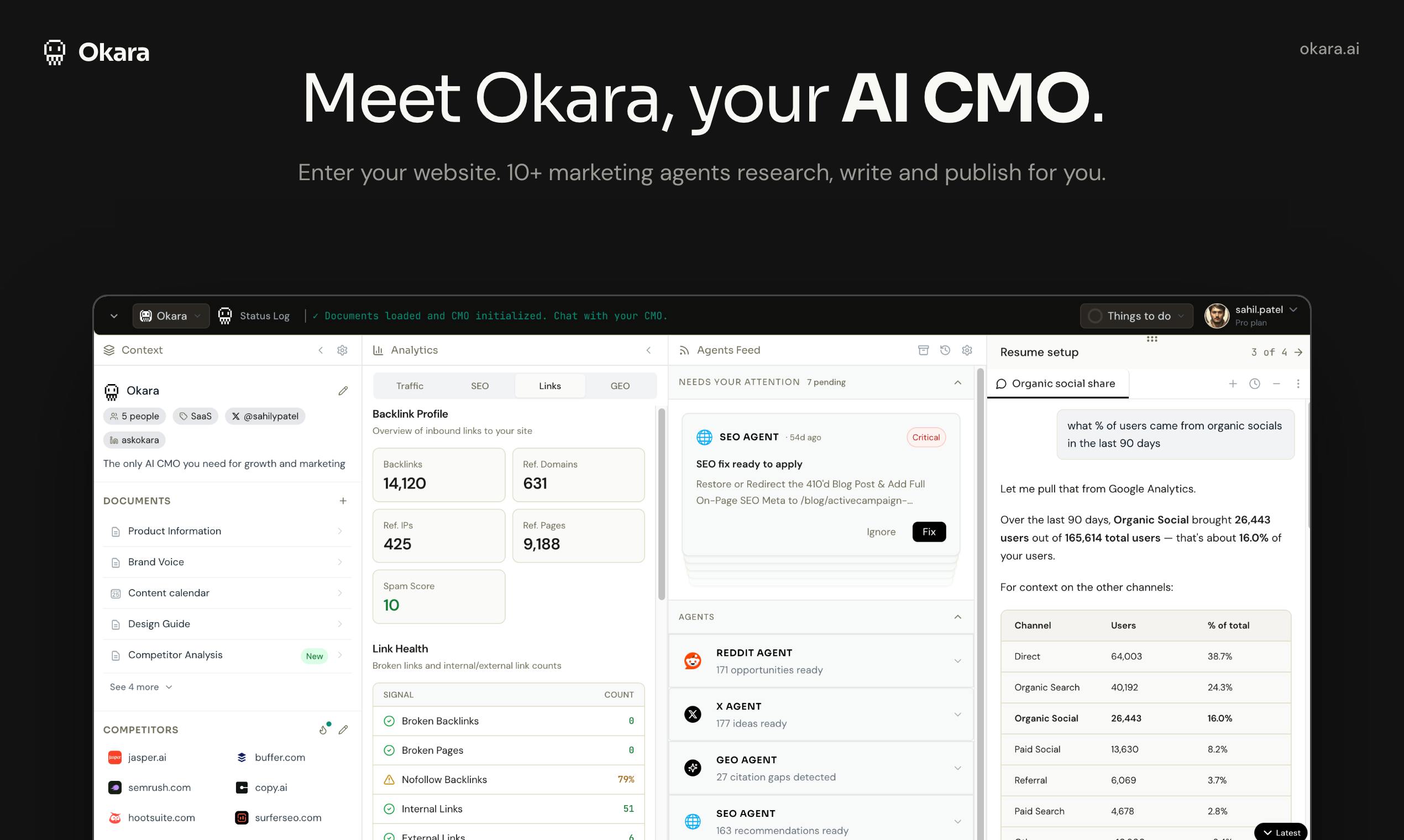
Okara is an “AI CMO” for founders and small teams. It analyzes a website and brand, proposes strategy, and coordinates SEO/GEO, content, social, Reddit, influencer, and video agents. Users review outputs; integrations connect analytics, code, publishing, and social systems (official product overview, Product Hunt).
Stripe reports thousands of paying customers within weeks of Okara’s March 2026 launch and attributes to its founder a claim of over $1 million ARR within two hours. Vercel reports 120,000 companies/websites and a four-person team. These partner case studies repeat company claims, not audited financials; 120,000 does not mean paying users. Still, this warrants diligence beyond launch votes (Stripe case study, Vercel case study).
The key test is whether Okara drives measurable, recurring growth rather than merely generating marketing tasks. Competition, platform risk, model costs, and unknown retention matter. Reported traction warrants DD, not investment, until cohorts, margins, and terms are verified.
Product Overview
Target users are solo founders and lean teams without a full marketing function. Okara builds website context and a 30-day strategy, then coordinates SEO/GEO, writing, GitHub fixes, Reddit discovery, social, influencers, and UGC. It integrates with analytics, GitHub, and CMS platforms. Outputs require review; the maker says automated Reddit comments were removed over ban risk (official introduction, Product Hunt discussion).
Free includes analysis and strategy; Lite costs $129 monthly/$1,290 annual and Pro $249/$2,490, with more agents and content. Agency plans are available. Flat pricing creates exposure to variable model costs (pricing).
Founder and Team Assessment
Okara names Fatima Rizwan as Founder & CEO. She says her prior, unnamed company reached 25 million monthly pageviews before acquisition; this is self-reported (founder statement). Stripe and Vercel describe a four-person launch team, but current staffing, ownership, and commitment are unknown.
A small team shipping a multi-agent product and integrations is evidence of execution. However, the product’s performance depends on marketing judgment, model orchestration, and third-party integrations; the public record does not show depth in customer success, sales, or platform partnerships. Key-person risk remains meaningful.
Founder Assessment: Strong relevant founder experience and early shipping velocity, with team depth and historical outcomes still requiring verification.
Market Opportunity
The beachhead is small digital firms and agencies unable to hire separate SEO, content, AI-search, and social specialists. Pricing of $129–$249 monthly is below a dedicated team, though it does not replace strategy or all channel work
No reliable qualified-market count is public. Illustratively, 20,000–100,000 firms at $1,290–$2,490 annual spend imply $26–$249 million revenue; this is an assumption, not TAM research. Venture scale requires meaningful penetration or larger agency/team plans. Okara claims 120,000 businesses/websites; Stripe reports thousands paying, with no disclosed reconciliation
Agency/team plans and more channels could expand ACV. Global distribution is plausible, but adoption depends on measurable traffic and revenue gains.
Traction and Growth Signals
Stripe reports thousands of payers within weeks of the March global launch, 70% US-based, and attributes a >$1 million ARR claim to the founder for two hours after launch. It provides no cohort, refund, or current ARR detail. Vercel and Okara report 120,000 businesses/websites, a reach figure, not evidence that all are active or paid
Product Hunt shows #6, about 210 points, 315 followers, and no reviews. The sheet says September 28; the October page said “9d ago,” a possible timezone/relaunch discrepancy. G2 has two positive reviews, too few to establish satisfaction (Product Hunt, G2).
Current ARR, active users, churn, retention, CAC, payback, and typical ROI remain unknown. Company case studies are selected examples, not controlled evidence
Traction Assessment: Unusually strong but company-reported early adoption and payment signals; retention, current scale, and typical customer ROI are unverified.
Competitive Position
Alternatives include agencies, ChatGPT plus standalone tools, Semrush, Jasper, and HubSpot. Jasper offers coordinated marketing agents; HubSpot embeds AI into its CRM (Jasper, HubSpot). Incumbents have brand, data, integrations, and distribution.
Okara’s advantage is one strategy/context layer across channels at a clear price. Proven customer outcomes could create habit, but agents are reproducible, APIs/policies change, and 120,000 claimed users are not a moat
If a major marketing platform ships the same multi-agent feature, Okara must win through better execution, transparent measurable outcomes, and faster cross-platform workflows—not just a larger agent count.
Defensibility Assessment: Low to Medium
Business Model and Economics
The model is freemium recurring SaaS, with paid tiers at $129/$249 monthly and annual discounts. Agency plans and higher-tier packages can raise account value. Stripe’s case study validates that billing is live and reports thousands of payers, but does not disclose net revenue, conversion, refunds, or retention.
Margins are unknown. Okara says open and third-party models (including OpenAI, Anthropic, and Bedrock) process service data, with possible US/Singapore/Ireland transfers; it says API data is not used for training. Flat fees risk model, image/video, and retry costs outgrowing revenue. No gross-margin, CAC, or support data is public (privacy policy)
Unicorn Path
At an illustrative 10× ARR, $1 billion requires $100 million ARR: about 77,500 annual Lite or 40,200 Pro customers (64,600/33,500 at monthly rates), before churn, discounts, costs, or mix
This scale is demanding but plausible if reported payers are retained. A path requires strong margins, agency distribution, higher-ACV plans, and measurable ROI—evolving beyond a bundle of agents into a trusted growth operating system
Unicorn Path: Conditional
Valuation Assessment
No round, investor, fundraising status, or valuation was found. The Stripe ARR claim does not establish current audited ARR or price. Valuation Attractiveness: Not Assessable. Needed: ARR, growth, retention, margins, cohorts, burn, runway, terms, cap table, preferences.
Key Risks
- AI output may not generate measurable incremental customer growth, driving churn.
- Retention and current revenue are unknown despite strong launch-era payment claims.
- Flat fees may underprice high-token, image, video, or multi-agent usage.
- Competitors such as HubSpot, Jasper, Semrush, and general-purpose AI can bundle similar workflows.
- Reliance on third-party social, CMS, analytics, and model APIs creates platform and policy risk.
- Automated or low-quality marketing may harm customer brands, trigger spam enforcement, or publish inaccurate claims.
- Customer business data and connected-service content flow to AI providers; data handling and international transfers require careful customer trust.
- A four-person team at launch may face support, security, and product-focus constraints as adoption grows.
Final Assessment
Venture Potential: 67/100
| Category | Score |
|---|---|
| Market Size and Expansion Potential | 15/20 |
| Traction and Growth Evidence | 12/20 |
| Founder and Team | 11/15 |
| Product Strength | 8/10 |
| Distribution Potential | 10/15 |
| Business Model and Economics | 7/10 |
| Defensibility | 4/10 |
| Total | 67/100 |
The upside comes from a broad, frequent marketing job, a coherent product suite, and credible reported payment activity. The main deductions reflect unverified retention/ROI, AI delivery costs, platform dependence, and weak structural defensibility.
Evidence Confidence: 57/100
Founder identity, product scope, pricing, legal entity, and integrations are publicly verifiable. Stripe and Vercel case studies provide third-party-hosted but company-attributed traction/team claims; they are not audited metrics. The 120,000-business reach claim is distinct from the thousands of payers claim, and current conversion is unknown. Funding, current ARR, retention, margins, CAC, and valuation remain undisclosed. The market sizing and revenue/customer calculations are analyst scenarios.
Final Decision: DD
DD is appropriate because a credible Stripe case study reports thousands of paying customers, and the product has expanded across multiple marketing workflows. Those claims merit founder access and validation. This is not Invest: current valuation, ARR quality, cohort retention, gross margins, and customer ROI are missing. The unicorn path is conditional, not established; valuation is not assessable.
Upgrade Conditions
- Verify current ARR, thousands of paying accounts, and healthy 6-/12-month cohort retention.
- Validate customer ROI with independently referenceable case studies and channel attribution.
- Demonstrate gross margins above 70% after model, image/video, and support costs.
- Show CAC payback and repeatable acquisition beyond founder-led launch channels.
- Clarify team depth, security posture, cap table, and attractive round terms.
Downgrade Conditions
- Paying customers or retained revenue are materially below the vendor case-study claims.
- Cohort churn, refunds, or poor output quality undermine recurring value.
- Model/API costs prevent healthy gross margins at advertised prices.
- Platform restrictions materially impair core channels or customer accounts.
- Security, privacy, or spam incidents damage customer trust.
Questions for Further Diligence
- What are current ARR/MRR, paid accounts, net revenue, refunds, and growth by month since March 2026?
- What source records support the reported $1 million ARR within two hours, and what was the definition and billing basis?
- How do the reported 120,000 businesses/websites divide into registered, activated, monthly active, trial, and paying accounts?
- What are 30-, 90-, and 180-day retention, gross revenue retention, and net revenue retention by cohort?
- What is free-to-paid conversion by channel and plan, and how much demand is from Product Hunt or launch incentives?
- What are CAC, payback, and sales/support costs for direct customers versus agencies?
- What gross margin and model cost per active customer apply to Lite and Pro, including generated video and retries?
- What evidence demonstrates customer ROI in incremental qualified traffic, leads, or sales versus content volume alone?
- Which agents actually publish versus draft for approval, and what safeguards prevent spam or brand/legal errors?
- How many employees work full-time today, and what are founder ownership, hiring plans, and key-person dependencies?
- What security controls, subprocessors, data retention, and international-transfer safeguards apply to connected customer data?
- Is the company raising capital; what are round size, valuation/cap, dilution, and use of proceeds?