
Table of Contents
Hopscotch AI Investment Report
Category: Developer infrastructure; managed multi-provider LLM gateway
Company Stage: Early-stage; recently launched publicly
Founder or Founders: Kevin Callahan (co-founder/CEO) and David Liu (co-founder/CTO), per founder statements
Headquarters: Not publicly disclosed
Funding: Founder-reported $7.5 million across pre-seed and seed; investors, terms, and valuation unverified
Business Model: Prepaid inference balance at stated provider prices; BYOK described as free. Other revenue is unspecified.
Product Hunt Launch Date: 2026/09/29 (spreadsheet column B)
Report Date: 2026-10-08
| Investment Metric | Assessment |
|---|---|
| Venture Potential | 60/100 |
| Unicorn Path | Conditional |
| Valuation Attractiveness | Not Assessable |
| Evidence Confidence | 48/100 |
| Final Decision | Watch |
Executive Summary
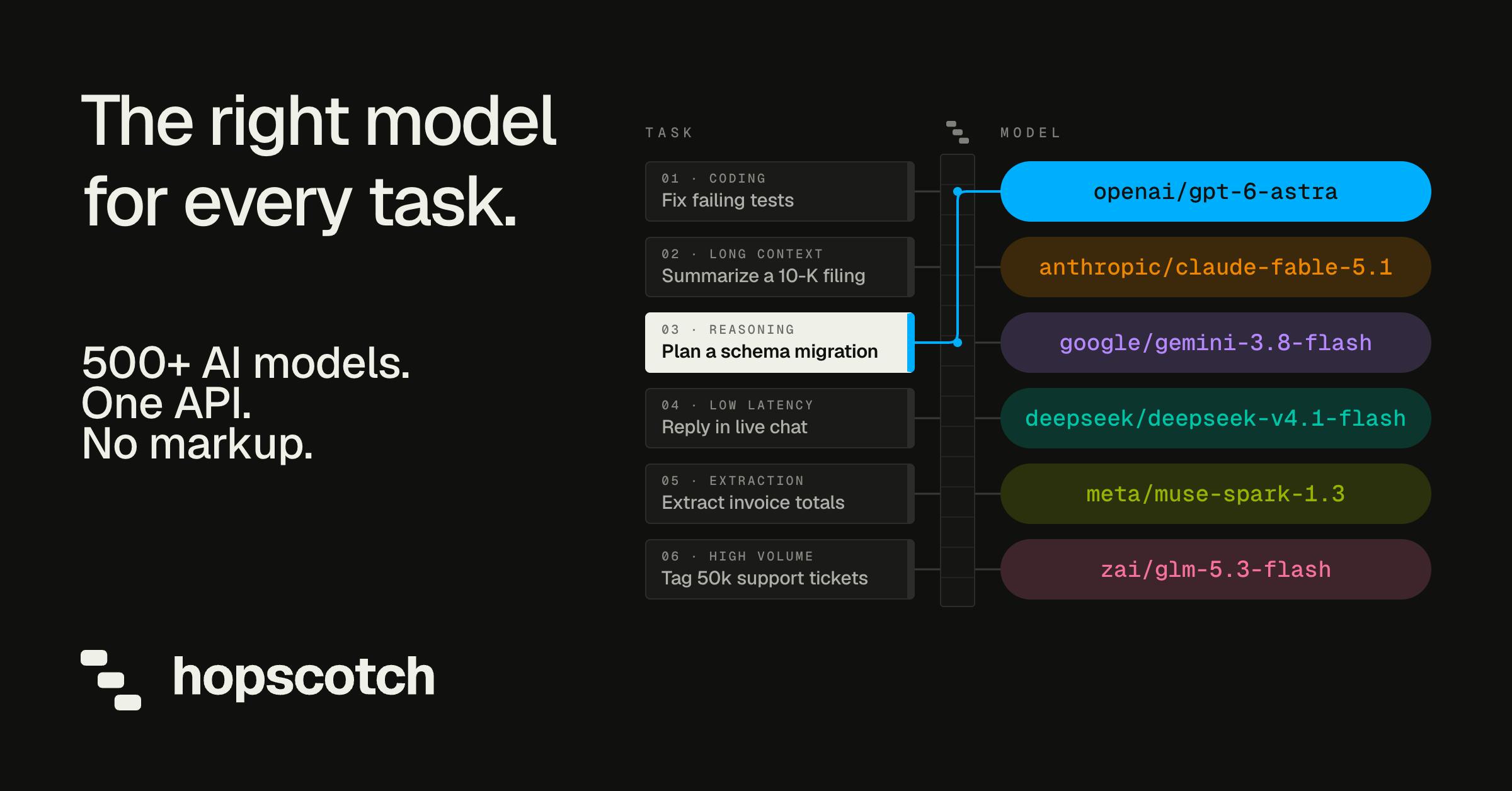
Hopscotch AI offers one API endpoint for models from multiple providers, with model selection, failover, usage records, and spend limits. It targets software teams that want to reduce integration work and switch models without rewriting applications.
Its official site describes request ceilings, team/workspace budgets, routing traces, and profiles for cost, speed, or reasoning. These could be useful production controls. However, its public catalog lists 201 models while Product Hunt and founder statements say 500+. The company should reconcile what each count includes. Official site Model catalog Product Hunt
Founder backgrounds appear relevant but are self-reported: Kevin Callahan describes prior Twitter and Coinbase roles; David Liu reports two seven-figure exits and computer-science teaching at the University of Toronto. A podcast listing attributes $7.5 million in pre-seed and seed funding to Callahan; investors and terms are undisclosed. AMA Podcast listing
The key concern is monetization. Hopscotch advertises provider-price pass-through without platform fees or token markup, and says BYOK is free. No subscription fee or enterprise plan is published. Product Hunt’s 135 points and #7 rank indicate launch attention, not retention or product-market fit. Watch until paid demand, margins, and enterprise readiness are demonstrated.
Product Overview
The initial customer is an AI software team using multiple model providers. Developers point an OpenAI-compatible client at Hopscotch and select a model. The service advertises consolidated billing, fallbacks, activity logs, and key/workspace spend limits that can reject requests before an upstream call. Official product site
The company now promotes evaluated profiles for cost-effective, reasoning, or speed-oriented work. Their value depends on evaluation quality, but public benchmarks and independent results were not found. The live catalog shows 201 entries against the launch claim of 500+; clarify whether variants or provider endpoints account for the difference. It is an API and dashboard product, not an app-store product. Product Hunt offered limited promotional credits. No recurring or enterprise price was found. Product Hunt
Founder and Team Assessment
Callahan reports business-development and platform roles at Twitter and Coinbase. Liu reports two prior seven-figure exits and teaching computer science at the University of Toronto. Both cite previous multi-provider routing work. These claims suggest relevant founder-market fit but remain unverified. Team size, full-time commitment, hiring, legal entity, and ownership are not public. Founder AMA
Founder Assessment: Relevant claimed experience, with commitment and team depth requiring verification.
Market Opportunity
The narrow initial segment is software companies operating AI features across multiple providers, especially teams seeking managed failover, cost controls, and shared governance without running a gateway. Willingness to pay is likely highest when reliability and organizational controls matter; current zero-fee positioning does not establish monetization.
Analyst scenario, not a measured market count: 10,000–30,000 potential teams × $10,000–$25,000 annual software spend implies $100 million–$750 million in possible yearly spend. Both inputs are assumptions, not verified data. Enterprise policy, evaluation, observability, and agent routing could expand contract value. The market is timely, but competition is established and basic API switching is easy.
Traction and Growth Signals
Product Hunt shows 135 points, a #7 day rank, and no product reviews. This is a launch signal, not evidence of commercial adoption. Sample activity rows on the website are not identified as customer case studies and should not be counted as traction.
No verified revenue, paying customers, active users, growth, retention, routed volume, customer references, or margins were found. The podcast’s funding figure is founder-reported and is not a traction metric.
Traction Assessment: Launch interest is visible; commercial adoption is unverified.
Competitive Position
Alternatives include managed OpenRouter and self-hosted LiteLLM, plus Eden AI, Cloudflare AI Gateway, and Vercel AI Gateway. OpenRouter provides unified model access, analytics, failover, and pass-through inference pricing; it charges for credit purchases and may charge 5% on BYOK beyond a plan allowance. LiteLLM offers a free self-hosted gateway with 100+ providers, budgets, spend tracking, and fallbacks, and sells enterprise governance/support. OpenRouter fees LiteLLM pricing
Hopscotch’s potential edge is a managed service with request limits, failure classification, routing traces, and evaluated profiles. A founder argues provider rotation can impair prompt caching and increase effective cost; this needs comparative proof. If the largest platform launches the same feature within six months, customers would need measured routing gains, lower total cost, reliable support, or stronger governance to stay. Without benchmarks, SLAs, and integrations, larger gateways can bundle much of the feature set. Switching costs are low.
Defensibility Assessment: Low
Business Model and Economics
The published offer is a prepaid balance billed at stated provider prices, with no markup or platform fee; BYOK is described as free. The site invites enterprise inquiries about invoicing, volume commitments, and MSAs, but publishes no enterprise price. No other revenue source is verified. Official site
Costs may include infrastructure, reliability, support, payment processing, and working capital for shared-key inference. Gross margin, cost per request, retry costs, CAC, and support burden are unavailable. If usage grows without fees, costs may rise without revenue. If fees are introduced, the company must differentiate from free self-hosted and competing managed gateways. Promotional credits also make early spend an unreliable proxy for paid demand.
Unicorn Path
A hypothetical 10× ARR multiple for high-growth infrastructure software implies $100 million ARR for a $1 billion valuation. At $20,000 annual contract value, that requires 5,000 customers. A hypothetical 5% inference fee requires $2 billion annual routed spend for $100 million revenue, but conflicts with today’s no-markup promise. These are scenarios, not forecasts. A credible path needs durable enterprise monetization, strong margins, customer expansion, and repeatable acquisition.
Unicorn Path: Conditional
Valuation Assessment
Valuation Attractiveness: Not Assessable. The only funding figure located is a founder-reported $7.5 million cumulative raise. Investors, dates, valuation, current fundraising, cap table, and terms are unknown. Revenue and growth are also unavailable, so a valuation range would be speculative. Diligence requires ARR, growth, margins, retention, burn/runway, round size, SAFE cap or post-money valuation, and investor rights.
Key Risks
- Monetization: No recurring fee or other revenue engine is published.
- Commoditization: Gateways and controls are available from established and open-source alternatives.
- Demand: Paid usage, retention, and customer references are unavailable.
- Catalog claims: The 500+ claim and 201-entry catalog need reconciliation.
- Routing: Evaluation methods and cost/quality gains are unproven.
- Reliability: Uptime, latency, incidents, and SLAs are undisclosed.
- Privacy/security: Liu says prompts are not stored and future shared-data features would be opt-in; this is a founder statement, not a public audit or contractual guarantee. AMA
- Team/financing: Headcount, commitment, investors, terms, and runway remain unknown.
Final Assessment
Venture Potential: 60/100
| Category | Score |
|---|---|
| Market Size and Expansion Potential | 17/20 |
| Traction and Growth Evidence | 4/20 |
| Founder and Team | 12/15 |
| Product Strength | 8/10 |
| Distribution Potential | 9/15 |
| Business Model and Economics | 5/10 |
| Defensibility | 5/10 |
| Total | 60/100 |
The strongest factors are a real developer problem, coherent product, and relevant founder-reported experience. Missing commercial proof, unclear monetization, and weak current defensibility constrain the case.
Evidence Confidence: 48/100
Public sources show product positioning, model catalog, launch engagement, and competitor offerings. Founder histories, prior exits, privacy handling, and funding are reported claims. Revenue, customer metrics, retention, margins, team size, security certifications, round terms, and valuation remain unknown. The catalog discrepancy lowers confidence.
Final Decision: Watch
There is a meaningful infrastructure problem and an interesting product, but not enough evidence for formal investment diligence. Paid traction, monetization, defensibility, and price are unverified.
Upgrade Conditions
- Verify paid usage, retention, and customer references over multiple months.
- Show positive contribution margins and a durable enterprise or software fee.
- Demonstrate benchmarked gains versus OpenRouter, LiteLLM, and direct APIs.
- Reconcile model counts and publish evaluation methods and security/reliability evidence.
Downgrade Conditions
- No paid conversion after promotional credits expire.
- Material outage, provider-policy breach, security incident, or misleading catalog claim.
- Weak retention, unsustainable support costs, competitor bundling, founder departure, or inadequate runway.
Questions for Further Diligence
- What are ARR/MRR, growth, paying customers, and top-customer concentration?
- What are active production workspaces, monthly routed spend, and 30/90/180-day retention?
- What converts after the $50 promotion, and how much credit remains unused?
- How does the company earn gross profit on prepaid and BYOK usage without fees?
- What are margins and per-request costs after infrastructure, payment fees, retries, and support?
- What benchmarks validate the profiles, and what measured cost/quality improvement do customers see?
- Why do launch materials say 500+ models while the catalog lists 201?
- What are uptime, latency, incidents, retry behavior, SLAs, prompt-retention terms, audits, funding terms, and runway?