
Table of Contents
GitBot Investment Report
Category: Local-first coding-agent orchestration / developer tools
Company Stage: Not publicly disclosed; free product with no verified commercial model
Founder or Founders: Product Hunt maker Sunny; full founding team not publicly verified
Headquarters: Not publicly disclosed
Funding: No reliable public funding announcement found
Business Model: Free MIT-licensed open-source software; future monetization undisclosed
Product Hunt Launch Date: 2026/09/30
Report Date: 2026-10-08
| Investment Metric | Assessment |
|---|---|
| Venture Potential | 48/100 |
| Unicorn Path | Conditional |
| Valuation Attractiveness | Not Assessable |
| Evidence Confidence | 46/100 |
| Final Decision | Watch |
Executive Summary
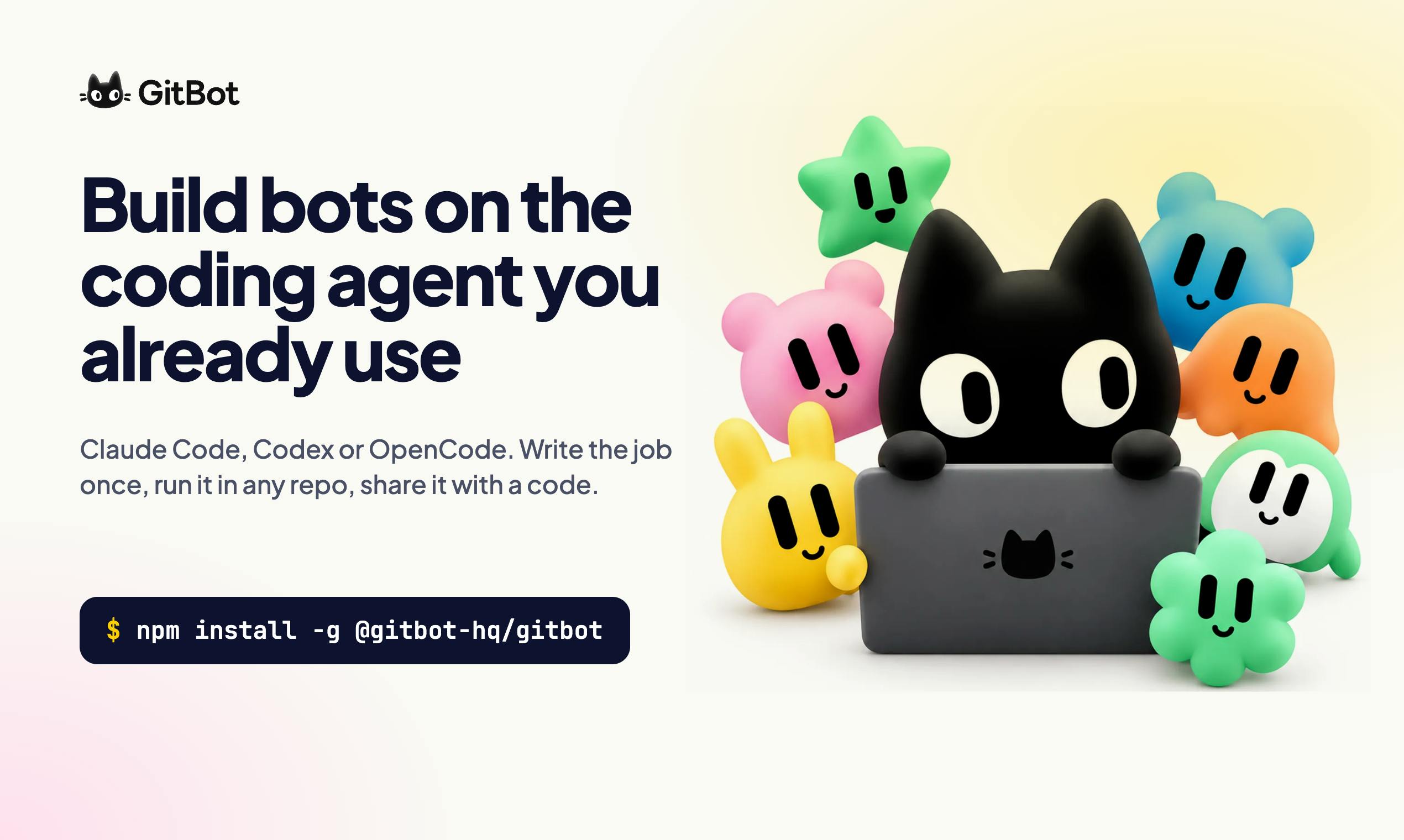
GitBot packages recurring coding-agent tasks into reusable “bots.” A developer selects Claude Code, Codex, or OpenCode, provides instructions and permissions, chooses a repository, and gets a persistent thread for each run. It runs locally, uses existing agent logins, and offers shareable bot configurations and a community library (Product Hunt; GitHub).
It addresses real friction for developers who repeatedly configure prompts, repositories, and permissions. The product is coherent and actively developed; GitHub showed 137 stars, 11 forks and 120 commits, while npm listed version 0.0.11 and 270 weekly downloads. These are distribution signals, not proof of active users, retention, or willingness to pay (GitHub; npm).
Product Hunt records a September 30, 2026 launch, #5 of the day and 194 points, but no reviews. This suggests launch interest only; it does not demonstrate product-market fit (Product Hunt). No public revenue, paid customers, retention, funding, legal entity, or financing terms were found.
The free MIT model has no disclosed revenue engine, and safe execution matters because bots use local shell and file access. Watch: monitor repeat usage and a paid team/enterprise wedge before formal diligence.
Product Overview
GitBot is a local server with a browser interface. A bot stores standing instructions, an agent, permissions, and optional setup steps; a thread connects it to a repository and conversation. Users can share bot definitions or publish them to a library. Scheduled triggers are described as forthcoming (GitHub).
The initial user is a developer or small team repeating code reviews, release-note generation, and test discovery. GitBot replaces setup repetition, not the coding agent. It is free, requires Node.js 18+ and an installed, authenticated agent CLI, and has no GitBot account requirement. Prompts and code may still be sent to the selected agent provider. Permission behavior differs by provider; GitBot documents that Codex does not enforce its allowed-tools list like Claude Code or OpenCode (npm).
Founder and Team Assessment
Product Hunt maker Sunny describes themself as a design engineer with 8+ years in product design, creative technology, UI/UX, and marketing, and says they have built 10+ products. This is self-reported, not independently verified employment or outcome data (maker profile). Package collaborators are listed, but public materials do not establish the founding team, engineering ownership, company entity, full-time commitment, prior exits, or commercial leadership. No public hiring signal was found.
Product-led design experience may fit an early developer tool; ability to build and maintain a secure cross-agent platform and sell to teams remains unknown.
Founder Assessment: A visible product/design-led maker, but team completeness, technical ownership, and commitment are unverified.
Market Opportunity
The narrow initial segment is developers using coding-agent CLIs across repositories who repeat similar tasks. The pain is credible, but willingness to pay for a layer around agents they already access is unknown. No reliable public estimate of reachable customers or spend was found.
A scenario illustrates scale, not a forecast: 100,000 reachable individual power users × hypothetical $120 annual revenue each would equal $12 million ARR before churn, support, and payment costs. Both inputs are analyst assumptions, not GitBot user estimates or pricing. Team administration, shared workflows, auditability, and support could raise contract value; none is validated. Venture scale requires expansion beyond today’s free local utility.
Traction and Growth Signals
Product Hunt showed 194 points and #5 for launch day; the page had no reviews. The maker reported two developers created library bots at a 90-minute build night—an anecdote, not repeat-use evidence (Product Hunt). The GitHub repository’s 137 stars, 11 forks and 120 commits show public interest and development activity. npm’s 270 weekly downloads and v0.0.11 show distribution and releases, but downloads may include repeat installs, tests, or automation (GitHub; npm).
No verified unique installs, active users, bot runs, retention, paid conversion, revenue, customer references, or post-launch growth were found.
Traction Assessment: Early open-source engagement and shipping are visible; commercial traction and retention are unverified.
Competitive Position
Alternatives include native agent instructions, skills, subagents and saved sessions; shell scripts; IDE integrations; and products managing multiple agents. GitHub Agentic Workflows is a platform substitute: Markdown-defined agent jobs run in GitHub Actions with triggers, permissions, and security controls. It focuses on repository automation in CI rather than GitBot’s local interactive threads, but overlaps in reusable agent workflows and benefits from GitHub’s distribution (GitHub Docs).
GitBot offers local use, several agent CLIs, persistent threads, and shareable bots; MIT also enables forks. There is no demonstrated proprietary data, switching cost, or network effect. A bot library could aid distribution if its content is useful and maintained. Agent vendors can bundle similar features or change CLI interfaces.
If the largest platform launched the same feature within six months, why would customers stay? Cross-provider portability, local control, and a curated library are plausible answers, but none is yet a durable moat.
Defensibility Assessment: Low
Business Model and Economics
The model is free open source; subscription, services, sponsorship, pricing, ACV, conversion, CAC, margin, and support costs are undisclosed. Avoiding hosted inference and workspaces may limit direct infrastructure expense, but development and support still cost money; users pay their own agent providers.
Possible monetization—only hypotheses—includes team sharing and administration, policy controls, audit features, managed remote workers, or enterprise support. Hosting remote execution would introduce infrastructure and security costs. A marketplace could support distribution, but no transaction model or liquidity is demonstrated. It is unknown whether users will pay without weakening the local-first proposition.
Unicorn Path
For sensitivity only, assume a hypothetical high-growth software business can command 10× ARR; this is not a comparable-based valuation or claim about GitBot. A $1 billion valuation would require about $100 million ARR. At hypothetical $1,000 annual revenue per team, that implies 100,000 paying teams; at $10,000 enterprise contracts, 10,000 customers. These are illustrative calculations, not current pricing or forecasts.
A route requires a trusted paid team/enterprise product, proven retention and expansion, and broader distribution. Unicorn Path: Conditional—possible only with a substantial, unproven business-model and product expansion.
Valuation Assessment
Valuation Attractiveness: Not Assessable. No reliable funding, investor, round, valuation, or financing terms were found. Stars, downloads, and Product Hunt ranking are not valuation inputs; no relevant financing comparable supports a range. Assessment requires ARR and growth, customer cohorts, retention, gross margin, CAC, burn/runway, round size, cap table, and terms. No valuation range is warranted.
Key Risks
- No monetization evidence: free MIT distribution may not become a venture-scale business.
- Platform dependency: agents may change interfaces or bundle the workflow.
- Security: bots access local shell/files; imported instructions and auto-approval can cause harm. There is no authentication; LAN mode should only be used on trusted networks (npm security guidance).
- Documentation consistency: npm describes loopback-only default binding and opt-in LAN access, while portions of GitHub README retain older, contradictory all-interface warnings. Verify shipped versions and security behavior (npm; GitHub).
- Weak moat: bot instructions are portable and copyable.
- Retention unknown: stars and downloads do not measure repeat productive use.
- Team risk: roles, commitment, and commercial capability are unclear.
- Cross-agent complexity: permission semantics differ by provider.
Final Assessment
Venture Potential: 48/100
| Category | Score |
|---|---|
| Market Size and Expansion Potential | 12/20 |
| Traction and Growth Evidence | 4/20 |
| Founder and Team | 7/15 |
| Product Strength | 8/10 |
| Distribution Potential | 8/15 |
| Business Model and Economics | 4/10 |
| Defensibility | 5/10 |
| Total | 48/100 |
The product is coherent and solves a real workflow nuisance; open-source iteration is promising. The weakest elements are absent commercial proof, an undisclosed team, and a thin moat against agent/platform bundling.
Evidence Confidence: 46/100
Verified public sources establish the stated workflow, MIT license, npm version/download count, repository activity, Product Hunt launch page, and maker profile. Founder experience and the build-night anecdote are self-reported. Revenue, customers, retention, legal structure, funding, economics, team commitment, and valuation remain unavailable.
Final Decision: Watch
Product quality and early developer interest justify tracking, but not formal diligence. Commercial proof, a paid wedge, and financing terms are missing; native platform competition and security risks remain material.
Upgrade Conditions
- Verify paid team/enterprise demand and a defined offer.
- Demonstrate 90-/180-day retention and recurring bot runs by cohort.
- Show repeatable acquisition beyond Product Hunt and open-source launch traffic.
- Verify team roles and commitment; document security controls and reconcile permission/version guidance.
Downgrade Conditions
- Release cadence, support, or agent compatibility stalls.
- Active use fades after launch without repeat workflows.
- A major platform bundles equivalent orchestration and GitBot lacks a differentiated team workflow.
- Security incidents or misleading privacy claims emerge.
Questions for Further Diligence
- How many unique installs, weekly active users, and monthly bot runs exist, and how are they measured without telemetry?
- What are 30-, 90-, and 180-day cohort retention rates?
- Have users paid, donated, sponsored, or committed to a team plan? What pricing has been tested?
- Which workflows drive repeat use, and how many runs occur per active user monthly?
- Who are the founders and contributors, what are their roles, and who is full time?
- What legal entity owns the product and IP, and are contribution rights documented?
- What is the monetization plan and why would teams pay instead of using native agent features?
- What threat model, security testing, and permission guarantees govern local and LAN operation?
- How are unsafe imported setup instructions and secret exposure prevented?
- How will the product respond to CLI changes or access-term changes from Claude Code, Codex, and OpenCode?
- What are monthly costs, burn, runway, fundraising status, and proposed financing terms?
- What measurable usage would show the bot library creates a real distribution or network effect?