
Table of Contents
jambuild Investment Report
Category: Prototyping; Artificial Intelligence; Vibe coding
Company Stage: Early public product; formal stage not disclosed
Founder or Founders: Rajiv Ayyangar is the publicly identified maker; other founders not disclosed
Headquarters: Not publicly disclosed
Funding: Not publicly disclosed
Business Model: Limited free daily builds; users can bring their own API key for more usage. Paid plan not disclosed
Product Hunt Launch Date: 2026/09/30 (spreadsheet B-column value)
Report Date: 2026-10-08
| Investment Metric | Assessment |
|---|---|
| Venture Potential | 53/100 |
| Unicorn Path | Conditional |
| Valuation Attractiveness | Not Assessable |
| Evidence Confidence | 43/100 |
| Final Decision | Watch |
Executive Summary
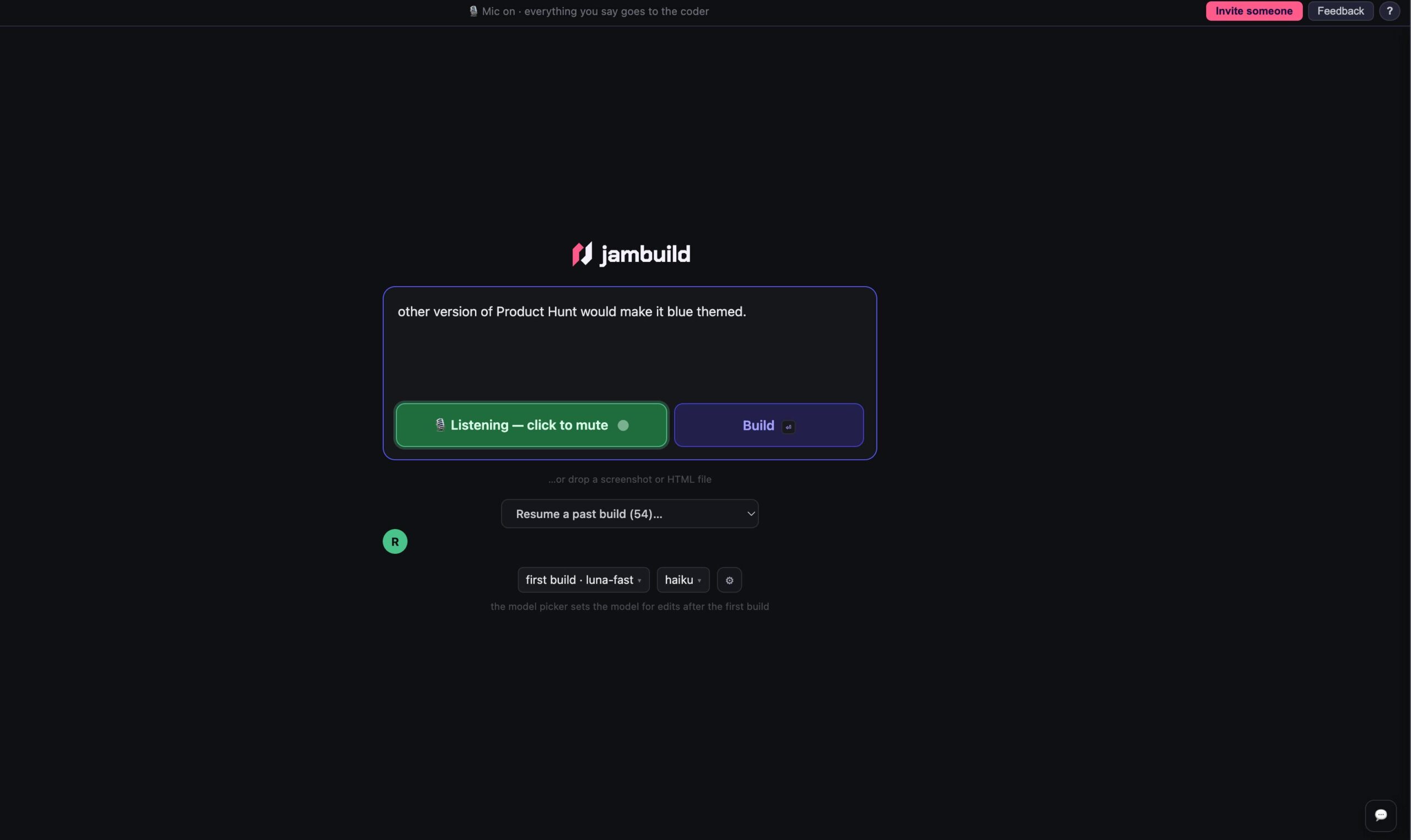
jambuild is a browser-based voice-driven prototyping tool. A user describes a web app, points to a page element, and asks for a change; one invited collaborator can join the same room and build on the page. It targets founders, designers, and product teams turning discussion into a prototype. The official site says changes land in under ten seconds (jambuild).
Its thesis is that visual context, voice, and pointing can make iteration feel like a whiteboard or Figma session. The maker says jambuild uses preemptive voice-turn detection and fast coding models to reduce waiting (Product Hunt). Whether this drives repeat use or willingness to pay is unverified.
Product quality and company quality are different questions. The public product concept is clear and the maker has relevant startup experience. However, legal structure, team, founder commitment, funding, pricing, usage, revenue, retention, and unit economics are not publicly disclosed. Product Hunt attention is an early launch signal, not product-market fit.
Final Decision: Watch. The product merits post-launch observation, but public evidence does not justify formal DD. A move to DD requires paid demand, repeat use by teams, repeatable distribution, and a path beyond a two-person prototyping room. Price and financing terms are unknown, so an investment decision cannot be made.
Product Overview
jambuild turns spoken instructions and pointer context into changes to a web app prototype. The site describes four interactions: talk to create, point to identify an element, click to request a behavior change, and invite another person to work on the same page. Invited collaborators do not need an account. The Product Hunt page describes limited trial credits and a bring-your-own-key option (jambuild, Product Hunt).
Its initial user is a founder-designer pair validating a flow; it may replace mockup handoffs and prompt writing. It is browser-based; other platforms and paid tiers are undisclosed.
Founder and Team Assessment
Rajiv Ayyangar is the maker identified on Product Hunt. His public profile identifies him as Product Hunt’s CEO and former co-founder/CEO of Tandem; Y Combinator lists Tandem as a 2019 company that is now inactive (LinkedIn, YC profile). His launch post says jambuild uses Deepgram, Pipecat, and a small model he trained for turn detection; these are founder-reported technical details, not independently verified performance results (launch post).
No jambuild cofounders, employees, hiring, legal entity, full-time commitment, or ownership information was verified. His Product Hunt CEO role makes time allocation and governance worth clarifying; this is a diligence question, not evidence of misconduct.
Founder Assessment: Relevant startup and product experience is visible, but team capacity and commitment to jambuild remain unverified.
Market Opportunity
The initial segment is product teams and founder-designer pairs that need to discuss and change web interfaces together. The problem is most acute when visual iteration matters more than production code, version control, or complex application logic. Willingness to pay for this workflow is unknown. The product launches into a timely AI-building market, but the same category is moving quickly; one Product Hunt user reported voice recognition understood English only.
No reliable public count of potential paying teams was found. A scale scenario is more defensible than a top-down TAM claim: at an assumed $30 per seat per month for two seats ($720 annual revenue per pair), $100 million ARR would require about 139,000 paying pairs. This is illustrative, not jambuild pricing, and excludes churn and costs. Larger teams, project history, repository integrations, and deployment workflows could expand the addressable market, but require product development and global language support.
Traction and Growth Signals
Product Hunt showed about 130 points and an #11 daily rank; its page also contains early feedback and feature requests (Product Hunt). The official site is live and publishes a privacy policy updated September 29, 2026 (Privacy). These verify a launch and an active product surface, not sustained adoption.
No verified users, paying customers, revenue, conversion, retention, cohort data, customer references, traffic, or post-launch growth were found. The key test is whether pairs return to jambuild on real projects and whether either side pays.
Traction Assessment: Early launch interest is visible, but commercial traction is unverified.
Competitive Position
Direct and adjacent alternatives include Replit Agent, v0, and Bolt. Replit offers AI app building with shared collaboration and deployment; v0 supports conversational app generation, team sharing, and publishing; Bolt offers prompt-based app creation and deployment (Replit, v0 docs, Bolt). Manual alternatives include Figma or whiteboard discussions followed by a developer or AI coding tool.
jambuild’s differentiation is voice plus pointer targeting in a synchronous shared room. No proprietary data, switching costs, network effects, code ownership advantage, or distribution moat was verified. If a large platform copies this interaction, customers would need to stay for better collaboration, measurable time savings, or persistent team workflow. Evidence for those advantages is not yet public.
Defensibility Assessment: Low
Business Model and Economics
The public model is limited free daily builds, with BYOK to remove the limit; no paid subscription price was found (jambuild, Product Hunt). BYOK may reduce direct model expense but adds setup friction and does not establish revenue. Cost per build, gross margin, usage limits, and the economics of company-funded free usage are unknown.
The privacy policy says voice is transcribed and kept with the prototype, audio is not retained, and a user’s API key stays in the browser and is sent for each build. Anyone with the room link can see the prototype and conversation (Privacy). These disclosures are clear, but retained transcripts and link-based access could limit confidential work. Paid conversion and repeat usage need verification.
Unicorn Path
An illustrative 8–12x ARR range for a high-growth software company implies $83–125 million ARR for a $1 billion valuation; 10x implies $100 million. This is a scenario, not a valuation of jambuild. At the hypothetical $720 annual revenue per pair above, that range requires roughly 116,000–174,000 paying pairs, before churn, discounts, support, and infrastructure.
A credible path likely requires expansion into persistent team projects, larger groups, repository and deployment integrations, and acquisition beyond Product Hunt. The present product alone has not demonstrated the retention or monetization needed.
Unicorn Path: Conditional
Valuation Assessment
No jambuild funding round, investors, current fundraising status, valuation, or terms were publicly verified. Category comparables cannot establish jambuild’s value without company financials.
Valuation Attractiveness: Not Assessable. Assessment requires ARR and growth, gross margin, retention, burn and runway, round size, SAFE cap or post-money valuation, cap table, and liquidation preferences.
Key Risks
- No evidence that users return after initial prototype sessions.
- No published paid tier or willingness-to-pay data.
- Replit, v0, or other platforms could bundle the interaction.
- Founder commitment, team size, and role-related governance are unknown.
- The current proposition centers on only one invited collaborator.
- Room links expose prototypes and conversation; transcripts are retained (Privacy).
- A Product Hunt user reported English-only voice recognition; breadth of language support is unverified.
- Free usage, transcription, hosting, and model costs may constrain margins.
Final Assessment
Venture Potential: 53/100
| Category | Score |
|---|---|
| Market Size and Expansion Potential | 11/20 |
| Traction and Growth Evidence | 4/20 |
| Founder and Team | 12/15 |
| Product Strength | 8/10 |
| Distribution Potential | 10/15 |
| Business Model and Economics | 5/10 |
| Defensibility | 3/10 |
| Total | 53/100 |
The strongest elements are a distinct interaction concept and an experienced, publicly identified maker. The weakest are absent commercial proof, uncertain monetization, and low demonstrated defensibility.
Evidence Confidence: 43/100
The product workflow and privacy disclosures are verifiable on the company site; launch and maker identity are visible on Product Hunt. Prior founder experience is supported by his profile and YC’s Tandem page. Technical details are founder-reported. Revenue, users, retention, team, company structure, funding, pricing, margin, and valuation remain unavailable.
Final Decision: Watch
The maker and product merit observation, but evidence does not warrant DD yet: traction and financing terms are unknown, and durable differentiation is unproven. Watch fits the 53/100 venture score, conditional unicorn path, low defensibility, and 43/100 evidence confidence.
Upgrade Conditions
- Verify paid conversion and a clear pricing model.
- Show 30-, 90-, and 180-day team retention and repeat projects.
- Provide customer references for real project use.
- Demonstrate repeatable acquisition beyond Product Hunt.
- Establish reliable collaboration, privacy controls, and expansion beyond two-person sessions.
Downgrade Conditions
- Product activity or founder support stops after launch.
- Cohort data shows low repeat use or negligible willingness to pay.
- A platform bundles equivalent collaboration into a broader builder.
- Room-link or transcript handling causes a material trust or security issue.
- The maker cannot commit time or resolve role-related governance questions.
Questions for Further Diligence
- How many users, active pairs, and completed builds have you had each week since launch?
- What are 7-, 30-, 90-, and 180-day retention rates by cohort?
- What share returns for a second project, and how often do pairs build together?
- What paid plan and price are planned, and what is free-to-paid conversion?
- What share of sessions uses company-funded models versus BYOK, and what is cost per completed build?
- What are gross margin, burn, runway, and current fundraising terms?
- How do you handle conflicting simultaneous requests, history, rollback, and code export?
- How long are transcripts and prototypes retained, and how are private projects protected?
- What voice accuracy and language coverage have you measured?
- Who works on jambuild, what is their commitment, and how is the project governed alongside your Product Hunt role?
- What measured workflow advantage do you have over Replit, v0, or Figma followed by an AI coding tool?
- Which customer segment and acquisition channel can support growth beyond early adopters?