
Table of Contents
Foley — Investment Assessment
Category: Consumer productivity software; voice-first task management; AI planner
Company Stage: Early-stage founder-led product; live across desktop and mobile; financing stage undisclosed
Founder(s): José Pedro Airosa (maker and developer)
Headquarters: Not publicly confirmed; App Store provider is Hanamori Labs, LLC in the United States; founder profiles list Portugal
Funding: No public financing round identified
Business Model: Freemium desktop app; paid Foley Pro subscription for hosted AI, sync, and sharing
Product Hunt Launch Date: 2026/10/11
Report Date: 2026/10/14
Executive Summary
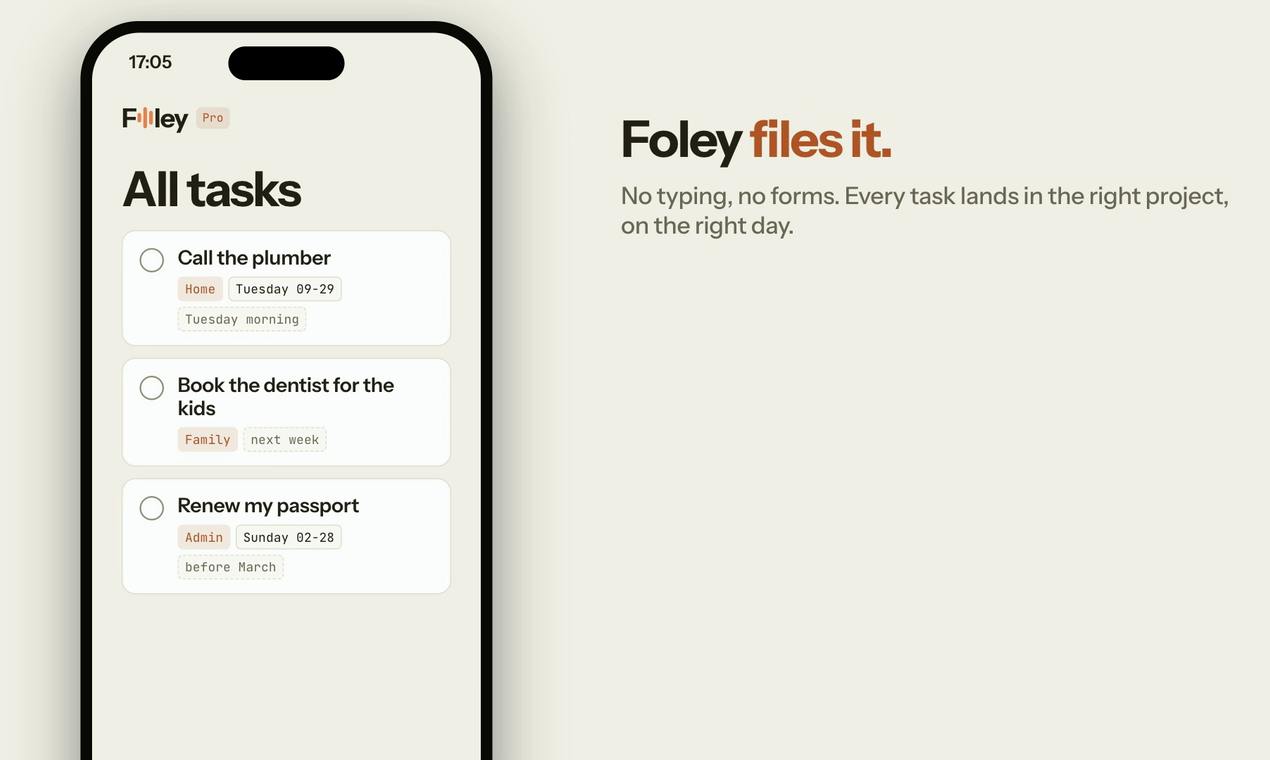
Foley is a voice-first personal task manager. Users speak tasks; the app adds context and dates, asks when unsure, and files them. It also offers planning, projects, history, and watch capture. Foley
It works across desktop, web, mobile, and watch. The free desktop app stores tasks locally and supports a personal AI key; Foley Pro adds hosted AI, sync, and sharing for $8/month ($4 first month). Native tools remain free substitutes. Foley pricing
Maker José Airosa describes himself as a software engineer with 25+ years’ experience and built Foley to stop losing spoken tasks. This is self-reported founder-problem fit. Public user, paid conversion, retention, and acquisition data are absent; the App Store says there are too few reviews for a rating summary. Product Hunt App Store
Apple Reminders/Siri and Google Tasks/Gemini already offer voice or AI task capture. Foley differentiates with cross-platform task context, clarification, and planning, but these features are replicable and low-priced. Apple Google
Privacy is material: Foley says audio and selected task context can go through OpenRouter to model providers; signed-in content syncs through Foley and Cloudflare without end-to-end encryption. The detailed disclosure is positive, while the data flows still require diligence. Privacy policy
Foley is a promising product, not yet an underwritable venture. Limited traction, low ARPU, and weak defensibility support Watch.
Product Overview
Foley turns speech into tasks with projects, dates, and reminders. It supports changes by voice, daily planning, folders, dependencies, shared projects, history, and undo across Mac, Windows, web, iPhone, Android, and watches. It says it checks dates against the device clock and asks rather than guesses when uncertain. Foley Product Hunt
The privacy policy says audio is sent for transcription and transcripts plus selected task context go to an AI provider. Signed-in data syncs through Foley; it is not end-to-end encrypted, and Foley can read it to provide the service. Desktop recordings can be retained locally by default. These are company disclosures, not independent verification. Privacy policy
Founder and Team Assessment
Product Hunt names José Airosa as maker; he self-reports 25+ years as a software engineer and describes building Foley for his own task-capture problem. Foley is published by Hanamori Labs, a studio with several consumer and developer products. This suggests software-building experience, though Foley may compete internally for resources. Product Hunt Hanamori Labs
Public sources do not establish Foley’s dedicated team, subscription-app scale, funding, or customer-acquisition ability. The visible founder involvement is a strength, but also leaves key-person risk.
Founder Assessment: Strong hands-on software experience and user empathy are positives, while team depth and distribution remain unknown.
Market Opportunity
Foley targets people who capture tasks on the move, prefer speech to typing, and want one list across devices. Likely users include professionals, caregivers, and people who switch between phone, desktop, and watch. No product-specific market size or customer study was found.
At $8/month, one full-price subscriber represents $96 annualized before discounts and platform fees. Ten thousand paid subscribers imply $960,000 annualized revenue; 100,000 imply $9.6 million. These are scenarios, not TAM or forecasts. The free local desktop app lowers trial friction, but users can remain free unless hosted AI, sync, or sharing is valuable. Pricing
Traction and Growth Signals
At review, Foley’s Product Hunt page showed 74 points and a #7 daily rank. The founder describes personal use and shared family projects. The App Store lacks enough ratings to display a review summary. No public download, active-user, paid conversion, revenue, retention, or churn metrics were found. Product Hunt App Store
Traction Assessment: Foley is live across platforms and has launch visibility, but paying demand and habitual use remain unproven.
Competitive Position
Foley’s edge is its capture-to-plan flow across desktop, phone, and watch: it places speech in task context, asks when meaning is ambiguous, and displays a unified timeline. Apple Reminders supports Siri capture and AI suggestions; Gemini can create, show, edit, and delete Google Tasks. Mature task apps also compete. Apple Google
Apple and Google control distribution and can bundle these features. Foley has no public proprietary data, network effect, or switching-cost advantage. It must prove better capture quality and repeat use.
If the largest platform in this market launched the same feature within six months, why would customers continue using this product?
They would need to prefer Foley’s cross-platform workflow and careful ambiguity handling. Retention has not validated that case.
Defensibility Assessment: Low. The interface is focused, but its core features are replicable and no durable distribution advantage is public.
Business Model and Economics
The free desktop app supports local task management and a personal AI key. Foley Pro costs $8/month on the website, with a $4 first month, and adds hosted AI, device sync, and sharing. UK App Store prices are £7.99 monthly and £79.99 annually. Foley App Store
At $96 annualized per full-price subscriber, Foley needs scale. Speech, model use, hosting, app-store fees, and support reduce margins. BYOK limits free-tier cost but may also reduce Pro conversion. No unit economics or acquisition cost are public.
Unicorn Path
At an illustrative 10x ARR, a $1 billion value requires $100 million ARR. At $96 annualized per subscriber, that is about 1.04 million paid users, before discounts, platform fees, churn, and costs. This is a sensitivity, not a forecast.
A credible path requires strong retention, low-cost global distribution, conversion from free to Pro, and trust across platforms. Native assistants make that difficult.
Unicorn Path: Improbable. The audience is broad, but the paid scale required is large and traction evidence is minimal.
Valuation Assessment
No Foley-specific financing, valuation, or ownership terms were found. Without paid-user, revenue, retention, and margin data, an entry valuation cannot be assessed.
Valuation Attractiveness: Not Assessable.
Key Risks
- Retention: Users may return to default reminders after novelty fades.
- Bundling: Apple and Google can add similar features for free.
- Low ARPU: $8/month requires significant subscriber scale.
- Acquisition: Consumer apps compete for costly attention.
- AI costs: Speech and model calls may erode margins.
- Privacy: Audio and tasks can leave the device; sync is not end-to-end encrypted.
- Accuracy: Misheard tasks or dates can undermine trust.
- Platform burden: Six-platform support adds engineering and service costs.
- Key-person risk: Team depth and operational backup are unclear.
Final Assessment
| Metric | Assessment |
|---|---|
| Venture Potential | 58/100 |
| Unicorn Path | Improbable |
| Valuation Attractiveness | Not Assessable |
| Evidence Confidence | 62/100 |
| Final Decision | Watch |
Evidence Confidence: 62/100. Features, pricing, founder identity, and privacy disclosures are documented. Usage, retention, conversion, margins, and demand remain uncertain; the founder’s usage claims are self-reported.
Final Decision: Watch. Revisit after Foley reports paying users, retention, and Pro unit economics. Upgrade on sustained voice use, durable conversion, and independent privacy review. Downgrade if platform tools close the gap or paid retention is weak.
Due-Diligence Questions
- How many monthly active users, paid subscribers, and downloads does Foley have?
- What are activation, conversion, churn, and 90-day retention by cohort?
- How many users choose hosted AI versus BYOK?
- What are AI, hosting, store, and support costs per subscriber?
- Which channels produce paid users, and what are CAC and payback?
- What user research shows Foley beats Siri, Google Tasks, or other task apps?
- Which AI providers receive audio and task context, and under what terms?
- What controls protect synced data that is not end-to-end encrypted?
- What is the roadmap and support capacity across platforms?
- What are Hanamori’s financing, runway, and resource allocation for Foley?
Sources
- Foley product and pricing — features and Pro plan.
- Foley privacy policy — data flows, providers, and retention.
- Product Hunt — launch details and maker statements.
- App Store listing — developer, regional prices, and rating status.
- Hanamori Labs — product portfolio.
- Apple Reminders and Google Tasks with Gemini — native alternatives.
- José Airosa on LinkedIn — self-reported background.
Conclusion
Foley makes task capture more structured across devices and has a clear Pro tier. Adoption, economics, and defensibility remain unproven against free alternatives. Maintain Watch pending customer and retention evidence.