
Table of Contents
Caddi Investment Report
Category: AI workflow automation / agentic back-office software
Company Stage: Seed-stage
Founder or Founders: Alejandro Castellano and Aditya Sastry
Headquarters: Seattle, Washington, United States
Funding: $5 million seed round led by Ubiquity Ventures, with Founders’ Co-op and AI2 Incubator
Business Model: B2B SaaS subscriptions, usage credits, enterprise contracts, and implementation services
Product Hunt Launch Date: August 28, 2026
Report Date: August 31, 2026
| Investment Metric | Assessment |
|---|---|
| Venture Potential | 75/100 |
| Unicorn Path | Plausible |
| Valuation Attractiveness | Not Assessable |
| Evidence Confidence | 67/100 |
| Final Decision | DD |
Executive Summary
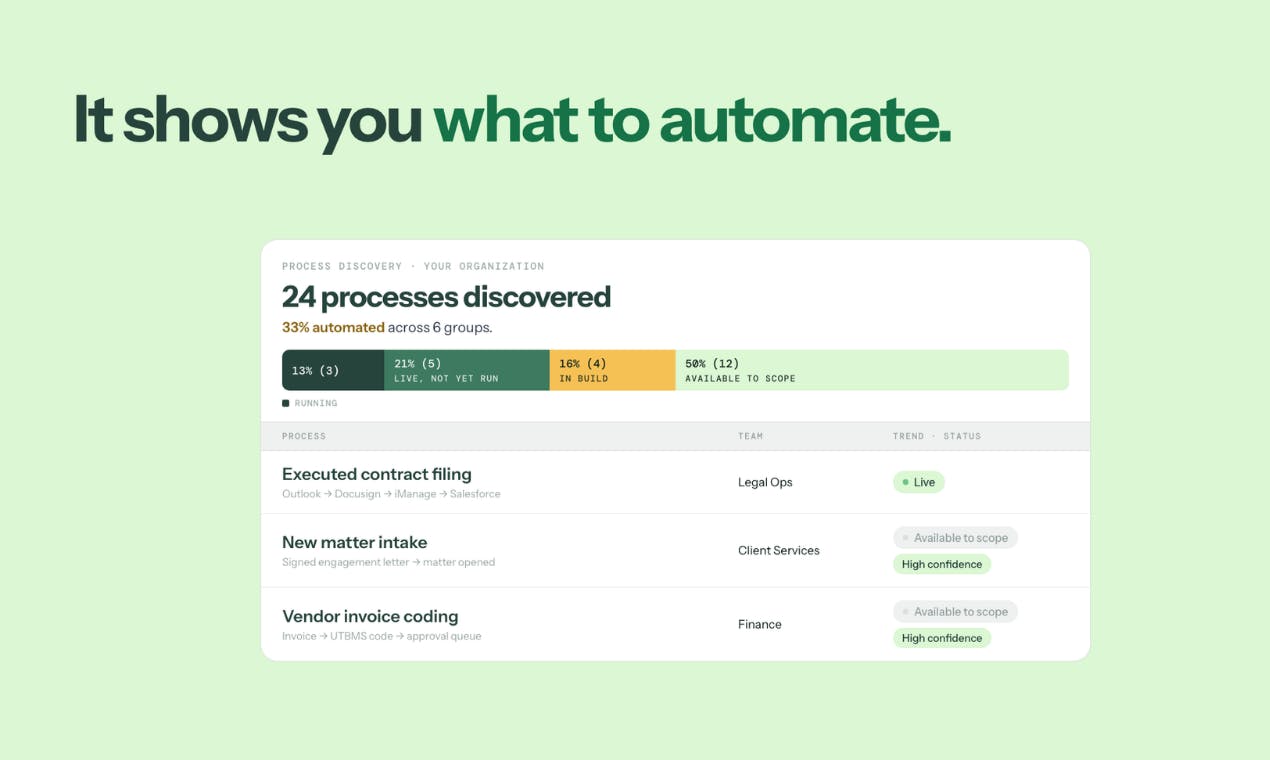
Caddi automates back-office workflows for law firms, registered investment advisers, accounting firms, insurers, and adjacent regulated businesses. Users demonstrate a process through a narrated screen share; Caddi identifies steps and exceptions, converts the process into an automation, and executes it across connected business applications (Product Hunt; official website).
The product is more ambitious than a screen-recording macro. Caddi combines AI for document interpretation and judgment with deterministic code for repeatable actions. It also provides scoped permissions, approval rules, and run-level audit records. This architecture directly addresses the reliability and governance requirements of firms handling confidential client, financial, and legal data.
The strongest investment signal is evidence of production usage at meaningful organizations. Caddi identifies The Planning Center and Palace Law as customers and reports deployments at an anonymous Am Law 100 firm and a Barron’s Top 10 RIA. Reported usage includes 53,000 documents processed, 21,000 accounting workflows completed, and 27,000 emails handled; these metrics are company-reported and have not been independently audited (customer page; launch announcement).
The most important concern is that revenue, customer count, retention, contract expansion, gross margin, and automation failure rates are not publicly disclosed. Caddi’s $6,500 monthly Business plan supports meaningful annual contract values, but long implementations, integration maintenance, AI costs, and enterprise support could reduce SaaS economics.
Caddi has a credible path to becoming a large vertical automation platform, supported by a technically and commercially relevant founding team, institutional seed investors, production references, and active hiring. The decision is DD: the public evidence is strong enough for a founder meeting and data-room review, but insufficient for an investment decision or valuation judgment.
Product Overview
Professional-services firms frequently move information manually between email, document-management systems, CRMs, billing platforms, e-signature tools, and accounting software. Traditional RPA can be brittle, while no-code automation still requires users to define triggers, actions, mappings, and exceptions.
Caddi attempts to reduce that implementation burden. It first analyzes connected systems to identify repetitive work, then lets an employee demonstrate the workflow through screen sharing and narration. The system asks about edge cases, translates answers into rules, and deploys a hybrid automation using AI only where interpretation is required. Every run is recorded with its decisions and permissions (product launch).
Current pricing is:
- Individual: Free; 200 monthly credits and ten active automations.
- Team: $250 per user per month.
- Business: $6,500 per month, including 20,000 credits, 100 active automations, unlimited users, SAML SSO, and a 99% uptime SLA.
- Enterprise: Custom annual contract, starting at 50,000 monthly credits and 200 active automations.
- Additional implementation services cost $5,000–$15,000; paid-plan overages range from $0.60 to $1.25 per credit (pricing).
The product is available as a web application with a browser-based recorder and integrations into existing software. The company reports more than 100 integrations, while its homepage now states 150-plus; this may reflect ongoing expansion rather than a material contradiction (official website).
Founder and Team Assessment
Alejandro Castellano is co-founder and CEO. His publicly available background includes managing a portfolio of businesses and investments, serving as an AI2 entrepreneur-in-residence, and completing a computer-science MEng at Cornell Tech. He previously co-founded a tutoring company and led a business in Peru (LinkedIn; GeekWire).
Aditya Sastry is co-founder and CTO. GeekWire describes him as a data-science specialist who previously led startup engineering teams and served as director of engineering at insurance-technology company AgentSync. This provides relevant experience in regulated software, integrations, and enterprise engineering (GeekWire).
Caddi’s LinkedIn page reports 14 associated employees and a company-size range of 11–50. The careers page lists open roles in enterprise sales, marketing, sales development, and software engineering, indicating active investment in both product and go-to-market capacity (LinkedIn; careers). Exact payroll headcount and founder ownership are not public.
The CEO brings operations and investment experience; the CTO brings engineering and regulated-technology experience. No verified prior exit was found. Key-person risk remains meaningful given the company’s early stage and complex product.
Founder Assessment: Strong technical-commercial complement and relevant operating experience, with enterprise scaling capability still to be proven.
Market Opportunity
The initial customer is a US professional-services firm with roughly 50 or more employees, multiple disconnected software systems, and recurring compliance-sensitive back-office workflows. Caddi has narrowed its primary focus to law firms and RIAs while also targeting insurance, specialty finance, and accounting (Legal IT Insider).
The SEC reports 22,932 investment advisers in 2025, although many are too small for Caddi’s $78,000 annual Business plan and not all are addressable customers (SEC statistics). The US also has more than 1.3 million active lawyers, but reliable public data on firms matching Caddi’s employee and technology criteria are limited (American Bar Association).
An illustrative bottom-up scenario is:
- 5,000–15,000 suitable US law, wealth-management, insurance, and accounting firms;
- $78,000–$150,000 annual contract value;
- Potential initial revenue pool of approximately $390 million–$2.25 billion.
This range is an analyst scenario, not a verified market-size estimate. International expansion is currently restricted: Caddi’s terms state that the service is offered only to users in the United States (terms).
The realistic market can support venture-scale revenue, particularly if Caddi becomes a system-wide automation and governance layer rather than a single-workflow tool.
Traction and Growth Signals
Caddi’s Product Hunt launch received 98 points and ranked second on August 28, 2026. This demonstrates launch interest but not retention or commercial growth (Product Hunt awards).
More substantive signals include:
- A $5 million seed round led by Ubiquity Ventures, with Founders’ Co-op and AI2 Incubator (funding announcement).
- The Planning Center reportedly used Caddi for more than one year across seven workflows and nine systems.
- Palace Law reportedly handled a near-tripling of inbound mail without adding headcount.
- An anonymous Am Law firm reportedly automated approximately 150 conflict checks per day.
- A large RIA reportedly uses Caddi for advisor-transition workflows (launch announcement).
- Five publicly listed openings across engineering and go-to-market functions (careers).
The customer names and operational metrics are largely company-reported. No verified ARR, number of paying customers, renewal rate, net revenue retention, or cohort data are available.
Traction Assessment: Credible production adoption, but financial traction and retention remain unverified.
Competitive Position
Direct and indirect competitors include Zapier, Make, UiPath, Automation Anywhere, Microsoft’s automation products, integration consultants, and internal engineering teams. Zapier offers more than 9,000 integrations and paid plans starting at $19.99 monthly, while UiPath offers enterprise-grade agentic automation, governance, and on-premises deployment (Zapier pricing; UiPath pricing).
Caddi’s differentiation is its demonstration-led workflow creation, proactive extraction of edge cases, vertical focus, deterministic execution, and auditability. At $6,500 per month, it is substantially more expensive than generic no-code tools but may be cheaper than consultants, dedicated developers, or enterprise RPA implementations.
Switching costs could become meaningful once a firm has dozens of workflow definitions, integrations, permission structures, and audit histories running through Caddi. The company could also accumulate proprietary knowledge about professional-services workflows, although the existence and transferability of such a dataset are not yet verified.
If a major automation platform launched equivalent demonstration-to-agent functionality within six months, Caddi would need to retain customers through superior vertical templates, implementation speed, reliability, compliance, and customer support. Generic technical differentiation alone is unlikely to be durable.
Defensibility Assessment: Medium
Business Model and Economics
The Business plan implies a published annual contract value of $78,000 before overages and implementation. Enterprise ACV may be higher but is not disclosed. Expansion can come from additional automation loops, usage credits, higher governance tiers, and implementation services.
AI extraction, model calls, cloud execution, integration maintenance, security, and support are variable costs. Caddi claims that deterministic code controls cost where AI reasoning is unnecessary, but no production inference-cost or gross-margin data are public.
Implementation fees of $5,000–$15,000 may accelerate adoption but also indicate non-trivial onboarding work. Investors should determine whether implementation is partner-deliverable and repeatable or whether each account behaves like a bespoke consulting engagement.
The pricing page uses credit-based overages despite marketing language describing predictable or flat costs. This is not necessarily contradictory, but customers’ actual total cost depends on usage.
Unicorn Path
For a vertical enterprise automation company with strong growth but meaningful implementation and support requirements, this report assumes an 8× ARR multiple.
Required ARR = $1 billion ÷ 8 = approximately $125 million.
At published or illustrative pricing:
- $78,000 Business ACV: approximately 1,603 customers.
- $100,000 blended ACV: approximately 1,250 customers.
- $150,000 enterprise ACV: approximately 833 customers.
- $250,000 enterprise ACV: approximately 500 customers.
These customer counts are achievable within the potential market, but only with strong retention, repeatable deployments, expansion revenue, and sales productivity. Caddi would also need gross margins above approximately 70%, international availability, deeper industry templates, partner-led implementation, and strong compliance credentials.
Unlike a low-priced horizontal productivity app, the current enterprise model can mathematically support $125 million ARR without implausible user volume.
Unicorn Path: Plausible
Valuation Assessment
Caddi announced a $5 million seed round led by Ubiquity Ventures, with Founders’ Co-op and AI2 Incubator participating. The post-money valuation, investor ownership, security type, and liquidation preferences were not publicly disclosed (official funding announcement).
No subsequent financing, secondary transaction, acquisition offer, or current fundraising terms were found. Revenue is also undisclosed, preventing a defensible revenue-multiple comparison.
Valuation Attractiveness: Not Assessable
Assessment requires current ARR, growth, gross margin, retention, burn, runway, cap table, proposed round size, pre- or post-money valuation, option-pool treatment, and investor rights.
Key Risks
- Revenue, customer count, growth, and retention are undisclosed.
- Customer results are mainly company-reported rather than independently verified.
- Enterprise deployments may require substantial custom implementation.
- Zapier, UiPath, and larger platforms have broader integration ecosystems.
- Automation errors could create legal, financial, or reputational liabilities.
- Integration APIs and permissions create third-party platform dependency.
- High usage may increase AI, infrastructure, and support costs.
- Current terms restrict service availability to the United States.
- Data-policy complexity could slow regulated-industry procurement: standard terms permit certain submitted recordings and instructions to be used for model improvement unless restricted by a DPA, while connected-system contents are excluded (terms).
- Current SOC 2 Type II status is company-reported; the underlying report is not publicly available.
Final Assessment
Venture Potential: 75/100
| Category | Score |
|---|---|
| Market Size and Expansion Potential | 17/20 |
| Traction and Growth Evidence | 13/20 |
| Founder and Team | 12/15 |
| Product Strength | 8/10 |
| Distribution Potential | 11/15 |
| Business Model and Economics | 8/10 |
| Defensibility | 6/10 |
| Total | 75/100 |
The strongest elements are enterprise-level pricing, relevant founders, production customer examples, and a large operational problem. The weakest are unverified economics, dependence on company-reported traction, and competitive replication risk.
Evidence Confidence: 67/100
Verified information includes pricing, legal entity, founders, seed funding, investor identities, hiring, headquarters, and product availability. Customer outcomes, automation volumes, ROI, and current SOC 2 Type II status are company-reported. Revenue, retention, gross margin, burn, runway, valuation, and cap table remain unavailable.
Final Decision: DD
Caddi has enough market potential, product differentiation, founder quality, and production evidence to justify formal diligence. It cannot merit “Invest” because valuation, financing terms, financial performance, retention, unit economics, and customer references have not been verified.
Upgrade Conditions
- Verified ARR above $2 million with strong annual growth.
- At least 20 referenceable enterprise customers.
- Gross margin above 70% after implementation and AI costs.
- Twelve-month gross retention above 90%.
- Evidence that deployment time declines as the template library expands.
- Independently verified automation accuracy and incident rates.
- Repeatable customer acquisition across law firms and RIAs.
Downgrade Conditions
- Customers require ongoing bespoke engineering.
- Poor renewal or expansion among initial accounts.
- Material automation errors in regulated workflows.
- Gross margin remains services-like.
- Major competitors replicate demonstration-led workflow creation.
- Security, privacy, or customer-data disputes emerge.
- Sales cycles exceed available runway without corresponding ACV.
Questions for Further Diligence
- What are current ARR, MRR, and year-over-year revenue growth?
- How many paying Business and Enterprise customers are active?
- What are gross retention and net revenue retention?
- What percentage of pilots convert into annual contracts?
- How long does deployment take, and how many staff hours are required?
- What are gross margin and AI/infrastructure cost per 1,000 executions?
- What percentage of automation runs fail, pause, or require human review?
- How independently verified are the reported customer time savings?
- What are sales cycle, CAC, payback period, and primary acquisition channels?
- What are monthly burn, cash balance, and runway?
- What are the current cap table and proposed financing terms?
- How are customer recordings and workflow data handled under standard terms versus a DPA?