
Invofox Self Serve — VENTURE INVESTMENT REPORT
Research date: 2026-10-08 | Product Hunt launch: 2026-10-05
SNAPSHOT
Product: Invofox Self Serve
Category: Document AI / document parsing API
Product Hunt signal: #3 daily rank, 321 points, and approximately 1,000 followers on the Invofox product page at capture. The company has launched three times on Product Hunt.
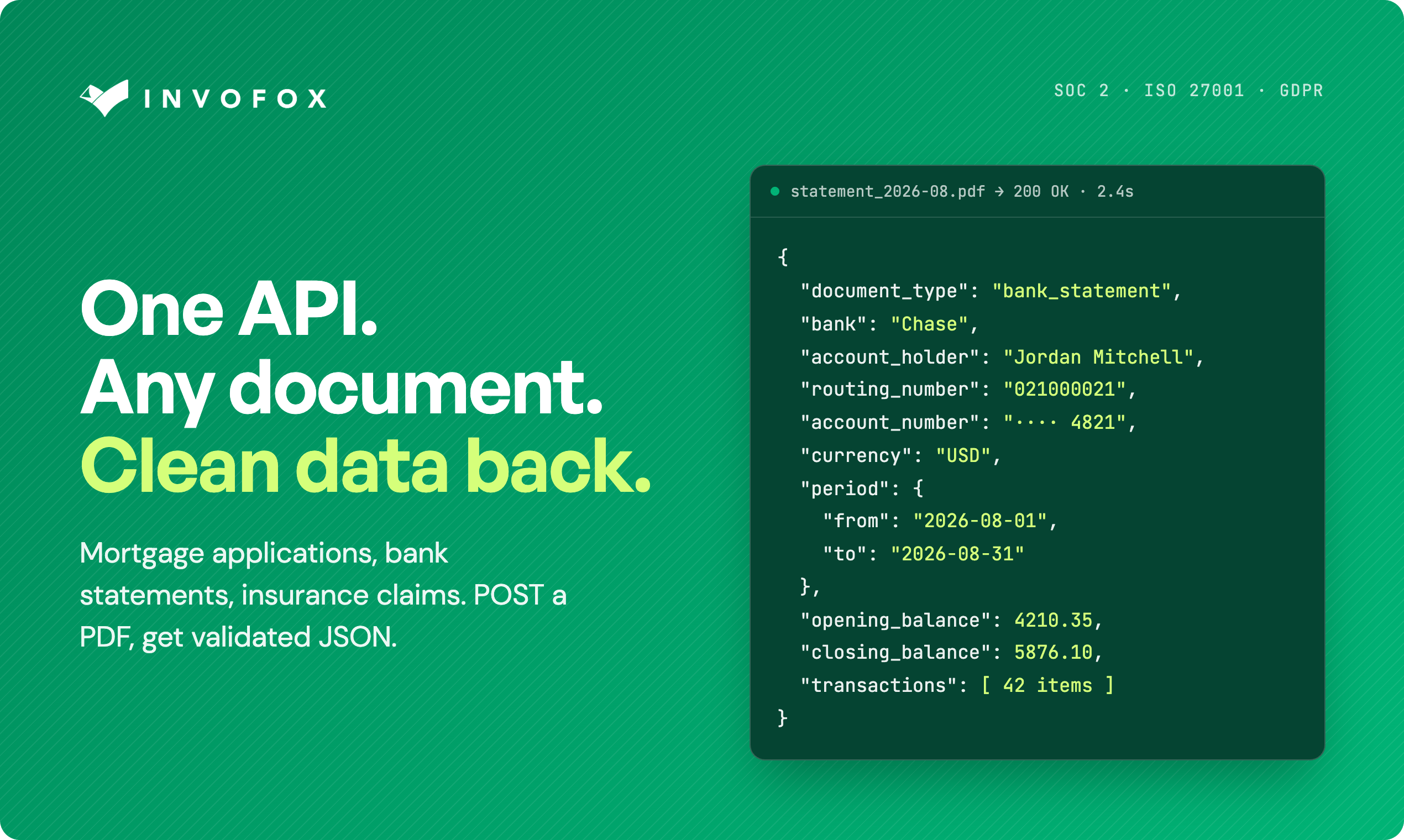
Product: API for ingesting PDFs and images and returning structured, validated JSON across invoices, receipts, statements, contracts, and custom document types.
Pricing: 500-page free evaluation. Paid pricing is usage and document-complexity based; an official Spanish pricing page lists a Starter offer starting at $500/month for up to 5,000 pages, while larger workflows are custom quoted.
Company signals: Product Hunt identifies Invofox as a Y Combinator company. Company materials claim 99.2% average accuracy and production use by 150+ companies; these are company-reported metrics.
Preliminary decision: WATCH.
EXECUTIVE SUMMARY
Invofox sells a production document-processing pipeline to engineering teams that need to convert messy, variable documents into structured data. Its pitch goes beyond OCR: one endpoint handles ingestion, document splitting and classification, extraction, validation, confidence handling, and feedback. The company argues teams can avoid building and maintaining a bespoke pipeline, with accuracy-backed billing that credits incorrect results.
This is a valuable and expensive problem in finance, logistics, lending, insurance, and other document-heavy workflows. The self-serve release removes a sales barrier from a product previously aimed at larger customers and offers developers a free batch to test on real documents. The company reports substantial production usage and a 99.2% accuracy figure, and Product Hunt identifies it as YC-backed. Those signals are meaningfully stronger than a launch-only concept, but remain company claims; the precise definitions, customer references, retention, revenue, and page-level economics need validation.
The investment case depends on consistent accuracy across customers’ long-tail document distributions and on whether Invofox can onboard document-heavy businesses faster and at a better total cost than in-house systems and incumbent IDP platforms. Its vertical data and feedback loop could compound, but document processing is crowded and heterogeneous. Recommendation: maintain an active watchlist and request a data-room discussion before advancing to an investment decision.
PRODUCT AND USER
The API accepts a file and a document type or schema and returns structured fields, typically asynchronously through a webhook or polling. The product describes dual-pass OCR, classification, splitting, extraction, cross-field validation, provenance, confidence scoring, monitoring, and a feedback loop. It supports standard document types and custom schemas. The developer documentation shows REST-based ingestion and webhook delivery, rather than requiring a customer to assemble a sequence of OCR and extraction vendors.
The target buyer is a product engineering lead or operations/automation team at a fintech, accounting software company, lender, logistics provider, insurer, or enterprise with recurring high-volume documents. They need reliable extraction across changing layouts, scan quality, handwritten fields, tables, bundled documents, and exceptions. The economic buyer cares about reducing manual review and processing cost while maintaining auditability. Invofox’s self-serve route can attract smaller teams for evaluation, but its economics and service model appear most compelling as volume and workflow complexity rise.
PROBLEM AND MARKET
Document work remains a common bottleneck in otherwise digitized processes. Traditional OCR returns text but often leaves downstream teams to classify pages, map fields, reconcile totals, and maintain templates as formats change. Generative AI has made flexible extraction more feasible, but high-stakes workflows still require validation, confidence thresholds, error routing, and measurable performance. A managed pipeline can remove years of integration and maintenance work if it meets accuracy and latency requirements.
The opportunity is attractive where documents are frequent, costly to review, and operationally varied. The breadth is also a challenge: an invoice pipeline, mortgage package, shipping manifest, and medical form have distinct schemas, regulatory expectations, and workflow integrations. Sales may require domain-specific onboarding and service even when the API is standardized. A scalable business needs reusable configurations, repeatable implementation, and increasing gross margin as new document types are added.
TRACTION AND PRODUCT HUNT
Product Hunt listed Invofox Self Serve at #3 for October 5, with 321 points. The parent product page showed roughly 1,000 followers and identifies Invofox as a YC company. The maker says the broader product has served large enterprises in Europe and the US, and the current site reports more than 150 companies using it in production. These are positive but company-supplied indicators; ask for paid-customer counts, annual recurring revenue, expansion, usage concentration, and referenceable accounts. A third Product Hunt launch suggests iterative product positioning and distribution, but launch frequency itself is not a retention measure.
The company’s materials contain more than one scale snapshot, so diligence should establish the reporting date and definitions behind documents processed, average accuracy, and average latency. A strong proof point would be a customer-approved comparison on a representative, held-out document set, with error categories, manual-review rates, and actual cost per accepted record.
BUSINESS MODEL
The company charges based on page volume, document type, complexity, and processing requirements, with volume discounts. The Product Hunt launch offered 500 free pages and an additional launch allotment. The official pricing material presents 500 free pages and a Starter option starting at $500/month for up to 5,000 pages on its Spanish page; the English pricing page emphasizes custom quotes and says enterprise SLA availability is tied to high annual throughput. Confirm current commercial terms because public pages differ in how much detail they disclose.
Usage-based pricing aligns payment with processed work and can expand with customer throughput. Crediting back wrong extractions is a strong trust signal and aligns incentives, but economics depend on the exact definition of an error, the verification process, and the cost of reprocessing or human review. The main cost drivers are compute/model inference, storage and secure handling, specialized onboarding, customer support, and human exception workflows. Measure gross margins by document type and complexity, not just average pages.
COMPETITIVE LANDSCAPE AND MOAT
Alternatives include in-house OCR plus LLM pipelines, cloud document-AI products, legacy intelligent document processing vendors, and narrower OCR APIs. Invofox’s stated differentiation is a single managed pipeline, complex-document performance, validation and feedback, and an accuracy-related billing commitment. A customer can potentially replace multiple tools and avoid template maintenance. Integration into accounting, ERP, lending, and insurance workflows can increase stickiness once error handling and audit trails are established.
A long-term moat is possible if customer corrections improve extraction for recurring layouts and if the company can safely learn across a diverse document base without compromising tenant privacy. However, raw OCR and general extraction are becoming more accessible, and broad performance claims are easy to imitate in marketing. The defensible asset would be measured accuracy and reliability across messy real-world inputs, document-specific evaluation data, and workflow embedment—not an API wrapper alone.
RISKS
- Accuracy claims: 99%+ is valuable only if the unit, ground truth, field weighting, and evaluation set are defined. A high average can obscure costly errors on critical fields.
- Heterogeneous workload: Supporting many formats and custom schemas can drive high implementation and support costs.
- Enterprise sales: Self-serve onboarding broadens acquisition, but compliance and integrations may still require long sales cycles.
- Pricing visibility: Complex and custom pricing can delay buyer evaluation; clarify how costs vary with page count and review behavior.
- Customer concentration: A few large enterprise accounts may account for a meaningful portion of volume or revenue.
- Model and vendor dependency: Validate fallback behavior, model-provider concentration, and how quality changes with upstream model updates.
- Data handling: Documents may contain sensitive financial, identity, health, or employment information. Verify zero-retention semantics, regional processing, access control, and auditability.
- Error reimbursement: Determine how credits are triggered and whether customers can reliably flag errors through an API.
SCORECARD (1 = weak, 5 = strong)
Problem urgency: 5/5
Market attractiveness: 4/5
Product completeness: 4/5
Distribution potential: 3/5
Verified traction: 3/5
Pricing and monetization: 3/5
Differentiation: 3/5
Defensibility: 3/5
Scalability: 3/5
Overall: 3.4/5 — promising operating signals; validate metrics and margins.
FINAL DECISION: WATCH
Invofox merits continued diligence because document automation is a painful, budgeted business problem and this product addresses more of the production pipeline than OCR alone. YC affiliation and company-reported production use make the signal stronger than a pre-revenue launch. The available public evidence does not establish revenue quality, customer retention, or durable unit economics. Advance only after reviewing cohort and customer data, accuracy methodology, and margins by document class.
DILIGENCE QUESTIONS
- What are ARR, net revenue retention, gross retention, and paid customer count, split between self-serve and enterprise?
- How much revenue and processed volume come from the top five customers?
- How is 99.2% accuracy defined: field-level, document-level, exact match, or weighted business outcome?
- Which fields and document families generate the most errors, credits, and manual review?
- What share of customers reaches production after the free tier, and how long does onboarding take?
- What are gross margins by document type, average page count, and customer volume?
- What is the exact correction-credit policy, and how is disagreement on correctness resolved?
- What data is retained by default, how does zero retention interact with logs/backups, and which regions are supported?
- How much of the feedback loop is customer-specific versus shared across tenants?
- What are uptime, p95 latency, and provider failover results during peak loads?
- What proportion of implementation requires custom engineering or ongoing human review?
- Which customers can independently verify reduced processing costs or higher straight-through processing?
SOURCES
Product Hunt launch: https://www.producthunt.com/products/invofox
Official product: https://www.invofox.com/en/
Pricing: https://www.invofox.com/en/pricing/
Self-serve developer documentation: https://developers.invofox.com/documentation/integrating-invofox
OCR API details: https://www.invofox.com/en/ocr-api/