
Table of Contents
Text Agent Store Investment Report
Category: AI-agent marketplace; messaging discovery; iMessage utility
Company Stage: Pre-seed/early-stage product within Soar Intelligence Inc.
Founder or Founders: Stanley Virgint founded Soar; Product Hunt also lists Patrick Sullivan and Jayanth Sidamsety as makers
Headquarters: New York, United States
Funding: Investors disclosed, but total funding and round terms are not publicly disclosed
Business Model: Free directory with paid featured placements and category sponsorships
Product Hunt Launch Date: September 17, 2026
Report Date: September 20, 2026
| Investment Metric | Assessment |
|---|---|
| Venture Potential | 52/100 |
| Unicorn Path | Conditional |
| Valuation Attractiveness | Not Assessable |
| Evidence Confidence | 53/100 |
| Final Decision | Watch |
Executive Summary
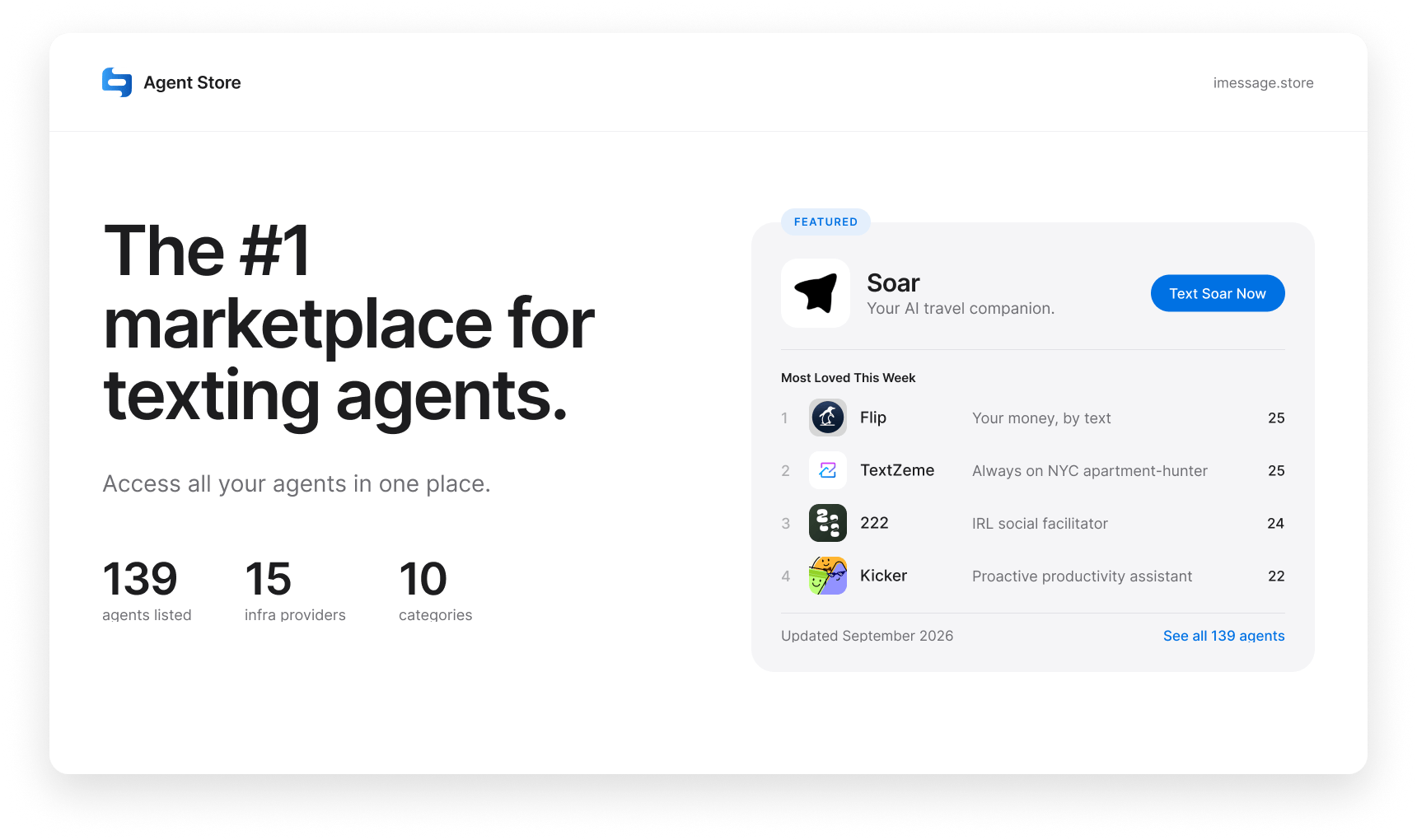
Text Agent Store is a web directory and free iMessage app for discovering AI agents that users can contact through ordinary text messages. Rather than hosting the agents, the product catalogs third-party services across productivity, travel, health, finance, shopping, social, and other categories, then opens a conversation in Messages or directs users to an agent’s website (official directory; App Store).
The product addresses a real discovery problem: messaging-based agents are fragmented across separate websites, phone numbers, and social-media announcements. Its no-account, low-friction interface is well suited to consumer experimentation, and the directory has expanded rapidly. The Product Hunt launch reported 137 agents after three months; the website’s structured data subsequently listed 155 agents (Product Hunt; official website).
The strongest investment signal is this early supply-side density, combined with links to recognized agent products such as Lindy, Poke, Perplexity, and 1-800-ChatGPT. The product is also connected to Soar, an operating travel assistant whose founder reports more than 10,000 travelers and 100,000 trips, and to Linq, a venture-backed messaging-infrastructure provider (PhocusWire; Linq).
The central weakness is that Text Agent Store currently resembles a curated directory and promotional channel rather than a full marketplace. It does not appear to control agent execution, billing, messaging infrastructure, or the customer relationship after a user leaves the directory. Revenue, traffic, clicks, repeat usage, paid placements, and marketplace transactions are not disclosed. The statement that listed agents are “collectively used by millions” refers to the agents’ aggregate audiences, not verified usage of Text Agent Store itself.
The product is worth monitoring, but the public evidence does not yet justify formal investment diligence. Watch is appropriate until the company demonstrates repeat consumer discovery, paid supplier demand, and a scalable monetization layer beyond advertising placements.
Product Overview
Text Agent Store lets users browse messaging-based agents by category, ranking, or search. Pressing “Text” opens an SMS or iMessage conversation with the agent’s public phone number; listings without a number may redirect to an external website. Developers can submit agents for free through a form that collects the agent’s name, category, number, website, and messaging-infrastructure provider (submission page).
The free iMessage extension offers a directory inside Apple Messages and requires iOS 17 or later. Its App Store page reports a 5.0 rating based on only two ratings, which is statistically insignificant. The listing says the app works without an account and can render a bundled directory offline, although it may refresh listings from the company’s servers (App Store).
The primary customer benefit is reduced discovery friction: users do not need to install and learn a separate application for each agent. For agent developers, the store offers a focused distribution surface and a route into the user’s existing messaging workflow.
The app is free. Listings appear to be free, while featured slots and category sponsorships are paid. The homepage showed an auction-like featured placement at approximately $330, but the duration and performance guarantees attached to that price were not clearly disclosed. The privacy policy confirms that placements are purchased through Stripe.
Product Quality: Simple, functional, and well matched to the intended behavior, but currently closer to a directory than a transactional marketplace.
Founder and Team Assessment
The App Store identifies Soar Intelligence Inc. as the seller. Soar’s official team page identifies Stanley Virgint as its founder and lists a small operating team with experience attributed to Expedia, DJI, and startup companies. The page also names Venrex Partners, Deel Ventures, and several angels and travel executives as investors or backers, but does not disclose amounts or financing terms (Soar team).
Virgint’s professional profile reports product, growth, design, and engineering experience, including work at DJI and Ello, followed by founding Soar in 2025 (LinkedIn). In an interview, he said he left Cornell’s AI/ML program to work on Soar full-time. These claims indicate relevant consumer-product and distribution experience, although no previous exit was verified.
Product Hunt also lists Patrick Sullivan and Jayanth Sidamsety as makers. Sullivan is a co-founder and CTO of messaging-infrastructure company Linq, while Sidamsety’s profile describes him as a Soar software-engineering intern rather than a company founder. Public evidence therefore suggests that Agent Store was built collaboratively by Soar and Linq rather than by three co-founders of a separate standalone company (Linq coverage; Sidamsety profile).
The precise ownership of the marketplace’s technology, data, brand, and future revenue should be clarified. Soar reportedly has 2–10 employees on LinkedIn, but exact headcount is not independently verified.
Founder Assessment: Relevant consumer and technical execution, but ownership boundaries, team allocation, and commitment to the marketplace versus Soar’s travel product are unclear.
Market Opportunity
The initial paying customer is not the consumer. It is the developer or company operating a text-accessible AI agent and seeking qualified distribution.
A reasonable bottom-up scenario is:
- 10,000–50,000 potentially marketable messaging-agent businesses worldwide;
- 10% purchasing promotion;
- $500–$2,000 average annual placement expenditure.
That produces an estimated $0.5M–$10M annual advertising opportunity. This is an analyst scenario rather than a verified market count, and even the high end would not independently support a large venture outcome.
The consumer side is broader, but the product must first prove that people want a dedicated discovery layer rather than finding agents through search, social media, app stores, or the underlying messaging platforms. Geographic expansion is also constrained by the initial iMessage orientation, although ordinary SMS numbers and a web directory provide partial cross-platform reach.
Larger opportunities would require transaction commissions, paid consumer subscriptions, agent analytics, verified reputation, messaging APIs, or infrastructure services. Without such expansion, the realistic market is more consistent with a profitable niche media or lead-generation property.
Traction and Growth Signals
The store grew to a company-reported 137 agents in three months and now exposes 155 listings in its website metadata. This is credible evidence of supply growth, although listings include some duplicated or closely related entries and do not establish active commercial relationships.
Text Agent Store ranked third on Product Hunt on September 17, 2026, with approximately 40 upvotes shown in the leaderboard data (Product Hunt leaderboard). This indicates launch-day attention, not sustained use.
The iMessage app has only two ratings. Downloads, active users, repeat visits, agent-click conversion, text initiations, placement customers, revenue, and customer retention are not disclosed. No meaningful body of independent consumer reviews was found.
Soar separately reports more than 10,000 travelers, 100,000 trips, organic acquisition, and one million monthly social-media views. These are founder-reported metrics for Soar’s travel product and should not be attributed to Text Agent Store (PhocusWire).
Traction Assessment: Rapid catalog growth and modest launch attention, but consumer and commercial traction are unverified.
Competitive Position
Direct alternatives include general AI-agent directories, the Relevance AI Marketplace, OpenAI’s GPT discovery ecosystem, and Poe’s bot platform and creator monetization. Indirect alternatives include Apple’s App Store, web search, social-media recommendations, and curated newsletters.
Large messaging and AI platforms represent a substantial bundling risk. WhatsApp is introducing native business agents, while major model providers can promote agents inside their existing interfaces (Meta Business Agent). Linq also operates the underlying messaging infrastructure used by Agent Store accounts, creating both a partnership benefit and supplier dependency.
Current differentiation comes from focus: it is a visually coherent directory specifically for agents reachable through messaging. Its brandable domain and early catalog provide some search and category-positioning potential.
However, switching costs are negligible. Agent operators can list in several directories simultaneously, and consumers can contact agents directly after the first referral. There is no verified proprietary dataset, exclusivity, checkout layer, or strong network effect.
If the largest platform in this market launched the same feature within six months, customers would have little reason to remain unless Text Agent Store had superior curation, trusted reviews, exclusive agents, measurable lead generation, or portable identity and payments. None is yet demonstrated.
Defensibility Assessment: Low
Business Model and Economics
The current model consists of free access, free submissions, featured placements, and category sponsorships. The homepage’s featured-placement mechanism appears auction-based, while payments are processed by Stripe. Revenue and the number of paying advertisers are not disclosed.
The directory should have low hosting and support costs. It does not run most agents and therefore generally avoids their model-inference and SMS expenses. Its own text-based discovery number uses Linq infrastructure, creating some messaging cost and vendor dependency.
Gross margins on advertising could be high, but revenue is constrained by traffic and the number of funded agent developers. A single $330 featured placement—even if sold weekly—would produce only about $17,000 annually. Category sponsorships could add revenue, but no pricing or sell-through data is available.
A true marketplace model could add commissions on agent subscriptions or transactions. That would improve revenue potential but require payment routing, attribution, refunds, fraud prevention, agent-quality controls, and potentially significant regulatory oversight for health, financial, betting, and travel agents.
Unicorn Path
A 10× revenue multiple is assumed for a rapidly growing, high-margin marketplace or advertising platform. This is an analytical assumption, not a current comparable-company valuation.
Required annual revenue = $1 billion ÷ 10 = $100 million.
At $1,000 of annual promotional spending per agent provider, the store would need 100,000 paying suppliers, versus 155 current listings. At a hypothetical 15% transaction take rate, it would need approximately $667 million of annual GMV. The current product does not process the agents’ transactions, making that scenario unavailable without a substantial platform expansion.
A $50 annual consumer subscription would require two million paying subscribers before payment fees and churn. There is presently no paid consumer plan, and the App Store provides insufficient demand evidence.
A unicorn outcome would require Text Agent Store to evolve from a directory into a cross-platform discovery, identity, reputation, billing, and distribution layer for messaging agents. It would also need to reduce dependency on iMessage and avoid strategic overlap with Linq and Soar.
Unicorn Path: Conditional
Valuation Assessment
Soar publicly names Venrex Partners, Deel Ventures, and several angel investors, but no reliable funding amount, round date, post-money valuation, or current fundraising terms were found. PhocusWire reports that the company expects to pursue a Series A in the future, but this is a founder plan rather than a completed financing.
It is also unclear whether investors would be financing Soar Intelligence as a travel company, Text Agent Store as a marketplace, or both. That distinction materially affects market size, business-model analysis, and comparable valuations.
Valuation Attractiveness: Not Assessable
Required information includes current ARR, marketplace revenue, Soar revenue, gross margin, growth, retention, cash balance, burn, runway, cap table, intellectual-property ownership, round size, valuation, and liquidation preferences.
Key Risks
- No verified demand: active users, repeat usage, text referrals, and revenue are undisclosed.
- Directory economics: paid placements may not support venture-scale revenue.
- Low defensibility: listings and outbound SMS links are straightforward to replicate.
- Unclear strategic identity: Agent Store may remain a top-of-funnel project for Soar rather than an independent platform.
- Linq dependency: messaging access and technical collaboration create supplier and ownership risk.
- Disintermediation: users and agents can transact directly after discovery.
- Platform concentration: the iMessage app excludes Android users and depends on Apple policies.
- Safety and regulatory exposure: medical, finance, investment, and betting agents create verification and consumer-protection risks.
- Privacy inconsistency risk: the App Store says some data may be collected, while marketing emphasizes “no data”; the privacy policy provides more nuanced disclosures.
- Marketplace quality: “verified” is not publicly defined, and inactive or unreliable agents could damage trust.
Final Assessment
Venture Potential: 52/100
| Category | Score |
|---|---|
| Market Size and Expansion Potential | 13/20 |
| Traction and Growth Evidence | 8/20 |
| Founder and Team | 10/15 |
| Product Strength | 7/10 |
| Distribution Potential | 7/15 |
| Business Model and Economics | 4/10 |
| Defensibility | 3/10 |
| Total | 52/100 |
The strongest elements are rapid supply accumulation, low-friction product design, and relationships with Soar and Linq. The weakest are monetization, demand evidence, ownership clarity, and defensibility.
Evidence Confidence: 53/100
The product, seller, app availability, privacy policy, catalog size, founders, and basic monetization mechanism are verifiable. Product Hunt and Soar provide additional company-reported claims. Revenue, active users, retention, paid placements, funding amount, unit economics, cap table, and valuation remain unavailable.
Final Decision: Watch
The product is useful and well timed, but it has not demonstrated the demand, monetization, or control points required for a venture-scale marketplace. Formal diligence would become appropriate once the company establishes that Agent Store is more than a promotional directory for Soar and other messaging agents.
Upgrade Conditions
- At least 100,000 monthly active marketplace users with strong repeat discovery.
- More than 1,000 monthly agent-to-user introductions and disclosed conversion data.
- At least $500,000 annualized marketplace revenue with recurring supplier spend.
- Evidence of 70%+ six-month retention among paying placement customers.
- Exclusive or deeply integrated agent inventory.
- A credible transaction, subscription, analytics, or API revenue layer.
- Clear ownership and commercial agreements among Soar, Linq, and the product’s makers.
Downgrade Conditions
- Catalog growth stalls or listed agents become inactive.
- Paid placements show weak renewal or measurable return on advertising.
- Apple, OpenAI, Meta, or Linq launches a competing native directory.
- Soar deprioritizes the product.
- Regulatory or safety incidents arise from listed medical, financial, or betting agents.
- Materially misleading claims about verification, usage, or privacy emerge.
Questions for Further Diligence
- What are Agent Store’s current MRR, monthly growth, and number of paying placement customers?
- How many monthly active users, repeat users, and outbound text initiations does it generate?
- What percentage of users return after 30, 90, and 180 days?
- How are agents “verified,” and how frequently are inactive listings removed?
- What are featured-placement duration, renewal rate, average revenue per advertiser, and advertiser ROI?
- Does Agent Store receive referral fees, booking commissions, or subscription revenue from listed agents?
- Who owns the code, brand, domains, listing data, and analytics: Soar Intelligence, Linq, or the individual makers?
- What are the commercial and infrastructure terms with Linq?
- What are gross margin, payment fees, messaging costs, CAC, burn, and runway?
- How will the product address Android, WhatsApp, RCS, and international messaging markets?
- What liability controls apply to medical, financial, trading, and gambling-related agents?
- What are the current cap table, fundraising valuation, round terms, and allocation of investor capital between Soar and Agent Store?
Sources
- Text Agent Store on Product Hunt
- Product Hunt daily leaderboard
- Official Text Agent Store website
- Messages Agent Store on Apple’s App Store
- Agent submission page
- Privacy policy
- Soar team and investors
- PhocusWire interview with Soar
- Stanley Virgint’s professional profile
- Linq platform
- TechCrunch coverage of Linq