
Table of Contents
Vizard Agent Investment Report
Category: AI video creation, editing, and content repurposing
Company Stage: Early-growth commercial SaaS
Founder or Founders: Gary Zhang; Qiumiao Chen is publicly identified as co-founder. Public databases conflict on the complete founder roster.
Headquarters: Palo Alto, California, United States
Funding: No reliable public funding amount or investor list found; third-party databases provide conflicting descriptions
Business Model: Freemium subscription SaaS, usage credits, team plans, API access, and custom enterprise plans
Product Hunt Launch Date: August 11, 2026
Report Date: August 14, 2026
| Investment Metric | Assessment |
|---|---|
| Venture Potential | 75/100 |
| Unicorn Path | Conditional |
| Valuation Attractiveness | Not Assessable |
| Evidence Confidence | 63/100 |
| Final Decision | DD |
Executive Summary
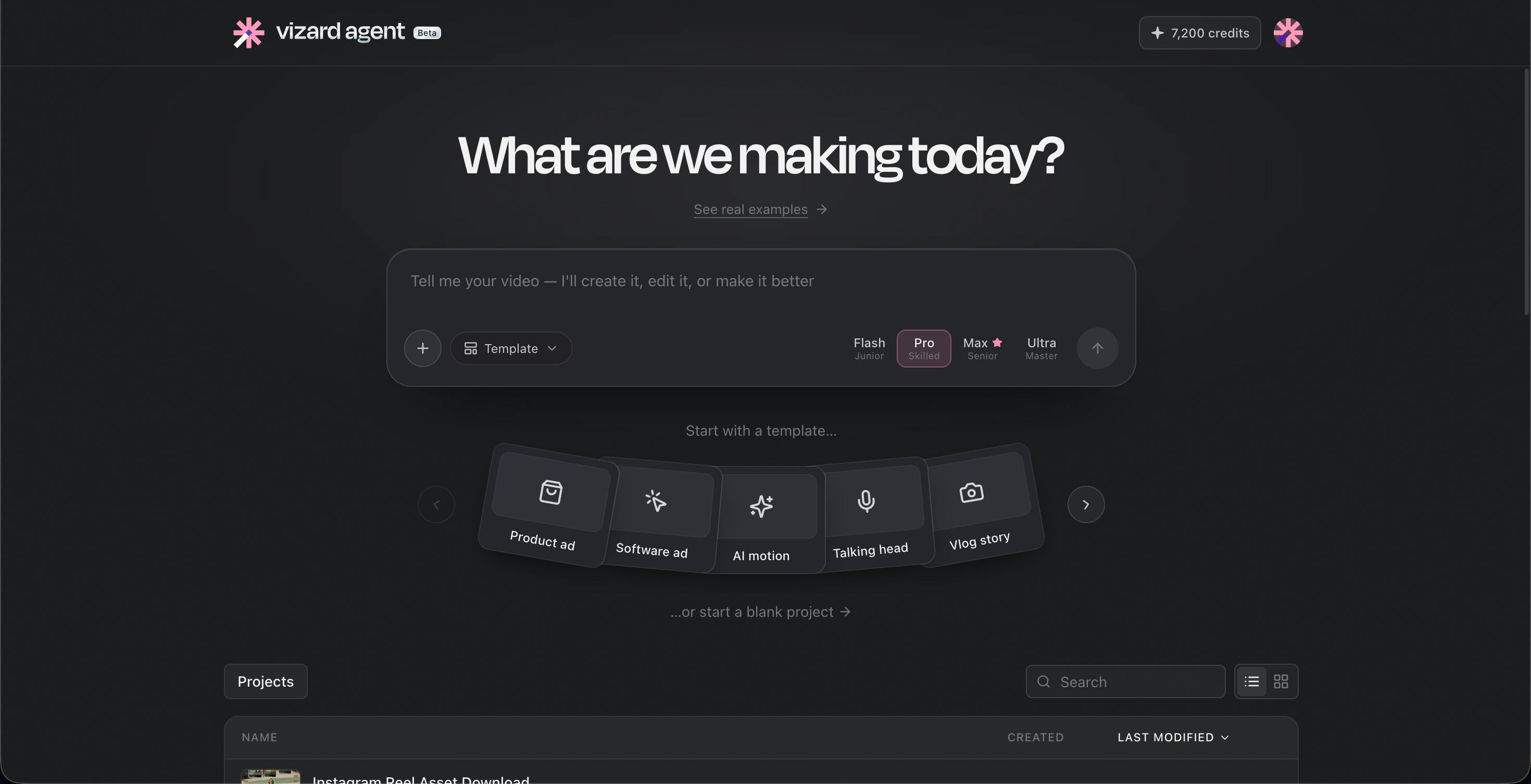
Vizard Agent is a prompt-based video-production agent within Vizard’s broader AI video platform. A user can begin with footage, an existing video, a URL, a script, images, or an idea and request a finished output such as podcast clips, a product advertisement, explainer, tutorial, documentary, localized video, or AI-generated film. The product combines content planning, generation, clipping, captions, editing, formatting, and publishing in one workflow (Vizard Agent, Product Hunt).
The underlying company is more developed than a typical Product Hunt launch. Vizard already offers web, iOS, and Android products; subscriptions; team workspaces; API access; social publishing; and a mature clipping/editor workflow. The founder reported reaching $1 million ARR in late 2024, while the company now claims more than 10 million creators and businesses have used its products (founder announcement, Vizard website). Both figures are company-reported: current ARR, active users, paying customers, and retention remain undisclosed.
The strongest investment signals are an established paid product, high public review scores, continued product releases, mobile distribution, and expansion from a narrow clipping utility into a broader video-production workspace. The iOS application has a 4.8/5 rating from 672 ratings, while Capterra search results show an approximately 4.9 rating across roughly 450 reviews (Apple App Store, Capterra).
The central concern is defensibility. AI video editing is intensely competitive, and Vizard relies partly on external generation models such as Sora, Veo, Kling, Luma, and others. CapCut, Adobe, Canva, Google, OpenAI, and well-funded specialists could bundle similar agent workflows. Vizard’s “first Video AGI” description should be treated as positioning, not independently verified general intelligence.
The decision is DD. Vizard has sufficient product maturity and claimed commercial traction to justify a founder meeting and data-room request. An investment decision cannot be made until current revenue, retention, margins, financing terms, and the quality of the claimed 10-million-user base are verified.
Product Overview
Vizard initially addressed a narrow but costly workflow: turning podcasts, webinars, interviews, courses, and other long videos into short clips for TikTok, Instagram Reels, and YouTube Shorts. The established product transcribes uploads, identifies highlights, reframes speakers, adds captions, and allows text- or timeline-based editing before publication (official product page).
Vizard Agent expands that proposition from repurposing to end-to-end production. Its interface offers templates for product ads, tutorials, UGC advertisements, explainers, localized content, podcast clips, AI avatars, event recaps, music videos, documentaries, and other formats. Users can start with source media or a blank project and describe the desired output through a conversational interface (Vizard Agent).
The product serves creators, podcasters, coaches, agencies, and marketing teams that need frequent social video but lack time or specialist editing capacity. It replaces combinations of freelance editing, manual tools such as Adobe Premiere or CapCut, separate transcription and captioning products, and model-specific video generators.
Vizard’s free plan includes 60 monthly credits, 720p exports, one connected social account, and three-day storage. The Creator plan starts at $29 monthly, or approximately $14.50 monthly when billed annually, with 600 credits, 4K exports, no watermark, scheduling, and additional storage. Business starts around $39 monthly, or $19.50 monthly billed annually, and adds shared workspaces, brand controls, and more social accounts (pricing page). Apple lists Creator purchases from $29.99 for 600 monthly credits and $199 annually for 7,200 credits, with higher usage tiers available (App Store).
Product Quality Assessment: Strong breadth, usability, and platform coverage; however, reliable output quality across all advertised video formats has not been independently established.
Founder and Team Assessment
Gary Zhang’s public profile identifies him as Vizard’s founder since February 2022. He holds a master’s degree in computer science from Tsinghua University, supporting technical founder-market fit, although earlier employment and previous startup outcomes are not publicly detailed on the available profile (LinkedIn).
Qiumiao Chen is publicly identified as a Vizard co-founder on LinkedIn search results. However, Tracxn lists Chunwei Song as founder, while Crunchbase identifies Gary Zhang. Vizard’s official About page confirms that Vizard, Corp. is a Delaware company but does not name its founders (About, Crunchbase, Tracxn). The complete founding and ownership history therefore requires verification.
LinkedIn lists Vizard in the 11–50 employee range and displays approximately 29 associated profiles; this is a directional indicator, not a verified payroll count (company profile). Frequent product updates across clipping, generative video, mobile, collaboration, and publishing suggest an active multidisciplinary team. Current hiring, employee retention, full-time founder commitment, and executive coverage are not publicly disclosed.
Founder Assessment: Relevant technical capability and demonstrated product execution, but founder history, complete team structure, and commercial leadership require verification.
Market Opportunity
The initial addressable customer is a creator, agency, coach, podcaster, or small marketing team that produces long-form content and needs multiple short videos each month. Willingness to pay is supported by Vizard’s existing subscriptions and by public reviews emphasizing time savings, although customer-level spending and renewal behavior are unknown.
A reasonable bottom-up scenario is:
- 1–3 million serious creators, agencies, and smaller marketing organizations globally that could regularly use automated video repurposing;
- Annual revenue of approximately $175–$500 per individual or small-team account based on current entry pricing and higher credit tiers;
- Implied core opportunity of approximately $175 million–$1.5 billion in annual revenue.
This is an analyst scenario, not a verified market-size figure. It excludes occasional creators unlikely to pay and does not assume that Vizard captures the entire market.
Expansion opportunities include enterprise brand governance, collaborative approval, API-based video automation, localization, paid advertising workflows, asset management, avatar video, and full prompt-to-published-video production. International expansion is structurally attractive because caption translation and generative video can be distributed digitally, although support, payment, copyright, and regional model costs may vary.
The realistic market can support a sizable software company. Reaching venture scale, however, requires Vizard to convert a consumer-heavy user base into durable team and enterprise revenue rather than relying primarily on low-price creator subscriptions.
Traction and Growth Signals
Gary Zhang announced that Vizard had reached $1 million ARR after growing from zero to that level in approximately nine months. The announcement is a founder-reported milestone from late 2024 and has not been independently audited; no current ARR or growth rate was found (LinkedIn announcement).
Vizard currently claims “10 million+ creators & businesses.” This likely refers to cumulative registrations or users rather than active or paying accounts, because no definition accompanies the number (official website). Monthly active users, processed-video volume, paying customers, conversion, retention, and customer concentration are not disclosed.
Third-party product evidence is more tangible. The iOS application has 672 ratings and a 4.8 average, supports in-app subscriptions, and was updated to version 2.0.2 shortly before this report (App Store). Capterra reports approximately 4.9/5 across hundreds of reviews, with users frequently citing ease of use and editing-time savings (Capterra). These reviews support product satisfaction but do not reveal retention or economics.
Vizard’s LinkedIn history shows continued releases spanning mobile applications, editing redesigns, AI Studio, model integrations, motion graphics, publishing controls, and a second-generation clipping model (LinkedIn company page). Product Hunt recorded roughly 125 launch votes on August 11, 2026, but the listing was promoted, further limiting its value as an organic traction measure (daily leaderboard).
Traction Assessment: Credible signs of product adoption and historical revenue, but current commercial performance is insufficiently verified.
Competitive Position
Direct competitors include OpusClip, Munch, Klap, Vidyo.ai, Captions, Submagic, Jupitrr AI, VEED, Descript, and InVideo. Indirect alternatives include CapCut, Adobe Premiere, Adobe Express, Canva, Final Cut Pro, freelance editors, and internal social-media teams.
Vizard’s present advantage is workflow breadth: it combines clipping, generation, editing, translation, collaboration, scheduling, mobile access, and API automation. Its established installed base and large body of public reviews provide stronger distribution than a new standalone agent.
Defensibility is less certain. Many underlying generation capabilities come from third-party models. Switching costs for individual creators are low because users can export standard video files, and several competitors offer similarly priced freemium products. Brand kits, team workflows, accumulated projects, templates, API integrations, and publishing connections can increase organizational switching costs, but no meaningful network effects are evident.
If Adobe, CapCut, or Canva launched an equally capable video agent within six months, users might remain with Vizard because of its specialized clipping quality, multi-model workflow, simpler interface, and established project history. That answer is credible but not strong enough to constitute a durable moat. Vizard needs proprietary performance data, superior automated editing outcomes, and deeper workflow integrations.
Defensibility Assessment: Medium-Low
Business Model and Economics
Vizard generates revenue through subscriptions, usage credits, higher-volume packages, team functionality, API access, and custom plans. The low entry price supports self-serve acquisition, while API and enterprise products provide potential expansion revenue.
The principal variable costs are video storage, transcoding, transcription, model inference, generative-image and video APIs, content delivery, and customer support. Generative video is substantially more compute-intensive than clipping existing footage. Vizard must ensure that higher Agent usage produces additional credit revenue faster than third-party model and infrastructure expense.
A $199 annual Creator subscription produces modest ACV and may be exposed to creator churn. Business and API customers are more attractive because workflow integration and larger volumes can improve retention. Gross margin, average credit utilization, unused-credit breakage, payment-processing fees, App Store revenue share, customer-acquisition cost, and support cost are not disclosed.
The business could have SaaS-like margins for clipping and editing but lower margins for model-intensive generation. This distinction should be tested by product line.
Unicorn Path
For an AI-enabled SaaS company with substantial compute costs, an 8× forward-ARR multiple is a reasonable normalized assumption. This is lower than exceptional AI financing multiples and requires strong growth, retention, and gross margins.
Required ARR = $1 billion ÷ 8 = approximately $125 million.
At the $199 annual Creator price, Vizard would require approximately 628,000 equivalent paying subscriptions before discounts, App Store fees, refunds, and churn. Alternatively:
- 250,000 customers at $500 annual revenue;
- 25,000 business accounts at $5,000 ACV; or
- 2,500 enterprise/API customers at $50,000 ACV.
The company’s claimed 10 million-user base would theoretically require around 6% to convert at $199 annually to produce approximately $125 million ARR. However, the denominator’s activity and quality are unknown, and consumer subscription conversion at that level cannot be assumed.
The credible route is a hybrid: creator subscriptions for distribution, business workspaces for retention, and API or enterprise contracts for ACV expansion. Vizard must also preserve healthy margins as Agent usage shifts from clipping toward expensive video generation.
Unicorn Path: Conditional
Valuation Assessment
No reliable public financing announcement, round size, investor list, SAFE cap, or company valuation was found. Third-party sources conflict: some databases characterize Vizard as funded, while another describes it as bootstrapped. None provides sufficiently reliable primary documentation to resolve the issue.
Valuation Attractiveness: Not Assessable
Assessment requires current ARR, year-over-year growth, gross margin by workflow, retention cohorts, burn, cash balance, financing history, cap table, proposed round size, post-money valuation, liquidation preferences, and founder ownership. Product quality and Product Hunt attention are not adequate substitutes for financing data.
Key Risks
- Current financial performance is unknown: The only ARR disclosure found is company-reported and dated.
- Feature commoditization: Major video suites can bundle prompt-based production.
- Weak consumer retention: Occasional creators may subscribe only during active projects.
- Inference-cost exposure: Generative video usage may reduce gross margin without disciplined credit pricing.
- Third-party model dependency: Model pricing, availability, safety policies, and output quality are outside Vizard’s control.
- Limited switching costs: Individual users can move exported assets between tools.
- Copyright and synthetic-media risk: Generated assets, uploaded footage, likenesses, and music create rights-management exposure.
- Unverified user claim: “10 million+” is not defined as registered, active, retained, or paying.
- Founder and funding ambiguity: Public sources conflict on founders and financing.
- Platform dependency: Social platforms and app stores can change APIs, fees, distribution, or content policies.
Final Assessment
Venture Potential: 75/100
| Category | Score |
|---|---|
| Market Size and Expansion Potential | 18/20 |
| Traction and Growth Evidence | 14/20 |
| Founder and Team | 11/15 |
| Product Strength | 9/10 |
| Distribution Potential | 11/15 |
| Business Model and Economics | 7/10 |
| Defensibility | 5/10 |
| Total | 75/100 |
The strongest elements are product maturity, multi-platform distribution, public customer feedback, historical revenue evidence, and expansion from clipping into a broader workflow. The weakest are defensibility, financial transparency, uncertain gross margins, and lack of verified current retention.
Evidence Confidence: 63/100
The product, legal entity, headquarters, pricing, app ratings, product activity, and Gary Zhang’s role are reasonably verifiable. Revenue and user figures are company-reported. Market calculations and unicorn requirements are analyst scenarios. Current ARR, retention, margins, funding, valuation, cap table, burn, and runway remain unavailable, while founder databases conflict.
Final Decision: DD
Vizard is sufficiently developed to justify formal due diligence. The score does not support an immediate investment because valuation and terms are unknown, commercial metrics are stale or unverified, and the competitive moat is incomplete.
Upgrade Conditions
- Verify current ARR and at least 50% annual growth.
- Demonstrate strong 6- and 12-month paid retention.
- Show gross margin above 70% after video-generation costs.
- Verify active-user and paying-customer composition of the claimed 10 million users.
- Establish material business or API revenue with higher ACV.
- Demonstrate repeatable acquisition outside Product Hunt and paid creator promotions.
- Provide evidence that proprietary clipping or editing models outperform major competitors.
- Present acceptable valuation, cap-table, and financing terms.
Downgrade Conditions
- Current ARR is materially below the implied trajectory from the 2024 announcement.
- High creator churn or weak free-to-paid conversion.
- Agent inference costs materially compress gross margins.
- CapCut, Adobe, Canva, or OpusClip replicates the workflow without meaningful differentiation.
- Loss of critical model or social-platform integrations.
- Material copyright, privacy, or synthetic-media incidents.
- Misleading definitions behind public user or revenue claims.
- Reduced release cadence or departure of key founders.
Questions for Further Diligence
- What are current ARR, monthly growth, and revenue by Creator, Business, API, and enterprise products?
- How many of the claimed 10 million users are monthly active, retained, and paying?
- What are 30-, 90-, 180-, and 365-day retention by acquisition cohort?
- What are free-to-paid conversion and subscription renewal rates?
- What are gross margins for clipping, editing, and generative Agent workflows separately?
- What are average model, transcoding, storage, and support costs per paid customer?
- Which acquisition channels generate the highest-LTV customers, and what is CAC by channel?
- What percentage of revenue comes through app stores, and how do platform fees affect margin?
- Who are the legal founders, what are their full-time roles, and how is equity allocated?
- Has Vizard raised external capital, and what are the current cap table, round terms, and proposed valuation?
- What proprietary models or datasets power clipping selection, and how are they benchmarked?
- What controls address copyright, customer-data use, model training, likeness consent, and generated-media disclosure?