
Table of Contents
Omni by xpander Investment Report
Category: Enterprise AI-agent infrastructure, orchestration, and governance
Company Stage: Seed; product generally available
Founder or Founders: David Twizer, Ran Sheinberg, Moriel Pahima
Headquarters: San Francisco, with operations in Tel Aviv
Funding: $7.5 million Seed round
Business Model: Usage-based hosted platform plus annual enterprise licenses
Product Hunt Launch Date: August 17, 2026
Report Date: August 20, 2026
| Investment Metric | Assessment |
|---|---|
| Venture Potential | 68/100 |
| Unicorn Path | Conditional |
| Valuation Attractiveness | Not Assessable |
| Evidence Confidence | 62/100 |
| Final Decision | DD |
Executive Summary
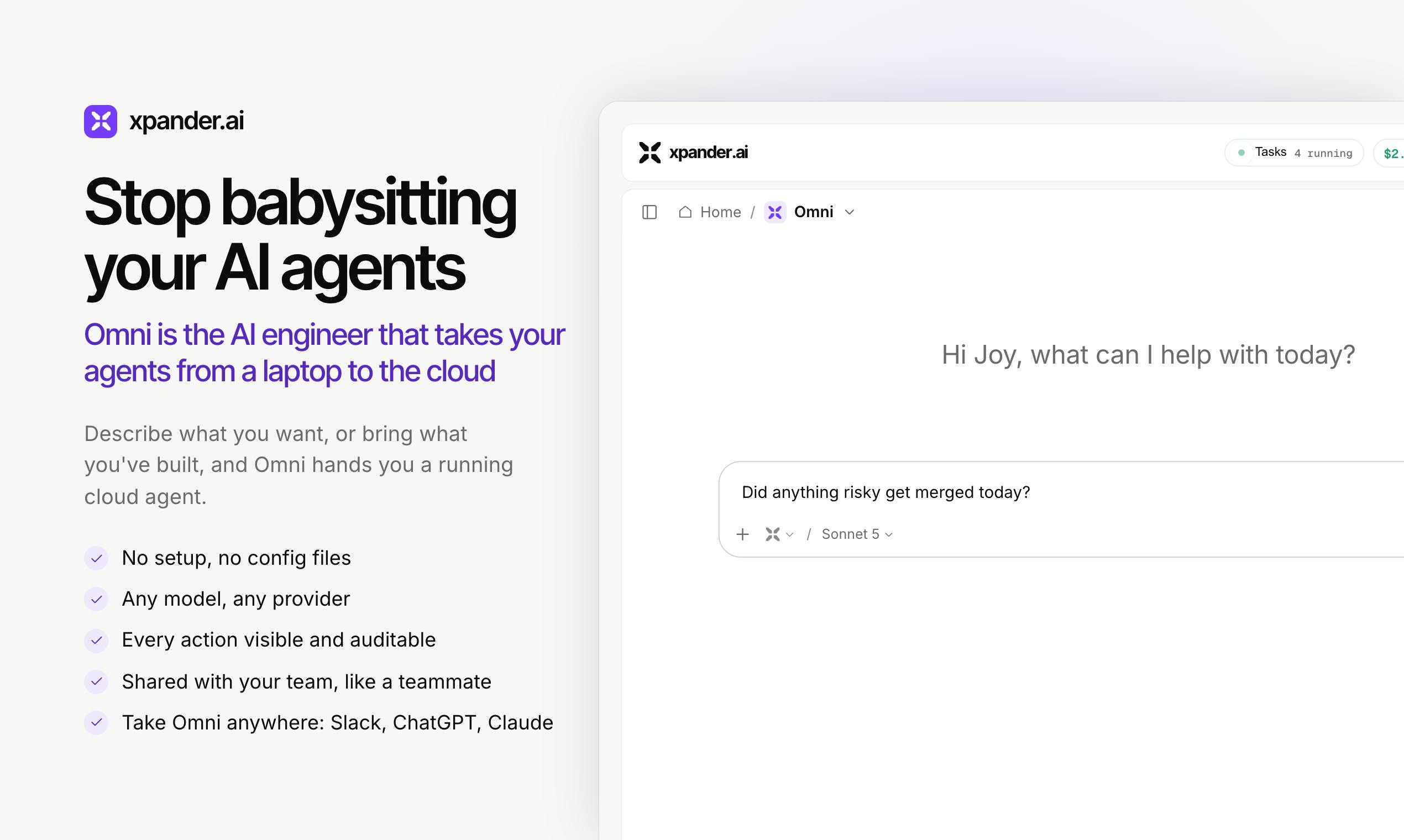
Omni is an “agentic Forward Deployed Engineer” within xpander’s broader enterprise AI-agent platform. It converts natural-language requests or existing agent code into cloud-hosted, long-running, shareable agents, while xpander supplies deployment, identity, tool access, observability, governance, and recovery infrastructure (Product Hunt; xpander).
The initial users are enterprise engineering, platform, security, and AI teams attempting to move agents from individual laptops and pilots into governed production environments. The product is technically substantive: it supports multiple models and frameworks, hosted or customer-controlled deployment, end-user identity, audit trails, credential injection, and air-gapped installations. Product quality appears promising, although independent production-reliability and customer-satisfaction evidence is limited.
Company quality is supported by strong founder-market fit. The three founders are former AWS engineers; CEO David Twizer previously held principal solutions-architecture and GenAI leadership roles at AWS (Twizer profile). The company also raised a $7.5 million Seed round led by Pico Venture Partners, with Emerge Ventures, Samsung Next, and SeedIL participating (funding announcement).
The strongest investment signal is the combination of experienced enterprise-infrastructure founders, a real governance problem, institutional financing, generally available software, security-oriented deployment options, and active hiring. The principal concern is commercial validation: revenue, growth, paying-customer count, retention, contract values, gross margin, and deployment expansion are not publicly disclosed. Corporate logos and claims of production use should not be interpreted as verified contracts or recurring revenue.
The venture case is credible but not established. xpander could become a valuable independent control plane for heterogeneous enterprise agents, but it competes with LangSmith, CrewAI, Temporal, hyperscalers, and model vendors. The appropriate decision is DD, focused on verifying production customers, expansion revenue, margins, platform portability, and financing terms.
Product Overview
The problem is that agents built in desktop tools or fragmented frameworks are difficult to run continuously, share across teams, secure, and audit. Omni accepts a desired outcome—or an existing agent—and configures tools, skills, tests, deployment, scheduling, monitoring, and failure recovery.
The broader xpander platform provides a framework- and model-neutral runtime, shared agent applications, REST and Python interfaces, identity controls, human approvals, audit trails, persistent memory, and deployment into managed cloud, private VPC, Kubernetes, on-premises, or air-gapped environments (platform overview; VentureBeat).
Hosted pricing is usage-based: one credit equals $0.01, with one credit per agent wake, one per tool call, and separate model-token charges. New accounts receive 1,000 credits; agents, workflows, and seats are unlimited. Enterprise deployments require a custom-priced annual contract starting at 50 agents (pricing).
The product replaces combinations of desktop agents, custom orchestration code, model gateways, workflow engines, authentication infrastructure, observability tools, and manually assembled governance controls.
Founder and Team Assessment
Xpander was founded in 2024 by David Twizer, Ran Sheinberg, and Moriel Pahima. Reputable coverage identifies all three as former AWS engineers; Twizer is CEO, Sheinberg is CPO, and Pahima is CTO (CTech; VentureBeat).
Twizer’s public profile shows approximately seven years at AWS, including Principal Solutions Architect and Senior Manager for GenAI Specialist Solutions Architects. Sheinberg reportedly led enterprise compute architecture work at AWS. This experience directly matches the technical and procurement challenges of enterprise agent deployment.
No previous founder exits were verified. Exact team size is not publicly disclosed; LinkedIn classifies xpander as an 11–50-person company, but that range is not reliable enough to treat as headcount (LinkedIn). Open positions in San Francisco and Tel Aviv include senior solutions, full-stack, and backend engineering roles, indicating continued investment in enterprise implementation and infrastructure (careers).
Founder Assessment: Strong technical and enterprise-infrastructure fit; repeatable commercial execution remains unproven.
Market Opportunity
The narrow initial segment is medium-to-large organizations operating multiple AI-agent pilots that require private deployment, centralized identity, auditability, and framework portability. Likely buyers are CIO, platform-engineering, security, and AI-platform teams.
An illustrative bottom-up scenario—not a company forecast—is 20,000–30,000 globally addressable organizations at $100,000–$300,000 annual platform spend, implying a $2–9 billion initial software opportunity. Both the customer count and contract-value range require validation. Expansion could include per-agent usage, model routing, governance, agent marketplaces, observability, and embedded-agent infrastructure.
Timing is favorable: enterprises are moving from experimentation toward production governance. However, the same trend attracts hyperscalers and well-funded developer-platform companies. The market is large enough for venture outcomes, but xpander must own a durable control-plane layer rather than become an implementation tool.
Traction and Growth Signals
The Product Hunt launch reached approximately 327 points and a #2 daily ranking, with roughly 900 followers shortly after launch (Product Hunt). This demonstrates launch interest, not product-market fit.
More substantive signals include:
- A $7.5 million institutional Seed round (xpander).
- General availability of Omni and the platform.
- An active GitHub organization with 15 public repositories; its principal repository showed approximately 870 stars and 127 forks at review time (GitHub).
- Active product development and hiring across Tel Aviv and San Francisco.
- Company-reported usage by teams associated with Lenovo, Intel, Workday, Siemens, Nvidia, SAP, Salesforce, and others (xpander). These logos are not independently verified as paid enterprise contracts.
- A company-reported 90.9% GAIA validation score. The result files are public, but internal orchestration is not fully published and the score uses a pass@2 model cascade, limiting comparability with single-attempt benchmarks (benchmark repository).
Revenue, customer count, usage, growth, retention, contract expansion, and customer references remain undisclosed.
Traction Assessment: Technically and institutionally promising, but commercially unverified.
Competitive Position
Direct competitors include LangSmith, CrewAI Enterprise, and other agent deployment and governance platforms. Temporal competes in durable execution, while Amazon Bedrock AgentCore, Google’s enterprise-agent stack, OpenAI, Microsoft, and other large platforms can bundle adjacent capabilities.
Free or lower-cost alternatives include open-source agent frameworks, Kubernetes, Temporal’s open-source service, custom MCP integrations, and internal platform engineering. Manual alternatives are security review, scripts, shared service accounts, and human-operated workflows.
Xpander’s differentiation is the combination of model, cloud, and framework neutrality with enterprise identity, governance, self-hosting, and an employee-facing collaboration layer. Its main weakness is that the proprietary Universal Harness may itself become a new lock-in point; public documentation does not clearly establish complete migration portability (VentureBeat).
If a hyperscaler launched equivalent functionality, customers might remain for cross-cloud neutrality, existing integrations, and customer-controlled deployments. That answer is credible only if xpander develops superior workflow portability, governance depth, and enterprise support.
Defensibility Assessment: Medium-Low
Business Model and Economics
Hosted revenue is consumption-based; enterprise revenue comes from custom annual licenses beginning at 50 agents. Usage pricing aligns revenue with agent activity and avoids seat-based friction. Enterprise self-hosting may support larger contracts and reduce xpander’s direct inference burden.
Variable costs include model inference, tool calls, cloud execution, sandbox containers, storage, observability, support, security compliance, and solution engineering. Hosted model costs are passed through through credits, but actual gross margin is unknown. Long enterprise deployments and “white-glove” onboarding could produce service-heavy economics.
Critical questions are whether usage revenue grows faster than model and infrastructure costs, whether enterprise onboarding becomes repeatable, and whether customers expand from pilot agents to organization-wide fleets. No public gross-margin, CAC, payback, or net-retention evidence is available.
Unicorn Path
A 10× ARR multiple is assumed for a high-growth, strategically important enterprise-infrastructure company. This is an analytical assumption, not xpander’s current multiple.
Required ARR:
$1 billion ÷ 10 = approximately $100 million ARR
Possible scale combinations include:
- 1,000 customers at $100,000 ARR;
- 400 customers at $250,000 ARR; or
- 200 large enterprises at $500,000 ARR.
Reaching this level would require repeatable enterprise sales, strong net retention, high gross margins, international expansion, hundreds of production agents per customer, and durable advantages in identity, governance, portability, and observability. The current self-service product alone is unlikely to support a unicorn; enterprise platform adoption must become the primary engine.
Unicorn Path: Conditional
Valuation Assessment
The verified funding event is a $7.5 million Seed round led by Pico Venture Partners, with Emerge Ventures, Samsung Next, and SeedIL participating. The post-money valuation, SAFE caps, ownership, liquidation preferences, prior financing, and current fundraising status were not disclosed.
Valuation Attractiveness: Not Assessable
A responsible assessment requires current ARR, growth, gross margin, retention, burn, runway, round size, post-money valuation, investor ownership, option-pool treatment, and liquidation preferences. Product quality and Product Hunt performance do not justify a valuation estimate.
Key Risks
- Revenue, retention, and paid deployment expansion are unverified.
- Hyperscalers and model vendors can bundle competing governance infrastructure.
- LangSmith, CrewAI, and Temporal already overlap with major platform capabilities.
- The Universal Harness could create the same control-plane lock-in xpander criticizes.
- Long enterprise security reviews may produce slow, service-intensive sales.
- Usage-based pricing may be volatile and exposed to model-cost changes.
- Low switching costs may persist until customer workflows and governance policies become deeply embedded.
- Customer-logo claims lack independently verified contract scope.
- Agent errors, prompt injection, or permission failures could create material security liability.
- Key-person dependence remains high at the current stage.
Final Assessment
Venture Potential: 68/100
| Category | Score |
|---|---|
| Market Size and Expansion Potential | 17/20 |
| Traction and Growth Evidence | 9/20 |
| Founder and Team | 13/15 |
| Product Strength | 8/10 |
| Distribution Potential | 9/15 |
| Business Model and Economics | 6/10 |
| Defensibility | 6/10 |
| Total | 68/100 |
The strongest elements are founder-market fit, market timing, deployment flexibility, and product breadth. The weakest are unverified commercial traction, crowded competition, and uncertain defensibility.
Evidence Confidence: 62/100
Founder identities, professional histories, product availability, pricing mechanics, legal entities, GitHub activity, and funding are reasonably well evidenced. The benchmark, customer usage, security capabilities, and production performance are principally company-reported. Revenue, growth, retention, customer count, margins, burn, valuation, and financing terms remain unavailable.
Final Decision: DD
The product and team justify formal diligence, and a venture-scale path exists through enterprise agent governance and infrastructure. An investment decision is premature because valuation, revenue quality, retention, unit economics, and customer deployment depth are unknown.
Upgrade Conditions
- Verified ARR above $1 million with strong sequential growth.
- At least 10–20 referenceable paying enterprise customers.
- Evidence that pilots expand into multi-team production deployments.
- Gross margin above 70%, excluding pass-through model costs.
- Strong six- and twelve-month customer retention.
- Documented portability from xpander without prohibitive migration costs.
- Repeatable acquisition beyond founder-led sales and launch channels.
Downgrade Conditions
- Customers remain in unpaid or low-value pilots.
- High implementation costs prevent attractive gross margins.
- Material customer churn or declining agent activity.
- Hyperscaler bundling eliminates willingness to pay.
- Security incidents involving credentials, permissions, or customer data.
- Misrepresentation of customer relationships or benchmark results.
Questions for Further Diligence
- What are current ARR, MRR, monthly growth, and contracted backlog?
- How many paying customers and production agents are active, excluding pilots?
- What are 30-, 90-, and 180-day customer and usage-retention rates?
- What percentage of the displayed customer logos represents paid contracts?
- What are median enterprise ACV, sales cycle, implementation time, and expansion rate?
- What are gross margin and inference, infrastructure, and support costs per agent task?
- Which acquisition channels generate qualified enterprise opportunities, and at what CAC?
- How portable are agent state, governance policies, audit records, and workflows if a customer leaves?
- What are current burn, runway, headcount, and hiring plan following the Seed round?
- What are the post-money valuation, cap table, option pool, and liquidation preferences?
- How are prompt injection, cross-agent access, and privilege escalation tested?
- What product advantage would remain if AWS, Microsoft, or Google matched xpander’s core feature set?