
Table of Contents
Clears Investment Report
Category: Agentic software-development lifecycle automation
Company Stage: Early-stage private company; financing stage not publicly disclosed
Founder or Founders: Tzahi Mor and Yonatan Maor
Headquarters: Not publicly disclosed
Funding: Not publicly disclosed
Business Model: Per-user SaaS subscription plus custom enterprise pricing
Product Hunt Launch Date: August 17, 2026
Report Date: August 20, 2026
| Investment Metric | Assessment |
|---|---|
| Venture Potential | 65/100 |
| Unicorn Path | Conditional |
| Valuation Attractiveness | Not Assessable |
| Evidence Confidence | 55/100 |
| Final Decision | Watch |
Executive Summary
Clears is an agentic software-delivery platform that takes backlog stories through requirements clarification, task decomposition, coding, testing, and pull-request creation. It connects to repositories and workflow systems, allowing engineering teams to execute multiple development tasks through AI agents while preserving human review before changes are merged (official documentation).
The initial customers are software companies with established engineering teams, backlogs, and formal development processes. Clears addresses a credible problem: AI coding assistants may accelerate code generation without resolving requirements ambiguity, cross-tool coordination, testing, review, and organizational context. Its proposed context layer indexes repositories, documentation, prior agent runs, CI results, reviews, and engineering decisions.
Product quality appears promising. The platform supports GitHub, GitLab, Bitbucket, Jira, and Slack, has detailed public documentation, and is presented as SOC 2 Type II compliant (integrations documentation; security page). Named engineering executives from Windward, PlaxidityX, Sofwave, and NoviSign appear on the company website, providing a stronger signal than anonymous testimonials, although contract status and deployment scale remain unverified (Clears).
Company quality is supported by relevant founder experience. CEO Tzahi Mor previously led six teams and approximately 40 engineers at PlaxidityX, while CTO Yonatan Maor describes himself as a three-time CTO (Mor profile; Maor profile). The strongest investment concern is the absence of publicly verified revenue, retention, customer count, growth, funding, and unit economics.
Clears could become venture-scale if it establishes itself as the cross-tool execution and organizational-context layer for AI-driven software delivery. However, it faces intense competition from GitHub, Atlassian, Cursor, Devin, Factory, and other agentic-development platforms. The decision is Watch pending verified commercial traction and evidence that customers adopt Clears as infrastructure rather than as a temporary AI coding feature.
Product Overview
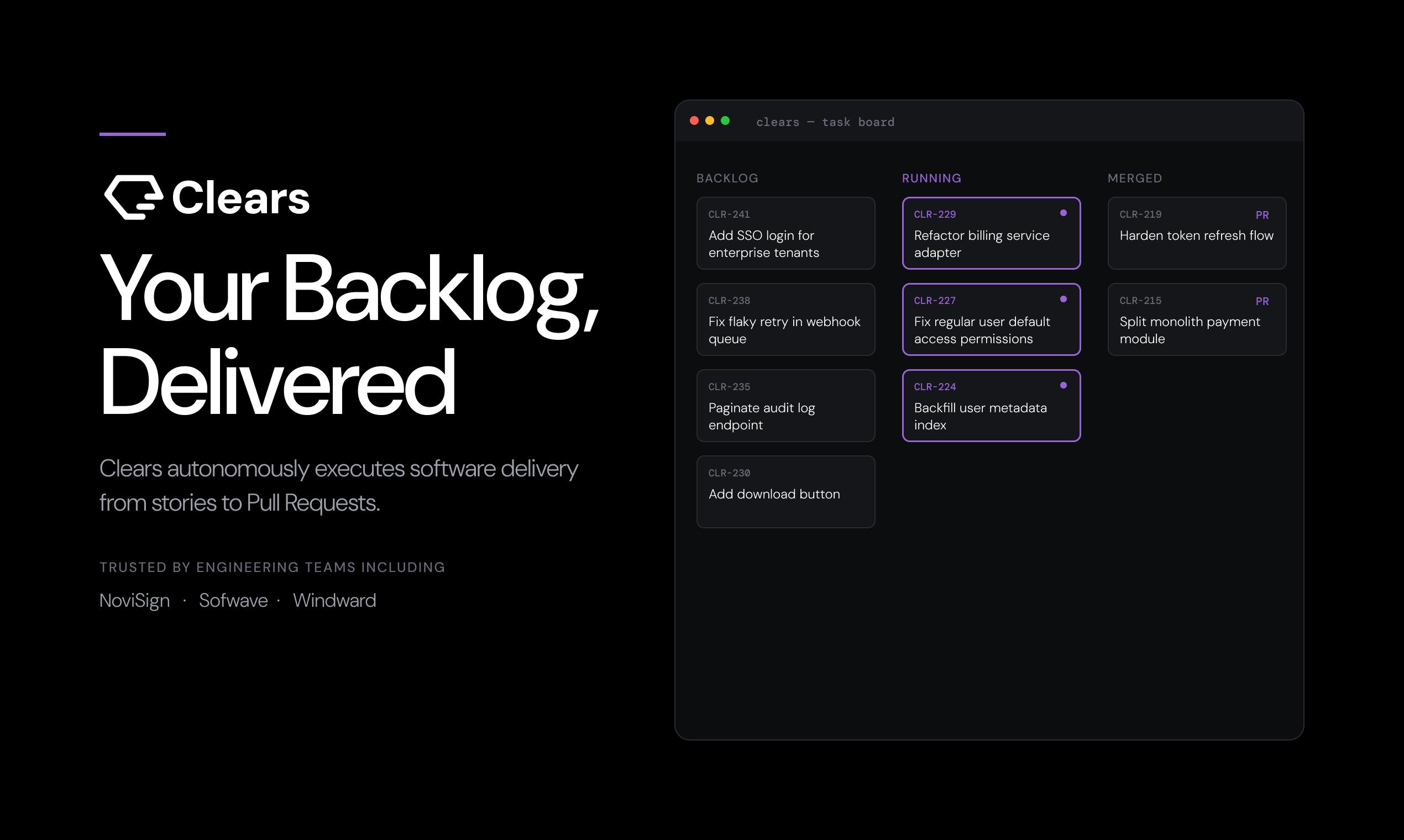
Clears addresses the gap between generating code and delivering production software. A user creates or imports a development story, answers AI-generated clarifying questions, reviews a specification and definition of done, and allows agents to create branches, implement subtasks, run validation, and open pull requests.
Core capabilities include autonomous story execution, parallel agent workflows, a shared context and memory layer, task scoring, live execution visibility, and synchronization with engineering systems. GitHub, GitLab, or Bitbucket is required; Jira and Slack are optional (documentation).
The public Pro plan is listed at $89 per user per month, equivalent to $1,068 annually before discounts. The company also offers custom enterprise pricing and a free trial without a credit card (pricing). Exact enterprise contract values, included AI usage, overage charges, and model-cost treatment are not publicly disclosed.
Clears is browser-based and integrates into existing development workflows. It replaces some combination of manual backlog refinement, technical-specification writing, task decomposition, coding assistants, project-status meetings, and internal scripts coordinating Jira, repositories, CI, and messaging tools.
Founder and Team Assessment
Tzahi Mor has served as Clears’ co-founder and CEO since November 2024. His public profile shows engineering and management experience at PlaxidityX, including responsibility for six teams and roughly 40 engineers. He previously co-founded Synairgy, but no exit or material commercial outcome from that company was verified (Mor profile).
Yonatan Maor is co-founder and CTO. His public profile describes him as a three-time CTO and shows direct involvement in AI-SDLC architecture and public technical education, including a stage-by-stage discussion of applying agents from product requirements through QA (Maor profile; LangTalks episode). His complete employment history could not be independently verified from accessible primary sources.
LinkedIn associates five visible profiles with Clears and categorizes the company as having 2–10 employees; this is a platform-derived signal rather than verified headcount (LinkedIn). A senior data-science/AI engineering job has also been advertised, indicating hiring, but the current number of open positions is unclear.
Both founders publicly identify as full-time. Their backgrounds provide strong founder-market fit in engineering management and software delivery. Commercial scaling, enterprise sales, and previous venture outcomes remain less evidenced.
Founder Assessment: Strong technical and engineering-management fit, but commercial scaling capability remains unproven.
Market Opportunity
The narrow initial segment is software companies with approximately 20–500 developers, multiple repositories, formal backlogs, and sufficient delivery volume to justify autonomous execution. Buyers are likely CTOs, VPs of Engineering, platform leaders, and engineering-productivity teams.
An illustrative bottom-up market scenario is:
- 50,000 potentially addressable software organizations globally;
- 25–100 paid Clears seats per organization;
- $1,068 annual list price per seat;
- approximately $27,000–$107,000 annual subscription value per organization before enterprise discounts or usage charges.
That produces a theoretical $1.3–$5.3 billion annual software opportunity. These customer-count and deployment assumptions are analyst estimates, not company-reported figures. The practical serviceable market will be smaller because many teams will use coding tools bundled by repository, cloud, or project-management vendors.
Adjacent opportunities include enterprise governance, agent observability, model routing, QA automation, security review, deployment automation, and consumption-based agent execution. International expansion is plausible because the product is delivered as SaaS and supports widely used development systems.
The market can support venture-scale revenue. Nevertheless, a large market does not ensure Clears will capture it; distribution and platform differentiation are the decisive variables.
Traction and Growth Signals
A third-party Product Hunt snapshot recorded approximately 277 votes and 18 comments, with an August 17, 2026 launch date (Launly). This indicates launch attention only.
More meaningful signals include:
- Named testimonials from senior engineering executives at Windward, PlaxidityX, Sofwave, and NoviSign (official website).
- Public product documentation covering onboarding, repositories, Jira synchronization, Slack, agent execution, and memory.
- Product activity extending back to 2024–2025 on the company’s LinkedIn page, suggesting development predates the Product Hunt launch (LinkedIn).
- Support for all three major hosted Git platforms.
- A company employee reported creating 42 pull requests over two weeks while dogfooding Clears. The author explicitly identified this as internal product usage rather than an external case study; the Reddit post received weak community reception and should not be treated as customer evidence (Reddit).
No reliable public information was found for revenue, paying-customer count, active users, customer retention, expansion, autonomous-task success rates, production incident rates, or cost savings. The named testimonials require direct reference checks.
Traction Assessment: Credible early product usage, but commercially unverified.
Competitive Position
Direct competitors include Devin, Factory, and other autonomous software-development agents. Adjacent competitors include GitHub Copilot, Cursor, Atlassian Rovo Dev, GitLab Duo, Qodo, and coding agents from model providers.
Free alternatives include open-source coding agents, repository-native automation, Claude Code or similar tools combined with custom scripts, and internal engineering-platform solutions. Manual alternatives include backlog refinement meetings, technical-lead planning, developer implementation, CI, and human code review.
Clears’ differentiation is its organization-level context and orchestration across requirements, coding, CI feedback, and pull requests—not merely code generation. Integration into Jira and repository workflows may create moderate switching costs as Clears accumulates decisions, conventions, and execution history.
However, proprietary-data and network-effect advantages are not yet demonstrated. The product depends on third-party model providers, code hosts, and workflow platforms, all of which could offer overlapping functionality.
If the largest platform launched the same feature within six months, why would customers continue using Clears? The credible answer would be deeper cross-platform support, higher autonomous-task reliability, accumulated organizational context, and better workflow orchestration. None is yet independently quantified.
Defensibility Assessment: Low
Business Model and Economics
At $89 per user per month, the Pro plan has an annual list value of $1,068 per seat. A 50-seat customer would represent approximately $53,400 in annual list revenue before discounts. Enterprise pricing is custom, preventing a reliable ACV estimate.
Potential gross margins depend heavily on whether AI usage is included, limited, or passed through. Variable costs include model inference, code indexing, embeddings, isolated execution environments, storage, CI workloads, security monitoring, and technical support. Clears may also incur substantial onboarding and integration costs for enterprise customers.
Per-user pricing is understandable but may become misaligned if agent output reduces the number of developers or if usage varies significantly between seats. A hybrid platform-and-consumption model could better align revenue with value, but no such public pricing structure was verified.
The critical economic test is whether revenue per customer expands faster than inference and execution costs while support requirements decline after onboarding. Gross margin, CAC, sales-cycle duration, and payback are unknown.
Unicorn Path
An assumed 10× ARR multiple is appropriate only for a high-growth enterprise SaaS company with strong retention and attractive gross margins.
Required ARR = $1 billion ÷ 10 = approximately $100 million
At the $1,068 annual Pro seat price, Clears would require approximately:
$100 million ÷ $1,068 = 93,600 paid seats
Alternative enterprise combinations include:
- 2,000 customers at $50,000 ARR;
- 1,000 customers at $100,000 ARR; or
- 400 customers at $250,000 ARR.
This scale would require international enterprise distribution, strong net revenue retention, high autonomous-execution reliability, gross margins above conventional services economics, and expansion beyond individual paid seats into platform, usage, governance, and premium-security revenue.
Unicorn Path: Conditional
Valuation Assessment
No reliable public funding announcement, round size, SAFE cap, or post-money valuation was found. Investor Moran Leshem Bar publicly identifies as a Clears investor, but the investment amount, date, instrument, and whether other investors participated are not disclosed (investor profile).
Relevant operating comparables include private coding-agent companies such as Cognition and Factory, and public platform vendors Microsoft/GitHub, Atlassian, and GitLab. Their valuations are not directly applicable without Clears’ revenue, growth, and retention.
Valuation Attractiveness: Not Assessable
Assessment requires current ARR, growth, gross margin, retention, burn, runway, financing instrument, valuation or SAFE cap, investor ownership, option pool, and liquidation preferences.
Key Risks
- Revenue, retention, and customer expansion are not publicly verified.
- GitHub, Atlassian, GitLab, and model vendors can bundle competing functionality.
- Incorrect autonomous changes could create security, reliability, or compliance incidents.
- The context layer requires broad access to sensitive source code and internal documentation.
- AI inference and execution costs may weaken gross margins.
- Per-seat pricing may not align with autonomous-agent value or usage.
- Named customers may represent pilots rather than recurring production contracts.
- A small team could struggle with enterprise integrations, support, and security requirements.
- Switching costs and proprietary-data advantages remain unproven.
- Funding and runway are unknown.
Final Assessment
Venture Potential: 65/100
| Category | Score |
|---|---|
| Market Size and Expansion Potential | 17/20 |
| Traction and Growth Evidence | 8/20 |
| Founder and Team | 12/15 |
| Product Strength | 8/10 |
| Distribution Potential | 8/15 |
| Business Model and Economics | 7/10 |
| Defensibility | 5/10 |
| Total | 65/100 |
The strongest elements are the market, founder-market fit, workflow breadth, and visible product maturity. The weakest are limited commercial evidence, platform competition, and low demonstrated defensibility.
Evidence Confidence: 55/100
Verified or reasonably evidenced information includes founder identity, founder roles, product functionality, pricing, integrations, security claims, and named testimonials. Customer scale, productivity improvements, and SOC 2 status remain company-reported. Market sizing is an analyst scenario. Revenue, retention, funding, valuation, margins, burn, runway, and contract terms are unavailable.
Final Decision: Watch
Clears has the product quality and market scope to merit continued attention, but public evidence does not yet support formal diligence. The company must demonstrate that named customers are paying, expanding production deployments and that organizational context produces durable differentiation.
Upgrade Conditions
- At least $1 million verified ARR with sustained growth.
- Ten or more referenceable paying customers using Clears in production.
- More than 70% six-month customer retention.
- Gross margin above 70% after inference and execution costs.
- Verified reduction in delivery cycle time without increased defect rates.
- Repeatable acquisition beyond founder networks and Product Hunt.
- Evidence that accumulated context materially improves task success.
Downgrade Conditions
- Named deployments prove to be unpaid pilots.
- Weak paid conversion or high six-month churn.
- Frequent defective or insecure agent-generated changes.
- Gross margins materially below enterprise SaaS norms.
- Major repository or project-management platforms replicate the context layer.
- Declining product activity or founder disengagement.
- Misleading customer, security, or performance claims.
Questions for Further Diligence
- What are current ARR, MRR, contracted backlog, and monthly revenue growth?
- How many paying organizations, paid seats, and weekly active users are there?
- What are 30-, 90-, and 180-day customer retention and net revenue retention?
- Which displayed customers are paying, and how many repositories and tasks do they run?
- What percentage of autonomous stories reaches an accepted PR without major rework?
- What are inference and execution costs per completed story and gross margin by plan?
- What are CAC, sales-cycle duration, and primary acquisition channels?
- How are source code, credentials, and indexed organizational context isolated and deleted?
- What are current headcount, burn, runway, and founder salaries?
- What funding has been raised, at what valuation or SAFE cap, and from whom?
- How does Clears outperform repository-native agents on delivery cycle time and defect rate?
- What product and data remain portable if a customer terminates the service?