
Table of Contents
Expert Chase 2.0 Investment Report
Category: Consumer AI personal assistant / “Life OS” (productivity, health, finance aggregation)
Company Stage: Bootstrapped, solo-founded; company started ~August 2025; first public launch April 2026
Founder or Founders: Yair Cohen (solo founder, Israel-based)
Headquarters: Expert Chase, Inc., Newark, Delaware, USA (registered address); founder operates from Israel
Funding: None disclosed; no funding evidence found
Business Model: Freemium consumer subscription — $19/month or $199/year
Product Hunt Launch Date: August 19, 2026 (3rd launch; prior launches April 17 and July 30, 2026)
Report Date: August 22, 2026
| Investment Metric | Assessment |
|---|---|
| Venture Potential | 39/100 |
| Unicorn Path | Improbable |
| Valuation Attractiveness | Not Assessable |
| Evidence Confidence | 42/100 |
| Final Decision | Pass |
Executive Summary
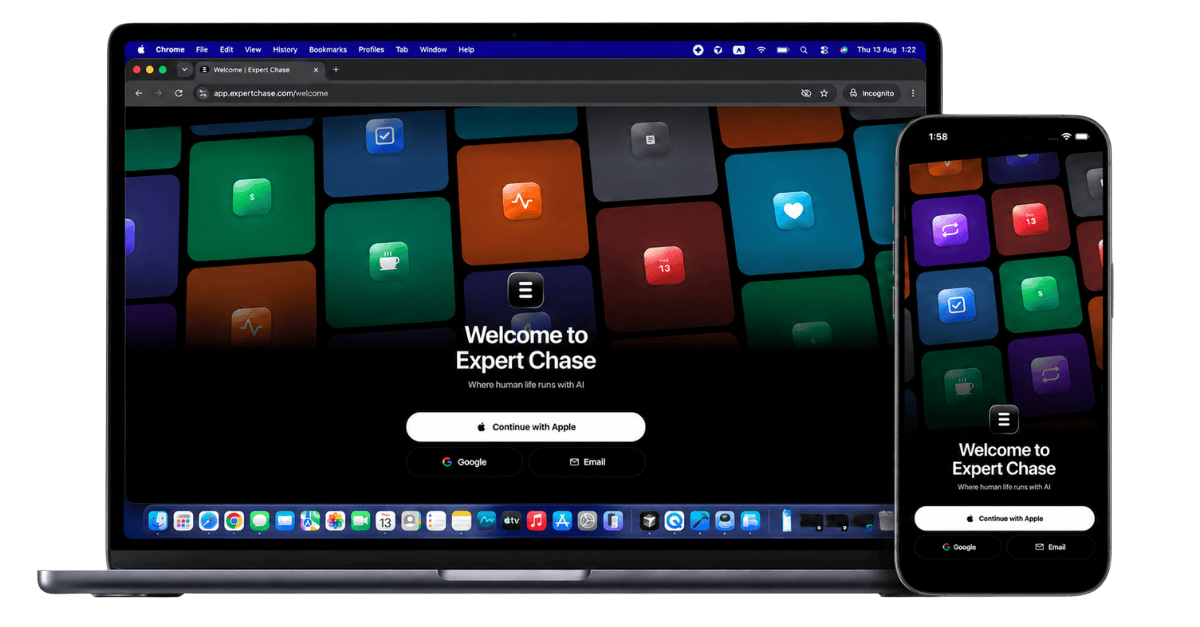
Expert Chase is a consumer “Life OS” app built around an AI assistant called E.Y.E. (“Empower Your Everyday”). It attempts to consolidate tasks, calendar, habits, sleep, nutrition (including camera-based meal scanning), fitness, finance tracking, and notes into one subscription, with the AI answering from the user’s own data rather than generic responses. Version 2.0, launched on Product Hunt on August 19, 2026, is a ground-up redesign adding chat-based on-device reminders and a refreshed interface across iOS, Android, and web.[1][2][3]
The strongest positive signal is execution velocity: a solo founder shipped a web app in April, native mobile apps by July, and a full redesign by August, earning a #4 Product of the Day finish and a Product Hunt newsletter feature to 1M+ subscribers along the way. Clear monetization exists from day one at $19/month or $199/year.[4][5][6]
The most important concern is the gap between narrative and verifiable traction. The founder reported in April that users were “flooding in” and “Premium users coming in fast”, yet the Google Play listing shows only 100+ downloads and the US App Store page shows no rating count at all. Launch promotion also shows signs of being orchestrated — a professional hunter and multiple near-identical third-party LinkedIn posts on launch day.[2][3][4][7][8][9]
Structurally, the product competes with free, platform-native AI from Apple, Google, and OpenAI — the same platforms whose calendar, tasks, and health APIs it depends on. A solo founder maintaining eight-plus product categories against those platforms is an extremely difficult venture case.
Final decision: Pass. This is a determined bootstrapped effort, not a venture-scale company on current evidence.
Product Overview
The customer problem is app fragmentation: everyday life is spread across to-do, calendar, habit, sleep, food, finance, fitness, and notes apps. Expert Chase consolidates all of these behind a conversational AI with persistent memory that logs, plans, reminds, and summarizes using the user’s actual data. Integrations with Google Calendar/Tasks and Apple Calendar/Reminders are live with two-way sync; health and finance sync are announced as upcoming. The free tier includes all trackers with AI chat capped at 30 interactions per month; Premium ($19/month, $199/year) unlocks unlimited AI, insights, and integrations. The product is real, multi-platform, and functional — but in each individual category it replaces, incumbents (Todoist, MyFitnessPal, Copilot Money, Apple Health) are far deeper, and the product is only months old.[4][6][10]
Founder and Team Assessment
Yair Cohen is the solo founder, based in Israel, operating a Delaware-registered entity (the Play Store lists a Newark, DE registered-agent address with an Israeli contact number). His LinkedIn profile shows “Founder, Expert Chase, Inc., August 2025 – Present” with ~868 followers; no prior professional history is visible in public sources reviewed, and he should not be confused with same-named Israeli tech executives. He describes himself as a “solo maker… no team… just me building day and night,” and the stack (Cursor, Supabase, Vercel, Next.js) is consistent with AI-assisted solo development. Shipping cadence is genuinely impressive for one person. However, there is no team, no verified technical or commercial track record, and total key-person dependency.[4][7][11][12]
Founder Assessment: High solo execution velocity, but unverified background and extreme single-person risk.
Market Opportunity
The initial customer segment is narrow despite the broad pitch: consumers willing to pay ~$199/year to consolidate life management into an AI chat — realistically, productivity-enthusiast prosumers already paying for two or more of the apps being replaced. A bottom-up frame (analyst assumptions): if 5–10 million consumers globally pay for any life-management subscription and 2–5% would consolidate into an AI-first bundle at $199/year, the near-term serviceable pool is roughly $20–100M annually — meaningful for a bootstrapped business, thin for venture scale, and contested by free platform AI. Adjacent expansion (family plans, coaching, B2B wellness) exists but requires capabilities far beyond a solo team. Market timing cuts both ways: consumer AI interest is high, but Apple, Google, and OpenAI are shipping exactly this “personal context AI” natively and free.
Traction and Growth Signals
Verifiable: three Product Hunt launches — April 17, 2026 (#4 Product of the Day, newsletter feature to 1M+ subscribers, per the founder); July 30, 2026 (#8 daily, iOS/Android launch); August 19, 2026 (127 upvotes, #6 per Hunted.Space, #7 per Product Hunt’s own leaderboard — a minor conflict). The product page shows 961 followers and 5.0 stars from 2 reviews. Against that: Google Play reports 100+ downloads and the App Store shows no ratings count. Company-reported claims of rapid user and Premium growth cannot be reconciled with these public signals. Launch-day promotion included a professional hunter and multiple templated third-party LinkedIn posts, indicating orchestrated rather than organic attention. Most important missing metrics: registered users, DAU/MAU, paying subscribers, and retention.[1][2][3][4][5][7][8][9][13]
Traction Assessment: Launch visibility achieved; sustained commercial traction unverified and public signals are weak.
Competitive Position
Direct competitors include every best-of-breed app the product claims to replace (Todoist, Notion, Habitify, MyFitnessPal, Copilot Money, Sleep Cycle) and AI-assistant startups (Martin, Ohai, Hero). The decisive competitive fact is platform-level: Google Gemini is natively integrated into Calendar, Tasks, and Health; Apple Intelligence owns on-device data; ChatGPT offers memory and tasks free or near-free. Expert Chase’s differentiation — an AI grounded in your cross-domain life data — is precisely what these platforms can replicate with deeper data access and zero price. Switching costs could grow with accumulated personal history, but today there is no proprietary data, no network effects, and full dependency on the platforms’ APIs and app stores. If Apple or Google shipped the same feature in six months, there is no credible reason customers would stay.
Defensibility Assessment: Low
Business Model and Economics
The model is a freemium consumer subscription: $19/month or $199/year, with a 50%-off-first-3-months promotion circulating. “Unlimited AI” at a flat price creates inference-cost exposure: a heavy user can consume more than $19/month in model costs, making the best customers margin-negative unless usage is throttled behind the scenes. App Store fees take 15–30% of mobile revenue. Consumer subscription economics demand low churn and cheap acquisition; neither is evidenced, and the category (life-tracking apps) is notorious for high churn after initial motivation fades. Assumptions requiring verification: AI cost per active user, free-to-paid conversion, monthly churn, and CAC by channel.[6][14]
Unicorn Path
Assume an 8× ARR multiple, generous for a consumer subscription business. Required revenue: $1B ÷ 8 = $125M ARR, which at $199/year requires roughly 630,000 paying subscribers (more after app-store fees and discounts). For calibration, that would place Expert Chase among the top consumer subscription apps globally — a tier reached by companies like Calm only with large teams and substantial paid-acquisition budgets. A solo, unfunded founder reaching ~630K paying subscribers against free platform-native AI is not a reasonable expectation under the current model.
Unicorn Path: Improbable
Valuation Assessment
No funding rounds, investors, or valuations are disclosed; the company appears bootstrapped, with a possible $30K Vercel credit award tied to launch day (not equity). Valuation Attractiveness: Not Assessable. Assessment would require verified subscriber counts, MRR, churn, gross margin after inference costs, and the terms of any round being contemplated.[4]
Key Risks
- Platform replication: Apple, Google, and OpenAI can offer equivalent personal-context AI free, with deeper data access.
- Solo-founder risk: one person spanning eight-plus product categories, support, and compliance.
- Weak verifiable traction: 100+ Play downloads and no visible iOS ratings contradict growth claims.[2][4][7]
- Sensitive-data burden: health and financial data linked to identity, managed by one developer — a breach would be existential.[2]
- Margin risk: “unlimited AI” pricing versus per-user inference costs.
- Category churn: life-tracking apps historically lose users quickly.
- Distribution reality: orchestrated launch promotion suggests limited organic pull; consumer CAC is unforgiving.[8][9]
- Positioning sprawl: “replace everything” prevents excellence in any single wedge.
- App-store dependency: fees, review opacity, and featuring decisions.
- Listing anomaly: the Product Hunt slug contains “deleted-1107920,” indicating a prior listing was deleted or merged — unexplained.[1]
Final Assessment
Venture Potential: 39/100
| Category | Score |
|---|---|
| Market Size and Expansion Potential | 10/20 |
| Traction and Growth Evidence | 4/20 |
| Founder and Team | 6/15 |
| Product Strength | 6/10 |
| Distribution Potential | 6/15 |
| Business Model and Economics | 5/10 |
| Defensibility | 2/10 |
| Total | 39/100 |
Strongest element: solo shipping velocity and a coherent product vision. Weakest: defensibility against platform owners and the absence of verifiable traction.
Evidence Confidence: 42/100
Verified: founder identity, entity, pricing, launch history, download bucket. Company-reported: user growth claims. Conflicting: daily ranking (#6 vs #7). Unavailable: revenue, subscribers, retention, funding, founder background detail.
Final Decision: Pass
Expert Chase does not currently fit a venture strategy: differentiation is structurally weak against free platform AI, traction is unverifiable and thin, the business is a solo bootstrapped project four months post-launch, and the unicorn path is improbable. This is not a Hard Pass — the product is real, functional, and honestly priced, and the founder’s effort is genuine. It could be reconsidered if conditions change materially.
Upgrade Conditions
- Verified paying subscriber base exceeding ~10,000 with disclosed MRR
- Demonstrated 6-month subscriber retention above 50%
- A focused wedge strategy (one category done exceptionally) rather than “replace everything”
- Team expansion beyond the solo founder
- Organic growth channels independent of orchestrated launch promotion
Downgrade Conditions
- Flat download and rating counts over the next quarter
- Evidence of paid review or astroturfing practices
- A platform announcement replicating the core feature set
- Founder burnout signals or slowed release cadence
- Any data-privacy incident involving health or financial data
Questions for Further Diligence
- How many registered users, MAU, and DAU does the product have today across web and mobile?
- How many paying subscribers are there, and what is current MRR?
- What is the free-to-paid conversion rate and the 30/90/180-day subscriber retention?
- What is the AI inference cost per monthly active user, and gross margin on the $19 plan?
- How many users converted from the April Product Hunt newsletter feature, and how many remain?
- What customer acquisition channels exist beyond Product Hunt and coordinated LinkedIn posts?
- Why does the Product Hunt product slug contain “deleted-1107920” — was a prior listing removed?
- How is health and financial data stored, encrypted, and isolated — and has any security review been done?
- Is the plan to remain bootstrapped, or is a round being raised — on what terms?
- Which single use case retains users best, and would you consider narrowing focus to it?
- What happens to the product if Google or Apple restricts or reprices the APIs you depend on?
- What is the roadmap for the announced health and finance sync, and what compliance obligations come with it?
Sources
- Product Hunt — E.Y.E. by Expert Chase / Expert Chase 2.0
- Hunted.Space — Expert Chase 2.0 launch analytics
- Product Hunt — August 19, 2026 daily leaderboard
- Product Hunt — July 30, 2026 daily leaderboard
- Yair Cohen — LinkedIn (founder)
- Yair Cohen — LinkedIn launch retrospective
- Apple App Store — Expert Chase: AI for Life
- Google Play — Expert Chase: AI for Life
- Expert Chase — Terms of Service and pricing
- Expert Chase — official website
- Product Hunt — built-with stack
- Example coordinated LinkedIn promotion (secondary)