
Table of Contents
ChatGPT for Teens Investment Report
Category: Consumer AI — education and teen-safety product line
Company Stage: Not a standalone company; a feature mode of ChatGPT by OpenAI (late growth-stage, $852B post-money)
Founder or Founders: No distinct founder. Parent OpenAI co-founded in 2015 by Sam Altman, Greg Brockman, Ilya Sutskever and others; CEO Sam Altman
Headquarters: San Francisco, California (parent)
Funding: Parent closed a $122B round on March 31, 2026 at an $852B post-money valuation[1][2]
Business Model: Free safety-and-learning mode inside freemium ChatGPT; no separate pricing[3]
Product Hunt Launch Date: Week of August 18, 2026 (OpenAI’s 47th Product Hunt launch)[3]
Report Date: August 22, 2026
| Investment Metric | Assessment |
|---|---|
| Venture Potential | 61/100 (scored as an OpenAI product line; no standalone venture exists) |
| Unicorn Path | No Credible Path (standalone); moot within an ~$852B parent |
| Valuation Attractiveness | Not Assessable (no standalone entity or terms) |
| Evidence Confidence | 72/100 |
| Final Decision | Pass |
Executive Summary
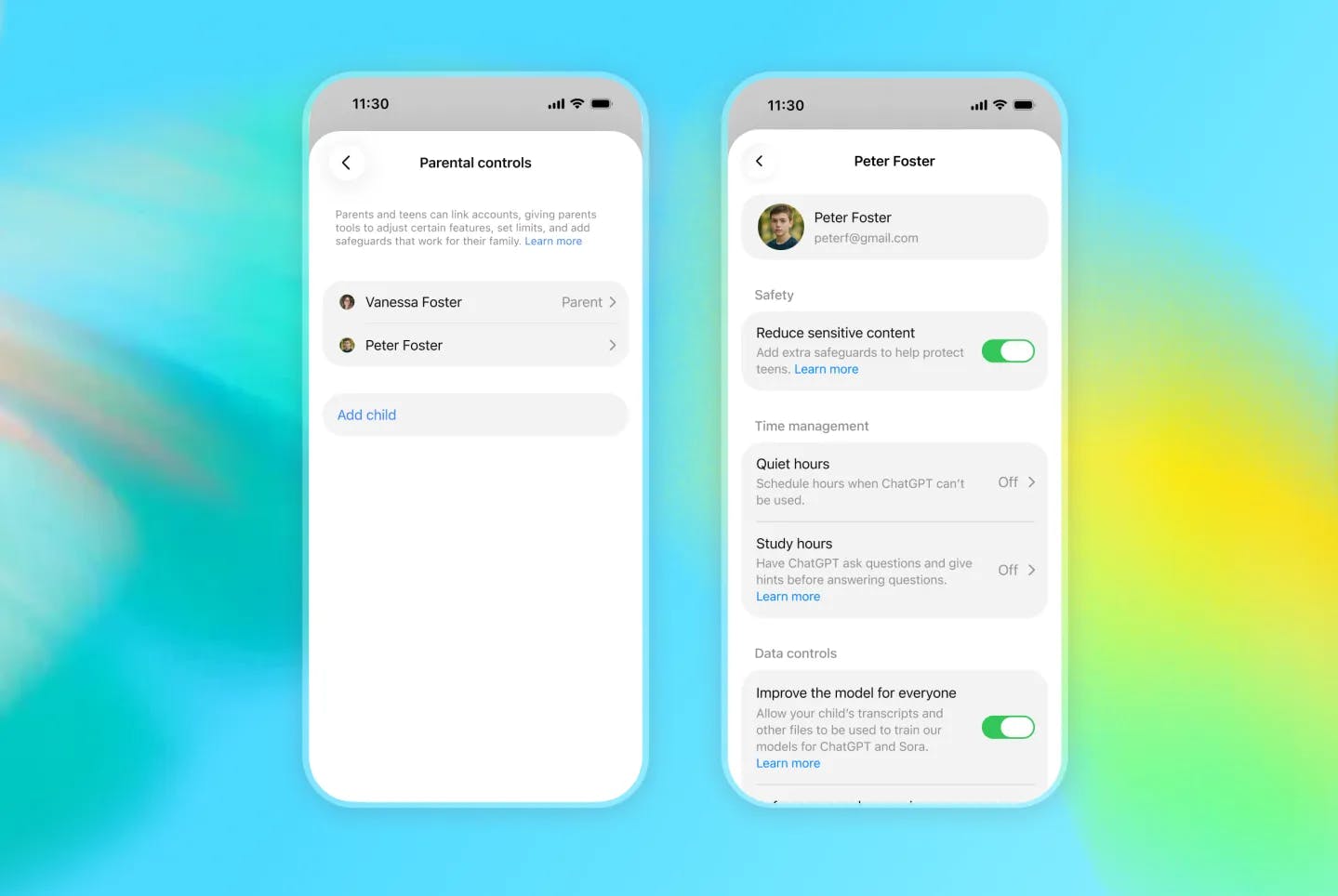
ChatGPT for Teens is a dedicated under-18 experience of ChatGPT, launched August 18, 2026, combining learning tools (Study Mode, quizzes, learning visualizations, Study Hours) with default-on safety protections, age-prediction-based enrollment, and optional parental controls such as Quiet Hours and safety notifications. It is free and carries no standalone pricing.[3][4][5]
The critical fact for any venture analysis: this is not a startup. It is a product mode of OpenAI, which closed a $122B round at an $852B post-money valuation in March 2026. There is no separate entity, cap table, round, or security a venture investor could purchase. The only way to “invest” in ChatGPT for Teens is to buy OpenAI exposure at growth-stage prices — a different mandate entirely.[1][2]
The strongest positive signal is strategic, not commercial: the product converts OpenAI’s largest liability — teen-safety litigation and regulatory scrutiny — into a default-distribution learning product in front of a base of roughly one billion weekly users. Pew found 54% of U.S. teens already use chatbots for schoolwork help, so the addressed behavior is real and mass-market.[6][7][8]
The most important investment concern is that the product exists primarily to mitigate legal and regulatory risk — including the Raine v. OpenAI wrongful-death suit and an FTC 6(b) inquiry into chatbot impacts on minors — and generates no direct revenue. Product quality appears high; company quality at the parent level is exceptional; but venture-scale potential as an investable opportunity is nil because there is nothing to underwrite. Final decision: Pass.[9][10]
Product Overview
The customer problem is twofold: teens use general-purpose chatbots for homework and emotional support in ways that can produce harm (shortcut learning, inappropriate content, unhealthy attachment), and parents lack tools to supervise that use. ChatGPT for Teens automatically enrolls users estimated or self-declared as under 18, defaulting to the safer setting when age is uncertain.[4][5]
Core features: Study Mode with guiding questions; “responsible homework reminders” that redirect answer-seeking into step-by-step work; quizzes and learning visualizations; Study Hours and Quiet Hours; break reminders after 90 minutes of use within three hours; sensitive-image upload warnings; content protections across self-harm, violence, eating disorders, and sexual/graphic material; and a model behavior spec prohibiting romantic language or implied consciousness toward minors. Parents with linked accounts manage selected settings and receive notifications in limited high-risk situations, now including eating-disorder-related signals, without reading conversations. OpenAI also announced a CodeAI partnership for AI literacy.[4][11][12]
It replaces the prior workflow — teens using unrestricted adult ChatGPT — and consolidates a year of safety work: parental controls (September 2025), the Teen Safety Blueprint (November 2025), age prediction, and an under-18 Model Spec. Target users are teens 13–17 and their parents; platforms are ChatGPT web and apps; pricing is free.[3][13][14]
Founder and Team Assessment
There is no founding team to diligence; the product is built by OpenAI’s safety, policy, and education teams under CEO Sam Altman. Parent-level capability is verified and exceptional: ~$40B annualized revenue run rate as of July 2026 (company-reported to shareholders), over one billion weekly active users, and more than two million business customers. The product was developed with teachers, pedagogy experts, and developmental-science input, and OpenAI has begun publishing under-18 model evaluations in its system cards.[4][6]
Counterweights: key-person and governance risk at OpenAI is well documented; the safety posture was substantially reactive, with major safeguards announced after the Raine lawsuit was filed in August 2025. Founder Assessment: World-class parent organization, but this product line is a policy-driven initiative, not a founder-led venture.[9][15]
Market Opportunity
Initial customer segment: U.S. teens aged 13–17 (roughly 25 million, analyst estimate from census data) and their parents, expanding to the several-hundred-million global teen population. Willingness to pay is untested and currently zero by design — the product is free.[3]
Bottom-up: ~25M U.S. teens × 54% chatbot schoolwork usage ≈ 13.5M reachable U.S. teen users; globally, plausibly 100M+ teens already in the ChatGPT funnel given one billion weekly actives. Direct revenue at current pricing: $0. The realistic monetizable adjacency is institutional education (schools, districts, ChatGPT for Teachers) and long-run conversion of teen users into paid adult subscribers. That adjacency is meaningful for OpenAI’s P&L but does not constitute a venture-scale market for this product as a standalone business. Market timing is favorable: regulators and schools are actively demanding exactly this category of guardrailed AI.[6][8][10][16]
Traction and Growth Signals
Launch attention is four days old. Product Hunt lists it as OpenAI’s 47th launch, tagged Education and Artificial Intelligence, on a page with 825 reviews and 17K followers; launch-specific vote counts were not captured and would carry minimal evidentiary weight regardless. No teen-mode adoption, retention, or engagement metrics have been published.[3]
Inherited traction is real but not attributable: ChatGPT reports over one billion weekly users, and Pew documents that a majority of U.S. teens already use chatbots for information (57%) and schoolwork (54%). The most important missing metrics: teen-mode weekly actives, age-prediction accuracy and false-positive rate, parental-linkage rate, Study Mode engagement, and safety-incident rates. Traction Assessment: Massive inherited distribution; product-specific traction commercially unverified.[6][7][8]
Competitive Position
Direct competitors: Google Gemini’s teen/child experiences (Gemini reportedly reached one billion monthly users in August 2026); Meta’s teen AI-character controls; Snap My AI. Indirect: Khanmigo and school-district AI tools. Notably, Character.AI exited the category, banning open-ended under-18 chat in November 2025 under litigation and regulatory pressure — evidence the companion-style teen market is being regulated away, while the learning-oriented mode OpenAI chose is the regulator-preferred quadrant.[7][16][17][18]
If Google ships an equivalent teen mode — it largely has — why would users stay? The honest answer is default distribution and habit: teens already live in ChatGPT, and the mode is automatic rather than opt-in. The safety feature set itself is replicable, and OpenAI publishes its under-18 spec and evaluations, lowering rivals’ copying costs. Switching costs are near zero. Defensibility Assessment: Low as a product; high only via parent’s distribution.[4]
Business Model and Economics
There is no revenue model: free tier, no teen-specific paid plan, no advertising. The mode likely increases costs (age-prediction infrastructure, safety classifiers, notification systems, restricted-but-still-billed inference) while deliberately reducing engagement (break reminders, Quiet Hours). For the parent, the economic logic is defensive and strategic: litigation-risk reduction, regulatory goodwill, school-channel credibility, and a future paid-subscriber funnel. Assumptions requiring verification: teen-mode inference cost per user, parental-linkage conversion, and teen-to-paid-adult conversion over time. As a standalone P&L, unit economics are structurally negative by design.[3]
Unicorn Path
Assumed multiple for a consumer subscription AI product: ~10x forward revenue (analyst assumption, consistent with high-growth consumer AI comparables). Required revenue for $1B ≈ $100M ARR. At the actual price of $0, required paying customers are infinite — there is no monetization mechanism. Even under a hypothetical $60/year teen plan, the product would need ~1.7M paying households, and charging for child safety would be reputationally untenable. The parent passed $1B in valuation years ago and now sits at $852B post-money. Unicorn Path: No Credible Path (standalone); irrelevant within the parent.[1]
Valuation Assessment
No standalone valuation, round, or terms exist — Valuation Attractiveness: Not Assessable. For context only, the parent’s $852B post-money equals roughly 21x the company-reported ~$40B July 2026 annualized run rate, or ~65x 2025 actual revenue of $13.07B (third-party estimate); the round was upsized from $110B at $730B announced in February to $122B at $852B at closing. Assessing entry at that level requires growth-equity diligence — burn, compute commitments, cap structure — outside this report’s venture scope. Unverified third-party reporting suggests 2025 costs near $34B, implying heavy ongoing losses.[1][2][6][19][20][21]
Key Risks
- Litigation overhang: Raine v. OpenAI and additional wrongful-death suits allege design choices harmed minors; adverse findings could force product changes or damages.[9][15][22]
- Regulatory escalation: the FTC’s 6(b) inquiry into OpenAI and six peers on child/teen chatbot impacts is unresolved; teen chatbot bans are no longer hypothetical.[10][18]
- Age-prediction failure: misclassification either exposes minors or wrongly restricts adults; accuracy is unpublished.[4]
- Circumvention: logged-out or age-misstating use can bypass protections, undermining efficacy claims.[23]
- Documented crisis exposure at scale: 0.15% of weekly users (~1.2M people) expressed suicidal ideation to ChatGPT in a given week, per Wired reporting.[24]
- Efficacy risk: no published evidence yet that Study Mode guardrails improve learning outcomes at scale.
- Reputational reflexivity: the product’s existence concedes prior harm; any new teen-safety incident will be judged against these promises.
- No monetization: the line consumes inference and safety investment with zero direct revenue.
Final Assessment
Venture Potential: 61/100
| Category | Score |
|---|---|
| Market Size and Expansion Potential | 13/20 |
| Traction and Growth Evidence | 8/20 |
| Founder and Team | 13/15 |
| Product Strength | 7/10 |
| Distribution Potential | 13/15 |
| Business Model and Economics | 3/10 |
| Defensibility | 4/10 |
| Total | 61/100 |
Strongest elements: unmatched default distribution and parent capability. Weakest: no business model and no investable entity — the score describes a product line, not a venture.
Evidence Confidence: 72/100
Verified: launch, features, enrollment mechanics (official blog, Reuters, CNN); parent funding and valuation (OpenAI, Bloomberg, CNBC); litigation and FTC inquiry (court/press/FTC). Company-reported: revenue run rate, user counts. Third-party estimates: 2025 losses, paying-subscriber counts. Unavailable: all teen-mode-specific usage, retention, safety, and cost data.[1][2][4][5][6][9][10][11][19][21][25]
Final Decision: Pass
There is no standalone company, security, or round to invest in, and the product is a risk-mitigation feature with zero direct revenue. This is not a judgment on product quality, which is high, or on OpenAI, which is formidable — it is a judgment that no venture investment opportunity exists here.
Upgrade Conditions
- OpenAI spins out or separately capitalizes an education/teen-safety entity with its own terms
- Published teen-mode retention and learning-outcome data demonstrating durable engagement
- Institutional (school/district) paid contracts anchored on the teen experience
- Favorable resolution of pending teen-safety litigation and the FTC inquiry
Downgrade Conditions
- Adverse ruling or damaging discovery in Raine v. OpenAI[15]
- Regulatory restriction or banning of teen chatbot access in major markets[18]
- Documented failure or abuse of age prediction
- A new high-profile teen-safety incident post-launch
Questions for Further Diligence
- How many weekly active users does ChatGPT for Teens have, and what share of estimated teen users does age prediction capture?
- What are the age model’s false-positive and false-negative rates, and how are they audited?
- What is the parental-account linkage rate among eligible teen accounts?
- What are 30/90/180-day retention and Study Mode engagement for teen users?
- What is the incremental inference and safety-operations cost per teen user?
- What conversion rate do aging-out teen users show into paid adult tiers?
- What reserves or insurance cover pending teen-safety litigation, and what is management’s expected range of outcomes?
- How would a COPPA-style or state age-verification mandate change the product’s architecture?
- What evidence exists that homework-redirect behavior improves measurable learning outcomes?
- Is any monetization (institutional, family plans) planned for the teen experience, and on what timeline?
Sources
- Product Hunt — OpenAI: ChatGPT for Teens launch
- OpenAI — Introducing ChatGPT for Teens
- Reuters — OpenAI unveils ChatGPT for Teens (Aug 18, 2026)
- CNN — OpenAI introduces ChatGPT for Teens amid child-safety scrutiny
- OpenAI — $122B round at $852B post-money and CNBC coverage
- Unite.AI — OpenAI investor update: $40B run rate, 1B+ WAU (secondary)
- BBC — Raine v. OpenAI wrongful-death suit; The Guardian — amended complaint
- FTC — 6(b) inquiry into AI companion chatbots
- Pew Research — How Teens Use and View AI (Feb 2026)
- Fortune — Character.AI under-18 chat ban (competitor context)
- OpenAI — Parental controls and Teen Safety Blueprint