
Table of Contents
Spline V2 Investment Report
Category: Browser-based collaborative 3D design and interactive experience platform (Design Tools / AI)
Company Stage: Growth-stage private SaaS, ~6 years old, post–Series A
Founder or Founders: Alejandro Leon, CEO (YC W21); a COO/co-founder is referenced in company communications but not independently verified by name
Headquarters: Conflicting records — LinkedIn lists San Francisco, CA; trackers list Reston, VA; founder based in Santiago, Chile; company appears remote-first
Funding: ~$25M reported: $15M seed (July 2023, Gradient Ventures led) plus $10M Series A (August 2024, Third Point Ventures led, per databases — no primary press release found); a $32.4M total appears in one tracker, unverified
Business Model: Freemium seat-based SaaS ($12–$60 per seat/month) with AI usage credits and custom enterprise plans
Product Hunt Launch Date: Spline V2 launched August 28, 2026
Report Date: August 31, 2026
| Investment Metric | Assessment |
|---|---|
| Venture Potential | 60/100 |
| Unicorn Path | Conditional |
| Valuation Attractiveness | Not Assessable |
| Evidence Confidence | 56/100 |
| Final Decision | DD |
Executive Summary
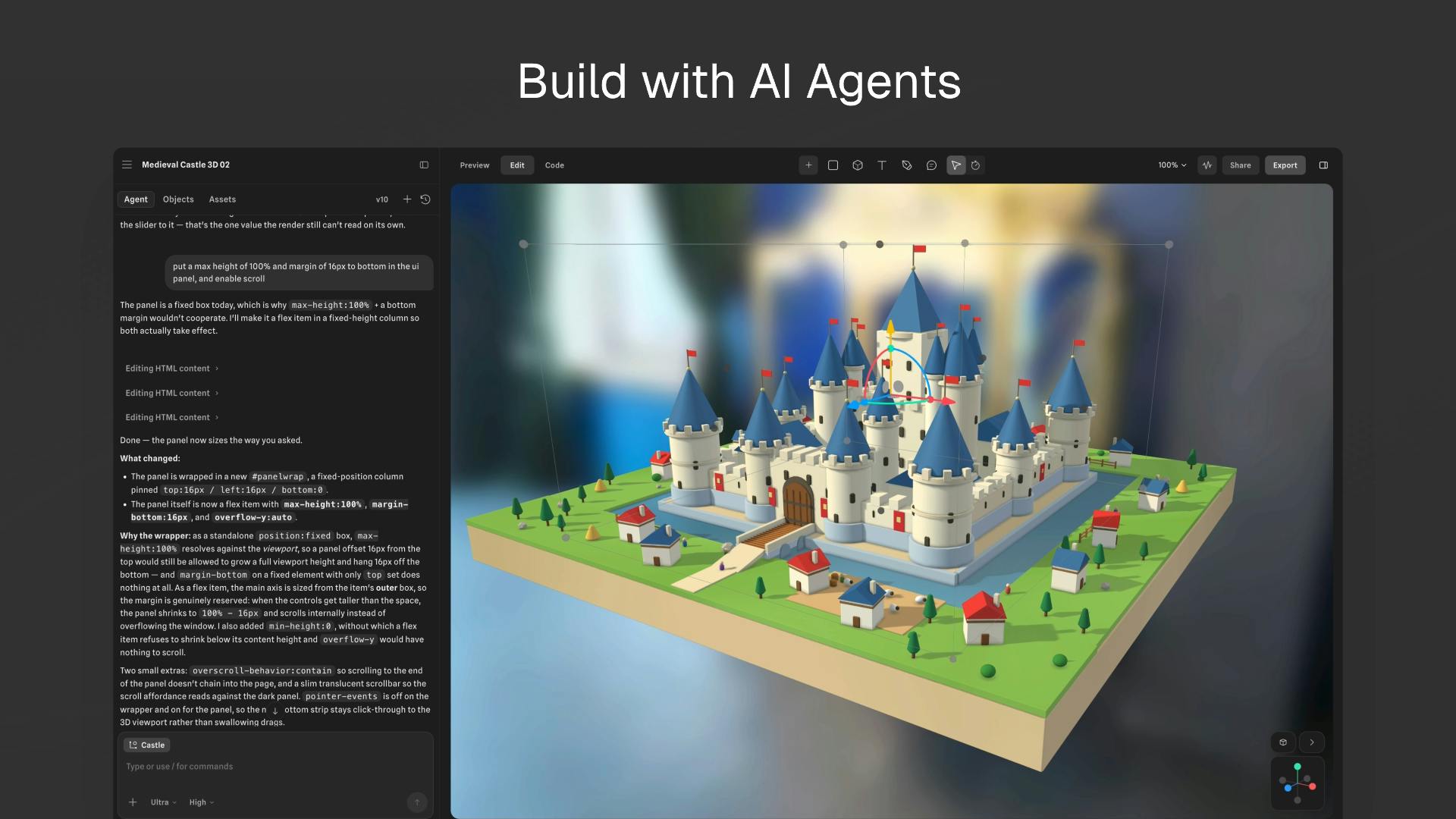
Spline is a browser-based, real-time collaborative 3D design tool used by web, brand, and product designers to build interactive 3D experiences that ship directly to websites and apps. Spline V2, released August 20, 2026, is a complete rebuild of the editor that adds MCP support, letting external AI coding agents work directly on live, editable scenes. The company also now runs Hana, a 2D interactive design canvas, and Omma, an agentic builder that generates 3D scenes, websites, and apps (released March 25, 2026). thenewstack
The customer base is designers at startups, agencies, and brand teams — people who previously needed Blender plus a developer to put interactive 3D on the web. Pricing is verified and conventional: free tier, then $12, $25, and $60 per seat per month, up to custom enterprise plans with SSO, SOC 2, and ISO 27001 compliance. spline
The interesting part is the combination of designer loyalty, six years of consistent shipping, and a well-timed agentic pivot. Third-party estimates put revenue around $4–7 million, web traffic runs at roughly 800K visits per month with unusually strong 8-minute average sessions, and investors include Gradient Ventures, First Round, and reportedly Third Point Ventures. getlatka
The strongest positive signal is product velocity and engagement: Omma, Hana, V2, MCP support, and enterprise compliance all shipped in 2026 alone, while the Product Hunt page carries a 4.6/5 rating across 31 accumulated reviews. thenewstack
The most important concern is that the core niche — interactive 3D embeds for marketing sites — looks bounded, AI text-to-3D tools are commoditizing asset creation (Meshy draws roughly six times Spline’s traffic), and traffic was flat to slightly declining through H1 2026. Meanwhile, three parallel products are being run by a team of roughly 25–40 people against much larger competitors. semrush
Final decision: DD. The company is credible enough to justify formal due diligence, but growth, retention, and Omma’s economics are unverified, and the current valuation is unknown.
Product Overview
The customer problem: putting interactive 3D on a website historically required 3D artists (Blender, Cinema 4D) and developers (Three.js) working across a painful handoff. Spline collapses that into one browser tool where designers model, animate, add interactivity via a states-and-events system, and export embeds for web, iOS, Android, and Webflow without code. spline
V2 rebuilds the editor from scratch — new materials, modeling tools, and a hair system — and exposes scenes to external agents through MCP, so tools like Claude or Cursor can edit live 3D scenes programmatically. Target users are web, brand, and product designers; the primary benefit is shipping production-grade interactive 3D without engineering support, which customers explicitly cite in case studies. Pricing and platforms are verified: web-first, downloadable apps, free tier with watermarks and limited files. Hands-on V2 quality is not independently verifiable from public sources, and community sentiment on the free tier’s limits and pricing is mixed. thenewstack
Founder and Team Assessment
Alejandro Leon is the verified founder and CEO — a lifelong 3D designer who co-founded education-tech startup PleIQ before Spline, giving him genuine founder-market fit. Spline went through Y Combinator’s Winter 2021 batch and remains active there. Team size is estimated at 25 (YC) to 31–41 (trackers) — call it 25–40, none of it company-verified. A COO/co-founder is referenced in launch posts but could not be independently verified by name; headquarters records conflict across sources. linkedin
There are no known prior exits. Technical capability is strongly evidenced by the V2 rebuild and MCP integration; commercial capability at venture scale is not yet evidenced. Key-person risk around Leon is elevated because he now fronts both Spline and Omma. thenewstack
Founder Assessment: Strong founder-market fit and six years of consistent execution, but commercial scale-up and the co-founder structure remain unverified.
Market Opportunity
The initial segment is narrow: designers building interactive web experiences — hero sections, product configurators, microsites — at startups, agencies, and mid-market brand teams. Willingness to pay is demonstrated by pricing of $144–$720 per seat per year. spline
A bottom-up sketch (analyst assumption): if 1–2 million professional designers worldwide have recurring need for web 3D and 5–15% adopt a paid tool at a blended ~$250 per seat per year, the core wedge supports roughly $12–75 million in ARR — meaningful, but likely not venture-terminal on its own. Team and enterprise seats (SSO, compliance, self-hosted exports) lift the ceiling toward $100 million+ if Spline becomes standard interactive-design infrastructure. Omma changes the math entirely, entering agentic app building, a category where Lovable is valued at $13.3 billion and Replit at $9 billion [ of prior report context — see sources]. Geographic reach is already global, though traffic skews to India (14.7%) over the US (11.1%), which compresses monetization. Timing on the agentic/MCP wave is genuinely good. thenewstack
Traction and Growth Signals
Verified product traction: 4.6/5 across 31 Product Hunt reviews and ~1.5K followers; active subreddit community. The V2 launch on August 28, 2026 drew roughly 112 upvotes and 3 comments as a promoted listing — modest and not a meaningful signal. producthunt
Third-party engagement data: ~800K monthly visits to spline.design (794.66K Dec; 848.25K Jan; 806.59K Feb; 816.51K June), 8+ minute average sessions, 54% direct traffic — a healthy, sticky audience, but flat to slightly declining through H1 2026. Revenue is estimated, not verified: $4.7M for 2024 per GetLatka and $6.7M per Growjo. Shipping velocity is high — Omma (March 2026), Hana, V2 (August 2026). No public data exists on paying customers, conversion, churn, retention, or net revenue retention — the most important missing metrics. thenewstack
Traction Assessment: Credible product-market engagement and estimated multi-million revenue, but growth is commercially unverified and web traffic has plateaued.
Competitive Position
Direct competitors: Bezi (collaborative 3D design, $13M Series A led by Benchmark, under $5M estimated revenue), Vectary (~$6M estimated revenue), and Womp ($4.7M seed). Free alternatives: Blender, Three.js/React Three Fiber, and Tinkercad — at least one developer built an R3F-based clone explicitly citing dissatisfaction with Spline’s free tier and pricing. AI-generation competitors such as Meshy are commoditizing 3D asset creation and draw 5.17M monthly visits versus Spline’s ~800K. Large platforms — Figma, Canva, Adobe — could bundle accessible 3D, and Omma now competes directly with Lovable, Replit, and v0 in agentic building. growjo
Spline’s differentiation is a designer-native UX, an embed ecosystem, a community remix library, and first-mover MCP integration in 3D. Switching costs are moderate: Spline-format files and live embeds create mild lock-in, but assets are exportable. The six-month replication question — “if Figma shipped native interactive 3D embeds, why would users stay?” — has only a partial answer: depth in real-time 3D and multi-platform export. MCP itself is an open standard, not a moat. thenewstack
Defensibility Assessment: Low to Medium
Business Model and Economics
The revenue model is verified seat-based SaaS with freemium conversion: Free → Hobby $12 → Pro $25 → Max $60 per seat per month (annual billing), enterprise custom. Estimated annual contract value runs ~$144–$720 per prosumer seat; team and enterprise deals likely $1K–$20K+. spline
Notable margin-aware design: paid tiers bundle AI credits (2,000–10,000 per month) rather than unlimited generation, which caps inference cost exposure on 3D generation, textures, and style transfer. Omma’s economics are unknown — it is in open beta with no published pricing. Unverified items: gross margin, conversion, churn, and support load. A specific consumer-SaaS risk applies: 3D projects are episodic, so designers may subscribe project-by-project and churn between projects, suppressing net revenue retention. Usage growth versus inference cost cannot be assessed until Omma’s monetization is disclosed. omma
Unicorn Path
Assume a 10x ARR multiple, appropriate for a growth-stage design/collaboration SaaS (category leaders like Figma command premiums at scale; a mid-market tool should not assume them). Required revenue is therefore roughly $100 million ARR.
At verified pricing, that implies ~330–400K paying seats at a Pro-weighted blend (~$250–$300 per seat per year), versus an implied ~15–28K paying seats on the unverified $4–7M revenue estimates — requiring 15–25x growth. Alternatively, ~5,000–10,000 design teams at $10–20K ACV. Gross margin must hold above roughly 70% given AI inference costs.
Strategically, the core 3D-embed niche alone plausibly tops out below $100M. Reaching unicorn scale requires the expansion bets to work: Omma winning meaningful agentic-building share against Lovable/Replit-class competitors, team/enterprise conversion on compliance features, and international monetization. That is a business-model expansion, not an extension.
Unicorn Path: Conditional
Valuation Assessment
Known funding: $15M seed in July 2023 led by Gradient Ventures with First Round, NXTP, Chapter One, Y Combinator, and angels including Guillermo Rauch and Vlad Magdalin; $10M Series A in August 2024 led by Third Point Ventures per funding databases. No valuation, SAFE cap, or post-money figure has ever been disclosed, and no current round is known. Comparable financings (Bezi’s Benchmark-led $13M; Lovable/Replit at $9–13B) span too wide a range to anchor Spline without verified revenue. clay
Valuation Attractiveness: Not Assessable. Assessing it responsibly would require current ARR, revenue growth, cohort retention, gross margin, burn, runway, round size, and post-money terms. As an illustration only: at the upper unverified estimate (~$6.7M revenue), a $1 billion valuation would imply ~150x revenue, which no comparable design tool commands — confirming that any unicorn pricing depends entirely on the expansion story.
Key Risks
- Bounded core market — interactive 3D embeds for the web may cap ARR well below venture scale
- Unverified growth — revenue estimates are third-party, and traffic was flat to declining through H1 2026 semrush
- AI commoditization — text-to-3D generators erode asset-creation value; Meshy outdraws Spline ~6:1 in traffic semrush
- Strategic sprawl — three products (Spline, Hana, Omma) run by a ~25–40 person team against billion-dollar competitors thenewstack
- Capital disadvantage — ~$25M raised versus Lovable’s $13.3B valuation war chest [ context]
- Platform replication — Figma, Canva, or Adobe bundling accessible interactive 3D would compress the wedge
- Pricing friction — documented community dissatisfaction with the free tier and pricing reddit
- Founder concentration — Leon fronts both Spline and Omma; no verified second founder or exit history x
Final Assessment
Venture Potential: 60/100
| Category | Score |
|---|---|
| Market Size and Expansion Potential | 13/20 |
| Traction and Growth Evidence | 11/20 |
| Founder and Team | 10/15 |
| Product Strength | 7/10 |
| Distribution Potential | 9/15 |
| Business Model and Economics | 6/10 |
| Defensibility | 4/10 |
| Total | 60/100 |
The strongest elements are product strength, founder-market fit, and timing on the agentic wave. The weakest are defensibility and the unverified, possibly plateauing growth trajectory.
Evidence Confidence: 56/100
Verified: product, features, pricing, founder identity, YC affiliation, seed round, PH metrics, and 2026 release cadence. Company-reported: customer testimonials and logos. Third-party estimates: revenue ($4–7M), team size (25–41), traffic, and the Series A details. Unavailable or conflicting: funding totals ($25M vs $32.4M), headquarters, co-founder structure, retention, conversion, valuation, and current fundraising status. Material conflicts reduce confidence. thenewstack
Final Decision: DD
Spline clears the DD bar: a credible product with differentiated MCP execution, a capable founder, real (if unverified) multi-million revenue, top-tier investors, and a conditional but genuine venture path through team/enterprise expansion and Omma. It falls short of Invest because growth, retention, unit economics, and valuation are all unknown, and the competitive picture is deteriorating at the edges. A DD process should prioritize financials, cohort retention, Omma’s standalone metrics, and current round terms.
Upgrade Conditions
- Verified ARR above $10M with 40%+ annual growth
- Omma demonstrating above 60% 90-day retention and a clear monetization model
- Enterprise logos with six-figure contracts and net revenue retention above 110%
- Re-accelerating web traffic or verified distribution beyond organic design communities
Downgrade Conditions
- Verified revenue below ~$5M or flat growth after six years
- Omma shelved, or showing consumer-grade churn
- Figma, Canva, or Adobe shipping competitive interactive 3D
- Evidence that the 2024 Series A was a bridge rather than a growth round, or founder attention permanently shifting away from Spline
Questions for Further Diligence
- What is current ARR, and what was it at the Series A in August 2024?
- How many paying customers and active seats, and what is the plan mix across Hobby, Pro, Max, and Enterprise?
- What are 30/90/180-day retention and logo retention by cohort?
- What is free-to-paid conversion, and how do episodic 3D projects affect churn?
- What is net revenue retention, and what share of expansion comes from teams versus individuals?
- How many Omma users exist, what is its retention, and when and how will it be monetized?
- What are AI inference costs per active user across Spline generation features and Omma?
- What is gross margin after AI credits and rendering infrastructure?
- What are burn rate and runway, and is a new round currently open — at what terms and valuation?
- Why has spline.design traffic been flat since December 2025 — churn, market saturation, or channel shift? semrush
- How will V2’s MCP integration be defended if Bezi, Vectary, Figma, or AI-native tools match it within six months?
- What is the team structure and co-founder situation, and how is Leon’s time split between Spline and Omma?
Sources
- Product Hunt — Spline and August 28, 2026 daily leaderboard
- Spline official website and pricing page
- TechCrunch — Spline raises $15M seed and FinSMEs coverage
- Y Combinator — Spline company page
- The New Stack — Spline V2 and MCP agents
- Omma official site and Spline’s Omma release announcement
- Semrush — spline.design traffic analytics (secondary)
- GetLatka — Spline revenue estimate (secondary)
- Growjo — competitor revenue estimates (secondary)
- Clay — Spline funding dossier (secondary) and StartupIntros (secondary)
- GamesBeat — Bezi $13M Series A
- Yahoo Finance — Womp seed round
- ZoomInfo — Alejandro Leon profile (secondary)
- Reddit — r/Spline3D community and pricing feedback