
Table of Contents
myAIcademy Investment Report
Category: Enterprise AI training, workforce upskilling, and consumer education
Company Stage: Early-stage; financing stage not independently verified
Founder or Founders: Malika Malik
Headquarters: Dubai, United Arab Emirates appears to be the operating location; the Android listing provides a Delaware, United States developer address
Funding: Not publicly disclosed
Business Model: Freemium consumer subscription, custom enterprise licensing, live training, bootcamps, and consulting
Product Hunt Launch Date: September 4, 2026
Report Date: September 7, 2026
| Investment Metric | Assessment |
|---|---|
| Venture Potential | 51/100 |
| Unicorn Path | Conditional |
| Valuation Attractiveness | Not Assessable |
| Evidence Confidence | 45/100 |
| Final Decision | Watch |
Executive Summary
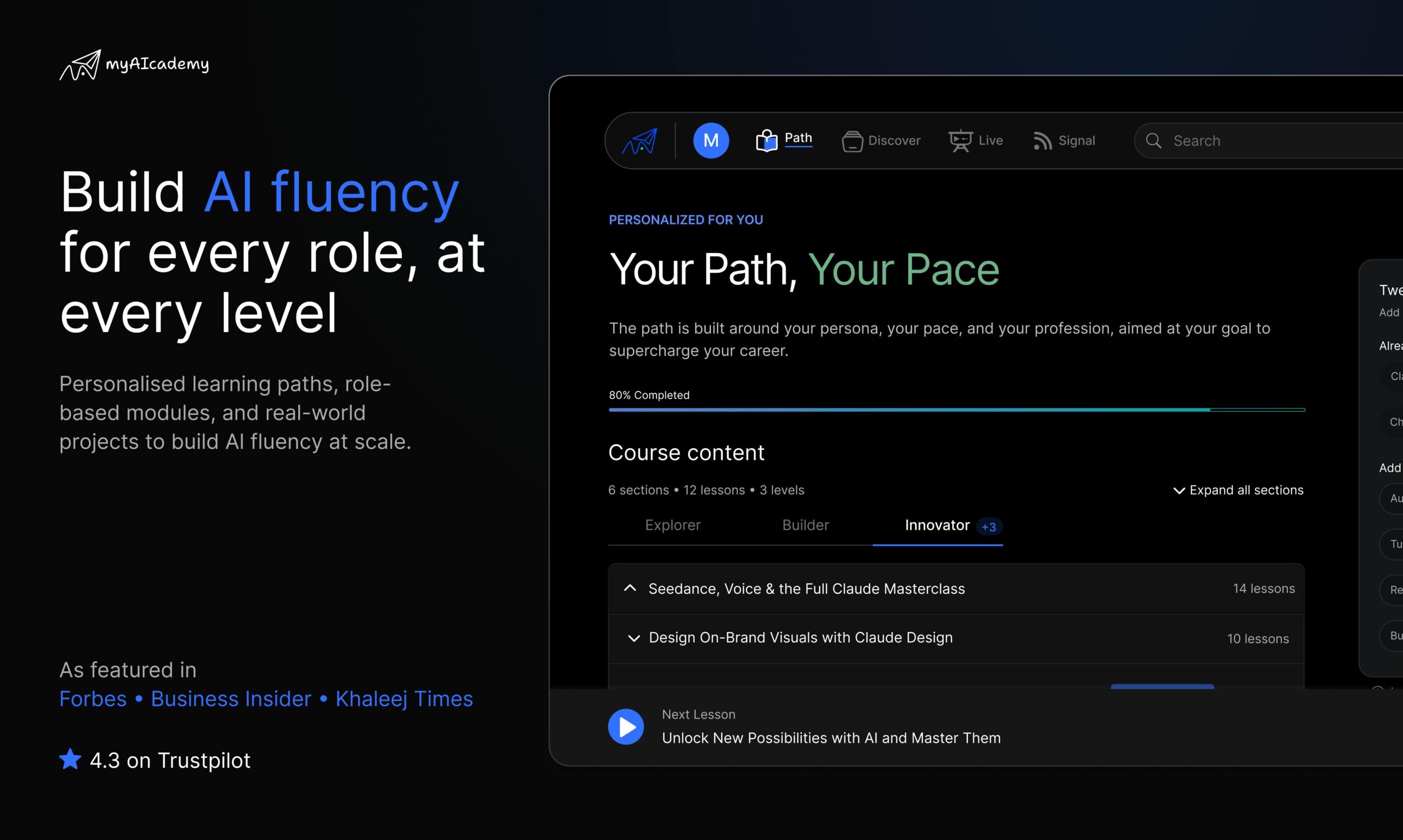
myAIcademy provides personalized AI training based on a learner’s role, experience, goals, and software tools. It combines short lessons, simulated practice, role-specific learning paths, live masterclasses, and enterprise reporting. The product is available on web, iOS, and Android (official website, Apple App Store).
The initial enterprise proposition is credible: companies are purchasing AI software faster than employees are learning how to apply it safely and consistently. A 2026 Goldman Sachs small-business survey found that 76% of respondents used AI, but only 14% had fully integrated it into core operations and 73% wanted more training or implementation resources (Goldman Sachs).
The strongest investment signal is founder-market fit. Founder Malika Malik reports previous enterprise AI-adoption experience at Google Cloud and cloud experience at Microsoft. The company has also published case studies involving Fortecho Solutions and Dubai AI Campus (Product Hunt founder statement, Fortecho case study).
The principal concern is lack of verified commercial traction. Revenue, paying users, enterprise contract values, retention, growth, gross margin, funding, and acquisition efficiency are not publicly disclosed. Google Play displays only 100+ downloads, while the App Store says the rating was recently reset and does not provide a meaningful review base (Google Play, App Store).
The decision is Watch. The product addresses a real and timely problem, but evidence is insufficient for formal due diligence. The venture case depends on converting a training product into a repeatable, high-retention enterprise software platform rather than remaining a founder-led education and consulting business.
Product Overview
The customer problem is not access to AI models but practical adoption. Employees often receive generic AI courses that do not reflect their jobs, approved software, security requirements, or recurring workflows.
myAIcademy asks users about their role, experience, goals, and tools, then generates a sequenced learning path. Lessons are designed around practical workflows and supplemented by simulated exercises, capstones, masterclasses, progress tracking, credentials, and an AI guidance product called Aimy. The company says affected content is reviewed and refreshed within 24–72 hours after material tool changes (Product Hunt).
The free plan provides onboarding, a learning-path preview, weekly updates, community access, and multi-platform availability. Pro costs $12.99 per month and includes the complete personalized path, capstones, coverage of more than 40 AI tools, daily updates, credentials, and one monthly masterclass. Enterprise pricing is custom from 25 seats and adds an administrative dashboard, SSO, contractual security features, dedicated customer success, four monthly masterclasses, and quarterly bootcamps (pricing page).
Existing alternatives include generic course catalogues, internal training, prompt libraries, external consultants, vendor tutorials, and informal learning through online videos. myAIcademy’s potential advantage is combining role-level personalization with continuously maintained content and practical workflow exercises.
Product Quality: Promising and well-positioned, but learning outcomes and software-driven personalization have not been independently validated.
Founder and Team Assessment
Malika Malik is identified consistently as founder and CEO. She reports working as a Generative AI Black Belt at Google Cloud, previously working in Microsoft’s cloud business, and training more than 10,000 professionals before the product launch (Product Hunt). Her public LinkedIn profile also identifies her as a former Google Generative AI Black Belt, but a complete independent employment verification was not available (LinkedIn).
Some descriptions call Malik a former “Google AI engineer,” while her own Product Hunt description emphasizes enterprise adoption. Those roles may overlap, but the precise scope is not independently established. Claims regarding adjunct teaching at Georgetown University were found primarily in founder and company materials, not a current official university faculty profile.
Product Hunt identifies Ashfaq in design, Rahul as a founding engineer, and Ruchit in engineering. F4’s secondary directory estimates one to ten employees, but no verified company headcount is available (Product Hunt, F4 directory). The careers page invites applications but did not display specific open roles when reviewed (careers page).
The founder appears well suited to enterprise AI education and sales. However, previous startup outcomes, exits, fundraising history, and the depth of the full-time technical team are not verified.
Founder Assessment: Strong apparent founder-market fit, but team depth, prior outcomes, and independently verified commercial execution remain limited.
Market Opportunity
The narrow initial customer is an organization with at least 25 knowledge workers that has deployed ChatGPT, Claude, Gemini, or Copilot but lacks role-specific adoption, governance, and outcome measurement.
Demand is credible. Goldman Sachs found that only 14% of surveyed AI-using small businesses had fully integrated AI, while 73% said additional training and resources would help implementation. However, the survey covered participants in a particular small-business program and should not be extrapolated mechanically to every enterprise (Goldman Sachs).
Because myAIcademy does not disclose enterprise pricing, a bottom-up scenario requires assumptions:
- 10,000 addressable mid-market organizations
- $25,000–$75,000 assumed annual contract value
- Implied serviceable opportunity: $250–$750 million annually
This is an analyst scenario, not a company forecast. A broader international opportunity could be larger, but achieving it would require multilingual content, enterprise security certifications, LMS and identity integrations, and a repeatable sales organization.
Adjacent markets include universities, schools, public-sector workforce development, AI-vendor onboarding, compliance training, and workflow implementation. The market can support a venture-scale company, but myAIcademy must prove that enterprises will buy recurring software rather than episodic workshops.
Traction and Growth Signals
myAIcademy ranked #2 on Product Hunt on September 4, 2026 and accumulated approximately 296 points. Product Hunt showed one review at the time of research (Product Hunt awards). This demonstrates launch interest, not product-market fit.
The Android application has 100+ downloads. The iOS app is active, supports in-app purchases, and recently released version 1.0.60, but its overall rating was reset and therefore provides little evidence of customer satisfaction (Google Play, App Store).
The company reports delivering a four-day program to Fortecho’s sales, engineering, and software-development departments; Fortecho’s chief commercial officer provides a testimonial on the company case-study page. It also reports a founder masterclass with Dubai AI Campus (Fortecho, Dubai AI Campus). These are useful customer-development signals, but neither case discloses contract value, renewal, measurable productivity improvement, or platform usage.
A syndicated launch release claimed thousands of waitlist sign-ups but supplied no underlying data. It explicitly states that Business Insider’s editorial team was not involved, so it should be treated as company-provided publicity rather than independent validation (syndicated release).
The most important missing metrics are ARR, paying users, enterprise contracts, active-user growth, course completion, retention, renewal, engagement after training, and customer acquisition cost.
Traction Assessment: Early customer-development activity, but commercially unverified.
Competitive Position
Direct competitors include Section AI, corporate AI-training specialists, and role-based AI academies. Section offers individual plans from $41 per month and small-team access at $750 per seat, with coaching, certifications, reporting, and enterprise services (Section pricing).
Broader competitors include Coursera’s Generative AI Academy, LinkedIn Learning’s AI Skill Pathways, DataCamp for Business, Udemy Business, and existing learning-management systems. Free alternatives include model-vendor academies, YouTube, documentation, newsletters, internal champions, and direct experimentation with AI assistants (Coursera, LinkedIn Learning).
myAIcademy competes on lower consumer pricing, role personalization, rapid content updates, practical simulations, and a unified enterprise dashboard. However, switching costs appear low, network effects are unproven, and no proprietary dataset or exclusive distribution channel has been established publicly.
If a large learning platform launched equivalent role-specific pathways within six months, customers would remain only if myAIcademy demonstrated materially fresher content, better workflow outcomes, superior administrative analytics, or substantially faster customization. No such durable advantage is yet verified.
Defensibility Assessment: Low
Business Model and Economics
Consumer Pro pricing equates to $155.88 annually before discounts, payment fees, taxes, refunds, and app-store commissions. Enterprise revenue is potentially more attractive, but pricing and contract terms are undisclosed.
Software content generation and AI tutoring could support favorable gross margins. Conversely, monthly live instruction, quarterly bootcamps, custom content, in-person intensives, and dedicated success management introduce service costs. The business could therefore resemble a training consultancy unless software delivery becomes the dominant component.
AI inference and content-monitoring expenses are probably modest for short lessons relative to frontier-model products, but actual provider contracts and costs are unknown. The company must demonstrate that additional learners increase subscription revenue faster than instructor, curriculum-review, support, and model expenses.
Unicorn Path
An optimistic 6-times ARR multiple is assumed for a high-growth education SaaS business with recurring enterprise revenue. The multiple is lower than elite pure SaaS because live training and consulting can reduce scalability and gross margin.
Required ARR = $1 billion ÷ 6 = approximately $167 million.
At the current $155.88 annual Pro price, myAIcademy would need approximately 1.07 million continuously paying subscribers, before considering app-store deductions and churn.
Alternatively, at an assumed $25,000–$75,000 enterprise ACV, it would require approximately 2,200–6,700 enterprise customers. The ACV range is an analyst assumption because enterprise pricing is private.
A credible path would require enterprise software to become the core business, measurable adoption outcomes, repeatable international sales, integrations with corporate identity and learning systems, high renewal, and proprietary benchmarking data. The present consumer and workshop model alone does not establish that path.
Unicorn Path: Conditional
Valuation Assessment
No reliable public information was found regarding financing rounds, invested capital, valuation, SAFE cap, investor ownership, or current fundraising terms. A press article names Lucy Chow and Roberto Ordonez as supporting investors or advisors, but does not disclose whether they invested, how much, or under what terms (Khaleej Times).
Revenue, growth, gross margin, burn, and retention are also unavailable. A valuation range would therefore be false precision.
Valuation Attractiveness: Not Assessable
Assessment requires current ARR, revenue composition, cohort retention, gross margin, burn, cash runway, cap table, round size, valuation cap or post-money valuation, and liquidation preferences.
Key Risks
- Commercial traction is not publicly verified.
- Enterprise case studies may represent one-time training rather than recurring SaaS.
- Large learning platforms can reproduce role-based AI pathways.
- Consumer education subscriptions typically face high churn and weak completion.
- Live instruction and customization may constrain gross margins.
- Product differentiation depends on keeping content reliably current.
- Switching costs and network effects appear limited.
- Enterprise security and compliance maturity are not independently verified.
- Founder and small-team dependency is high.
- Press visibility partly reflects syndicated or company-supplied content rather than independent reporting.
Final Assessment
Venture Potential: 51/100
| Category | Score |
|---|---|
| Market Size and Expansion Potential | 15/20 |
| Traction and Growth Evidence | 5/20 |
| Founder and Team | 10/15 |
| Product Strength | 7/10 |
| Distribution Potential | 6/15 |
| Business Model and Economics | 5/10 |
| Defensibility | 3/10 |
| Total | 51/100 |
The strongest elements are market timing, founder-market fit, and a practical enterprise proposition. The weakest are unverified traction, limited defensibility, uncertain software-versus-services economics, and absent financial information.
Evidence Confidence: 45/100
Product availability, pricing, platforms, launch ranking, application activity, and company-authored case studies are verified. Founder experience, customer outcomes, waitlist size, and content-refresh capabilities are largely company-reported. Revenue, retention, funding, valuation, burn, cap table, and unit economics remain unavailable.
Final Decision: Watch
myAIcademy is promising but too early and commercially under-documented for formal due diligence. The appropriate next step is to monitor whether Product Hunt attention and founder-led training convert into recurring enterprise contracts and durable platform usage.
Upgrade Conditions
- At least $500,000–$1 million in recurring ARR.
- Ten or more paying enterprise customers with documented renewals.
- Six-month learner retention above 70% for paid enterprise seats.
- Evidence that software represents most revenue and delivery.
- Gross margin above 70%, excluding exceptional implementation work.
- Repeatable acquisition outside founder relationships and Product Hunt.
- Independently verified learning or productivity outcomes.
- Enterprise security certifications and standard integrations.
Downgrade Conditions
- Enterprise customers fail to renew after initial workshops.
- Consumer paid conversion or retention remains weak.
- Services costs prevent scalable gross margins.
- Product or curriculum updates slow materially.
- Major competitors bundle equivalent functionality.
- Material inconsistencies emerge in customer, founder, or traction claims.
- Significant privacy, security, or content-accuracy issues arise.
Questions for Further Diligence
- What are current MRR, ARR, and monthly revenue growth?
- How many paying consumers and contracted enterprise customers are active?
- What percentage of revenue is subscription software versus training and consulting?
- What are 30-, 90-, and 180-day consumer and enterprise-seat retention rates?
- What are enterprise renewal rate and net revenue retention?
- What outcomes improved for Fortecho, and did it renew or expand?
- What are gross margin and AI-inference cost per active learner?
- How much instructor and curriculum-review labor is required per 1,000 users?
- Which channels generate customers, and what are CAC and payback period?
- Who works full-time, and what are the current engineering, content, and sales headcounts?
- What are current burn, runway, cap table, financing valuation, and proposed round terms?
- What proprietary data or integrations will prevent established learning platforms from replicating the product?