
Table of Contents
Mycel Investment Report
Category: AI workflow automation / professional-services operating system
Company Stage: Very early commercial / pre-seed-stage classification
Founder or Founders: Islam Hachimi
Headquarters: Not publicly disclosed
Funding: Not publicly disclosed
Business Model: Hosted SaaS with a free Apache-2.0 self-hosted open-source edition
Product Hunt Launch Date: September 20, 2026
Report Date: September 23, 2026
| Investment Metric | Assessment |
|---|---|
| Venture Potential | 54/100 |
| Unicorn Path | Conditional |
| Valuation Attractiveness | Not Assessable |
| Evidence Confidence | 43/100 |
| Final Decision | Watch |
Executive Summary
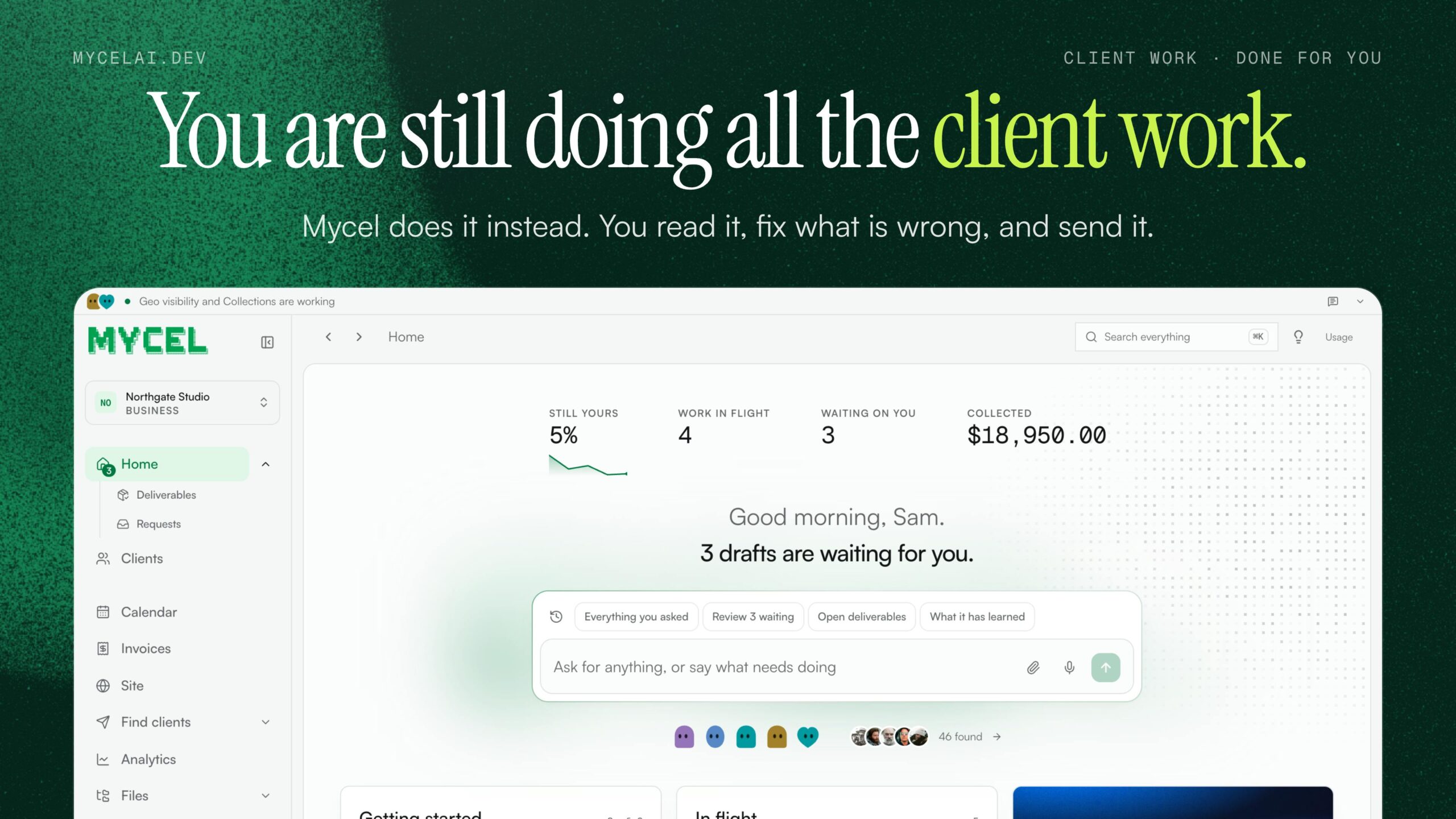
Mycel is an AI operating system for small service businesses. It turns prior client deliverables into templates and institutional knowledge, drafts recurring work, manages approvals and client portals, and can support invoicing, collections, recruiting, bookkeeping, contracts, and outbound workflows. Each agent job runs in an isolated environment, while outward actions are held for human approval (official website; GitHub).
The product is more ambitious than a generic AI writing interface. Its strongest product idea is to connect AI generation to the complete service-delivery loop: client context, recurring work, corrections, approval, delivery, and billing. The open-source kernel, credential separation, approval gate, and audit chain provide credible evidence of technical execution.
The strongest investment signal is the founder’s shipping velocity and willingness to expose the architecture publicly. The core repository was created in July 2026, had 12 stars and no forks at the research date, and was still described as “pre-alpha” (GitHub API). This demonstrates a working technical foundation, but not market adoption.
The principal concern is the near-total absence of verified commercial evidence. Revenue, paying customers, active usage, retention, conversion, gross margin, acquisition cost, funding, and financing terms are not publicly disclosed. Website testimonials are company-reported and cannot substitute for customer references or cohort data.
Product quality appears promising; company quality is only partially assessable; the venture case remains unvalidated. Mycel could become meaningful if it owns recurring service-delivery workflows rather than remaining an AI drafting layer. The appropriate decision is Watch, pending sustained paid usage and retention.
Product Overview
Mycel targets owner-led service firms where recurring client deliverables still require founder review. Users describe a service, upload a prior deliverable, assign new work, review the generated output, and approve delivery. The system retains the original draft and the corrected version so future work can better reflect the firm’s process (official website).
Core capabilities include:
- Drafting recurring reports, proposals, shortlists, contracts, and other deliverables.
- Client portals, approvals, invoices, schedules, and audit records.
- Isolated execution sandboxes with credentials held outside the agent.
- Service “wedges” for bookkeeping, invoice collection, recruiting, contracts, content, GEO reporting, and security questionnaires.
- Hosted web software plus a headless, Apache-2.0 self-hosted kernel (GitHub).
Hosted pricing is $299 per month for Starter—three seats, two businesses, and 2,000 jobs—and $899 per month for Growth—ten seats, ten businesses, and 10,000 jobs. Scale pricing is negotiated. A seven-day trial and free self-hosting are offered (pricing).
The main alternative is a combination of staff, general-purpose AI tools, project-management software, documents, email, invoicing software, and custom automations. Mycel’s primary benefit is reducing founder review time while preserving a human approval point.
Founder and Team Assessment
The official team page identifies Islam Hachimi as the sole founder and describes his focus as product, systems, and agentic infrastructure (team page). His public GitHub profile identifies him as an applied-AI engineer building autonomous agents and LLM applications and locates him in Annecy, France (GitHub profile).
The company’s LinkedIn page lists one employee, a nominal company-size range of 2–10, and a 2025 founding year, but no headquarters (LinkedIn). No reliable evidence of prior exits, fundraising success, scaled sales leadership, or a broader full-time team was found.
The open repositories support technical capability, particularly around multi-tenancy, approvals, auditability, and agent isolation. Commercial capability remains unproven, and sole-founder concentration is material across engineering, sales, support, security, and fundraising.
Founder Assessment: Credible technical execution, but commercial capability, team depth, and prior scaling experience remain unverified.
Market Opportunity
The initial segment should be defined narrowly as founder-led agencies and professional-service firms producing recurring digital deliverables for multiple clients—not all service businesses.
The U.S. Census counted approximately 4.0 million nonemployer businesses in professional, scientific, and technical services in 2022, although most are too small, non-recurring, or low-revenue to be realistic Mycel customers (U.S. Census).
A conservative scenario is that 0.5%–2% of this broad base fits Mycel’s workflow and willingness-to-pay profile:
- 20,000–80,000 potential U.S. accounts.
- $3,588 annual Starter revenue per account.
- Indicative narrow-segment revenue pool: approximately $72 million–$287 million annually.
This is an analyst scenario, not a verified market estimate. It excludes employer firms and international expansion but overstates suitability by using a broad industry category.
Expansion into larger agencies, accounting practices, recruiting firms, legal operations, and enterprise service teams could support a larger market. However, each vertical requires specialized integrations, compliance, reliability, and domain-specific evaluation. Market size is sufficient for a venture case, but only if Mycel achieves repeatable adoption across several service categories.
Traction and Growth Signals
The Product Hunt launch generated early attention and was presented as a leading daily launch, but the page showed only limited visible voting activity at the research date (Product Hunt). This is launch interest, not evidence of product-market fit.
The website includes testimonials attributed to Mailwarm, Figr, an SEO agency, Crossnode, and Sourclip. These are company-published or Product Hunt comments; contract status, payment, usage duration, and measurable results are not independently verified (official website).
The open-source kernel had 12 GitHub stars, zero forks, and no identified contributors in the API response. Recent commits show active pre-launch development, but the repository explicitly calls the core “pre-alpha” (repository metadata; commits).
No reliable public information was found regarding ARR, MRR, paying customers, active accounts, retention, conversion, traffic, customer concentration, or growth. Product Hunt performance and website requests cannot establish commercial momentum.
Traction Assessment: Active product development and initial user interest, but commercially unverified.
Competitive Position
Mycel competes with three groups:
- Professional-services platforms such as Productive and Scoro, which already combine projects, finance, clients, reporting, and AI.
- Workflow platforms such as n8n, which offer flexible hosted and self-hosted automation.
- Free or low-cost combinations of general AI, documents, spreadsheets, email, and manual review.
Mycel’s differentiation is that it attempts to produce and deliver the client work—not merely track projects—while learning from approved corrections. Its credential architecture and human approval gate are thoughtful design choices.
Switching costs could emerge from accumulated client knowledge, correction history, integrations, and embedded delivery workflows. Today, however, proprietary data, network effects, and unique distribution are not demonstrated. The Apache-2.0 kernel encourages adoption but also permits replication and reduces direct software lock-in.
If a large professional-services platform launched equivalent deliverable generation within six months, customers would remain only if Mycel produced materially better vertical output, integrated faster, or had accumulated firm-specific workflow knowledge that was costly to migrate. That advantage has not yet been demonstrated.
Defensibility Assessment: Low to Medium
Business Model and Economics
Hosted annualized contract value is approximately $3,588 for Starter and $10,788 for Growth, before discounts. Scale contracts could raise ACV, but pricing and demand are unknown.
Gross-margin potential is uncertain. Mycel absorbs AI usage under hosted plans, while each plan includes thousands of monthly jobs. Variable costs include model inference, isolated sandboxes, cloud hosting, transcription, databases, third-party connectors, support, and payment processing. The privacy page lists OpenAI, AWS, Supabase, Daytona, Composio, Stripe, and other subprocessors (privacy policy).
There is also a material pricing-policy inconsistency: the homepage says there is “no overage charge,” while the terms state that usage above plan is billed in arrears (website; terms). This should be clarified before investment.
The model can be attractive if automation value supports high pricing while job costs remain controlled. It becomes structurally weaker if high-volume customers consume disproportionately expensive inference and sandbox resources without corresponding expansion revenue.
Unicorn Path
Assume a 10× ARR multiple, above the 6–8× public SaaS median range reported by SaaS Capital and therefore requiring strong growth, retention, and margins (SaaS Capital).
Required ARR = $1 billion ÷ 10 = approximately $100 million.
That would require approximately:
- 27,900 Starter-equivalent customers at $3,588 ARR; or
- 9,300 Growth-equivalent customers at $10,788 ARR; or
- Roughly 15,000 accounts at a blended $6,700 ARR.
This is not credible from current traction. It becomes possible only if Mycel establishes repeatable vertical distribution, moves upmarket, raises ACV through enterprise deployments, and maintains strong gross margins despite AI and sandbox costs. International expansion and an ecosystem of third-party service configurations could also be necessary.
Unicorn Path: Conditional
Valuation Assessment
No verified funding history, investors, SAFE cap, priced round, secondary transaction, current fundraising status, revenue, or valuation was found.
Valuation Attractiveness: Not Assessable
Assessment would require current ARR, growth, gross margin, retention, burn, runway, round size, valuation cap or post-money valuation, cap table, option pool, investor rights, and liquidation preferences. Product quality and Product Hunt attention do not support a responsible valuation range.
Key Risks
- No verified revenue, retention, or sustained usage.
- Broad multi-vertical positioning may dilute product focus.
- Low switching costs until customer knowledge and workflows become deeply embedded.
- Incumbent professional-services platforms can bundle similar AI functionality.
- Unknown inference and sandbox economics at the advertised usage limits.
- Sole-founder execution, support, and key-person concentration.
- No SOC 2, formal penetration test, contractual SLA, or data-classification layer (security page).
- Sensitive client data passes through multiple international subprocessors.
- Free self-hosting may complicate hosted conversion and monetization.
- Inconsistent public language concerning availability and overage billing.
Final Assessment
Venture Potential: 54/100
| Category | Score |
|---|---|
| Market Size and Expansion Potential | 15/20 |
| Traction and Growth Evidence | 5/20 |
| Founder and Team | 8/15 |
| Product Strength | 8/10 |
| Distribution Potential | 7/15 |
| Business Model and Economics | 6/10 |
| Defensibility | 5/10 |
| Total | 54/100 |
The strongest elements are product architecture and a potentially large service-business workflow opportunity. The weakest are commercial validation, distribution evidence, team depth, and defensibility.
Evidence Confidence: 43/100
Verified information includes public pricing, open-source repositories, product architecture, founder identity, security disclosures, and legal terms. Testimonials and product-performance statements are company-reported. Market sizing and unicorn customer requirements are analyst calculations. Revenue, customer count, retention, margins, funding, legal entity, cap table, valuation, and runway remain unavailable.
Final Decision: Watch
Mycel is too early for formal investment diligence based solely on public evidence. The product is technically credible and addresses a costly workflow, but venture-scale demand is not demonstrated. Valuation attractiveness cannot be determined, and the sole-founder structure creates substantial execution risk.
Upgrade Conditions
- At least $500,000–$1 million ARR with documented monthly growth.
- More than 100 paying service firms outside the founder’s immediate network.
- Strong six-month logo and revenue retention.
- Gross margin above 70% after inference and sandbox costs.
- Repeatable acquisition beyond Product Hunt and founder-led outreach.
- Several referenceable customers using Mycel for recurring external deliverables.
- A focused initial vertical with measurable output-quality advantages.
- Additional senior engineering or go-to-market capacity.
Downgrade Conditions
- Weak conversion after the launch period.
- High churn caused by unreliable deliverables or setup complexity.
- Material negative gross margins among high-usage accounts.
- Declining repository and product activity.
- Rapid replication by established agency-management platforms.
- Security, privacy, or unauthorized-action incidents.
- Founder discontinuation or misleading traction claims.
Questions for Further Diligence
- What are current MRR, paying-account count, and monthly revenue growth?
- How many accounts completed a first deliverable, and how many remain active after 30, 90, and 180 days?
- What proportion of customers are Starter, Growth, discounted, or self-hosted?
- What is gross margin by plan after model, sandbox, storage, connector, and support costs?
- How much human setup or intervention is required per new customer?
- Which service vertical has the best activation, retention, and willingness to pay?
- What are customer acquisition cost and payback period by channel?
- How often are drafts approved unchanged, edited, rejected, or abandoned?
- What legal entity owns the code and customer contracts, and is all IP assigned?
- What are the cap table, monthly burn, runway, proposed valuation, and round terms?
- What is the roadmap for SOC 2, penetration testing, SLAs, and regulated-data controls?
- How will the hosted product retain an advantage over the free Apache-2.0 edition?