Table of Contents
Hemory Investment Report
Category: Always-on conversation capture and personal memory that feeds AI agents over MCP (iPhone and Apple Watch)
Company Stage: Early. The product launched in September 2026. The company’s funding stage is not publicly disclosed.
Founder or Founders: Not publicly disclosed by name. The launch post says the product was built by the founder of ONES together with “Jun,” CEO of WizNote (Hemory blog). My inference is that the unnamed founder is Wang Yingqi, founder and CEO of ONES.com (ONES). This is not verified.
Headquarters: Sunnyvale, CA, under the legal entity Beautiful ONES Inc. (Hemory Terms)
Funding: Not publicly disclosed for Hemory
Business Model: Consumer and prosumer subscriptions sold through app stores, at $10, $20 or $50 a month (Pricing)
Product Hunt Launch Date: September 26, 2026, where it ranked #1 for the day (PH leaderboard)
Report Date: September 29, 2026
| Investment Metric | Assessment |
|---|---|
| Venture Potential | 49/100 |
| Unicorn Path | Conditional |
| Valuation Attractiveness | Not Assessable |
| Evidence Confidence | 40/100 |
| Final Decision | Watch |
Executive Summary
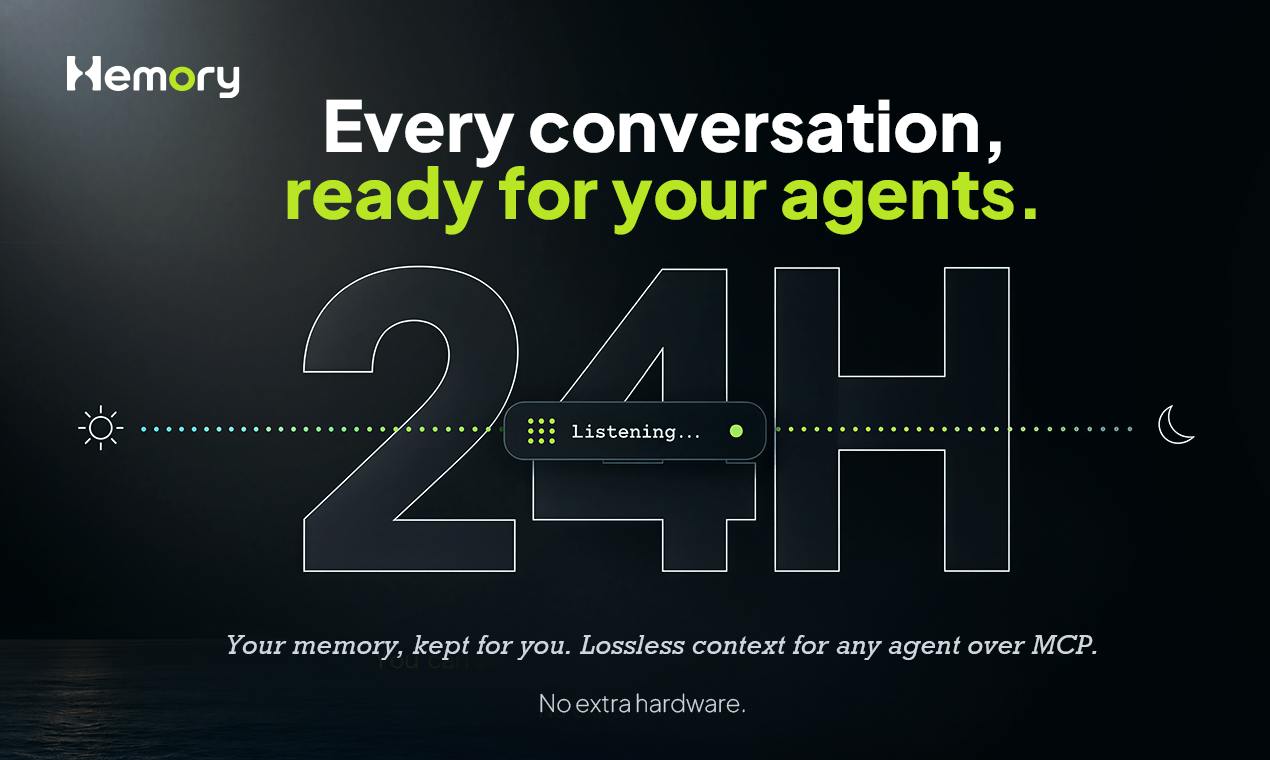
Hemory listens through the iPhone or Apple Watch the user already owns, either on a schedule or when switched on manually. It transcribes speech and labels who is speaking, then splits the day into separate “moments” and stores them as searchable memory. An MCP server lets agents such as Claude, Codex and Cursor query that memory (Website; App Store).
Its target users are founders, consultants, salespeople and lawyers whose work runs mostly through conversation (App Store).
It is interesting for two reasons. It needs no extra hardware, and it positions memory as input for agents rather than as meeting notes. Capture devices in this category have scaled and been acquired. Plaud reports reaching $100M ARR (Plaud). Amazon bought Bee (TechCrunch), and Meta bought Limitless (Limitless).
Strongest positive signal: the team appears to have experience building and buying software companies. The legal entity, Beautiful ONES Inc., shares its name with the entity behind ONES.com (ONES privacy), which says it raised nearly $100M (ONES). The co-builder ran WizNote, which ONES acquired (Zhihu).
Most important concern: Apple now ships Siri Recap, which takes ambient notes on conversations from the Apple Watch (Apple). That puts the platform owner in direct competition with Hemory. Legal experts are also questioning whether always-listening watch features breach all-party-consent recording laws (LA Times/Bloomberg).
Decision: Watch. The product is credible and the team appears to be experienced. However, there is no commercial data, the relationship with ONES is unclear, and competitive and legal risks come directly from the platform Hemory runs on.
Product Overview
Problem. Meeting recorders have to be started and stopped by hand. They cap file lengths and produce lossy memos that are hard to recall across time (Hemory blog).
How it works. Listening runs in manual or scheduled mode, for example weekdays from 9:00 to 18:00. Voice-activity detection (VAD) meters usage so that silence does not count. The listening quota is counted only when speech is detected (Website).
Features. Every plan includes the same features: transcription in 100 languages, activity segmentation, summaries, voice-based speaker recognition, a built-in Q&A agent, MCP access and Apple Watch listening (Pricing).
Pricing. A one-time free trial gives 10 hours. Starter costs $10 a month for 20 hours. Pro costs $20 a month for 60 hours. Max costs $50 a month for unlimited use under fair-use rules, capped at 24 hours a day (Pricing).
Platforms. iOS and Apple Watch through the App Store. Android is offered as a directly downloaded APK (Website). No Google Play listing was found. Desktop, web and self-hosted versions are listed as “coming soon.”
What it replaces. Granola, Otter, and hardware recorders such as Plaud (Hemory blog).
Privacy claims conflict. The website says audio is “never stored in the cloud” and is destroyed when processing ends (Website). The privacy policy says raw audio is “retained by default for a limited period” (Privacy). The Terms describe recording as “user-initiated only” (Terms), yet scheduled always-on listening is the product’s central feature. Separately, the App Store lists identifiers as “Data Used to Track You” (App Store). None of these points is disqualifying, but the conflicts should be resolved.
Founder and Team Assessment
Verified.
- Beautiful ONES Inc. is the seller and publisher of Hemory (App Store; Terms).
- ONES.com names an entity with the same name in its own privacy policy, at a different California address (ONES privacy).
- ONES acquired WizNote (Zhihu).
Company-reported.
- The launch post says the author persuaded “Jun,” CEO of WizNote, to join. It describes him as having more than 20 years in note-taking tools.
- It says the team spent nine months on the build, rebuilt the product three times, and describes itself as a “little team.”
- It says the founder has used the product daily for more than seven months (Hemory blog).
Analyst inference, not verified. The author is probably Wang Yingqi, founder and CEO of ONES. His LinkedIn lists Sunnyvale (LinkedIn), which matches Hemory’s address. No named founder appears on the website, the Product Hunt makers page, or in the press.
Unknown. Team size, hiring, and whether the founder works full-time on Hemory or also runs ONES.
Founder Assessment: The team appears to have a strong record of building and buying B2B software, but it cannot be publicly verified, and focus and ownership relative to ONES are unclear.
Market Opportunity
Initial customer. English-speaking professionals who use AI agents heavily and spend much of their day in meetings, and who already own an iPhone and ideally an Apple Watch.
Willingness to pay. There is evidence this category can charge. Plaud reports $100M ARR (Plaud). Granola reached a $1.5B valuation (TechCrunch).
Bottom-up estimate (my assumptions, not verified).
- Assume 5–15 million knowledge workers worldwide who are heavy meeting users, use agents, and own iPhones.
- Assume 2–5% become paying users.
- Assume blended net revenue of $150–$250 per user per year.
- That gives roughly $15M–$190M in annual revenue.
Expansion. Team and enterprise “organizational memory,” other languages (the app already supports Japanese, Korean and Simplified Chinese), desktop apps, and self-hosting.
Timing. Agent-memory products are an emerging category, which favors Hemory. Apple’s entry and the legal scrutiny of ambient listening weigh against it.
The upper end of this range could support venture scale, but only with team or enterprise expansion.
Traction and Growth Signals
Launch attention.
- #1 Product of the Day on September 26, 2026 (PH).
- #11 for the week, with roughly 372 upvotes and 80 comments (PH weekly).
- An unofficial Chinese-language write-up on Threads (Threads).
Product activity.
- The App Store shows a 5.0 rating from 21 ratings.
- The latest version was released four days before this report, adding new navigation and Android fixes (App Store).
- A subreddit, r/Hemory, exists.
Missing data. None of the following is public: downloads, users, paid subscribers, revenue, conversion, retention, cost per listening hour, or Android adoption.
Traction Assessment: Product quality and launch reception look promising, but the product is commercially unverified.
Competitive Position
Platform competition. Apple’s Siri Recap, currently in beta on Apple Watch Series 12 and Ultra 4, takes ambient notes on conversations and summarizes them (Apple).
Direct and adjacent competitors.
- Plaud, a hardware recorder.
- Omi, an open-source wearable that claims 300,000+ users (GitHub).
- Bee, now owned by Amazon.
- Granola and Otter for meetings.
- Product Hunt lists Limitless, Granola and HyNote as alternatives (PH alternatives).
Differentiation. Apple’s Siri Recap does not produce a transcript and deliberately does not attribute statements to speakers. Its summaries delete themselves after 7 days unless saved (Apple). Hemory keeps full transcripts with speaker labels, keeps them long term, and exposes them to third-party agents over MCP. Its differences are depth of the record and openness to agents.
Six-month test. If Apple added transcripts and agent access, Hemory’s remaining advantages would be cross-platform coverage, multilingual support and openness. Those are real but hard to defend.
Other factors.
- Switching costs rise as a user’s archive grows. That is the main source of retention.
- There are no network effects.
- Hemory depends on Apple’s background microphone access and watchOS policies.
Defensibility Assessment: Low.
Business Model and Economics
Revenue model. Auto-renewing subscriptions through the App Store (Terms). Apple takes 15–30%. The Android APK route avoids store fees but limits reach.
Costs.
- Every heard hour requires transcription, speaker processing, embeddings and calls to third-party LLMs (Anthropic, OpenAI and Azure), hosted on AWS (Privacy).
- VAD metering matches revenue to usage on the Starter and Pro plans.
- The unlimited $50 Max plan, marked “Most popular,” carries the main margin risk. Heavy users could approach cost parity with their fee. The cost per hour is not disclosed.
Customer acquisition. Product Hunt, paid social (an X advertising pixel), and Singular for install attribution (Privacy). This suggests the company plans paid acquisition.
Enterprise potential. A self-hosted “DPU” option is described in the Terms and could support enterprise deals, but it is not priced (Terms).
Unicorn Path
Assumed multiple: 6–10× ARR. That fits prosumer subscriptions with strong archive lock-in and AI-related variable costs.
Required ARR: $1B ÷ 6–10 = $100M–$167M.
Required subscribers. Assume a blended $20 a month gross, or about $170 a month net after store fees, which is about $204 a year. That implies roughly 490,000–820,000 paying subscribers. Plaud’s reported $100M ARR shows the scale is achievable in this category (Plaud).
What would have to happen.
- Hold subscribers against Apple’s bundled feature.
- Ship desktop and web versions, and list on Google Play.
- Add team or enterprise plans with shared memory.
- Keep gross margin above roughly 60% on heavy users.
- Settle recording-consent legal risk.
- Clarify whether Hemory is independent of ONES.
Unicorn Path: Conditional.
Valuation Assessment
Hemory-specific data. Funding, investors, round terms and valuation are not publicly disclosed. It is unclear whether Hemory is a product line inside ONES or a company that could be invested in separately.
Comparables.
- Granola: $1.5B valuation (TechCrunch).
- Acquisitions of Bee by Amazon and Limitless by Meta (terms undisclosed).
Valuation Attractiveness: Not Assessable. Assessing it would require the investable entity and cap table, ARR and paying subscribers, retention by plan, cost per listening hour and gross margin, burn and runway, and round size, SAFE cap or post-money valuation.
Key Risks
- Platform competition. Apple’s Siri Recap bundles similar ambient capture into the device Hemory relies on.
- Recording-consent liability. Several states require all-party consent, and experts are publicly questioning always-listening watch features (LA Times). Hemory’s Terms push compliance onto users (Terms), which does not remove the reputational risk.
- Conflicting privacy claims. The website’s “never stored in the cloud” wording conflicts with the privacy policy’s limited-period retention of raw audio.
- Unclear corporate structure. How Hemory relates to ONES, and how much of the team’s attention it gets, is unknown.
- Margin on the unlimited plan. Inference and transcription costs on the $50 Max tier are unknown.
- Weak Android distribution. An APK-only release limits reach and trust.
- Dependence on Apple. Background microphone access, watchOS policies and store fees are all under Apple’s control.
- No commercial data. Retention and paid conversion are unknown.
Final Assessment
Venture Potential: 49/100
| Category | Score |
|---|---|
| Market Size and Expansion Potential | 12/20 |
| Traction and Growth Evidence | 4/20 |
| Founder and Team | 11/15 |
| Product Strength | 7/10 |
| Distribution Potential | 7/15 |
| Business Model and Economics | 5/10 |
| Defensibility | 3/10 |
| Total | 49/100 |
The strongest elements are the apparent team experience and a well-executed product that needs no hardware and connects to agents natively. The weakest are defensibility against Apple and the complete absence of commercial evidence.
Evidence Confidence: 40/100
Verified: legal entity, pricing, platforms, App Store rating and update activity, Product Hunt rank, and that ONES acquired WizNote.
Company-reported: the team’s story, battery figures, and privacy practices.
Inferred: the founder’s identity and the link to ONES.
Unavailable: users, revenue, retention, costs, funding and team size.
The conflicting privacy statements lower confidence.
Final Decision: Watch
The product is well built, and the team has an unusually credible (though inferred) background. Even so, the corporate structure, the economics and the competitive response to Apple all need to be seen before formal diligence makes sense.
Upgrade Conditions
- A named founding team and a confirmed entity that can be invested in separately from ONES.
- Publicly verified paying subscribers, for example more than 10,000, or $1M+ ARR.
- 90-day paid retention above 60% after Siri Recap launches broadly.
- Disclosed gross margin above 60%, including heavy users on the Max plan.
- Google Play launch and a desktop client shipped.
- Privacy statements brought into line, plus an independent security audit.
Downgrade Conditions
- Apple adds transcripts or agent access to Siri Recap, or restricts background listening.
- Legal action or regulatory complaints over recording consent.
- Pricing changes to the unlimited plan that suggest margin stress.
- Declining update cadence, or the team moving back to ONES priorities.
- Evidence that privacy claims are materially inaccurate.
Questions for Further Diligence
- Who are the founders, and how is Hemory owned relative to ONES.com? Is there a separate cap table?
- How many paying subscribers do you have on each plan, and what is paid conversion from the 10-hour trial?
- What are your 30-, 90- and 180-day paid retention rates, and has Siri Recap’s beta affected churn?
- What is your all-in cost per VAD-metered hour, and what is gross margin for a heavy Max user?
- How long is raw audio kept in the cloud, and why does the website say it is never stored?
- What is your legal position on all-party-consent states, and do you plan to add in-product notices to people being recorded?
- What share of users listen through the Apple Watch versus the iPhone, and how do you depend on Apple’s background-audio permissions?
- What is the timeline for Google Play, desktop and self-hosting?
- How big is the team and how is it split, and is the founder full-time on Hemory?
- What CAC and payback period are you seeing from paid X campaigns?
- How much of your usage comes from MCP queries, and which agents drive it?
Sources
- Product Hunt – Hemory; Daily leaderboard, Sept 26, 2026; Weekly leaderboard
- Hemory website, Pricing, Launch blog
- Hemory Terms and Privacy Policy
- App Store listing
- ONES.com privacy policy (Beautiful ONES Inc.); ONES funding announcement; ONES acquires WizNote (Zhihu, secondary)
- Apple – Audio Intelligence and Siri Recap; LA Times/Bloomberg on eavesdropping laws
- Plaud $100M ARR (company claim); Granola $1.5B (TechCrunch); Amazon acquires Bee (TechCrunch); Limitless acquired by Meta