
Table of Contents
Bracket — Investment Research Report
Product Hunt launch date: October 1, 2026
Category: AI workflow / project memory / productivity
Product Hunt page: Bracket
Founders: Saksham Shukla and Tanay Vyas
Review date: October 8, 2026
Recommendation: Watch
Evidence confidence: 63/100
Executive summary
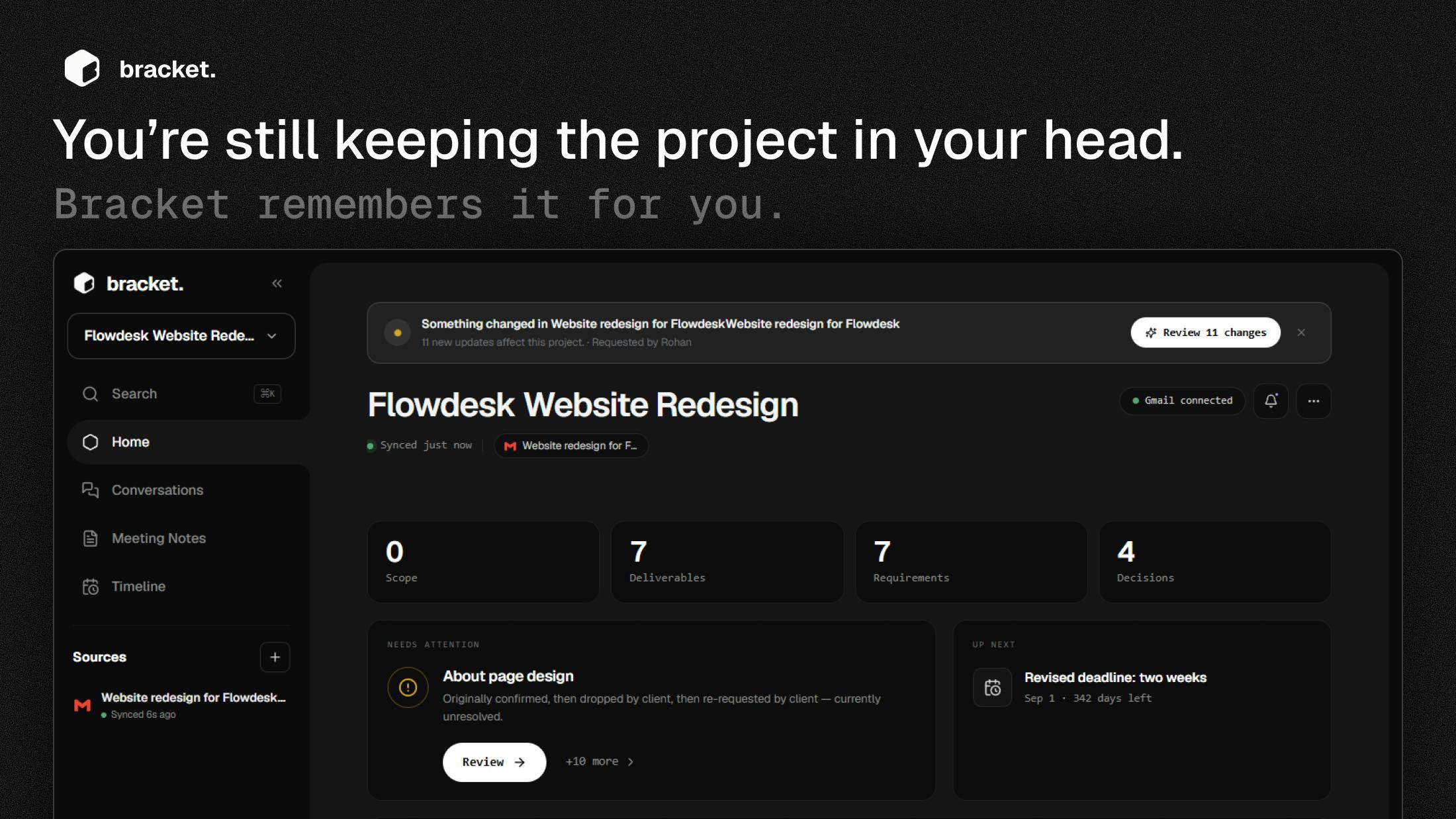
Bracket is building a memory layer for project work. It connects to the tools where client and internal work already happens—Gmail, Slack, Figma, GitHub, and Notion—and tries to keep scope, requirements, decisions, deliverables, and deadlines current without asking users to maintain another project tracker. Users can ask what happened, inspect the source behind an answer, review what changed, and draft client replies using the project context.
The pain is specific for consultants, freelancers, and agencies: a small change in email or design feedback can change scope and deadlines, but is easy to miss. Bracket aims to detect changes from existing work streams and maintain a project record. Its product page offers a 14-day trial; Product Hunt asks users to test the product and report where it fails.
Final Decision: Watch. The product addresses a real coordination problem and the founders have made a concrete, differentiated product attempt. The company is too early for formal investment diligence: it has relaunched after materially changing its initial product, has no public customer or retention metrics, and is still asking for feedback. The business also needs to prove that its AI can reliably identify conflicting or consequential changes across real customer projects. Revisit after independent teams use it repeatedly and the data-handling posture is ready for client communications.
Product and user value
Bracket’s current version is framed as “your business, remembered.” Users connect source conversations and tools; Bracket maintains a project memory, flags changes that may affect scope or deadlines, and answers questions with supporting context. It can also generate suggested client replies. The Terms say communications are not intentionally sent without a user action or approval, an important control for an assistant that can touch client relationships.
The initial use case is service projects where email, Slack, Figma, and GitHub each hold pieces of scope and delivery history. Linking these changes to source material could reduce missed commitments and time spent reconstructing decisions. Bracket is most valuable if it shows what a new event changes and lets the owner review that update.
Bracket’s July launch described a workspace users populated themselves; its October relaunch describes continuously updated memory from connected tools. The founders say they rebuilt after seeing manually maintained records become stale. That shows iteration, but the current version needs fresh customer validation.
Team
Product Hunt lists Saksham Shukla and Tanay Vyas as makers. Saksham’s portfolio describes him as a product designer with experience in enterprise and AI-powered products, and says he is currently working at Verizon while building Bracket. The Terms identify Saksham as the individual operator based in India. Public information reviewed did not establish Tanay’s role, technical background, full-time status, or the company’s legal and ownership structure.
The product benefits from design experience, but needs reliable integrations, permissions, event ingestion, source attribution, conflict resolution, and AI extraction. Clarify engineering and security ownership, founder availability, and the customer evidence behind the current wedge.
Market and competition
Likely first buyers are freelancers, consultants, and small agencies managing client projects across email, chat, design, and code tools. Bracket needs a narrow initial segment where missed scope has a direct cost and a project owner can buy without enterprise procurement.
Alternatives include project tools such as Asana, Linear, and Notion, native Gmail and Slack search, and cross-app assistants such as Glean. Bracket’s potential edge is a project record that detects the implications of new messages, not simply search across them. It must prove accuracy and reduce project leakage; larger vendors have wider integrations and customer distribution.
Bracket must cover enough of each customer’s workflow and handle stale or conflicting information. A maker says it preserves both sources and timelines when details conflict; real-world testing should establish whether it does so correctly.
Traction and business model
The October Product Hunt launch reached the top ten with about 100 points and 82 followers in the reviewed snapshot; there were no reviews. It was the second launch after a substantial rebuild, and the founders were soliciting real-world feedback. This is a discovery signal, not evidence of conversion or repeatable distribution.
The official pricing page offers ₹999 per month for up to 10 active projects and unlimited archived projects, or ₹199 for one project active for 60 days. It also advertises a 14-day free trial without a card. This is a simple self-serve structure and aligns revenue with ongoing or occasional client work. At ₹999 per month, a full-price account yields about ₹12,000 annualized; 10,000 such accounts would mean roughly ₹120 million in annual recurring revenue before discounts and churn. Reaching a venture-scale outcome would therefore require a very large number of small accounts, higher-value agency or team plans, or expansion into a broader work system.
There are no public figures for users, paying teams, project volume, revenue, retention, conversion, or acquisition cost. The current public legal terms and privacy policy are dated August 31, before the October relaunch, so investors should confirm that they accurately cover the latest integrations and features.
Data, security, and trust
Bracket may process sensitive client email, scope, design feedback, and delivery details. Its privacy policy says selected Gmail conversations and relevant project information can go to AI providers and says it does not sell project content. It does not name those providers, defines retention broadly, and gives only general examples of security controls. No independent certification or assessment was found.
Users can disconnect accounts and request deletion, but derived memory may remain until the project is deleted or deletion is requested. The Terms put client-permission responsibility on users and cap liability at fees from the prior 12 months or US$50, subject to applicable law. These terms may deter agencies handling confidential work; clear retention, deletion, subprocessors, and security controls will matter.
Scale potential and valuation
A reliable source-linked change record could expand into a lightweight client-delivery system for consultants and agencies. Bracket must avoid becoming another tracker users have to correct; automation needs to save more work than it creates.
No external financing, revenue, valuation, or formal company structure was identified. The current price points support an early self-serve product, but the company has not shown the account expansion or economics needed to justify a venture valuation. Before underwriting a round, investors should require independent paying customers, retention by cohort, time saved or reduced missed scope, and gross margins after AI and connector costs.
Key risks
- Premature product-market assumptions: The October product is a substantial rebuild after a July launch, and the founders are still seeking first-hand feedback.
- Change-detection errors: Missing a deadline or misreading a client’s scope can have real financial consequences; false alarms can also make users ignore the product.
- Incomplete context: Memory can be wrong when integrations miss relevant sources, permissions limit access, or a decision is recorded outside supported tools.
- Data trust: Client communications and project files are sensitive; AI subprocessors, retention, deletion, and access controls need stronger public evidence.
- Competitive response: Work platforms and enterprise search products already connect collaboration tools and can add project-memory features.
- Founder capacity: Public information points to an early, small team; technical execution and full-time commitment need verification.
- Low average revenue: Current monthly pricing is modest, so venture-scale economics require substantial account volume or higher-value plans.
Score and decision
| Dimension | Score | Rationale |
|---|---|---|
| Team | 12/20 | Product-design strength is visible; technical leadership, founder availability, and team structure remain unclear. |
| Product | 15/20 | Specific cross-tool project-memory use case with source history and review; accuracy is unproven. |
| Market | 14/20 | Broad coordination pain, with a plausible service-business wedge and strong adjacent platforms. |
| Traction | 8/20 | Top-ten launch and early user feedback; no reviews, customers, revenue, or retention disclosed. |
| Business model and economics | 12/20 | Clear low-cost subscription and project pricing; customer value, acquisition cost, and AI margin unknown. |
| Total | 61/100 | Keep on the watchlist until real customers validate the new product. |
Final Decision: Watch. Bracket is a promising early product with a concrete problem, but the current evidence is mainly launch materials and founder feedback. Wait for repeat usage and reliable change detection among independent paying customers before starting investment diligence.
Upgrade to DD if multiple agencies or consultants use Bracket weekly across live client projects; customers can show fewer missed changes or less coordination time; source-linked changes are accurate and reviewable; and the company publishes a clear, credible data-processing and security posture.
Downgrade to Pass if users continue to maintain a separate project tracker, the product misses or misclassifies consequential updates, integration setup requires founder intervention, or customers will not pay enough to support its recurring AI and connector costs.
Priority diligence questions
- How many independent customers are active weekly, and how many pay for Bracket today?
- What percentage of detected changes are correct, missed, or dismissed across real project histories?
- How often do users return to the project memory after the initial setup, and what are 30-, 60-, and 90-day retention?
- Which customer segment has the most urgent problem: freelancers, consultants, agencies, or internal teams?
- How much time or project leakage has a customer measured before and after using Bracket?
- Which integrations are live and reliable today, and what share of product value comes from each?
- How does Bracket resolve conflicting dates, scope statements, and decisions, and can users inspect the source and timeline?
- Who are the AI subprocessors, what data do they receive, and what are the retention and deletion guarantees?
- What are the founders’ full-time commitments, technical responsibilities, equity split, and company structure?
- What are current conversion, revenue, churn, gross margin, acquisition channels, and the plan to expand beyond ₹999 monthly accounts?
Sources
- Bracket Product Hunt launch and founder comments
- Bracket official product page
- Bracket pricing
- Bracket privacy policy
- Bracket terms of use
- Saksham Shukla’s portfolio and product-design background
- Glean’s guide to connected work context
- Glean enterprise search and integrations
- Asana’s agentic work-management announcement