
Table of Contents
Chat.sh — Investment Research Report
Launch date: October 1, 2026
Category: Customer support software / AI knowledge base
Product Hunt page: Chat.sh
Founder: Damon Chen
Review date: October 8, 2026
Recommendation: DD
Evidence confidence: 65/100
Executive summary
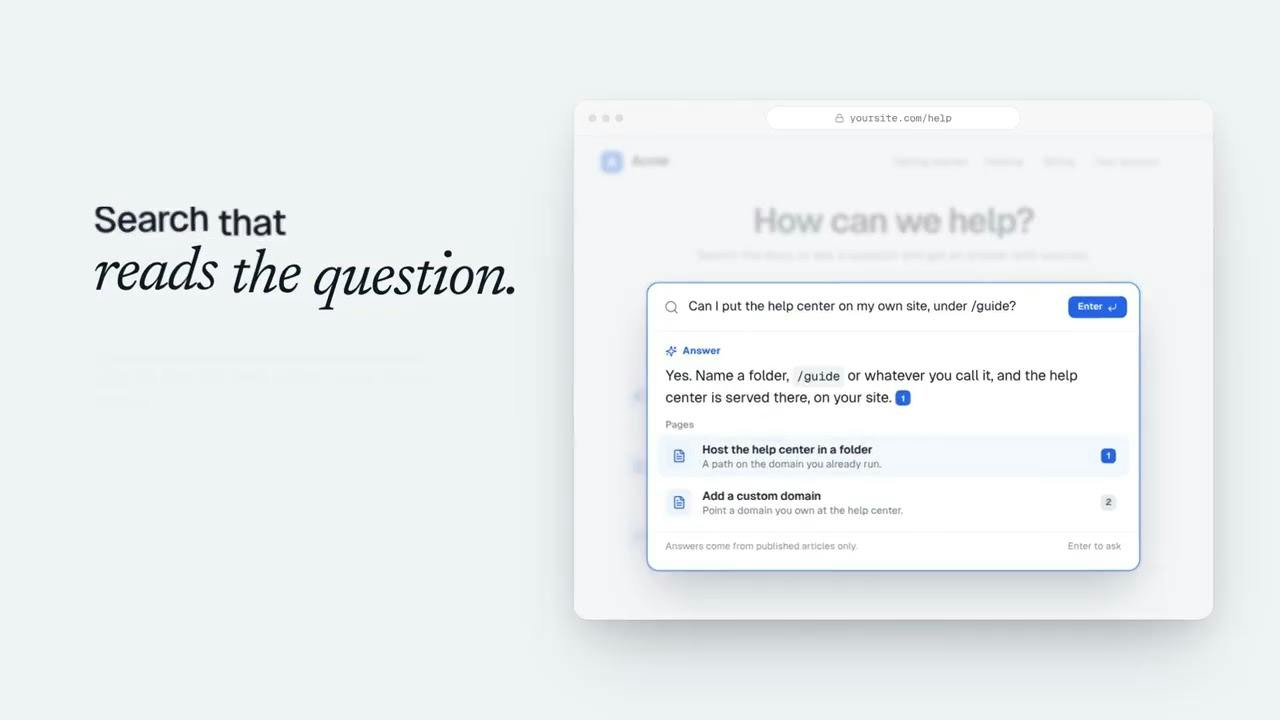
Chat.sh is an AI-first help center for software companies. It answers a visitor’s natural-language question using published help articles, then cites the pages behind its answer. Its positioning combines an on-site help center under a customer’s own URL path, a chat widget that uses the same knowledge base, and Markdown exports plus llms.txt for AI agents. The product addresses a familiar frustration: keyword search often returns irrelevant pages, while customers still have to read and interpret the results themselves.
Founder Damon Chen says he built the initial version after a poor search experience with Intercom and moved Testimonial.to’s help center to Chat.sh. The product is live, clearly differentiated on URL structure and AI-readable content, and comes from a repeat software founder with a history of shipping and selling small SaaS products. The main investment question is whether a founder-led launch and self-deployment can turn into repeatable third-party adoption.
Final Decision: DD. Chat.sh merits focused diligence because it solves a concrete customer support problem with a founder-led product wedge and a functioning experience. Public evidence does not yet show customer count, recurring revenue, retention, answer quality, or support-cost economics. The current lifetime pricing is especially important: customers pay once while receiving monthly AI credits and future features. Before investment, verify demand beyond the founder’s own company and prove that pricing can support recurring costs.
Product and user value
Chat.sh combines a knowledge base, cited AI answers, and a customer-facing messenger. Articles, links, and files feed one knowledge base; the same answers appear in the help center and app widget. Content can be exported as Markdown and indexed through llms.txt for use by AI tools. The product page lists the help center and messenger as live, with a human support inbox still shipping.
Its clearest differentiation is deployment under a customer path such as company.com/help, with readable URLs and cited answers. The founder says this uses a reverse proxy in the customer’s infrastructure, not static files; customers can repoint the path, and Markdown exports support migration. The live help center still depends on Chat.sh uptime and correct configuration.
The product’s value should be measurable: answer deflection, reduced time to resolution, lower support volume, and better self-service success. These outcomes are not yet documented with public customer data. AI answers also create quality risks: stale or conflicting articles can produce poor answers, citations do not guarantee correctness, and support managers need a way to measure unanswered questions and update content.
Team
Chat.sh is maker-led by Damon Chen, the founder of Testimonial.to. His personal portfolio describes eight years as a software engineer at Cisco before building software products. He has previously shipped and operated products including Testimonial.to and PDF.ai, and has acquired products such as QuickyAI. This gives him relevant experience building lightweight SaaS, using product-led distribution, and serving his own software businesses. His choice to migrate Testimonial.to’s own help center is useful dogfooding and provides an immediate live example.
Founder interviews and posts report revenue from earlier products, but those self-reported figures do not establish Chat.sh traction. No management team, financing, ownership terms, or valuation were found. The roadmap spans help center, search, messenger, inbox, imports, analytics, and ongoing support, creating founder-bandwidth risk.
Market and competition
The initial buyer is likely a small or midsize SaaS company that has a meaningful help center but limited support staffing. The problem exists across SaaS, online services, and customer portals. A path-based help center can preserve the company’s domain and analytics, while AI answers may resolve basic questions without opening tickets. Markdown and llms.txt support a newer need: making company knowledge readable by external AI tools.
Competition comes from established help-center and support platforms, including Intercom, Zendesk, HelpKit, Mintlify, and AI documentation-answer products such as DocsBot. Larger vendors already have customer relationships, ticketing, analytics, and AI answer features; they can bundle search improvements into existing contracts. Chat.sh will need to win on better answer quality, simpler deployment, content portability, price, or a sharply defined small-business segment. “AI search” alone is likely to become a standard feature.
The same-domain folder approach is valuable but technically dependent on proxy configuration. It can preserve URL continuity and search visibility, but prospects may prefer a static or self-hosted solution. The team should quantify setup success across common stacks and establish whether the configuration can be made reliably self-service.
Traction and business model
Product Hunt showed Chat.sh at #8 for the day with 125 points and 108 followers in the reviewed snapshot. The founder says Chat.sh is live on Testimonial.to’s own /guide path. This is real product usage, but it is founder-company dogfooding rather than an independent paid customer reference. No public download, customer, answer-volume, conversion, retention, or revenue metrics were found.
The pricing model is in transition. The site offers a free plan for 50 pages and 100 AI answers per month. The lifetime plan currently shows $499 per workspace for 1,000 pages and 1,000 monthly AI credits, with additional 1,000-credit blocks sold for a one-time $20. The launch pitch initially offered $399 and $799 tiers, and said price would rise as features shipped. The current site says the messenger is live and the inbox is forthcoming. The lifetime buyer pays once but receives recurring monthly AI usage and ongoing service, creating a possible mismatch between collected revenue and continuing model, hosting, and support costs. The page says pricing will eventually move to monthly plans, but no conversion plan or unit economics are public.
The model could work if most customers use limited credits, support costs remain low, and one-time buyers create referrals or future paid upgrades. It could fail if heavy users consume recurring inference and support while no renewal revenue offsets it. Diligence should inspect actual per-workspace answer volume, inference cost, hosting cost, refund rate, customer support time, and the proportion of lifetime buyers who later convert to subscription plans.
Scale potential and valuation
A larger business could combine support deflection, in-product help, and content for AI agents, then expand into inbox and analytics. The current one-time license creates no predictable recurring revenue: 20,000 sales at $499 yield $10 million cumulative gross bookings before fees and service costs, not $10 million ARR. Venture scale requires subscription or paid usage revenue.
No Chat.sh financing, revenue, or valuation was found in public sources. The founder’s track record can support a bootstrapped path, but an institutional investment case needs evidence that the opportunity can grow beyond a useful solo-founder business. Valuation should be based on third-party paid adoption, retention, contribution margin, and a realistic transition from lifetime pricing to subscriptions.
Key risks
- Lifetime economics: Monthly credits bundled with a one-time payment can create long-lived service costs without renewals.
- Unproven customer demand: Product Hunt activity and founder dogfooding do not establish independent willingness to pay or retention.
- Incumbent bundling: Intercom, Zendesk, and documentation vendors can improve search and add generated answers for existing customers.
- Answer quality and trust: Incorrect or stale support answers can harm customer experience; citation links alone do not guarantee correctness.
- Hosting dependency: Reverse-proxy deployment can preserve URLs but introduces uptime, configuration, and migration concerns.
- Founder bandwidth: The roadmap spans multiple support products and may be difficult for a small team to ship and support.
- Distribution: The market is crowded, and no repeatable acquisition channel or customer acquisition cost has been disclosed.
Score and decision
| Dimension | Score | Rationale |
|---|---|---|
| Team | 15/20 | Experienced founder with relevant bootstrapped SaaS history; team depth is not public. |
| Product | 15/20 | Clear help-center workflow, cited answers, same-domain URLs, and agent-readable content; quality data is missing. |
| Market | 13/20 | Broad self-service support need, but powerful platforms can bundle AI search. |
| Traction | 10/20 | Live founder deployment and Product Hunt interest; no independent customer or retention data. |
| Business model and economics | 11/20 | Low-friction free entry and paid tiers, offset by lifetime pricing with recurring monthly AI costs. |
| Total | 64/100 | Advance to focused diligence; validate paid demand and lifetime unit economics. |
Final Decision: DD. The founder has a credible history of shipping software and the product addresses a specific support-search problem. The investment case depends on evidence not yet public: independent paid customers, answer quality, measurable ticket deflection, and economics that work after the initial lifetime payment.
Upgrade to Invest if a cohort of independent customers adopts Chat.sh, retains it, reports measurable support deflection, and produces attractive contribution margin; the team demonstrates reliable self-service deployment; and subscription or usage pricing replaces indefinite unfunded service obligations.
Downgrade to Watch or Pass if adoption remains limited to the founder’s own properties, users do not renew or convert from lifetime offers, answer quality causes support escalations, or established vendors bundle comparable functionality at a low incremental price.
Priority diligence questions
- How many paying customers use Chat.sh outside Damon Chen’s own businesses, and how many are active each week?
- What are the lifetime-plan sales, refunds, monthly credit consumption, and support hours per workspace?
- What percentage of customer questions receive a helpful answer, and how is answer correctness measured?
- What ticket deflection or time-to-resolution improvement have customers measured against their existing help centers?
- What are per-answer model costs, hosting costs, and gross contribution margin at median and high usage?
- How many customers have successfully deployed the reverse-proxy configuration, and what setup failures require founder help?
- What is the migration path if a customer cancels, including Markdown exports, URLs, redirects, and search indexing?
- When will the inbox ship, and what service and feature obligations have lifetime buyers been promised?
- What subscription pricing, packaging, and lifetime-plan transition does the company intend to use?
- What are current revenue, runway, ownership, financing needs, and the founder’s hiring plan?