
Table of Contents
Cuey Investment Report
Category: Productivity software / multi-model AI verification
Company Stage: Early commercial product; private company
Founder or Founders: Product Hunt lists Morris Cheung, Wilson Chen, Adam Kazwell, and Mani Kabir as makers; roles and full-time commitment are unverified
Headquarters: LinkedIn lists Palo Alto, California; Chrome Web Store gives Llama Valley Inc.’s Delaware address
Funding: Not publicly disclosed
Business Model: Freemium Chrome extension; paid higher-usage tiers
Product Hunt Launch Date: 2026/09/27
Report Date: 2026/10/08
| Investment Metric | Assessment |
|---|---|
| Venture Potential | 61/100 |
| Unicorn Path | Conditional |
| Valuation Attractiveness | Not Assessable |
| Evidence Confidence | 56/100 |
| Final Decision | Watch |
Executive Summary
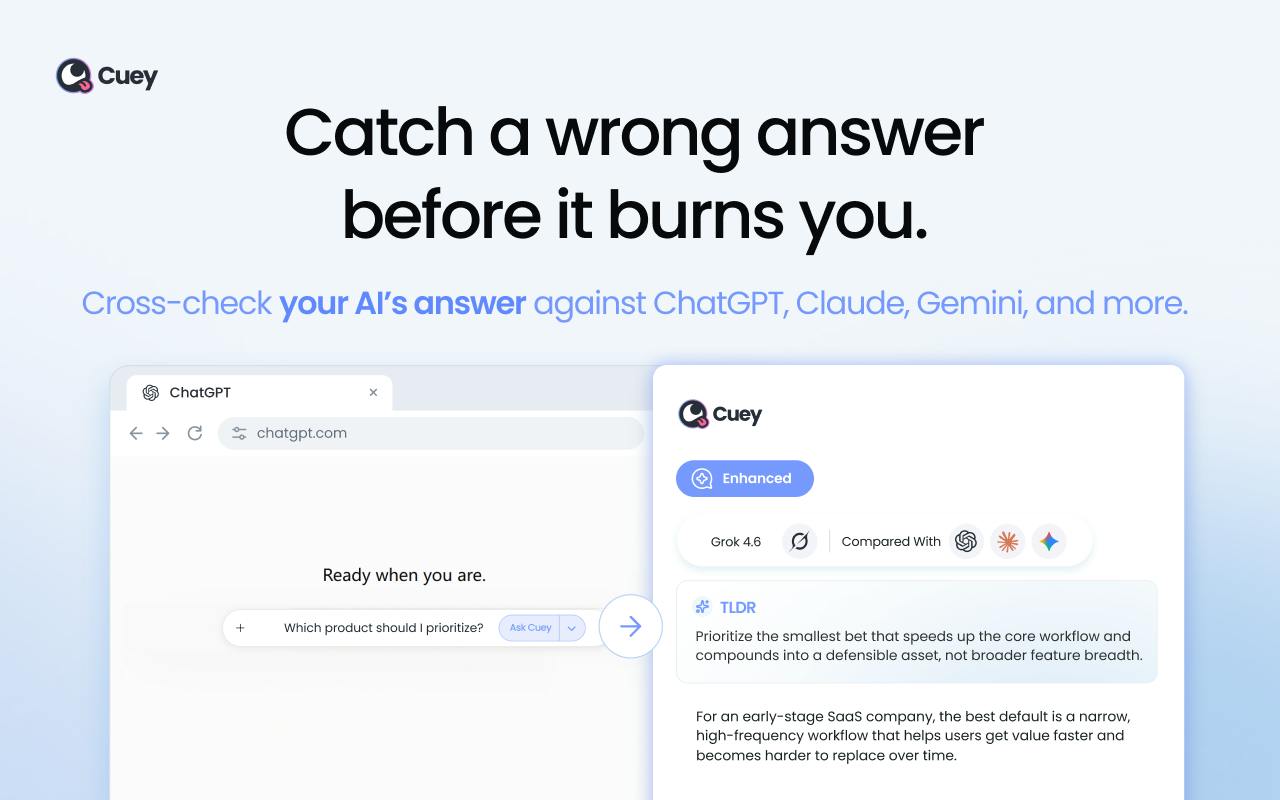
Cuey is a Chrome extension that compares answers across ChatGPT, Claude, Gemini, and other models within users’ existing chats. It presents additional responses and disagreements in a sidebar and promotes portable memory. Its target is frequent AI users who need a second opinion for professional work.
Manually repeating prompts is cumbersome, and confident AI answers can be wrong. Cuey’s in-context workflow is a usability advantage. Product Hunt ranked it #3 on launch day; Chrome Web Store showed about 2,000 users and 11 ratings. These are early distribution signals, not active use, retention, willingness to pay, or PMF. Product Hunt · Chrome Web Store
The investment question is whether cross-checking is frequent enough to support recurring revenue, rather than a feature larger AI providers can bundle. Revenue, retention, and gross margin are not public. Privacy descriptions also need reconciliation before team adoption.
Venture scale likely requires expansion from an individual Chrome utility into a trusted cross-platform workflow with team controls and repeatable distribution. At indicative prices, $100 million ARR requires hundreds of thousands of subscribers. Watch pending proof of retention, paid conversion, unit economics, and privacy controls.
Product Overview
Cuey works inside supported AI-chat websites. Product materials describe automatic checks against other models, side-by-side answers, disagreement cues, prompt templates, and portable context. Product Hunt makers say comparisons are limited by count rather than token allowance and that the host response is checked against three other models; these are company statements, not independent performance validation. Cuey on Product Hunt · Official website
The initial user is a knowledge worker who already uses multiple assistants and needs a second opinion for research, analysis, client work, or consequential drafting. Alternatives are manual copy/paste, a multi-model chat hub, or checking primary sources. Cuey is confirmed on Chrome; other browser channels were not verified. The official site describes free access with usage limits and paid tiers, but the live pricing page is dynamically rendered and external snapshots disagree on exact prices and limits. Official pricing · Chrome listing
Founder and Team Assessment
Product Hunt lists Morris Cheung, Wilson Chen, Adam Kazwell, and Mani Kabir as makers; its profiles describe Chen as ex-Meta and an AI/distributed-systems scientist, and Kazwell as a product builder. These bios are not independently verified. LinkedIn states 2–10 employees but shows a different roster. Roles, commitment, prior exits, and ownership are not public. Product Hunt makers · Cuey LinkedIn
Founder Assessment: The listed team appears to combine product and AI/engineering experience, but commercial execution and commitment remain unproven.
Market Opportunity
The initial segment is high-frequency AI users—researchers, consultants, analysts, and small teams—who can justify paying to save time or avoid costly errors. Model agreement is not factual verification; correlated errors can create false confidence.
No reliable serviceable-customer count is public. A screening scenario assumes 1–5 million global professional seats at $120–$228 annual revenue each, or $120 million–$1.14 billion theoretical spend before conversion, churn, and discounts. This is an analyst assumption, not a measured TAM. Team workspaces, audit trails, and APIs could expand it, but require new product and sales capabilities.
Traction and Growth Signals
Product Hunt shows #3 for the day, 309 points, and one review on its page. The Chrome Web Store showed about 2,000 users, 11 ratings averaging 5.0, and a September 28, 2026 update. A maker also reported 2,000 users in just over three months. That user figure is company-reported, and store installations are not active users. None of these sources establishes paid customers, repeat usage, retention, or revenue. Product Hunt · Chrome Web Store
Recent product updates and maker engagement show activity. Missing metrics include weekly active users by cohort, comparisons per retained user, paid conversion, renewal/churn, CAC, and independently validated answer-quality outcomes.
Traction Assessment: Promising launch and early installs, but commercial traction is unverified.
Competitive Position
Direct alternatives include ChatHub and TypingMind; adjacent assistants such as Monica, Merlin, and Sider bundle multi-model access with broader browser features. Manual use of ChatGPT, Claude, and Gemini is a free substitute. Cuey alternatives
Cuey’s differentiation is checking answers in the interface the user already chose, with portable context and disagreement cues. But switching costs and proprietary-data advantages are not demonstrated, and Chrome integrations can break when provider websites change. OpenAI, Anthropic, Google, or browser vendors could bundle similar checks. If a major platform launches this within six months, Cuey needs cross-provider neutrality, superior comparison quality, and team governance to retain users; none is yet proven.
Defensibility Assessment: Low to Medium.
Business Model and Economics
Cuey appears freemium: limited free comparisons and paid higher-usage plans. Official pages confirm tiers, but public snapshots conflict on price and allowances; ARPU and gross margin are unknown.
Each comparison may call several models, making inference a direct variable cost. Margins depend on prompt size, model mix, retries, discounts, and usage limits. Flat pricing may make heavy users unprofitable. Maintenance, privacy/security, support, and acquisition add costs. Team seats could lift contract value, but enterprise contracts and CAC are unreported.
Privacy is material. Cuey’s homepage and Chrome listing make strong privacy claims, while a third-party policy review describes prompts sent to model providers and a clause permitting anonymized/aggregated content to improve company models unless users opt out. I could not reconcile the full current policy; treat this as a diligence discrepancy, not proof of misuse. Request current terms, provider policies, retention/deletion flow, consent UX, and a DPA. Cuey homepage · Chrome listing · Third-party policy review
Unicorn Path
Use 10× ARR as an illustrative multiple for a scaled recurring-revenue software business; a $1 billion valuation would require about $100 million ARR. At indicative monthly prices of $9.99–$18.99—conflicting third-party snapshots, not verified terms—that implies approximately 439,000–834,000 paying subscribers before churn, discounts, taxes, and payment costs. Cuey would likely need team/enterprise contracts or API revenue to raise annual contract value and escape dependence on a consumer Chrome extension. No evidence establishes that distribution or product today.
Unicorn Path: Conditional
Valuation Assessment
No reliable public funding announcement, investor list, current round, SAFE cap, or valuation was found. Comparable AI assistants have different pricing, usage, and distribution, so they do not support a responsible valuation range.
Valuation Attractiveness: Not Assessable. Required data include ARR and growth, paid-user cohorts, gross margin by model tier, churn, CAC/payback, burn/runway, cap table, round size, and financing terms.
Key Risks
- Retention and monetization: launch points and installs do not show recurring value.
- Inference costs: multi-model calls may make free or heavy use uneconomic.
- Platform dependency: provider UI changes can break the extension.
- Privacy ambiguity: public claims and third-party policy descriptions need reconciliation.
- Commoditization: model providers may bundle second opinions.
- Weak defensibility: portability may not create switching costs or proprietary data.
- Distribution: repeatable low-CAC growth is unproven.
- Team opacity: roles, commitment, ownership, and operating structure need validation.
Final Assessment
Venture Potential: 61/100
| Category | Score |
|---|---|
| Market Size and Expansion Potential | 15/20 |
| Traction and Growth Evidence | 9/20 |
| Founder and Team | 8/15 |
| Product Strength | 8/10 |
| Distribution Potential | 9/15 |
| Business Model and Economics | 6/10 |
| Defensibility | 6/10 |
| Total | 61/100 |
A clear workflow pain and low-friction product are the strongest points. Missing commercial proof and limited defensibility against bundling are the weakest.
Evidence Confidence: 56/100
Product availability, the Chrome listing, Product Hunt launch, and listed makers are verifiable. User and pricing details are company-reported or inconsistent across snapshots. Revenue, active usage, retention, unit economics, financing, founder commitment, and current privacy terms remain unavailable or unverified.
Final Decision: Watch
Cuey merits monitoring, not an investment decision today. Its product is useful and its launch drew attention, but the venture case depends on retention, profitable model usage, and expansion beyond a browser extension. Unknown valuation and terms also preclude Invest.
Upgrade Conditions
Upgrade to DD if Cuey provides two quarters of cohort data showing sustained weekly use and improving paid conversion; positive gross margin after model costs; repeatable acquisition with CAC payback under 12 months; reconciled privacy/provider terms; and paid team demand beyond launch-driven installs.
Downgrade Conditions
Move to Pass if installs do not return, paid conversion is negligible, heavy users have negative contribution margin, or major platforms replicate the core feature. Misleading privacy statements, material security failures, or loss of key integrations would warrant a more negative view.
Questions for Further Diligence
- What are current MRR/ARR, paying subscribers, and monthly growth, supported by billing records?
- How many weekly/monthly active users run comparisons, and how many per retained user?
- What are 30-, 90-, and 180-day cohort retention and free-to-paid conversion?
- What are CAC and payback by Product Hunt, ads, newsletters, referrals, and organic channels?
- What is gross margin by plan/model after provider charges, retries, refunds, and payment fees?
- What are the current prices and free/paid limits, and how are heavy users managed?
- Which providers receive prompts, context, or imported history; what are their retention/training terms?
- How does Cuey test whether disagreement cues catch errors rather than amplify correlated errors?
- Who works full-time, how are responsibilities divided, and what is the cap table?
- What are the current round terms, burn, and runway?
- What paid team demand exists, and what security, admin, audit, and compliance features are planned?
- Why would users stay if a major AI provider adds comparable cross-model checks?