
Table of Contents
OpenSwarm Investment Report
Category: AI workflow automation and desktop multi-agent orchestration
Company Stage: Early access / private beta; public site currently emphasizes a waitlist
Founder or Founders: Not publicly disclosed. Product Hunt credits Haylli Weintraub, Eric F. Zeng, and Aymi Malik as makers; Alex Dakhli identifies himself as OpenSwarm’s CMO.
Headquarters: San Francisco is stated on the CMO’s personal site; formal headquarters are not publicly disclosed.
Funding: Not publicly disclosed
Business Model: No public commercial pricing. Product Hunt’s maker describes the private beta as free; future monetization is not disclosed.
Product Hunt Launch Date: 2026/10/08
Report Date: 2026/10/11
| Investment Metric | Assessment |
|---|---|
| Venture Potential | 56/100 |
| Unicorn Path | Conditional |
| Valuation Attractiveness | Not Assessable |
| Evidence Confidence | 36/100 |
| Final Decision | Watch |
Executive Summary
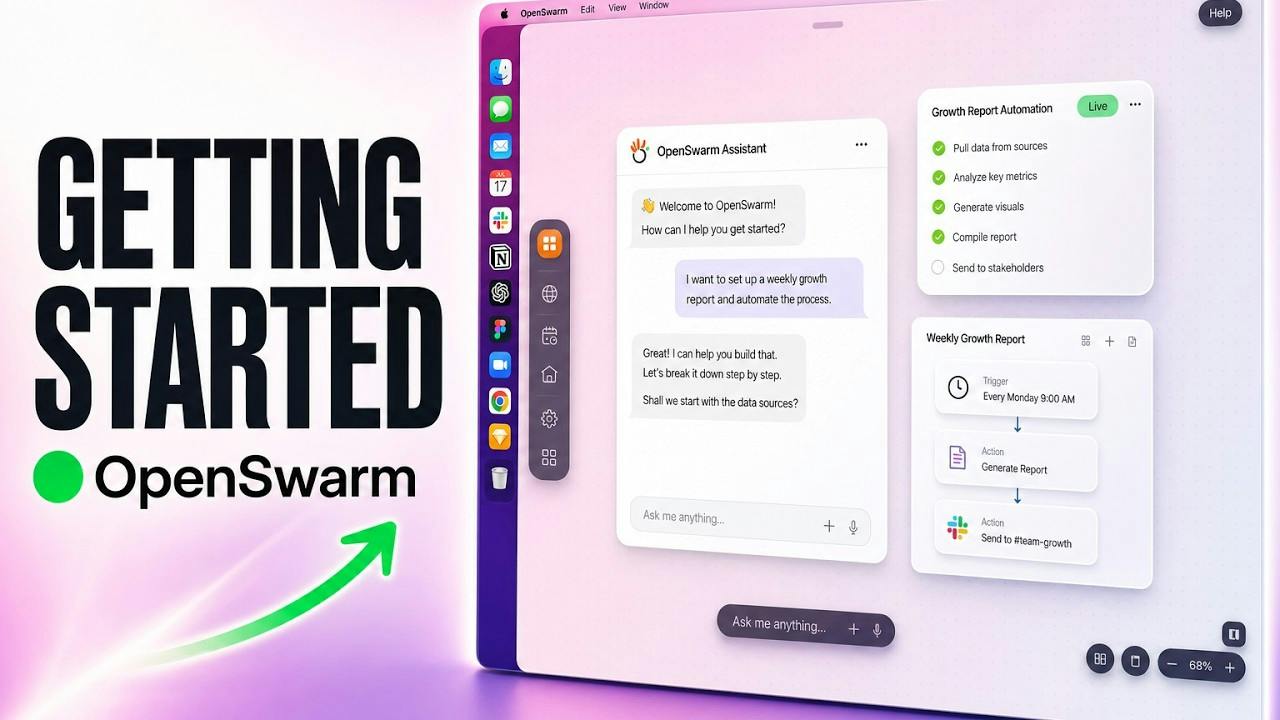
OpenSwarm presents itself as a desktop environment where users can orchestrate multiple AI agents across browser and connected applications. Its pitch is to split a large digital task into parallel workstreams, show each agent’s activity on a shared canvas, and let the user intervene or stop execution. Product Hunt’s maker says the current app runs on macOS and Windows, supports users’ own model subscriptions or API keys, and is in a free private beta. These are maker statements, not independently tested capabilities. Product Hunt
The concept targets knowledge workers, developers, researchers, and small teams who perform repeatable, multi-step work across web and desktop tools. A useful product could save time by coordinating agents while retaining human approval for external or sensitive actions. The most promising signal is a focused product narrative paired with apparent early launch interest: Product Hunt showed 387 points and a #1 daily rank in the retrieved launch listing. The company website also displays 10,899 waitlist signups, a company-reported count with no disclosed conversion or deduplication methodology. Neither signal proves active use or willingness to pay. Product Hunt Official site
The investment case remains highly preliminary. The public site is a waitlist and product showcase; no public pricing, paid customer count, retention, revenue, or unit economics were found. The legal entity’s terms describe the website and waitlist and say software is governed by a separate license, while details of commercial product agreements are not published. Terms
Final Decision: Watch. Continue monitoring for an accessible product, repeat usage, and evidence that parallel agents finish valuable workflows reliably. Do not infer product-market fit from launch attention or waitlist volume.
Product Overview
OpenSwarm’s website describes a desktop for running many agents at once, each with its own browser, apps, and tools. The product narrative includes research across multiple sources, lead research and outreach preparation, building simple custom apps, and operations spanning services such as Gmail, Calendar, and Slack. It proposes a live canvas for monitoring agent work and handing off or stopping tasks. Official site
The Product Hunt page categorizes the product around task management, developer tools, and AI. In maker replies, OpenSwarm says the app runs on top of macOS or Windows rather than replacing the operating system, and that Linux is not yet supported. The maker also says users can connect Claude, ChatGPT, or Gemini subscriptions, or enter API keys from providers including Anthropic, OpenAI, Google, and OpenRouter. Those claims need product access and security review. Product Hunt
The target customer is a technically comfortable professional or small team whose work can be divided into independent browser, research, coding, or operations tasks. Product Hunt comments describe per-action permissions and approvals for sensitive or outward-facing actions, but these controls have not been independently evaluated. No official price or paid plan is published; the beta is described as free.
Founder and Team Assessment
Public launch materials associate Haylli Weintraub, Eric F. Zeng, and Aymi Malik with the launch; Alex Dakhli appears in the Product Hunt discussion and says on his own site that he is CMO at OpenSwarm and that the company is an Entrepreneur First startup in San Francisco. His site describes experience in product growth and content distribution, but those are self-reported claims. Product Hunt Alex Dakhli
No official team page, verified engineering biographies, headcount, founder equity, or full-time commitment was found. The public evidence is insufficient to assess technical leadership or whether the group can support a secure desktop agent product at scale.
Founder Assessment: A publicly identified growth lead and launch team are visible, but engineering depth, founder roles, and commitment remain unverified.
Market Opportunity
The initial segment is small software, research, marketing, and operations teams that repeatedly execute multi-step work across desktop applications and websites. Their problem is coordination overhead: one agent or person handles a task serially, while work that can be split into independent pieces requires repeated context switching and synthesis. Willingness to pay depends on provable time saved and reliable completion, neither of which has been quantified.
No reliable public count exists for this specific buyer group. As an explicit analyst scenario, 100,000–500,000 paid seats worldwide at $20–$50 per month would represent $24 million–$300 million in annual recurring revenue (customer count × monthly price × 12). This is not a measured market estimate and assumes both a paid offering and durable seat-level value. The realistic expansion route is team administration, audited workflow controls, and enterprise integrations; without those, the addressable individual-user business may be materially smaller than the broad “AI agents” category implies.
Traction and Growth Signals
Product Hunt reported 387 points, a #1 daily rank, and 826 followers in the retrieved product listing. These indicate launch attention, not sustained engagement or commercial traction. The official website displays 10,899 waitlist signups, but the count is company-reported and does not reveal unique people, activation, invitation acceptance, or usage. A Product Hunt commenter reports a PPC result under $0.20 and 17% conversion while using OpenSwarm for ads; it is an individual, unverified anecdote and cannot establish typical results. Product Hunt Official site
No public revenue, paying customers, active-user counts, retention, workload completion rates, error rates, customer references, or post-launch cohorts were found. The most important missing proof is whether users return to run consequential tasks and whether the product saves measurable time after correcting for agent supervision.
Traction Assessment: Strong launch visibility but no verified commercial or retention evidence.
Competitive Position
Direct and adjacent alternatives include Anthropic Claude Cowork, which runs multi-step work across local files and tools as part of paid Claude plans; ChatGPT agent, available on web, mobile, and desktop; and Browser Use, which provides both open-source browser agents and a hosted, usage-based service. Relay App and automation platforms such as Zapier also compete for cross-application workflows. Claude Cowork ChatGPT agent Browser Use Relay App
OpenSwarm’s potential differentiation is its visual coordination of multiple agents, broad desktop access, and model-provider choice. But foundation-model vendors can add parallel execution and desktop controls, while open-source frameworks can reproduce orchestration for technical users. No proprietary model, exclusive distribution, unique data network, or proven switching cost was identified. If a leading platform launches a comparable swarm interface within six months, OpenSwarm would need to win through cross-provider control, safer execution, higher task-completion reliability, and team governance.
Defensibility Assessment: Low. The interface and orchestration may be useful, but durable technical or distribution advantages are not yet demonstrated.
Business Model and Economics
No public subscription pricing, paid plans, or company-run inference economics were found. In the beta, makers say users can connect their own model subscriptions or API keys, which may shift model costs to customers but could also create authentication, provider-policy, and support dependencies. A future hosted team product could charge per seat or usage, but that model is an analyst hypothesis, not a disclosed plan.
Economics will depend on task length, number of agents launched, model mix, retries, browser infrastructure, and human review. Parallelism can increase throughput while also multiplying token consumption and failure costs. The company must show that completed work is valuable enough to support a price that covers product support, security, and integrations. No CAC, gross margin, support burden, or payback evidence is public.
Unicorn Path
Using an illustrative 10× ARR multiple for a high-growth software company, a $1 billion valuation implies approximately $100 million ARR. This is a scenario multiple, not a current market quote or valuation claim. At $20–$50 per seat per month, that requires roughly 417,000–167,000 paid seats, respectively. At an illustrative $12,000 annual team contract, it would require about 8,300 teams.
A route at that scale would likely require OpenSwarm to evolve from an early desktop beta into a reliable team platform with administration, permissions, auditability, enterprise procurement, and repeatable distribution. No such commercial proof is yet public, and product-level operating costs are unknown.
Unicorn Path: Conditional
Valuation Assessment
Valuation Attractiveness: Not Assessable. No verified funding round, investor announcement, financing terms, revenue, or company valuation was found. Open Swarm Inc. identifies itself as a Delaware corporation in its terms, but a legal entity alone does not establish capitalization or investment availability. Terms
A responsible assessment requires current ARR and growth, paid cohort retention, gross margin, customer acquisition costs, burn and runway, round size, SAFE cap or post-money valuation, cap table, and investor rights.
Key Risks
- Product availability: Public access appears to be waitlist/private beta, limiting independent evaluation and slowing feedback.
- Task reliability: Multi-agent workflows can compound model errors, duplicated work, and coordination failures.
- Launch-to-usage gap: Points and waitlist count do not show activation, retention, or payment.
- Platform dependency: Model access, subscription authentication, and provider terms can change.
- Security and privacy: Desktop access across connected apps increases exposure to prompt injection, accidental actions, and data leakage. The privacy policy says task content may be sent to model providers and optional usage sharing may send conversation data to OpenSwarm. Privacy policy
- Cost uncertainty: Parallel agents may multiply model and browser costs; no margin data exists.
- Weak defensibility: Large model platforms and open-source tools can reproduce orchestration features.
- Team uncertainty: Engineering ownership, headcount, and founder commitment are not sufficiently verified.
- Unclear monetization: The beta is free, and no public price or conversion plan was found.
Final Assessment
Venture Potential: 56/100
| Category | Score |
|---|---|
| Market Size and Expansion Potential | 15/20 |
| Traction and Growth Evidence | 5/20 |
| Founder and Team | 8/15 |
| Product Strength | 8/10 |
| Distribution Potential | 10/15 |
| Business Model and Economics | 4/10 |
| Defensibility | 6/10 |
| Total | 56/100 |
The product addresses a real coordination burden and has a clear interface-level thesis. The low scores reflect unverified task performance, no paid usage evidence, no pricing, and easy replication by platforms with existing models and distribution.
Evidence Confidence: 36/100
The official site and terms verify the waitlist, legal operator name, product positioning, and stated data practices. Product Hunt verifies the launch page, maker replies, and launch signals. Team background details rely partly on a CMO’s self-published profile. Waitlist volume and user anecdotes are company or user statements, not audited metrics. Revenue, customer retention, margins, financing, and valuation remain unavailable.
Final Decision: Watch
OpenSwarm merits follow-up as an early product concept, but it is not ready for formal investment diligence on public evidence alone. The market could support a substantial software company if the product reliably completes multi-step work and sells into teams; current attention is not proof of that outcome.
Upgrade Conditions: Release a reviewable product broadly; demonstrate at least three months of returning paid users; publish task completion and intervention rates across representative workflows; show positive contribution margin after model and browser costs; and secure repeatable team adoption beyond launch traffic.
Downgrade Conditions: Persistent failure on real workflows, weak repeat usage after waitlist activation, material data leakage or unsafe actions, inability to support provider changes, or no credible paid product after the beta.
Questions for Further Diligence
- How many waitlist signups are unique, invited, activated, and weekly active, and what percentage returns after 30, 90, and 180 days?
- How many users or teams pay today, and what are monthly recurring revenue, growth, churn, and expansion?
- What is the measured task-completion rate by workflow, and how often does a user need to intervene or redo work?
- How are conflicting edits, browser state, and delegated-agent failures handled and logged?
- What provider credentials are stored, where are they stored, and how are prompt injection and secret exfiltration tested?
- What proportion of tasks use customer-provided subscriptions versus metered API keys, and how do provider terms govern each path?
- What pricing and packaging are planned, and what is gross margin after model, browser, and support costs?
- Which acquisition channels convert waitlist users into active customers, and what are CAC and payback?
- Who owns engineering, security, and product operations, and which team members are full-time?
- Has Open Swarm Inc. raised capital? If so, what are the round date, amount, instrument, cap, investors, and current runway?
- What team features are planned for permissions, audit logs, SSO, data retention, and admin controls?
- What evidence supports the claimed PPC and conversion result, and was it measured against a comparable baseline?