
Table of Contents
- Media Sharing by Argos Investment Report
Media Sharing by Argos Investment Report
Category: Developer tools / visual testing / AI-agent collaboration infrastructure
Company Stage: Early commercial; financing stage not publicly disclosed
Founder or Founders: Greg Bergé, co-founder and CEO; any additional co-founder is not clearly identified in current official materials
Headquarters: Paris, France
Funding: Not publicly disclosed; no reliable public funding announcement was found
Business Model: Usage-based B2B SaaS with free, Pro, add-on, and Enterprise tiers
Product Hunt Launch Date: August 12, 2026 (Product Hunt)
Report Date: August 15, 2026
| Investment Metric | Assessment |
|---|---|
| Venture Potential | 74/100 |
| Unicorn Path | Conditional |
| Valuation Attractiveness | Not Assessable |
| Evidence Confidence | 66/100 |
| Final Decision | DD |
Executive Summary
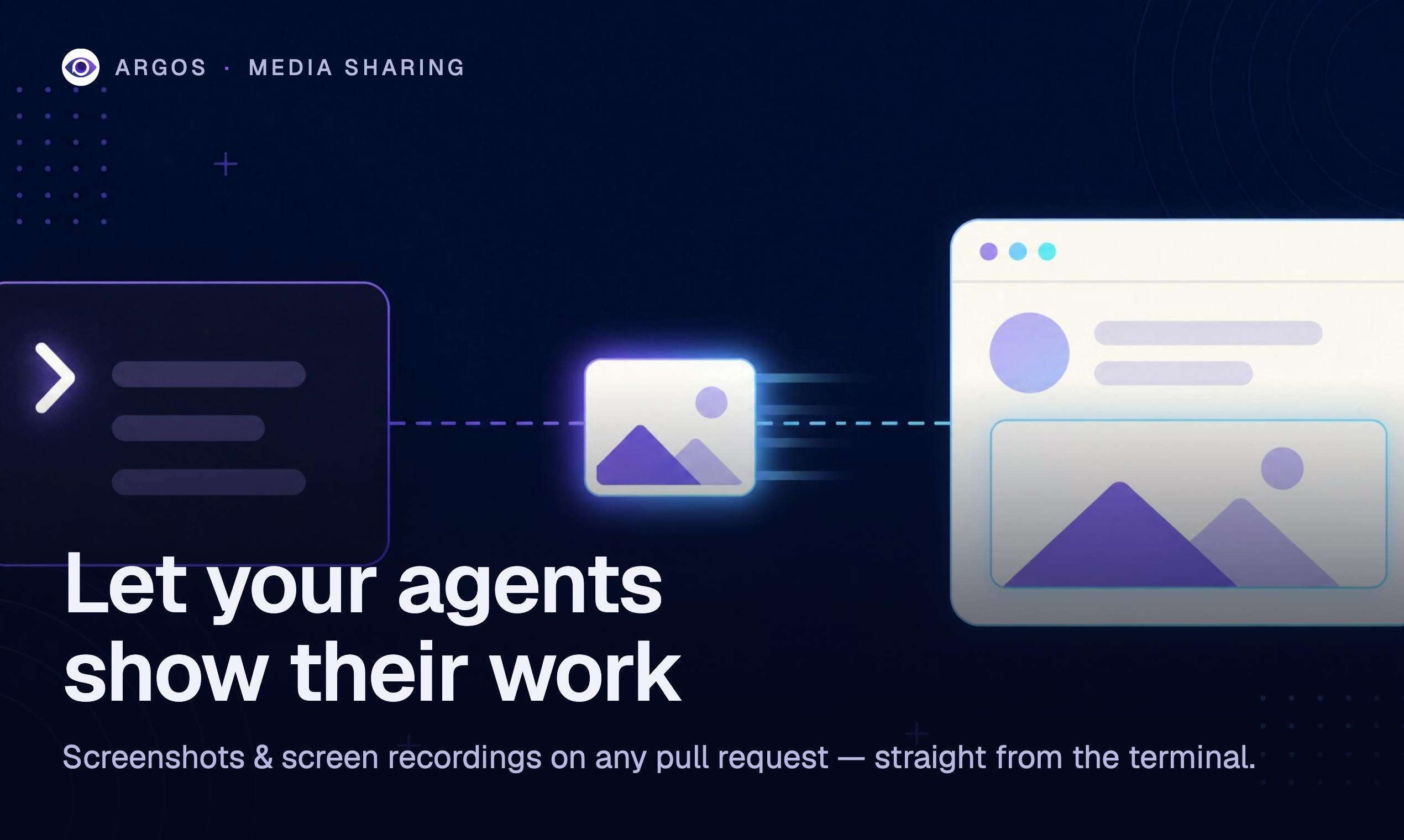
Media Sharing is a new Argos feature that lets developers and AI coding agents upload images or videos from a CLI, SDK, REST API, or MCP server and insert them into pull requests through stable links and generated Markdown. It addresses a specific workflow gap: GitHub does not provide a public API for attaching files to comments, making it difficult for autonomous agents and CI jobs to show visual evidence of their work (Argos launch announcement; documentation).
The feature is strategically more interesting as an extension of Argos than as an independent product. Argos already provides visual regression testing, snapshot review, deployments, GitHub/GitLab integrations, collaborative review, and agent-facing interfaces. Media Sharing could make Argos a broader review and product-quality layer for AI-generated software rather than merely a screenshot-testing utility.
The strongest investment signal is evidence of real deployment in demanding engineering environments. Argos publishes customer references involving GitBook, Le Monde, Pivot, Finviz and MUI; MUI reportedly processes more than 2.5 million screenshots monthly across five projects, although paid status and commercial terms are not disclosed (customer references; MUI case study). Argos also has an active open-source repository and SOC 2 Type II compliance, both useful for developer adoption and enterprise procurement (GitHub; SOC 2 announcement).
The principal concern is the absence of public commercial metrics. Revenue, growth, customer count, paid retention, gross margin, concentration, and acquisition costs are not disclosed. Founder commitment also requires verification: Greg Bergé’s public LinkedIn profile lists both Argos and a current product-engineering role at GitBook (LinkedIn).
Final decision: DD. The product and reference customers warrant formal diligence, but investment cannot be recommended without verifying founder commitment, recurring revenue, retention, economics, ownership, and financing terms.
Product Overview
Media Sharing enables a developer or agent to upload a standalone image or video without creating an Argos visual-test build. Argos returns a stable share URL and Markdown suitable for a pull request, issue, or chat message. Files can be staged against a branch and automatically published when a pull request opens (product page).
Core capabilities include:
- Stable links with version history when a file is re-uploaded.
- Before-and-after image pairs with synchronized comparison.
- Comments pinned to image coordinates, accessible to agents through the CLI.
- Support for PNG, JPEG, WebP, MP4, WebM, and MOV files.
- CLI, Node.js SDK, REST API, and MCP access.
- Team-restricted links and longer retention on paid plans (documentation).
The product replaces several imperfect workflows: committing screenshots to repositories, manually uploading through GitHub’s browser interface, maintaining release assets, or distributing files through generic storage products disconnected from the pull request.
Product quality appears strong for an initial release because the feature fits Argos’s existing review architecture rather than operating as an isolated file host. However, independent evidence about reliability, upload latency, agent adoption, or customer satisfaction with Media Sharing specifically is not yet available.
Product Quality Assessment: Strong workflow design and integration, but the new feature lacks independent post-launch usage evidence.
Founder and Team Assessment
Argos’s official structured website data identifies Greg Bergé as founder and CEO and dates the original product to December 2016 (official About page). Bergé’s public profile shows extensive frontend and engineering experience, including roles at Le Monde, Doctolib, Scaleway, Pivot, and GitBook. His profile states that he originally conceived Argos while working at Doctolib, giving him credible founder-market fit in frontend quality and visual testing (LinkedIn).
Technical capability is well evidenced by the open-source codebase, long product history, integrations, and frequent releases. Commercial capability is less visible. Argos has named customer references and enterprise features, but no public evidence establishes sales efficiency, deal size, renewals, or expansion revenue.
Team information conflicts. Argos’s official schema places the organization in a zero-to-ten employee range, while LinkedIn reports three associated profiles but a company-selected size band of 11–50 (About page; LinkedIn company page). These sources are not sufficient to determine actual full-time headcount.
The largest diligence issue is commitment. Bergé’s LinkedIn profile lists an ongoing Product Engineer position at GitBook alongside Argos. This may represent a part-time arrangement, a customer relationship, or outdated profile data; it must be clarified before investment.
Founder Assessment: Excellent technical founder-market fit, but full-time commitment, team composition, and commercial leadership require verification.
Market Opportunity
The narrow initial market is software teams that operate web applications or component libraries, use continuous integration and pull-request workflows, and have enough frontend complexity to justify automated visual review.
No reliable public source provides a precise count of such teams. A reasonable analyst scenario, not a verified market figure, is:
- 50,000–200,000 potentially suitable engineering organizations globally.
- $1,200–$12,000 annual spending per organization, spanning the current entry-level Pro plan through higher-volume and enterprise contracts.
- Implied initial annual revenue opportunity: approximately $60 million–$2.4 billion.
The range is wide because most small teams will remain on free or low-volume plans, while large component libraries and enterprises may generate materially greater screenshot volumes.
Expansion opportunities are more important than visual testing alone. Argos is adding text snapshots, pull-request deployments, collaborative reviews, MCP access, and media generated by coding agents. If unified effectively, these could position Argos as a quality-control and review layer for human- and agent-generated software.
Market timing is favorable because AI coding tools increase code and pull-request volume, potentially increasing demand for automated verification. However, faster code generation does not automatically create willingness to buy a separate review platform.
Traction and Growth Signals
Verified or directly observable signals include:
- The principal open-source repository had 611 stars and 60 forks and was actively updated on August 14, 2026 (GitHub API).
- The repository dates to 2016, indicating substantially more operating history than the new Product Hunt feature launch (GitHub).
- The official customer page displays references including GitBook, Le Monde, MUI, Pivot, Finviz, ClickHouse, Qonto and others, although the page does not distinguish free users from paying customers (customers).
- MUI is company-reported to process more than 2.5 million screenshots monthly across five projects (MUI case study).
- Pivot and Le Monde provide named technical references describing Argos as part of their CI workflows (Pivot; Le Monde).
- Argos completed a SOC 2 Type II audit, reducing one enterprise procurement barrier (SOC 2).
- Media Sharing launched in the Argos changelog on August 11 and on Product Hunt on August 12, 2026 (changelog; Product Hunt).
These signals establish product activity and credible usage, but not product-market fit. No reliable public information was found for ARR, paying customers, revenue growth, logo retention, net revenue retention, or Media Sharing adoption.
Traction Assessment: Credible product usage and reference customers, but commercially unverified.
Competitive Position
Direct competitors include Chromatic, Percy by BrowserStack, Applitools, and other visual-regression platforms. Free alternatives include Playwright’s native screenshot assertions, open-source screenshot-diff tools, and manually maintained image baselines. Media Sharing also overlaps with GitHub’s browser uploads, generic cloud storage, Loom, and repository-hosted media.
Argos differentiates through:
- Open-source software and transparent implementation.
- Usage-based pricing.
- Deep visual-testing and pull-request integration.
- A unified workflow for screenshots, text snapshots, deployments, reviews, and standalone media.
- Machine-readable CLI, REST, and MCP interfaces for coding agents.
- SOC 2 Type II readiness for enterprise procurement.
Switching costs are moderate. Baselines, review history, CI configuration, permissions, and team practices create workflow friction, but customers can still move to other screenshot-testing tools. The MIT-licensed repository supports trust and distribution but also lowers code-level defensibility.
If GitHub, GitLab, BrowserStack, or a leading coding-agent platform launched equivalent agent-accessible media attachments, customers would continue using Argos only if its visual baselines, testing history, cross-platform review layer, reliability, and cost were materially better. Media Sharing by itself is readily replicable; the integrated quality platform is the more defensible asset.
Defensibility Assessment: Medium-Low
Business Model and Economics
Argos uses a freemium, usage-based SaaS model. The Hobby plan is free for up to 5,000 screenshots. Pro starts at $100 per month, including 35,000 screenshots; additional screenshots cost $0.004, or $0.0015 for Storybook. GitHub SSO costs $50 monthly and SAML SSO $200 monthly as optional add-ons. Enterprise pricing is custom (pricing).
For Media Sharing, one image consumes one screenshot unit and one video consumes 25 units. Free links are retained for 30 days and Pro links for one year (launch announcement).
The model should have SaaS-like gross-margin potential, but object storage, image delivery, video bandwidth, database operations, customer support, and high-volume processing are variable costs. The company has not disclosed gross margin or infrastructure cost per screenshot. Media Sharing could improve monetization by increasing usage of the existing meter, but large video files could produce less favorable economics than image comparisons.
Enterprise expansion is supported by SAML, access controls, dedicated support, and a stated 99.99% enterprise SLA. Argos’s DPA states that customer data is primarily stored on AWS infrastructure in the United States and replicated to the EU (pricing; DPA).
Unicorn Path
For an infrastructure SaaS company with recurring revenue, a mature 8×–10× ARR multiple is a reasonable analytical assumption, subject to strong growth, retention and gross margin.
- At 10× ARR, a $1 billion valuation requires approximately $100 million ARR.
- At 8× ARR, it requires approximately $125 million ARR.
Illustrative customer requirements include:
- Approximately 83,000 customers at $1,200 annual revenue;
- 10,000 customers at $10,000 annual contract value; or
- 2,500 enterprise customers at $40,000 annual contract value.
The low-end Pro plan alone is unlikely to produce a credible unicorn outcome. Argos would need to move upmarket, generate substantial usage expansion, and become a broader verification and review layer across AI-generated code, visual changes, deployment previews, and machine-readable software artifacts.
It would also need repeatable international distribution, a larger full-time team, strong net retention, high gross margin, and defensibility beyond screenshot storage.
Unicorn Path: Conditional
Valuation Assessment
No reliable public information was found on institutional funding, investors, SAFE terms, current fundraising, or valuation. Revenue is also undisclosed. Percy’s acquisition by BrowserStack demonstrates strategic interest in the category, but publicly available transaction information does not provide a usable valuation benchmark.
Valuation Attractiveness: Not Assessable
Responsible valuation work requires current ARR, growth, gross margin, retention, customer concentration, burn, runway, cap table, round size, post-money valuation, investor ownership, and liquidation preferences.
Key Risks
- Commercial opacity: No verified revenue, growth, retention, or paid-customer data.
- Founder commitment: The founder publicly lists another active employment role.
- Feature commoditization: Media upload and agent-facing attachment APIs can be replicated.
- Platform bundling: GitHub, GitLab, BrowserStack, or agent vendors could bundle comparable functionality.
- Moderate switching costs: Customers can migrate tests and baselines to competing platforms.
- Market breadth: Visual regression testing may remain a specialized developer-tool category.
- Infrastructure economics: Screenshot and video storage, processing and bandwidth may pressure margins.
- Small-team execution risk: Enterprise sales, support, security and product development may exceed available capacity.
- Data-security exposure: Screenshots and recordings may contain confidential application or personal data.
- Customer-evidence ambiguity: Public logos and case studies do not establish payment status or contract value.
Final Assessment
Venture Potential: 74/100
| Category | Score |
|---|---|
| Market Size and Expansion Potential | 16/20 |
| Traction and Growth Evidence | 13/20 |
| Founder and Team | 11/15 |
| Product Strength | 9/10 |
| Distribution Potential | 11/15 |
| Business Model and Economics | 8/10 |
| Defensibility | 6/10 |
| Total | 74/100 |
The strongest elements are technical quality, credible customer references, enterprise readiness, and alignment with AI-assisted development. The weakest are commercial transparency, team uncertainty, founder commitment, and limited structural defensibility.
Evidence Confidence: 66/100
Verified information includes the legal entity, product functionality, pricing, repository activity, published security posture, and named customer references. Usage figures in case studies are company-reported rather than independently audited. Funding, revenue, retention, margins, headcount, cap table, and valuation remain unavailable. Conflicting public team-size indicators reduce confidence.
Final Decision: DD
Argos is strong enough to justify a founder meeting and formal diligence. It has more substantive evidence than a typical Product Hunt launch: an established codebase, active releases, named technical users, paid plans and enterprise compliance. Nevertheless, an investment decision would be premature without verified financial and operational information.
Upgrade Conditions
- Verified ARR above $1 million with strong year-over-year growth.
- Gross revenue retention above 85% and net revenue retention above 100%.
- Gross margin above 75% after storage, bandwidth and processing costs.
- Confirmation that the CEO is working full-time on Argos.
- Multiple referenceable paying enterprise customers.
- Evidence that Media Sharing increases conversion, retention, or expansion revenue.
- Repeatable acquisition outside founder relationships and Product Hunt.
- Current financing terms that are reasonable relative to verified traction.
Downgrade Conditions
- Founder remains materially committed to another employer.
- Case-study customers are predominantly free or heavily subsidized.
- Weak paid conversion from the Hobby plan.
- High churn after initial CI integration.
- Storage and bandwidth costs materially reduce gross margin.
- A major platform bundles equivalent visual review and media workflows.
- Declining repository or release activity.
- A material security incident involving customer screenshots or videos.
Questions for Further Diligence
- What are current ARR, monthly recurring revenue and twelve-month revenue growth?
- How many organizations pay for Pro or Enterprise, and what is median contract value?
- What are 90-day, six-month and twelve-month customer retention rates?
- What are gross and net revenue retention, excluding free accounts?
- What percentage of named customer references are paying customers?
- What are gross margin and infrastructure cost per 1,000 screenshots and per video upload?
- How has Media Sharing affected activation, paid conversion, usage and expansion revenue?
- Is Greg Bergé full-time at Argos, and what is his current relationship with GitBook?
- What is the actual full-time team structure across engineering, sales and customer support?
- What are burn rate, cash balance and runway?
- What is the fully diluted cap table, and has Smooth Code SAS raised any external or founder financing?
- What round is currently being raised, at what valuation, and under what liquidation and governance terms?
Sources
- Argos on Product Hunt
- Media Sharing product page
- Media Sharing launch announcement
- Media Sharing documentation
- Argos pricing
- Argos About page
- Argos GitHub repository
- Argos customer references
- MUI case study
- Le Monde case study
- Argos SOC 2 announcement
- Greg Bergé’s LinkedIn profile
- Argos Terms and legal entity
- Argos Data Processing Agreement