
Table of Contents
FluidDocs CLI Investment Report
Category: AI-native documents / developer tools / sales-enablement SaaS
Company Stage: Pre-seed / early commercialization
Founder or Founders: Nishant Aggarwal and Ricardo Pacheco
Headquarters: San Francisco, California, United States; engineering leadership also based in Berlin
Funding: Not publicly disclosed
Business Model: Freemium SaaS with individual, team, usage-credit, and enterprise plans
Product Hunt Launch Date: August 13, 2026
Report Date: August 16, 2026
| Investment Metric | Assessment |
|---|---|
| Venture Potential | 54/100 |
| Unicorn Path | Conditional |
| Valuation Attractiveness | Not Assessable |
| Evidence Confidence | 48/100 |
| Final Decision | Watch |
Executive Summary
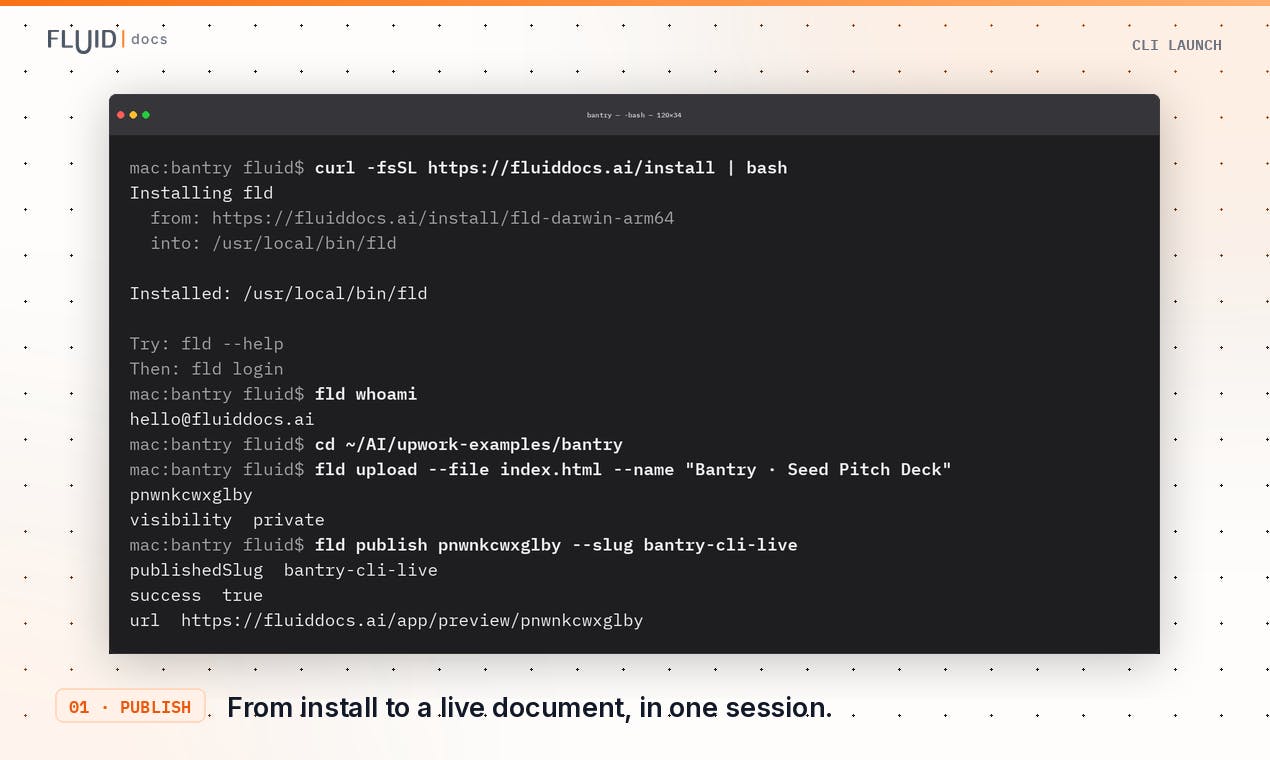
FluidDocs CLI is a command-line publishing tool for turning HTML, files, or directories generated by coding agents into live, interactive documents. Readers can ask questions grounded in the document, request summaries, and take actions such as booking a call; publishers receive viewer identity, attention, drop-off, and question analytics (official CLI page).
The initial customer appears to be an AI-native founder, developer, consultant, or sales team that creates pitch decks, proposals, reports, board updates, or other customer-facing documents through Claude Code, Codex, Cursor, or an internal agent workflow. The CLI differentiates FluidDocs from browser-first presentation tools by exposing structured commands and JSON responses suitable for autonomous agents and CI pipelines.
The strongest investment signal is the product architecture rather than traction. FluidDocs combines an open, portable HTML format with optional hosted intelligence and analytics. The founders also appear complementary: Nishant Aggarwal has product, consulting, and startup experience, while Ricardo Pacheco has more than 15 years of software experience, including Amazon, Thoughtworks, Globant, and Adidas (Aggarwal’s LinkedIn; Pacheco’s LinkedIn).
The principal concern is limited evidence of demand. FluidDocs reports that more than 1,000 documents have been created and that roughly half were generated programmatically, but this is a company-reported document count—not verified users, customers, retention, or revenue (Product Hunt). The associated open-source deck-builder repository had only 29 stars and two forks when checked (GitHub API). Product Hunt attention is similarly insufficient to establish product-market fit.
The decision is Watch. FluidDocs is an interesting product with capable founders, but it is too early for formal investment diligence. An upgrade requires evidence that interactive document engagement produces measurable business outcomes and that users convert into retained team or enterprise subscriptions.
Product Overview
Static PDFs and presentation files have several shortcomings: recipients cannot interrogate them, publishers receive limited feedback, and updated versions must be redistributed. FluidDocs replaces the attachment with an always-current web link containing grounded Q&A, summaries, actions, and reader analytics (official website).
The CLI allows a user or coding agent to create, update, publish, and analyze documents from the terminal. It supports file, ZIP, and directory publishing; structured JSON output; background jobs; aliases for old commands; document-level chat; and analytics retrieval. It runs as a single binary on macOS and Linux and is designed to work with Claude Code, Codex, Cursor, Windsurf, MCP clients, and CI workflows (CLI documentation).
FluidDocs also maintains an MIT-licensed deck-builder for coding agents. It produces self-contained HTML decks from prompts or existing PDF/PPTX files, supports pitch, sales, launch, keynote, and all-hands structures, and includes inline editing and automated brand, copy, and layout reviews (GitHub repository).
Public pricing is:
- Free: Unlimited documents, 10,000 AI credits monthly, anonymous analytics, and limited storage.
- Pro: $15 per month on the displayed monthly plan, adding 50,000 AI credits, viewer identity, open alerts, more storage, and branding removal.
- Team: $39 per user per month, with at least three users, shared workspaces, comments, pooled credits, and team analytics.
- Business: Custom pricing for white-labeling, embeds, SSO/SAML, SCIM, audit logs, API access, support, and an SLA.
- Additional 25,000 AI credits cost $5 (official pricing).
The main benefit is not document generation itself, which is increasingly commoditized. It is creating a measurable, interactive interface around AI-generated business content.
Product-quality assessment: Technically coherent and well aligned with agent workflows, but engagement lift, answer accuracy, and production reliability are not independently validated.
Founder and Team Assessment
Nishant Aggarwal is listed as co-founder of FluidDocs. His profile reports prior experience as Head of Product at Perl Street, co-founder of YC W22 company Emigre, founder of BlueWander, a Deloitte senior consultant, and an advisor or investor to multiple startups. He has a Dartmouth engineering-management degree and appears well suited to product positioning and early customer discovery (LinkedIn).
Ricardo Pacheco is FluidDocs’ technical co-founder. His profile reports senior engineering and leadership roles at Amazon, Thoughtworks, Adidas, Globant, and Perl Street, with more than 15 years of software experience (LinkedIn). GitHub lists Aggarwal and Pacheco as the two human contributors to the open-source deck builder, with Aggarwal responsible for most commits (contributors).
LinkedIn lists two people associated with the company, consistent with a two-founder team (company profile). Both founders’ profiles also list continuing positions at Perl Street. These records may be stale, but full-time FluidDocs commitment is not verified and should be a central diligence issue.
No prior founder exit attributable to either founder was independently verified. No public hiring page or active job openings were found.
Founder Assessment: Complementary product and engineering capability, but full-time commitment, company-building history, and sales execution remain unproven.
Market Opportunity
The narrow initial segment is AI-native sales, fundraising, consulting, and operations teams that produce high-value external documents and need better reader-intent signals. Likely buyers include startups, agencies, consultancies, investment firms, sales organizations, and developer-led teams automating document creation.
An illustrative bottom-up scenario is:
- 100,000 three-seat teams;
- Minimum Team-plan annual contract value of approximately $1,404 at monthly list pricing;
- Approximately $140 million in annual subscription value.
This is an analyst scenario, not a verified estimate of addressable customers. The current customer count and willingness to pay are unknown. At the individual Pro price, FluidDocs would need a much larger user base to reach venture-scale revenue.
Expansion opportunities include enterprise proposal automation, buyer enablement, investor relations, board reporting, data rooms, technical documentation, employee communications, and embedded interactive documents generated through an API. International expansion should be relatively straightforward for web-based documents, subject to privacy, security, localization, and data-residency requirements.
The market can support a meaningful company, as demonstrated by Dropbox’s $165 million acquisition of document-sharing and analytics platform DocSend (Dropbox announcement). A unicorn outcome would require FluidDocs to become a broader document workflow and buyer-intelligence platform rather than remain a developer CLI.
Traction and Growth Signals
Available evidence includes:
- FluidDocs’ company-reported claim of more than 1,000 documents created, with roughly half produced programmatically through agents or MCP (Product Hunt launch post).
- Multiple Product Hunt releases: the open-source Deck Builder in June 2026, the broader FluidDocs platform in July, and FluidDocs CLI on August 13, 2026.
- Approximately 244 Product Hunt followers but no Product Hunt reviews at the time of research.
- An open-source repository created in June 2026 with 29 stars, two forks, two human contributors, and no open issues (GitHub API).
- A functioning commercial website, free tier, public examples, CLI installer, privacy policy, and pricing.
These are product-activity signals, not commercial validation. “Documents created” may include founder testing, demonstrations, free-tier documents, or multiple documents from one user. No reliable information was found for registered users, monthly active users, paying customers, ARR/MRR, growth, retention, enterprise contracts, website traffic, or customer case studies.
Traction Assessment: Early product usage is plausible, but commercially unverified.
Competitive Position
Direct competitors include DocSend, Qwilr, PandaDoc, Proposify, and other interactive proposal or document-analytics products. Presentation-generation competitors include Gamma, Canva, Beautiful.ai, Pitch, and Microsoft PowerPoint. Free alternatives include static HTML hosting, PDF analytics, Google Slides, open-source slide frameworks, and documents generated directly by coding agents.
FluidDocs’ differentiation is its agent-native CLI, JSON command interface, standard HTML output, grounded reader Q&A, and feedback loop from reader analytics back into an agent workflow. The free, portable deck builder is a reasonable top-of-funnel mechanism for the hosted service.
Defensibility is weak today. The deck builder is MIT-licensed, the commercial CLI’s core functions can be replicated, and incumbents already own large document-creation or distribution channels. Proprietary engagement data could become defensible if FluidDocs reaches scale, but no such data advantage is presently demonstrated.
If Canva, Gamma, DocSend, or Microsoft shipped agent-controlled publishing plus document Q&A within six months, customers would remain only if FluidDocs had materially better developer ergonomics, cross-platform neutrality, answer quality, and workflow automation. There is insufficient evidence that these advantages are durable.
Defensibility Assessment: Low
Business Model and Economics
FluidDocs uses freemium product-led acquisition with paid upgrades for identity, alerts, storage, collaboration, governance, and enterprise support. The CLI and open-source deck builder can drive users into hosted publishing, creating a logical open-source-to-SaaS funnel.
Minimum annualized list revenue is approximately $180 for Pro and $1,404 for a three-seat Team account before annual discounts. Business plans could produce materially higher ACVs if SSO, compliance, embedding, and APIs become procurement requirements.
Variable costs include LLM inference for document Q&A and summaries, file storage, bandwidth, analytics processing, email alerts, and support. The credit system can limit AI cost exposure, but actual gross margin, credit consumption, and overage behavior are undisclosed.
Security is material because customers may upload confidential fundraising, board, sales, and operational documents. FluidDocs’ privacy policy identifies FluidForm, Inc. as the legal entity and describes general safeguards, but no public SOC 2 certification, penetration-test results, data-residency controls, or detailed AI-provider policy were found (privacy policy; terms).
Unicorn Path
A 10× ARR multiple is assumed for a high-growth B2B SaaS company with strong retention and gross margins. This is an analytical assumption, not FluidDocs’ current valuation multiple.
Required ARR = $1 billion ÷ 10 = $100 million.
At current pricing, this would require approximately:
- 556,000 Pro subscribers at $180 annualized list price;
- 71,000 minimum-size Team accounts at $1,404 annually; or
- 10,000 enterprise customers at a hypothetical $10,000 ACV.
The enterprise figure is an analyst scenario; FluidDocs does not disclose enterprise pricing or customers. The individual and small-team routes appear unrealistic without mass-market distribution. The more credible route requires larger enterprise ACVs, API or usage revenue, deep CRM and workflow integrations, security certifications, and measurable improvements in sales conversion or decision velocity.
Unicorn Path: Conditional
Valuation Assessment
No reliable public funding announcement, investor list, financing round, SAFE cap, valuation, secondary transaction, or acquisition offer was found.
Valuation Attractiveness: Not Assessable
Assessment requires current ARR, revenue growth, paying-customer cohorts, gross margin, burn, runway, cap table, founder ownership, round size, proposed valuation, option-pool treatment, and liquidation preferences. Product quality and Product Hunt performance do not justify a valuation range.
Key Risks
- No verified commercial traction: Revenue, customers, retention, and conversion are undisclosed.
- Feature commoditization: Large document and presentation platforms can replicate Q&A and analytics.
- Founder commitment: Both founders publicly list concurrent roles at Perl Street.
- Low current switching costs: Documents use portable HTML, and customers can move hosting or workflows.
- Narrow CLI audience: Many business-document users do not work through terminals or coding agents.
- Enterprise security gap: No public SOC 2 or detailed enterprise security documentation was found.
- AI answer risk: Incorrect answers inside sales, fundraising, or board documents could damage trust.
- Uncertain unit economics: Q&A and summaries introduce ongoing inference costs.
- Weak distribution evidence: GitHub, LinkedIn, and Product Hunt audiences remain small.
- Privacy and analytics sensitivity: Viewer identification and behavioral tracking may create consent or compliance concerns.
Final Assessment
Venture Potential: 54/100
| Category | Score |
|---|---|
| Market Size and Expansion Potential | 14/20 |
| Traction and Growth Evidence | 7/20 |
| Founder and Team | 12/15 |
| Product Strength | 8/10 |
| Distribution Potential | 6/15 |
| Business Model and Economics | 5/10 |
| Defensibility | 2/10 |
| Total | 54/100 |
The strongest elements are complementary founders, coherent product design, and a plausible open-source-to-hosted conversion funnel. The weakest are minimal commercial evidence, uncertain founder commitment, weak defensibility, and the large scale gap between current pricing and unicorn-level revenue.
Evidence Confidence: 48/100
Product functionality, pricing, legal entity, founders, public repositories, and launch activity are verifiable. Document volume is company-reported and not independently audited. Revenue, customers, retention, usage cohorts, gross margin, funding, burn, runway, and valuation remain unavailable.
Final Decision: Watch
FluidDocs is promising but does not yet justify formal investment diligence. The product could become a useful B2B SaaS platform, but current evidence supports only an early experiment with approximately 1,000 company-reported documents and minimal public developer adoption.
Upgrade Conditions
- At least $1 million ARR or another verified commercial threshold showing paid demand.
- More than 100 paying organizations with referenceable customers.
- Six-month logo retention above 80% for team accounts.
- Gross margin above 70% after AI inference and hosting costs.
- Verified evidence that interactive documents improve conversion or shorten sales cycles.
- Full-time founder commitment.
- SOC 2 compliance and credible enterprise security controls.
- Repeatable acquisition beyond Product Hunt and founder networks.
Downgrade Conditions
- Weak free-to-paid conversion or low repeat document creation.
- Usage concentrated in founder-generated demos.
- Canva, Gamma, DocSend, or Microsoft achieving equivalent functionality.
- High inference costs or abuse of free AI credits.
- Material hallucinations in customer-facing documents.
- Security or privacy incidents.
- Founders remaining part-time without building a dedicated team.
Questions for Further Diligence
- What are current MRR, paying-customer count, and monthly revenue growth?
- How many of the reported 1,000-plus documents were created by external, active users?
- What are 30-, 90-, and 180-day creator retention and repeat-publishing rates?
- What percentage of free workspaces convert to Pro, Team, or Business?
- How many Business customers are paying, and what is the current ACV?
- What measurable effect do FluidDocs have on response, conversion, or sales-cycle duration?
- What are inference and hosting costs per active document and per reader question?
- Are both founders working full-time on FluidDocs, and when did any Perl Street roles end?
- What security certifications, AI-provider controls, and data-retention options are planned?
- What are burn, runway, founder salaries, and current team-building plans?
- What is the cap table, and are any SAFEs or convertible notes outstanding?
- What round is being raised, at what valuation, and with what investor rights?
Sources
- FluidDocs on Product Hunt
- Official FluidDocs website and pricing
- FluidDocs CLI
- FluidDocs Deck Builder on GitHub
- GitHub repository metadata
- Nishant Aggarwal’s LinkedIn
- Ricardo Pacheco’s LinkedIn
- FluidDocs LinkedIn company page
- FluidDocs privacy policy
- FluidDocs terms of service
- Dropbox acquisition of DocSend
- Competitor pages: Gamma, DocSend, Qwilr, and Canva