
Table of Contents
DeepSeek Harness Investment Report
Category: Open-source AI-agent runtime and foundation-model developer platform
Company Stage: Late-stage private company; preparing for a possible mainland China IPO
Founder or Founders: Liang Wenfeng
Headquarters: Hangzhou, Zhejiang, China
Funding: Reuters reported a June 2026 first external round of approximately $7.4 billion at about a $52 billion post-money valuation; a proposed follow-on round at roughly $74 billion was subsequently paused
Business Model: Usage-based model API, hosted chatbot, enterprise/model services, and open-source ecosystem distribution
Product Hunt Launch Date: August 2026; the page showed “launched this week” but did not expose a reliable exact day
Report Date: August 17, 2026
| Investment Metric | Assessment |
|---|---|
| Venture Potential | 90/100 |
| Unicorn Path | Clear |
| Valuation Attractiveness | Not Assessable |
| Evidence Confidence | 75/100 |
| Final Decision | DD |
Executive Summary
DeepSeek Harness is an open-source agent runtime in which models, tools, prompts, storage, the agent loop, and the user interface are plugins. It provides profiles, agent presets, programmatic tool calling, and an event log for recovery and replay. The repository is an official deepseek-ai project, is MIT-licensed, and is explicitly labeled a rapidly changing developer preview. GitHub Product Hunt
The product is a strategic ecosystem layer rather than a standalone startup. It makes DeepSeek models easier to use in agent workflows while allowing components to be composed and replaced. DeepSeek’s broader business sells extremely low-cost API inference: official V4 pricing lists $0.14 per million uncached input tokens and $0.28 per million output tokens for V4 Flash, with a one-million-token context window. DeepSeek pricing
The strongest investment signal is company-level scale combined with developer pull. The Harness repository showed approximately 130,500 stars, 13,000 forks, and more than 12,000 commits shortly after launch. Product Hunt recorded 166 points and a #6 daily rank, but the GitHub adoption and DeepSeek’s existing model/API distribution are more informative than launch votes. GitHub Product Hunt
DeepSeek is already far beyond a conventional seed investment. Reuters reported a June 2026 financing of about $7.4 billion at approximately $52 billion post-money, with founder Liang Wenfeng, Tencent, CATL, China’s national AI fund, NetEase, JD.com, and investment firms involved. A planned second round around a $74 billion valuation was paused in July, and IPO preparations were reported. Reuters financing report Reuters pause report
Final decision: DD. DeepSeek has a clear venture-scale position and strong technical distribution. An investment decision still requires audited revenue, inference economics, financing access and terms, ownership verification, export-control exposure, data-governance review, and a price justified by cash flows. Public evidence does not support Invest.
Product Overview
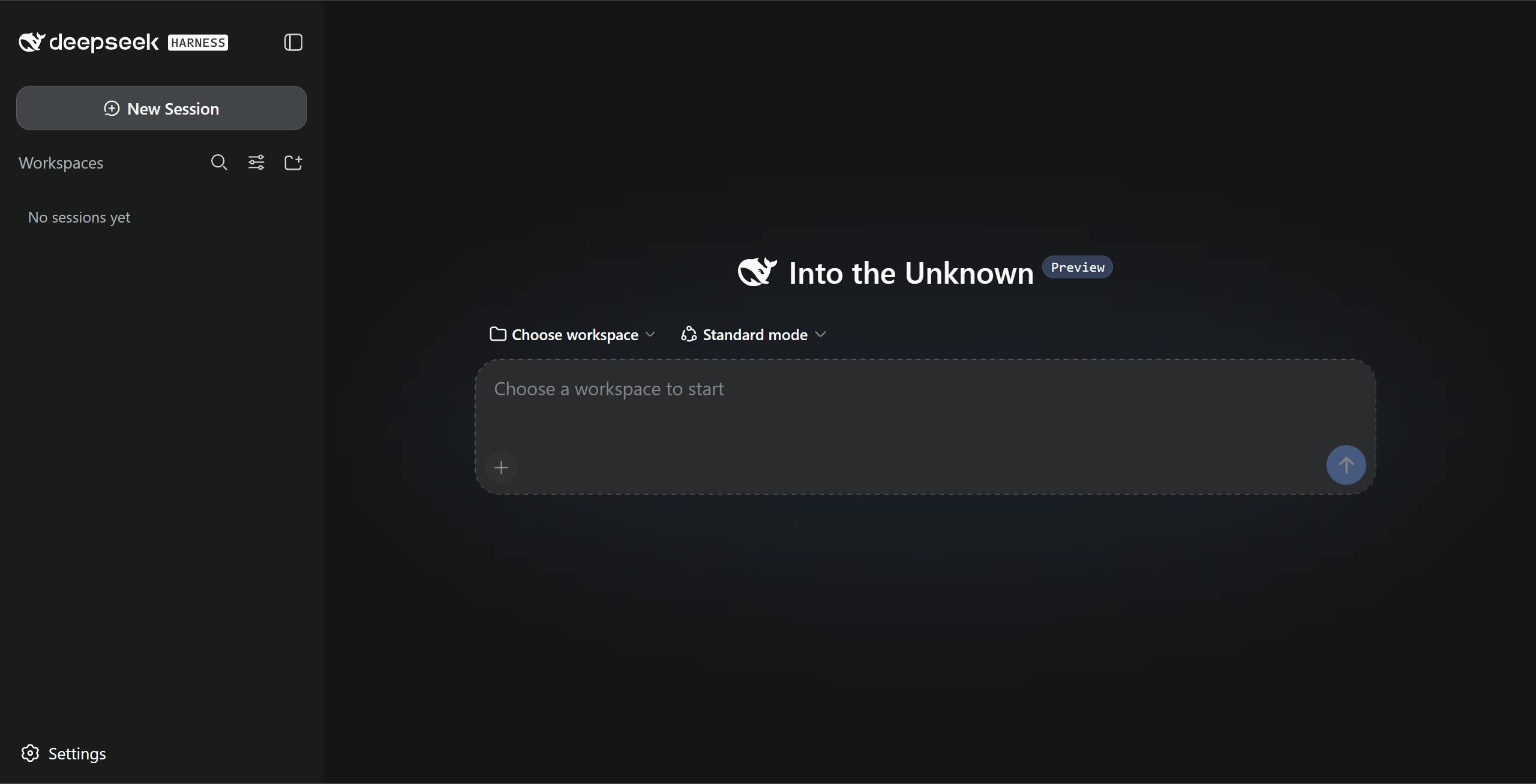
DeepSeek Harness is a composable runtime for building and operating agents. Rather than hard-code the model, tool layer, storage, UI, and loop, it exposes them as plugins. Users install it through npm, launch a local web UI, create profiles and presets, execute tool calls, and retain a full event log so sessions can be recovered or replayed. The official README warns that compatibility-breaking changes should be expected during developer preview. Official README
The customer is a developer or AI platform team that wants to build on DeepSeek models without assembling every runtime component from scratch. The product is free and MIT-licensed. It replaces custom agent loops, glue code, and portions of frameworks such as LangGraph, OpenAI Agents SDK, Microsoft Agent Framework, CrewAI, and OpenHands.
The commercial benefit to DeepSeek is indirect but important: Harness can make its API the default execution environment for agent developers, improve feedback, and increase token consumption. Because plugins can replace models, however, it may also facilitate multi-model use rather than lock customers exclusively to DeepSeek.
Founder and Team Assessment
Liang Wenfeng founded DeepSeek in 2023 after co-founding quantitative hedge fund High-Flyer. Associated Press reported that High-Flyer built machine-learning trading systems and accumulated significant computing resources, creating a technical and financial base for the AI company. Associated Press
DeepSeek has demonstrated exceptional model, systems, and open-source execution. The 2026 financing and planned staff expansion indicate organizational scale, although exact current headcount, leadership structure, compensation, retention, and commercial bench are not reliably disclosed. The founder’s reported emphasis on AGI and research may create tension with near-term monetization and investor expectations.
Founder Assessment: Exceptional technical ambition, capital access, and demonstrated execution, with material governance, commercialization, concentration, and geopolitical diligence requirements.
Market Opportunity
The initial customer is a developer or enterprise platform team buying model inference for coding, reasoning, search, and agent workflows. The market is large: every application that uses language, code, documents, or tools can consume tokens, and agents may increase usage per customer materially.
A bottom-up analyst scenario illustrates the scale. One million production developers spending $10,000 annually would produce $10 billion in revenue; 50,000 enterprise customers at $200,000 annual model and platform spend would also produce $10 billion. These are not DeepSeek-reported forecasts. DeepSeek’s very low token prices mean it must process enormous volume or attach higher-value enterprise services to reach comparable revenue.
Adjacent opportunities include enterprise deployment, private inference, model customization, agent hosting, developer tools, multimodal APIs, and possibly proprietary chips. The addressable market can unquestionably support a $1 billion company. The key question is whether value accrues to DeepSeek despite open-source models, severe price competition, and regulatory constraints.
Traction and Growth Signals
Harness-specific evidence is strong for a developer preview: approximately 130,500 stars, 13,000 forks, more than 12,000 commits, active discussions, and immediate community extensions. Product Hunt reports 166 points and a #6 daily ranking. The broader DeepSeek page lists thousands of followers and dozens of reviews. GitHub Product Hunt
Company-level signals include global recognition of V3/R1, a priced V4 API, large external financing, strategic investors, and reported IPO preparation. These are materially stronger than launch attention. Still missing are audited revenue, API token volume, paying customer count, revenue growth, net retention, customer concentration, model-serving gross margin, and product-specific conversion from Harness adoption to API spend.
Traction Assessment: Exceptional developer adoption and capital-market validation, but commercial economics remain insufficiently public.
Competitive Position
DeepSeek competes with OpenAI, Anthropic, Google, xAI, Alibaba/Qwen, Moonshot/Kimi, Zhipu, Meta’s open models, and numerous agent frameworks. Its current advantages are model price, open-source credibility, engineering efficiency, a huge developer community, and closer integration between models and Harness. Its API supports OpenAI- and Anthropic-compatible formats, one-million-token context, tool calls, and caching. Official API pricing
Weaknesses include low switching costs, open licensing, dependence on scarce compute and geopolitically constrained supply chains, and trust concerns for international enterprise data. Harness itself is MIT-licensed and explicitly modular, limiting code-level lock-in. Durable advantage must come from model quality per dollar, infrastructure efficiency, developer ecosystem, distribution, and research pace.
If the largest platform launched the same feature within six months, customers might retain Harness because of its open plugin architecture, enormous community, low-cost DeepSeek models, and local control. They could also switch rapidly because the runtime is early and components are intentionally replaceable.
Defensibility Assessment: High at the company/model ecosystem level; Medium for Harness alone.
Business Model and Economics
DeepSeek monetizes hosted inference by input and output tokens. The current V4 Flash price of $0.14 per million uncached input tokens and $0.28 per million output tokens is dramatically below many frontier APIs. Cache-hit input is cheaper still. Such pricing can drive volume and ecosystem adoption, but revenue must scale faster than accelerator, energy, networking, storage, and engineering cost.
Harness is free acquisition infrastructure. Potential enterprise monetization could include managed runtimes, private deployment, support, security, observability, and provisioned capacity, but no Harness-specific paid plan is public. Diligence must determine API gross margin, peak/off-peak utilization, subsidy, capex, depreciation, model-training cost, and whether open models reduce or increase paid API retention.
Unicorn Path
DeepSeek has already achieved a reported valuation far above $1 billion. The classification is therefore Clear on demonstrated financing evidence, not a prediction.
For economic context, a 15× revenue multiple—aggressive but plausible only for a high-growth strategic foundation-model company—would require approximately $3.5 billion in annual revenue to support the reported $52 billion post-money valuation. A proposed $74 billion valuation would require about $4.9 billion at the same multiple. At a more conservative 10×, the requirements rise to $5.2 billion and $7.4 billion. Revenue is not public, so these calculations cannot validate the price.
At V4 Flash prices, achieving billions of dollars from token sales alone requires extraordinary volume. DeepSeek must combine inference scale with enterprise contracts, premium models, infrastructure efficiency, and sustained global or domestic distribution.
Unicorn Path: Clear
Valuation Assessment
The most credible public report is the June 2026 financing at about $52 billion post-money. A second round targeting roughly $74 billion was reported and then paused. Exact share rights, liquidation preferences, governance terms, financial statements, and current availability are not public. Reported numbers are sourced to people familiar with private transactions rather than company filings.
Valuation Attractiveness: Not Assessable. Assessing price requires audited revenue, growth, gross margin, compute commitments, cash balance, cap table, ownership and control, round instrument, investor rights, liquidation preferences, regulatory restrictions, and IPO terms. The valuation is already very large, so small errors in growth or margin assumptions materially change returns.
Key Risks
- A $52–$74 billion reported valuation requires billions of durable annual revenue not publicly verified.
- Export controls and compute supply can constrain training and inference capacity.
- International privacy, security, censorship, and government-procurement restrictions may limit distribution.
- API price leadership may rely on economics or subsidies that are not disclosed.
- Frontier-model competition resets quality and price advantages rapidly.
- Founder and ownership concentration create governance and key-person risk.
- Open-source releases can diffuse technical advantage to competitors.
- Harness is developer preview software with breaking-change and security risk.
- Investors may have limited liquidity, information rights, or enforceability across jurisdictions.
- Research-first priorities may conflict with commercialization and IPO discipline.
Final Assessment
Venture Potential: 90/100
| Category | Score |
|---|---|
| Market Size and Expansion Potential | 20/20 |
| Traction and Growth Evidence | 18/20 |
| Founder and Team | 14/15 |
| Product Strength | 9/10 |
| Distribution Potential | 14/15 |
| Business Model and Economics | 7/10 |
| Defensibility | 8/10 |
| Total | 90/100 |
The strongest elements are global developer pull, model economics, capital access, and ecosystem distribution. The weakest are undisclosed revenue/margins and significant governance and geopolitical risk.
Evidence Confidence: 75/100
Verified: official product source, license, developer-preview status, repository activity, API specifications, and current API price. Credibly reported: founder history, June financing, investors, valuation, follow-on pause, and IPO planning. Company-reported: model capability and product benefits. Unavailable: audited revenue, growth, retention, gross margin, cap table details, and final financing rights.
Final Decision: DD
DeepSeek clearly warrants formal diligence if allocation is available. Its technical and ecosystem position is exceptional, but public evidence cannot support Invest at a reported tens-of-billions valuation without audited economics, regulatory analysis, governance rights, and transaction terms.
Upgrade Conditions
- Audited revenue and growth consistent with the reported valuation
- Verified positive API contribution margin after compute and depreciation
- Strong enterprise and developer retention across model generations
- Clear cap table, governance rights, and investor protections
- Defensible access to compute under export and supply constraints
- A credible international data-governance and regulatory strategy
- Financing terms offering acceptable risk-adjusted return
Downgrade Conditions
- Revenue materially below the level needed to support valuation
- Sustained API losses or dependence on non-economic pricing
- Material sanctions, export, procurement, or data restrictions
- Security failures in Harness or model infrastructure
- Research progress stalls while competitors close the price gap
- Governance actions disadvantage minority investors
- The proposed round or IPO imposes unfavorable liquidity or ownership terms
Questions for Further Diligence
- What are current annualized revenue, year-over-year growth, and revenue by API, consumer, and enterprise products?
- What are input/output token volumes, paid-customer count, and net revenue retention?
- What is gross margin by V4 Flash and V4 Pro after compute, energy, and depreciation?
- How does Harness adoption convert into paid DeepSeek API consumption?
- What are training capex, inference capacity, committed compute supply, burn, and runway?
- What is the final cap table after the June financing, including founder and state-linked ownership?
- What rights, valuation, liquidation preferences, and governance terms apply to a new investor?
- What data residency, model-training, privacy, and government-access policies govern international customer data?
- How are export controls and chip supply incorporated into the operating plan?
- What security review and compatibility policy will move Harness from developer preview to production?
- What are the IPO timetable, listing venue, lockups, and expected liquidity restrictions?
- Why will DeepSeek retain developers if rivals match price and ship comparable open agent runtimes?
Sources
- Product Hunt — DeepSeek Harness
- DeepSeek Harness — official GitHub repository
- DeepSeek — official API pricing
- Reuters — June 2026 financing and reported valuation
- Reuters — follow-on fundraising pause
- Bloomberg — reported IPO preparation
- Associated Press — DeepSeek and Liang Wenfeng background
- DeepSeek Platform