
Table of Contents
LaraCopilot Investment Report
Category: Vertical AI coding assistant / Laravel application development
Company Stage: Early commercial product within an established software-services company; standalone stage not publicly disclosed
Founder or Founders: Vishal Rajpurohit
Headquarters: Ahmedabad, Gujarat, India; founder also lists Herndon, Virginia
Funding: No verified standalone funding for LaraCopilot
Business Model: Credit-based SaaS subscriptions for individuals, teams, agencies and enterprises
Product Hunt Launch Date: August 12, 2026
Report Date: August 15, 2026
| Investment Metric | Assessment |
|---|---|
| Venture Potential | 64/100 |
| Unicorn Path | Conditional |
| Valuation Attractiveness | Not Assessable |
| Evidence Confidence | 56/100 |
| Final Decision | Watch |
Executive Summary
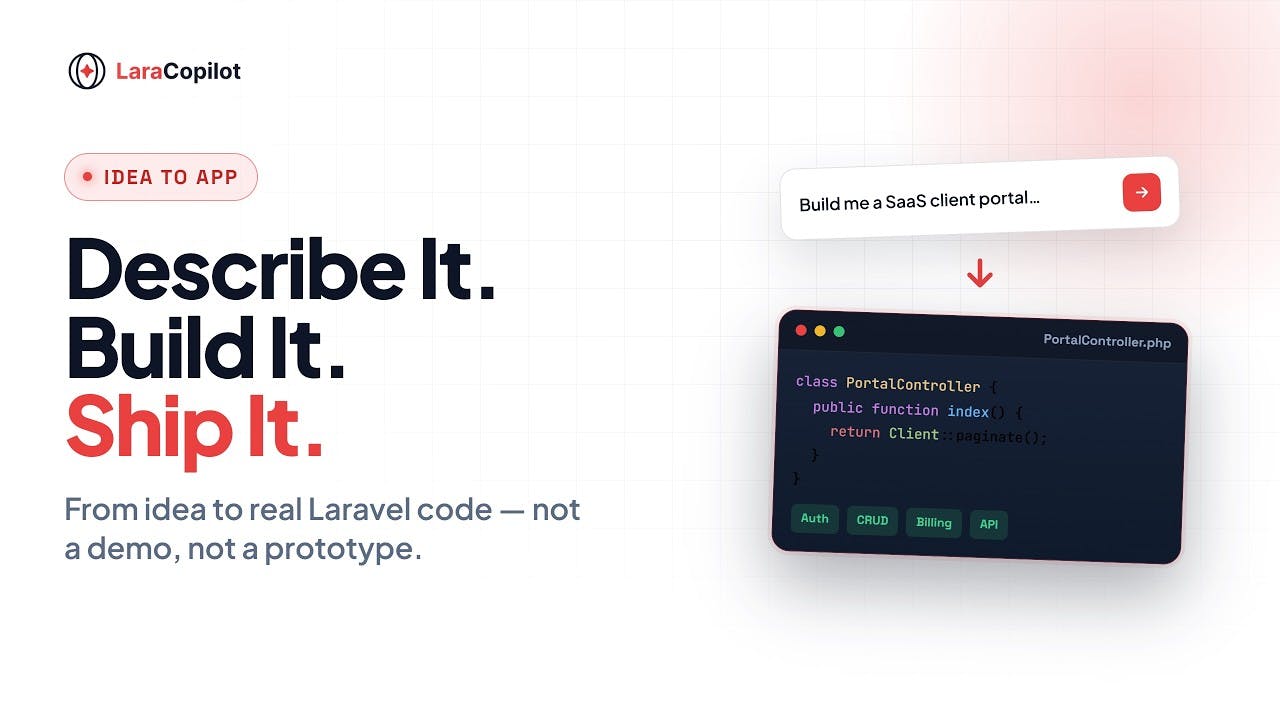
LaraCopilot is an AI application builder focused specifically on the Laravel web-development framework. A user describes an application in natural language, after which the platform generates frontend and backend code, database migrations, authentication, APIs and administrative functionality. Generated projects can be exported to GitHub and deployed through Laravel Cloud, Forge, Ploi or an SSH server (official website).
The product serves Laravel developers, agencies, startup founders and product teams that repeatedly build CRUD applications, internal systems and MVPs. Its vertical positioning is more focused than general AI coding products: it claims to understand conventions including Eloquent, Blade, Livewire, Inertia, Sanctum and Nova rather than generating generic PHP code.
The strongest positive signal is founder-market fit and community distribution. Founder Vishal Rajpurohit has worked in software engineering since 2005, co-founded ViitorCloud in 2010 and organizes Laracon India. His proximity to Laravel developers provides an efficient channel for product feedback and adoption (founder website). Laravel News independently reported that more than 600 developers joined LaraCopilot’s waitlist after its introduction at Laracon India (Laravel News).
The primary concern is the absence of verified commercial performance. LaraCopilot reports more than 6,000 developers, 2.4 million lines of generated code and 98% satisfaction, but these figures are company-reported and lack methodology. Revenue, paying customers, conversion, retention, gross margin and usage frequency are not publicly disclosed. The legal provider is ViitorCloud Technologies Pvt. Ltd., creating additional uncertainty over product-level ownership, accounting, staffing and investor access (terms).
The decision is Watch. LaraCopilot appears to be a credible vertical developer tool, but its current Laravel-only market, limited independent customer evidence and low apparent defensibility do not yet justify formal investment diligence. Verified paid retention and evidence that agencies standardize their production workflows on the platform would support an upgrade.
Product Overview
Laravel developers frequently spend time creating standard project architecture, migrations, models, controllers, authentication, CRUD functionality and deployment configuration. General-purpose AI tools can generate PHP code, but their output may not consistently follow Laravel conventions or produce a complete deployable application.
LaraCopilot packages this workflow into a browser-based application builder. Users create a project from a prompt, preview the resulting application, request changes conversationally, connect a source-control repository and deploy the application. The platform also supports importing and refactoring existing projects on higher-priced plans.
Core capabilities advertised on the official site include:
- Full-stack Laravel code generation.
- Support for Laravel 9 through 12.
- Models, controllers, migrations, routes, tests and administrative panels.
- Existing-code import and context-aware editing.
- GitHub, GitLab and Bitbucket integrations.
- Laravel Cloud, Forge, Ploi and SSH deployment.
- Team seats, role-based access and audit logs.
- An API for programmatic application generation.
- Attachments such as Figma files, documents and screenshots.
Pricing is credit-based:
| Plan | Published Price | Included Usage |
|---|---|---|
| Free | $0 | 10 credits, two public projects, one seat |
| Starter | $29/month | 150 credits, unlimited projects, two seats |
| Pro | $79/month | 350 credits, five seats |
| Agency | $199/month | 1,800 credits, ten seats |
| Enterprise | Custom | Private deployment, SLA and custom integrations |
Paid plans include a 14-day trial. The company has also offered discounts as high as 60%, making realized average revenue potentially lower than list pricing (official site; company LinkedIn).
The product’s customer value is speed rather than eliminating engineering. Users retain generated source code, but still need to review security, business logic and architecture. LaraCopilot’s terms explicitly state that generated output should be reviewed before use.
Product Quality Assessment: Focused and functionally broad, but production-code quality and claimed productivity improvements lack independent benchmark evidence.
Founder and Team Assessment
Vishal Rajpurohit is the verified founder of LaraCopilot and co-founder and CTO of ViitorCloud. His public history includes engineering and product-development roles beginning in 2005 and leadership of ViitorCloud since 2010. He is also an organizer of Laracon India and reports serving on the Laravel Certification Program’s board (founder profile; LinkedIn).
This background creates strong founder-market fit. Rajpurohit has direct experience managing Laravel projects, operating a development agency and interacting with the relevant developer community. ViitorCloud also provides engineering capacity and exposure to repetitive client-development workflows that could inform LaraCopilot’s product design.
Commercial capability is more difficult to isolate. ViitorCloud appears to be an established services business, but no verified LaraCopilot revenue data or previous product exit was found. The founder’s LinkedIn profile also lists a separate company, Devlyn AI, founded in 2026. The relationship among Devlyn AI, LaraCopilot and ViitorCloud—and the founder’s allocation of time—requires clarification.
LinkedIn lists approximately nine employees associated with LaraCopilot and a company-size range of 11–50. LinkedIn counts are directional rather than authoritative. The website displays logos of several companies, but it does not clearly distinguish customers, evaluators or affiliated organizations, so these should not be treated as verified contracts.
Founder Assessment: Strong technical and ecosystem fit, but standalone product commitment, ownership and SaaS commercialization remain insufficiently verified.
Market Opportunity
The initial customer segment is Laravel-focused freelancers and development agencies that regularly build MVPs, administrative systems and client applications. Their willingness to pay depends on measurable reductions in billable engineering time without introducing code-quality or security costs.
There is no reliable public count of professional Laravel developers or agencies. Laravel’s ecosystem is clearly active: Laravel 13 was updated on August 11, 2026, and its framework remains distributed through Packagist and developed on GitHub. Downloads do not equal unique developers, however.
An illustrative bottom-up scenario is:
- 100,000–500,000 addressable professional users or small teams
- $350–$1,200 annual revenue per account
- Implied annual revenue pool: $35 million–$600 million
These are analyst assumptions, not verified market statistics. The revenue range reflects a mixture of Starter and Pro subscriptions, discounts, free users and smaller agency accounts.
The Laravel-only opportunity could support a profitable vertical SaaS company. A venture-scale outcome would probably require deeper agency adoption, enterprise contracts, application hosting or expansion into adjacent PHP frameworks and broader backend development.
Geographic expansion is plausible because Laravel is globally distributed and the product is browser-based. LaraCopilot’s presence at Laracon events in India, the United States, Europe and Japan provides an ecosystem-specific acquisition channel.
Traction and Growth Signals
Available traction evidence includes:
- More than 600 waitlist registrations following a Laracon India introduction, according to Laravel News.
- Company-reported metrics of 6,000-plus developers, 2.4 million generated lines of code and 98% satisfaction as of June 2026 (LinkedIn).
- More than 100 developers reportedly tested the product at Laravel Live Japan; this is another company-reported event metric.
- Sponsorship and attendance at Laracon US and other Laravel conferences.
- A Product Hunt daily ranking of #8 on August 12, 2026, with approximately 146 votes shown on the leaderboard (Product Hunt leaderboard).
- Continued product announcements covering Git repository export, deployment connectors, existing-project import, an API and a marketplace.
These indicate sustained development and community marketing beyond the Product Hunt launch. They do not prove paid adoption. The 98% satisfaction claim is especially difficult to evaluate because the survey population, response count and question wording are not disclosed.
Independent review volume is minimal. Trustpilot showed only two reviews in search results, while no substantial body of verified marketplace reviews or public customer case studies with measurable outcomes was found.
The most important missing metrics are paid accounts, monthly active developers, generated projects reaching production, free-to-paid conversion, subscription renewal and cohort retention.
Traction Assessment: Meaningful community awareness, but commercially unverified.
Competitive Position
Direct or adjacent competitors include Lovable, Bolt, Replit, Base44, Cursor and GitHub Copilot. Laravel-specific competitors and alternatives include Crudly, Laravel Blueprint, Filament, Laravel Shift and traditional starter kits. Developers can also combine Claude Code, OpenAI Codex or Cursor with Laravel documentation and project-specific instructions.
Pricing is not obviously advantageous. LaraCopilot’s $79 Pro plan exceeds GitHub Copilot Pro at $10 per month and Cursor’s $20 individual plan, although LaraCopilot attempts to deliver complete applications rather than general coding assistance (GitHub Copilot pricing; Cursor pricing). Its $29 Starter plan is close to Lovable’s entry paid pricing (Lovable pricing).
Differentiation comes from Laravel conventions, full-stack generation, framework-specific deployment and the founder’s community access. Users retain their source code, which reduces adoption friction but also creates low switching costs. No proprietary dataset, model or network effect has been verified.
If the largest platform launched the same feature within six months, why would customers remain? The credible answer is superior Laravel output, faster support for framework releases and deeper agency workflows. That advantage must be continuously demonstrated; GitHub, Cursor or Laravel itself could integrate comparable framework-specific agents.
Defensibility Assessment: Low
Business Model and Economics
LaraCopilot earns subscription revenue through credit-limited plans and custom enterprise contracts. Potential expansion revenue includes additional credits, agency seats, private deployments, API usage, hosting and marketplace services.
Gross-margin potential is uncertain. Variable costs include model inference from third-party providers, preview environments, codebase indexing, storage, deployment infrastructure, payment processing and technical support. Credit limits should constrain inference exposure, but the company does not explain how credits map to model cost.
The core economic test is whether subscription revenue increases faster than inference and support expense. Agency customers may have higher willingness to pay but can also generate long, complex agent sessions and support requests. Enterprise private deployments could raise ACV while requiring services-heavy implementation.
Customer acquisition currently appears community-led through Laracon sponsorships, founder reputation, content and organic referrals. The company claims zero paid acquisition, but CAC, conference costs and the contribution of ViitorCloud’s existing relationships are not disclosed.
Unicorn Path
A high-growth developer-tools SaaS business could receive approximately 8–12× ARR. Using a 10× midpoint:
Required ARR = $1 billion ÷ 10 = approximately $100 million
At published list prices:
- Pro at $79/month, or $948 annually: approximately 105,000 paying accounts.
- Agency at $199/month, or $2,388 annually: approximately 42,000 agency accounts.
- Hypothetical enterprise ACV of $20,000: approximately 5,000 enterprise customers.
The enterprise ACV is an analyst scenario, not published pricing. Discounts, churn and payment fees would increase gross customer acquisition requirements, while additional usage revenue could reduce them.
The current claim of 6,000 total developers is far below the required paid scale. A credible path would require expansion from MVP generation into ongoing software-development workflows, security testing, maintenance, deployment, enterprise governance and potentially frameworks beyond Laravel.
Unicorn Path: Conditional
Valuation Assessment
No standalone fundraising announcement, institutional investor, financing round, SAFE cap or valuation was found for LaraCopilot. Its terms identify ViitorCloud Technologies Pvt. Ltd. as the service provider. It is unclear whether investors could purchase equity in LaraCopilot, ViitorCloud or another entity.
Revenue and growth are not publicly disclosed, preventing revenue-multiple analysis. General AI developer-tool financings are not useful comparables without retention, growth and gross-margin data.
Valuation Attractiveness: Not Assessable
Required information includes product-level ARR, growth, gross margin, retention, ViitorCloud-related-party arrangements, intellectual-property ownership, cap table, burn, runway, proposed round size and post-money valuation.
Key Risks
- Unverified commercialization: No public paid-customer or revenue evidence.
- Narrow market: Laravel specialization improves positioning but constrains scale.
- Incumbent replication: GitHub, Cursor, Anthropic or Laravel could offer comparable functionality.
- Low switching costs: Customers own and export generated code.
- Entity and ownership ambiguity: LaraCopilot is legally provided by ViitorCloud rather than a disclosed standalone company.
- Founder-focus risk: The founder simultaneously lists ViitorCloud, LaraCopilot and Devlyn AI roles.
- Inference economics: Credit usage and model costs are not transparent.
- Code-quality liability: Security or architectural defects in generated applications could harm retention and reputation.
- Weak independent validation: Customer logos, testimonials and satisfaction metrics are not independently substantiated.
Final Assessment
Venture Potential: 64/100
| Category | Score |
|---|---|
| Market Size and Expansion Potential | 13/20 |
| Traction and Growth Evidence | 10/20 |
| Founder and Team | 12/15 |
| Product Strength | 8/10 |
| Distribution Potential | 10/15 |
| Business Model and Economics | 7/10 |
| Defensibility | 4/10 |
| Total | 64/100 |
The strongest factors are founder-market fit, a focused product and access to the Laravel community. The weakest are commercial evidence, market ceiling, ownership clarity and defensibility.
Evidence Confidence: 56/100
Pricing, features, legal provider, founder identity and Product Hunt ranking are verifiable. User, output and satisfaction figures are company-reported. Market size and enterprise ACV scenarios are analyst assumptions. Revenue, retention, margins, funding, valuation and product-level team allocation remain unavailable.
Final Decision: Watch
LaraCopilot may become a credible vertical SaaS business, but current evidence does not establish a venture-scale company. The decision should move to DD only after paid adoption, retention and entity ownership are verified.
Upgrade Conditions
- At least $1 million in product-level ARR.
- More than 1,000 paying accounts or multiple referenceable enterprise contracts.
- Six-month paid retention above 70%.
- Gross margin above 70% after model and hosting costs.
- Verified production deployment and repeat-usage data.
- Clear standalone entity, IP ownership and founder commitment.
- Evidence that agency adoption creates repeatable seat or usage expansion.
Downgrade Conditions
- Low conversion after conference and Product Hunt campaigns.
- High churn after users generate their first application.
- Material security failures in generated code.
- Increasing inference costs without pricing power.
- Major Laravel-native functionality from a larger competitor.
- Continued ambiguity over product ownership or founder allocation.
- Unsupported or materially misleading traction claims.
Questions for Further Diligence
- What are current LaraCopilot ARR, MRR and monthly revenue growth?
- How many of the reported 6,000 developers are monthly active and paying?
- What are 30-, 90- and 180-day retention by subscription cohort?
- How many generated applications have reached production?
- What is conversion from free accounts and trials to paid subscriptions?
- What are gross margin and model-inference cost per credit?
- How much acquisition comes from Laracon, ViitorCloud clients, search and referrals?
- Which legal entity owns the source code, brand, customer contracts and training assets?
- How many people work full-time on LaraCopilot, and how is founder time allocated?
- What are burn rate, runway and any intercompany charges from ViitorCloud?
- What are the current cap table, proposed valuation and financing terms?
- What measurable Laravel-specific advantage remains over properly configured general coding agents?
Sources
- Product Hunt — LaraCopilot
- Product Hunt daily leaderboard
- Official LaraCopilot website and pricing
- LaraCopilot Terms of Use
- LaraCopilot Privacy Policy
- Laravel News product interview
- Founder website — Vishal Rajpurohit
- Founder LinkedIn profile
- LaraCopilot LinkedIn company page
- Laravel framework repository
- GitHub Copilot pricing
- Cursor pricing