
Table of Contents
Caveman Investment Report
Category: AI infrastructure / developer tools / LLM cost optimization
Company Stage: Pre-seed / early commercialization
Founder or Founders: Julius Brussee
Headquarters: Netherlands; specific headquarters not publicly disclosed
Funding: Not publicly disclosed
Business Model: Open-source-led SaaS; free local tools, paid team/cloud/enterprise infrastructure
Product Hunt Launch Date: August 13, 2026
Report Date: August 16, 2026
| Investment Metric | Assessment |
|---|---|
| Venture Potential | 68/100 |
| Unicorn Path | Conditional |
| Valuation Attractiveness | Not Assessable |
| Evidence Confidence | 53/100 |
| Final Decision | DD |
Executive Summary
Caveman is an AI-efficiency stack intended to reduce the context and output tokens consumed by coding agents and production AI systems. It began as a free “caveman-speak” skill that makes agents answer more tersely, then expanded into a local proxy, content-aware compression engine, agent SDK, usage monitoring layer, and planned managed cloud and enterprise products (official website; GitHub).
Product quality appears promising. The local engine recognizes logs, JSON, code, diffs, tables, and other structured context, stores original bytes for recovery, and passes uncompressible or failed payloads through unchanged. The strongest evidence is not Product Hunt attention but unusually large open-source reach: approximately 98,000 GitHub stars and 5,600 forks as of the report date, with code updated immediately before this report (GitHub API). Stars are not equivalent to active users or paying customers, but they create a potentially valuable developer-distribution funnel.
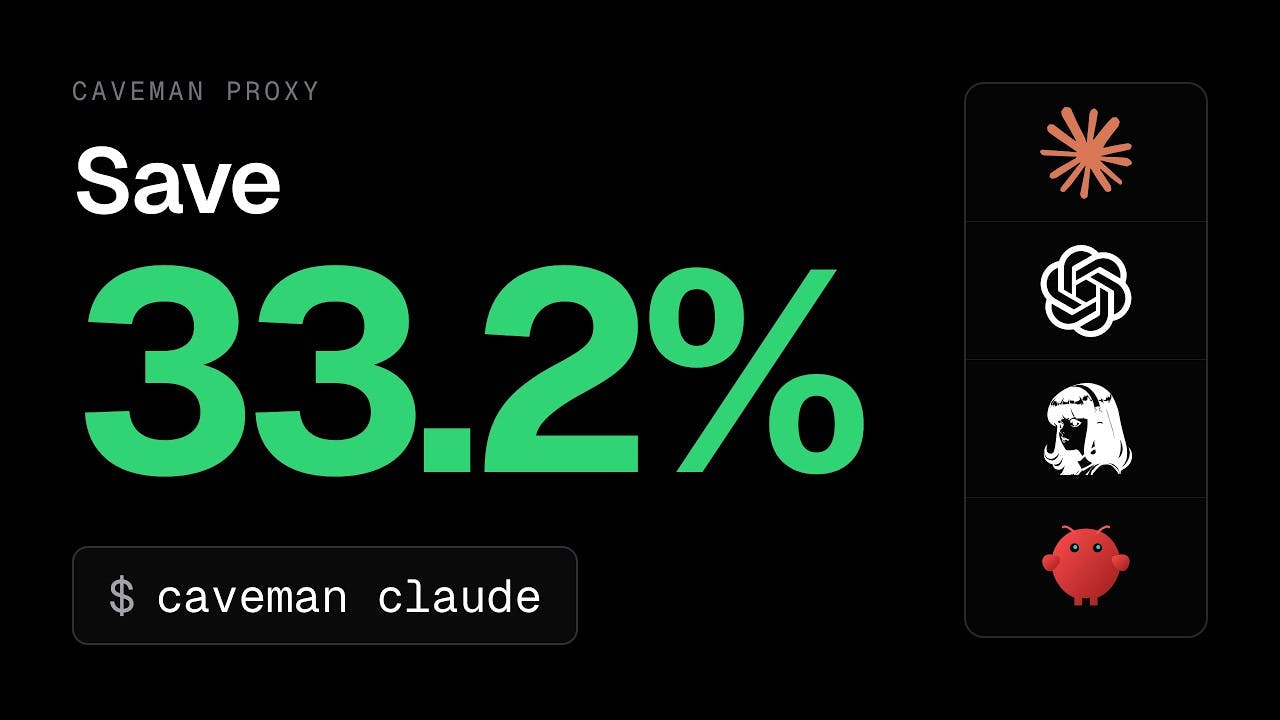
The principal concern is the distance between open-source popularity and a durable commercial company. Revenue, paying organizations, retention, production traffic, gross margin, enterprise contracts, and fundraising terms are not publicly disclosed. Caveman’s own benchmark claims a 33.2% reduction in provider-reported input tokens in a 54-run test, but its public CaveBench remains self-administered and explicitly reports verified production savings of zero (GitHub benchmark; CaveBench).
There is also conflicting performance evidence. An independent JetBrains benchmark measured only an 8.5% output-token reduction on realistic agentic coding tasks, versus the 65% headline for the original skill, although it found no statistically detectable quality degradation (JetBrains). The newer input-compression engine may offer greater commercial value, but independent production validation is still limited.
The appropriate decision is DD, not Invest. The technical execution and organic distribution are strong enough to justify a founder meeting and data-room request, but the company cannot be underwritten without commercial metrics, clarity on founder commitment, legal structure, team capacity, security controls, and round terms.
Product Overview
Caveman addresses a real cost problem: AI agents repeatedly send tool schemas, logs, files, history, and other context to model providers. Its original MIT-licensed skill reduces conversational output; Caveman 2 adds a local proxy that compresses input context before transmission (GitHub README).
The stack includes:
- A free skill supporting Claude Code, Codex, Cursor, Windsurf, Gemini CLI and other agents.
- A local proxy and engine with content-specific compression.
- Recoverable context storage, allowing an agent to retrieve exact original bytes.
- Token and estimated-cost monitoring.
- An agent SDK for production applications.
- Planned cloud optimization, routing, governance, and enterprise deployment (official product overview).
The free skill and adoption surfaces use MIT licensing, while engine-linked components use BSL 1.1 and later convert to Apache 2.0. Third-party hosted or embedded commercialization requires a commercial license, creating a potential monetization boundary while preserving free first-party self-hosting (licensing explanation).
The official site states that local compression is free and that cloud analytics, teams, governance, verified savings, on-premises deployment, and commercial embedding are paid products (Caveman Engine). Publicly indexed pricing has included an Indie plan at $19 per month and a Team plan at $299 per month for ten seats, with enterprise pricing by contract; current purchasability and paid-plan adoption are not verified.
Product-quality assessment: Strong technical concept and rapid execution, but production efficacy and operational reliability remain insufficiently validated.
Founder and Team Assessment
Julius Brussee is publicly identifiable as Caveman’s creator and lead developer. His personal site says he studies Data Science and AI at Leiden University and works as a founding engineer at Stacklink, an enterprise RAG project (founder website). His GitHub activity provides direct evidence of technical ability: he is responsible for the substantial majority of visible repository contributions among the leading contributors (GitHub contributors).
Brussee demonstrates exceptional ability to ship, attract developer attention, communicate technical limitations, and evolve a meme-like project into infrastructure. The repository’s “honest numbers” warnings, inferred-versus-verified labels, recoverability architecture, and reproducible benchmark design are positive engineering signals.
Commercial capability remains unproven. No independently verified prior exit, scaled software company, enterprise-sales history, or full-time Caveman team was found. His personal site also identifies simultaneous work on Stacklink and other projects, creating a material commitment and key-person question.
Founder Assessment: Exceptional early technical and community execution, but full-time commitment, enterprise-selling capability, and organizational depth require verification.
Market Opportunity
The initial customer is not every software developer. It is an AI-native development team or AI application company with sufficiently high model expenditure that reducing context cost, improving context-window utilization, or governing usage creates measurable ROI.
A useful bottom-up scenario is:
- 25,000 AI-intensive teams globally;
- $3,588 annual spending per team at the publicly indexed $299 monthly team price;
- approximately $90 million of potential ARR.
This is an analyst scenario, not a verified market-size estimate. A larger market becomes possible if Caveman sells enterprise gateways, governance, routing, on-premises deployments, and OEM licenses at five- or six-figure annual contract values. Conversely, the individual developer plan alone would probably not support venture-scale revenue.
Market timing is favorable because coding agents and production AI workloads are increasing token consumption. However, model prices continue to fall, providers improve caching, and platforms can incorporate compression or routing themselves. Caveman must sell operational control and verified savings—not merely “fewer tokens”—to preserve willingness to pay.
Traction and Growth Signals
The principal verified signals are:
- Approximately 98,400 GitHub stars, 5,600 forks and 485 open issues (GitHub API).
- Repository creation in April 2026 and active updates through August 2026.
- Caveman 2.0 released on August 11, 2026, showing rapid expansion from a prompt skill into a broader engine and proxy (release).
- Independent JetBrains testing found modest but real output savings without statistically detectable quality damage (JetBrains).
- Product Hunt launch attention, which is useful as an awareness signal but not evidence of product-market fit (Product Hunt).
Missing metrics include active installations, monthly active users, production tokens processed, paid organizations, ARR/MRR, conversion, churn, cohort retention, expansion, customer references, and verified savings from live traffic. The official CaveBench page explicitly distinguishes inferred benchmark savings from booked savings and shows verified savings of $0 in its published benchmark receipt (CaveBench).
Traction Assessment: Exceptional open-source awareness, but commercially unverified.
Competitive Position
Direct and adjacent competitors include AI gateways and observability platforms such as LiteLLM, Helicone, and Portkey. These products already provide combinations of routing, caching, observability, governance, prompt management, and cost controls. LiteLLM explicitly offers prompt compression and extensive enterprise gateway functionality.
Free alternatives include provider-native prompt caching, manually shortening prompts or tool output, open-source compression libraries, and direct application-level context management. Anthropic, OpenAI, Google, coding-agent vendors, and established gateways can bundle similar optimization.
Caveman’s advantages are its developer brand, very low-friction open-source funnel, local-first architecture, recoverable compression, content-specific transformations, and licensing boundary around commercial hosting. Switching costs are currently low, and proprietary data or network effects are not evident.
If the largest platform launched comparable compression within six months, customers would continue using Caveman only if it delivered independently verified cross-provider savings, superior local/privacy controls, auditable receipts, and integrations the platform could not offer neutrally.
Defensibility Assessment: Medium-Low
Business Model and Economics
The likely model combines individual and team subscriptions, enterprise contracts, managed gateway usage, support, on-premises licensing, and OEM embedding. This is preferable to monetizing the free skill alone because enterprise infrastructure can support higher ACVs and expansion revenue.
Software gross margins could be attractive for local and self-hosted deployments. Managed cloud economics are less certain: Caveman would incur hosting, telemetry storage, security, support, and possibly model-evaluation costs. Compression should reduce customers’ provider costs, but Caveman must capture enough of those savings without introducing unacceptable latency or failure risk.
No reliable public information was found regarding revenue, gross margin, customer-acquisition costs, support burden, cloud cost per request, or paid conversion. These are essential diligence items.
Unicorn Path
An AI-infrastructure SaaS company with strong growth and retention might receive approximately a 10× ARR valuation multiple. This is an analytical assumption, not Caveman’s current multiple.
At 10× ARR:
Required ARR = $1 billion ÷ 10 = $100 million.
At $299 per month, Caveman would need approximately:
$100 million ÷ $3,588 = 27,900 Team-plan equivalents.
That is demanding for a specialist compression product. A more credible route would combine, for example, 1,000 enterprise customers at $75,000 ACV with $25 million from team, usage-based, and OEM revenue. Those figures are scale illustrations, not forecasts.
Reaching that level requires Caveman to become a cross-provider AI efficiency and governance platform; prove savings in production; sell to enterprises; support cloud, on-premises, and embedded deployment; build security and reliability capabilities; and convert open-source awareness into repeatable commercial distribution.
Unicorn Path: Conditional
Valuation Assessment
No reliable public funding round, investors, SAFE cap, post-money valuation, acquisition offer, or current fundraising terms were found. Revenue, growth, retention, and gross margin are also undisclosed.
Valuation Attractiveness: Not Assessable
Assessment requires current ARR, growth, gross margin, paid-customer cohorts, burn, runway, round size, valuation or SAFE cap, option pool, ownership, and liquidation preferences. Product popularity alone cannot support a responsible valuation range.
Key Risks
- Commercial conversion: 98,000 GitHub stars may produce few paying organizations.
- Savings may be workload-dependent: JetBrains measured 8.5%, materially below the original 65% headline.
- Platform bundling: Model vendors and AI gateways can add compression, caching, and routing.
- Founder commitment and key-person risk: The project appears heavily dependent on one founder with other commitments.
- Low switching costs: Customers can remove a proxy or move to another gateway.
- Enterprise security risk: The proxy handles sensitive prompts, code, credentials, and provider traffic.
- Quality and reliability risk: Lossy compression may omit context required for difficult tasks despite recovery mechanisms.
- Unproven managed-cloud economics: Storage, replay, evaluation, support, and compliance may constrain margins.
- Brand-to-enterprise gap: A meme-driven developer brand may not translate into enterprise procurement.
- Legal and organizational uncertainty: Legal entity, IP assignment, employee structure, and financing status are not public.
Final Assessment
Venture Potential: 68/100
| Category | Score |
|---|---|
| Market Size and Expansion Potential | 15/20 |
| Traction and Growth Evidence | 13/20 |
| Founder and Team | 11/15 |
| Product Strength | 8/10 |
| Distribution Potential | 12/15 |
| Business Model and Economics | 5/10 |
| Defensibility | 4/10 |
| Total | 68/100 |
The strongest elements are organic developer distribution, technical execution, and expansion from a skill into an infrastructure stack. The weakest are absent commercial metrics, limited organizational depth, low switching costs, and bundling risk.
Evidence Confidence: 53/100
Product architecture, repository activity, founder identity, open-source reach, licensing, and the JetBrains benchmark are verifiable. Performance figures for the new engine are predominantly company-produced. Revenue, customer retention, team size, funding, legal entity, unit economics, and valuation are unavailable.
Final Decision: DD
Caveman clears the threshold for formal diligence because its open-source distribution and technical velocity are unusually strong. It does not clear the threshold for investment without evidence that developer attention converts into durable revenue and that the founder intends to build a focused, enterprise-capable organization.
Upgrade Conditions
- Verified ARR approaching or exceeding $1 million.
- At least 20–30 referenceable paying organizations, including production deployments.
- Strong six-month logo retention and expansion among high-usage customers.
- Demonstrated gross margin above 70% for managed offerings.
- Independent production evidence of material, quality-preserving savings.
- Full-time founder commitment and credible enterprise/security hires.
- Repeatable acquisition beyond launch communities and GitHub stars.
Downgrade Conditions
- Weak paid conversion or rapid churn after initial trials.
- Production savings consistently below implementation and switching costs.
- Major gateway or model provider replicating the core functionality.
- Security incident involving prompts, code, credentials, or recovery storage.
- Excessive latency, support burden, or cloud infrastructure costs.
- Declining repository activity or loss of founder focus.
- Materially misleading benchmark or commercial claims.
Questions for Further Diligence
- What are current MRR, paid-organization count, and monthly revenue growth?
- How many GitHub users have installed the proxy, and how many remain active after 30, 90, and 180 days?
- What percentage of free users convert to Indie, Team, or enterprise plans?
- What savings do production customers realize by workload, excluding self-run benchmarks?
- What are logo retention, gross revenue retention, and net revenue retention?
- What are cloud cost, evaluation cost, and support cost per million tokens processed?
- Which acquisition channels generate paying customers, and what is CAC by segment?
- Is Julius Brussee working full-time on Caveman, and who owns sales, security, and operations?
- What security certifications, penetration tests, data-retention controls, and incident-response processes exist?
- Which components and trademarks are assigned to the company rather than personally owned?
- What is the current legal entity, cap table, burn rate, cash runway, and fundraising plan?
- What are the proposed round size, valuation or SAFE cap, discount, and investor rights?