
Table of Contents
PageIndex Investment Report
Category: AI document intelligence / reasoning-based retrieval infrastructure
Company Stage: Early-stage, commercial launch
Founder or Founders: Mingtian Zhang; Yu Tang (“Ray”)
Headquarters: London, United Kingdom
Funding: $1.42 million reported by third-party databases; not independently verified
Business Model: Open-source core with usage-based cloud services, subscriptions, and enterprise deployment
Product Hunt Launch Date: August 28, 2026
Report Date: August 31, 2026
| Investment Metric | Assessment |
|---|---|
| Venture Potential | 67/100 |
| Unicorn Path | Conditional |
| Valuation Attractiveness | Not Assessable |
| Evidence Confidence | 53/100 |
| Final Decision | Watch |
Executive Summary
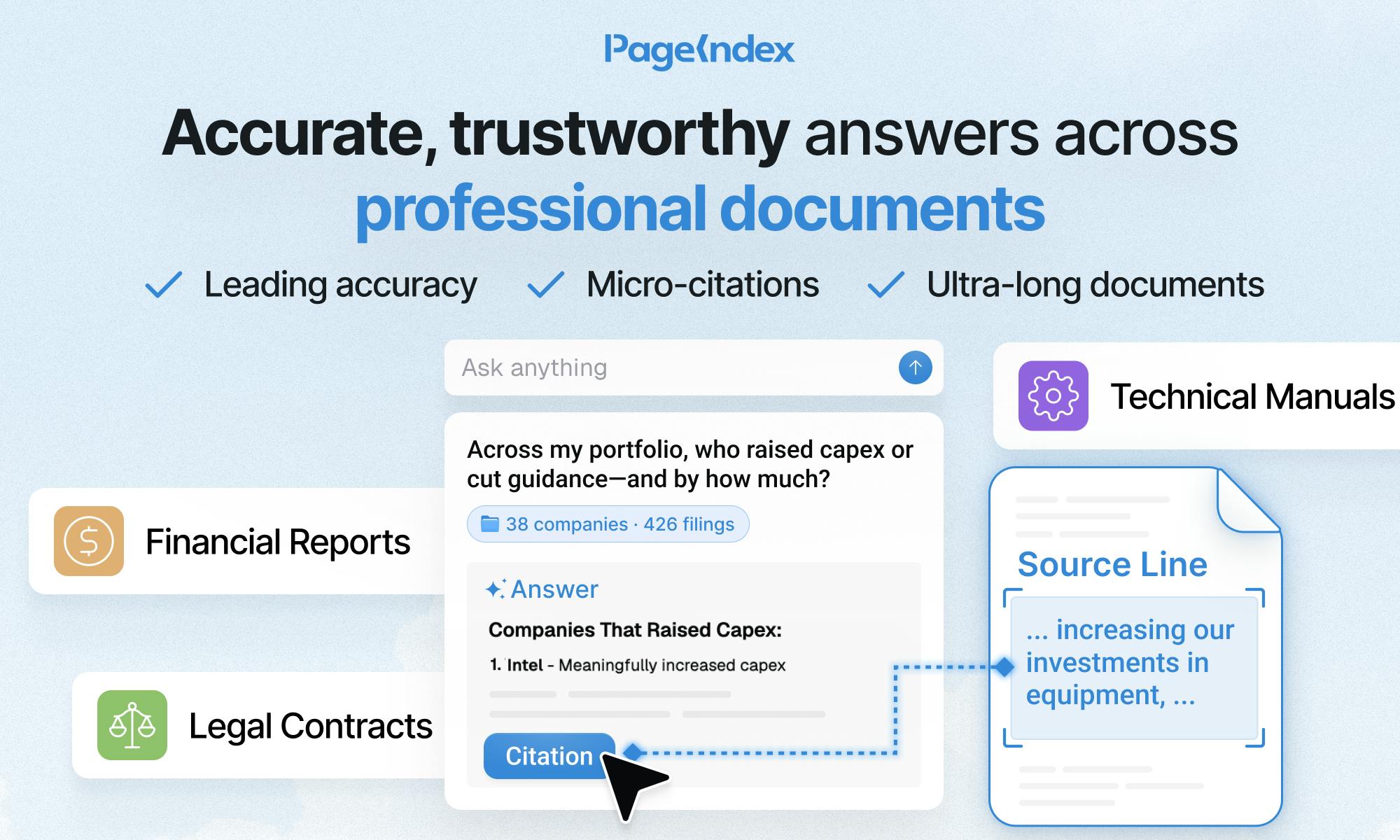
PageIndex is a document-retrieval system that replaces conventional embedding and vector-search pipelines with hierarchical document trees navigated through LLM reasoning. It is offered as an open-source Python framework, a hosted API/MCP service, an end-user document chat application, and an enterprise product with private deployment options (official website; GitHub).
The product is most relevant where errors are costly and source verification matters: financial reports, legal and regulatory materials, technical documentation, and other long, structured documents. Its central product-quality advantage is traceable retrieval that follows document structure and cross-references rather than relying exclusively on semantic similarity.
The strongest investment signal is developer distribution. As of the report date, the repository had approximately 35,430 stars, 3,117 forks, recent code activity, 16 contributors, and an MIT licence (GitHub API). Selection for GitHub’s Secure Open Source Fund provides an additional external signal of project relevance, although it does not establish commercial traction (announcement).
The principal concern is the absence of verified commercial metrics. Revenue, paying customers, enterprise contracts, retention, growth, gross margin, and customer-acquisition economics are not publicly disclosed. The Product Hunt launch ranked first on its launch day, but that reflects launch attention rather than product-market fit (Product Hunt leaderboard).
Product quality appears strong; company quality is promising but commercially unverified. The venture case depends on converting open-source adoption into high-value enterprise contracts without losing its differentiation as model context windows, native document tools, and competing RAG frameworks improve. The appropriate decision is Watch, not DD, until repeatable paid adoption is demonstrated.
Product Overview
PageIndex addresses a known weakness in document retrieval: similarity search can miss relevant passages whose wording differs from the query or whose meaning depends on document hierarchy and cross-references. PageIndex generates a tree-structured index, then has an LLM navigate the tree to locate supporting evidence (developer documentation).
The product supports local open-source operation and a hosted cloud service. The cloud version adds managed parsing, OCR, image understanding, storage, cross-document search, and line-level citations. Interfaces include Python SDK, REST API, MCP, hosted chat, and enterprise deployment.
Consumer pricing starts with a free allowance of 1,000 pages and 100 chat messages; Pro begins at $20 per month. Developer plans cost $30, $50, or $100 per month, with annual prices of $300, $500, and $1,000. Additional indexing credits cost $0.01 per page-equivalent credit, while customers may supply their own LLM and bear inference charges directly (consumer pricing; developer pricing).
The existing alternatives are vector databases, conventional chunk-and-embed RAG pipelines, native full-document LLM input, knowledge-graph retrieval, and manual keyword/table-of-contents navigation. The principal customer benefit is potentially better accuracy and auditability on complex professional documents.
Founder and Team Assessment
Mingtian Zhang is an active director and person with significant control of Vectify AI Limited, owning at least 75% of its shares and voting rights according to Companies House. His public profile reports a PhD in machine learning from UCL and research experience at the UCL Centre for Artificial Intelligence (Companies House; personal website).
Yu Tang, also known as Ray, identifies as co-founder and CTO. On Product Hunt, he reported completing a database PhD at Oxford; his LinkedIn search profile is consistent with an Oxford affiliation (Product Hunt; LinkedIn). Companies House does not list Tang as a director or significant controller, which is not necessarily unusual but leaves his ownership and employment status unverified.
Professor David Barber became a director in March 2025. Public sources also associate him with UCL’s AI research activities (Companies House officers). LinkedIn reports a company size of 2–10, but an exact current team size and hiring plan are not verified.
The founders show strong technical founder-market fit in machine learning, databases, and information retrieval. Commercial leadership, sales capacity, full-time commitment, previous exits, and operating experience at enterprise scale remain unclear.
Founder Assessment: Strong technical credibility and product-market knowledge, but commercial execution and team depth remain unproven.
Market Opportunity
The narrow initial market is software teams and professional-services organizations that repeatedly analyze long, structured, high-value documents and require auditable citations. Likely buyers include financial research, compliance, legal, engineering, and regulated-enterprise teams.
Public information does not establish the number of organizations actively purchasing reasoning-based document retrieval. A bottom-up scenario therefore requires explicit analyst assumptions:
- 10,000 target organizations internationally;
- $25,000–$100,000 annual enterprise contract value;
- Implied initial revenue opportunity of $250 million–$1 billion annually.
This is an illustrative scenario, not a verified market-size estimate. At current self-service pricing of $300–$1,000 annually, the addressable customer count would need to be much larger.
Expansion opportunities include enterprise knowledge search, APIs embedded in third-party applications, private deployments, multi-document repositories, workflow automation, and industry-specific applications. The market can support venture-scale revenue only if PageIndex moves materially beyond low-priced developer subscriptions and establishes enterprise ACVs.
Traction and Growth Signals
PageIndex launched on Product Hunt on August 28, 2026 and ranked first that day. Reliable vote and comment totals were not available from the retrieved page, and the ranking should be treated solely as launch attention (Product Hunt).
The stronger signal is open-source adoption: approximately 35,430 GitHub stars, 3,117 forks, 145 repository subscribers, recent commits, and an expanding SDK as of August 31, 2026 (GitHub API). Product updates include local mode, faster “Flash” indexing, hosted cloud services, and file-system-level indexing across large document collections (repository).
The company reports 98.7% accuracy on FinanceBench. Its newer open-source benchmark reports 85.5%–100% accuracy over 62 selected questions, depending on model and reasoning effort. However, the benchmark is company-created, excludes documents the local system cannot index, and does not cover charts, tables, arithmetic, or production throughput (benchmark repository).
A small Reddit discussion contains mixed anecdotal reports: users praised retrieval quality on complex documents but raised latency, token-cost, and scaling concerns. These comments are unverified and based on a limited sample (Reddit discussion).
Revenue, customer counts, active usage, paid conversion, retention, enterprise references, and post-launch commercial momentum are unavailable.
Traction Assessment: Strong developer interest, but commercially unverified.
Competitive Position
Direct competition includes conventional RAG frameworks, document-intelligence platforms, and graph-based retrieval. LlamaIndex offers parsing, extraction, indexing, citations, workflow tools, private deployment, and enterprise compliance capabilities (LlamaIndex pricing). Microsoft’s free GraphRAG project is an indirect technical alternative, although Microsoft describes it as a research project in maintenance mode rather than a supported commercial service (GraphRAG).
Free alternatives include PageIndex’s own MIT-licensed implementation, self-hosted vector RAG, GraphRAG, and direct long-context document processing. The open-source product creates distribution but may also constrain cloud pricing and allow competitors to reproduce core techniques.
PageIndex differentiates through hierarchical indexing, reasoning-led navigation, explicit source paths, and a credible developer community. Potential switching costs could arise from indexed document stores, API integration, evaluation pipelines, and enterprise deployment—but these are not yet demonstrated. No proprietary dataset or network effect has been verified.
If a major AI or document platform launched equivalent tree-based retrieval within six months, customers would remain only if PageIndex delivered measurably superior accuracy, cost, deployment control, and workflow integration. Current evidence supports technical differentiation, but not durable insulation from replication.
Defensibility Assessment: Medium-Low
Business Model and Economics
Revenue sources include consumer subscriptions, developer subscriptions, top-up credits, hosted retrieval, and custom enterprise contracts. Enterprise options include SaaS, dedicated infrastructure, VPC, and on-premises deployment (enterprise page).
Self-service annual contract value is approximately $300–$1,000. Enterprise ACV is not disclosed. Gross-margin potential could be attractive when customers supply their own LLM, but managed OCR, parsing, retrieval, storage, and repeated reasoning introduce variable costs.
The company reports local indexing of about $0.001 per page under its tested configuration. Its benchmark reports answering costs from approximately $0.003 to $0.082 per question, depending heavily on model choice (GitHub benchmark). These are controlled test results, not verified production unit economics.
Key unknowns are hosted inference cost, latency, gross margin after support, cloud storage expense, enterprise deployment burden, and whether revenue grows faster than reasoning-token consumption.
Unicorn Path
A reasonable analytical assumption for a fast-growing AI infrastructure SaaS business is a 10× ARR multiple, contingent on high growth, strong retention, and software-like gross margins.
Required ARR = $1 billion ÷ 10 = approximately $100 million.
At published annual pricing:
- $300 Standard plan: approximately 333,000 customers;
- $1,000 Max plan: approximately 100,000 customers;
- Assumed $50,000 enterprise ACV: approximately 2,000 customers;
- Assumed $100,000 enterprise ACV: approximately 1,000 customers.
The enterprise scenarios are substantially more credible than reaching $100 million ARR through current self-service plans. Success would require repeatable enterprise sales, strong retention, higher ACVs, international expansion, workflow integrations, proprietary retrieval/evaluation data, and margins that withstand inference and support costs.
Unicorn Path: Conditional
Valuation Assessment
PitchBook reports $1.42 million in total funding and names AlbionVC, Twin Path Ventures, and UCL as investors; a secondary industry article repeats the amount. No primary financing announcement, round terms, ownership data, or valuation was found (PitchBook profile; secondary coverage).
Valuation Attractiveness: Not Assessable
Assessment requires current ARR, growth, retention, gross margin, burn, runway, round size, SAFE or post-money valuation, cap table, investor rights, and liquidation preferences. Product quality and GitHub popularity cannot responsibly support a valuation range.
Key Risks
- No verified revenue, retention, or paying-customer evidence.
- Latency and inference costs may limit production use at scale.
- Low-priced subscriptions require extreme customer volume.
- Large AI and document platforms could replicate the approach.
- The open-source core may limit pricing power.
- Benchmarks are primarily company-produced and narrowly scoped.
- Enterprise security certifications and procurement readiness are not publicly verified.
- High founder and key-person concentration.
- Commercial leadership and repeatable distribution remain unproven.
Final Assessment
Venture Potential: 67/100
| Category | Score |
|---|---|
| Market Size and Expansion Potential | 16/20 |
| Traction and Growth Evidence | 8/20 |
| Founder and Team | 11/15 |
| Product Strength | 8/10 |
| Distribution Potential | 12/15 |
| Business Model and Economics | 6/10 |
| Defensibility | 6/10 |
| Total | 67/100 |
The strongest elements are technical differentiation, founder-market fit, and open-source distribution. The weakest are commercial traction, unit-economics evidence, and defensibility against platform replication.
Evidence Confidence: 53/100
The product, pricing, legal entity, directors, repository activity, and launch date are verified. Technical performance is largely company-reported. Funding is third-party reported. Revenue, customers, retention, gross margin, valuation, burn, runway, cap table, and enterprise adoption remain unavailable.
Final Decision: Watch
PageIndex has a credible venture-scale product direction and unusually strong developer attention, but the available evidence does not yet justify formal diligence. The route to a unicorn valuation requires a transition from popular open-source project to enterprise infrastructure company, and that transition has not been publicly demonstrated.
Upgrade Conditions
- Verified $1 million or more ARR with material year-over-year growth.
- At least 20 referenceable enterprise customers.
- Six-month paid retention above 80% or strong net revenue retention.
- Gross margin above 70% after hosted inference and support.
- Independent benchmarks confirming accuracy, latency, and cost advantages.
- Repeatable acquisition beyond GitHub and Product Hunt.
- Evidence of security certification and production procurement readiness.
Downgrade Conditions
- Repository or product-update activity materially declines.
- Paid conversion or renewal proves weak.
- Query latency or inference cost prevents production deployment.
- A major platform matches performance and bundles retrieval cheaply.
- Enterprise pilots fail to convert.
- Material security, privacy, benchmark-integrity, or founder-commitment concerns emerge.
Questions for Further Diligence
- What are current MRR, ARR, and monthly revenue growth?
- How many paying developers and enterprise customers are active?
- What are 30-, 90-, and 180-day retention by customer cohort?
- What proportion of GitHub users convert to cloud or enterprise plans?
- What are median query latency and cost for 1,000-, 100,000-, and million-page corpora?
- What are cloud gross margin and contribution margin by plan?
- Which benchmarks have been independently reproduced against current alternatives?
- What are the primary acquisition channels and customer-acquisition costs?
- What security certifications, penetration tests, and data-processing controls are complete?
- What are current burn, runway, team structure, and founder commitments?
- What is the fully diluted cap table, and how is Yu Tang’s role and ownership structured?
- What valuation and terms are proposed for the current or next financing?